
This post contains affiliate links.
Published: October 13, 2026 · ⏱ 10 min read · Ustaz Ahmad Raza, Senior Quran & Tajweed Teacher
What Is Sifat al-Huroof? (And How Is It Different from Makharij?)
Sifat al-huroof (صفات الحروف), literally “the characteristics of the letters,” is the branch of Tajweed that describes how each Arabic letter is produced — the quality of breath, voice, and tongue pressure behind the sound. It is the natural partner to makharij al-huroof, which describes where each letter is produced. If you’ve already worked through our makharij al-huroof chart, sifaat is the next layer: knowing the exit point gets you most of the way to a correct letter, but several letters share the exact same exit point and are told apart only by their sifaat.
Makharij vs. Sifaat, in One Line
Makharij = WHERE the letter exits (lips, tongue-tip, throat, etc.). Sifaat = HOW it exits (whispered or voiced, heavy or light, stopped or flowing). A letter is only fully correct when both are right.
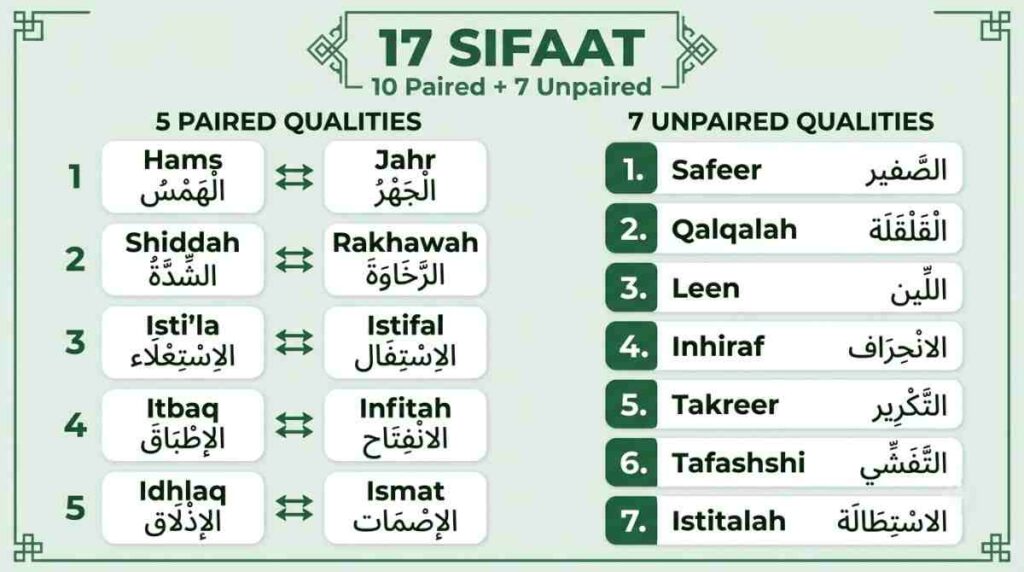
Classical Tajweed scholars catalogued 17 core characteristics, known as the sifaat lazimah (“permanent” or intrinsic qualities) — the fixed qualities every letter carries regardless of context. Ten of these come in five opposite pairs; seven stand alone with no opposite. Together, they explain almost every fine distinction a new reciter struggles with.
Why Sifaat Matters: Letters That Share a Makhraj
The clearest proof that sifaat deserves its own study is a simple fact: several Arabic letters share — or nearly share — the same exit point, and sifaat is the only thing separating them. Three groupings make this obvious:
- ت، د، ط (Taa, Daal, Taa heavy) — all three exit from the tip of the tongue against the base of the upper front teeth. They are distinguished by Hams vs. Jahr and by Isti’la vs. Istifal.
- ث، ذ، ظ (Thaa, Dhaal, Zaa heavy) — all three exit between the tip of the tongue and the edges of the upper front teeth, separated the same way.
- س، ص، ز (Seen, Saad, Zaay) — all three share the whistling Safeer quality and a tongue-tip exit, but differ by Hams/Jahr and Isti’la/Istifal.
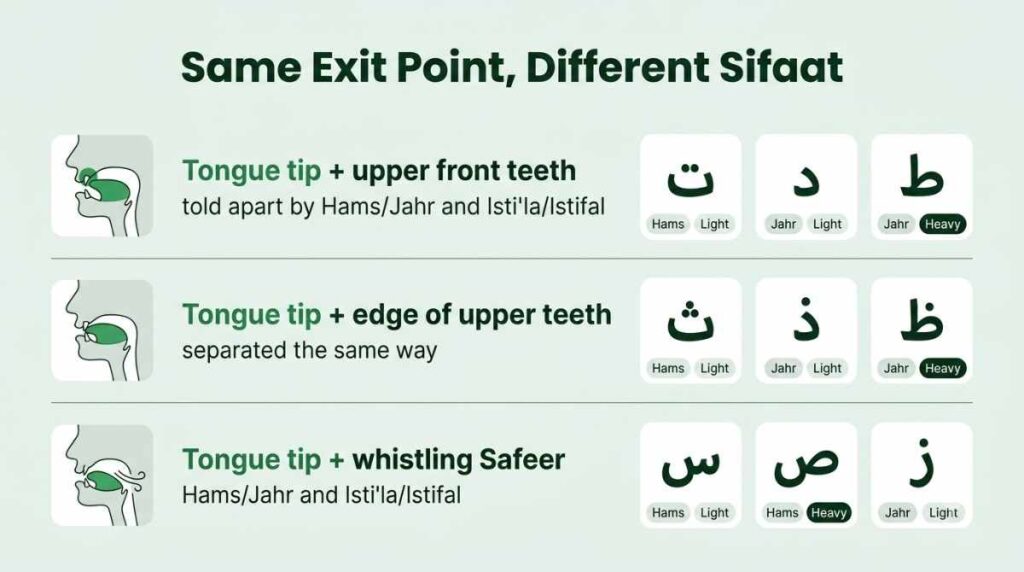
A student who has memorized every makhraj perfectly but never studied sifaat will still blur these letters into each other — because the exit point alone cannot tell them apart. This is also why sifaat is best corrected the way we approach it in a live, one-on-one class: a teacher listening in real time can catch the exact quality that’s off, something a written chart can only describe.
The 5 Paired Characteristics (10 Opposite Qualities)
Each letter carries one quality from every pair below — never both, and never neither.
1. Hams (الهمس) vs. Jahr (الجهر) — Whispered vs. Voiced
Hams (“whispered breath”) means the letter is pronounced with the breath flowing freely and the vocal cords relaxed — almost like whispering it. Jahr (“voiced”) is its opposite: the vocal cords vibrate and the sound is fuller.
- Hams letters (10): ف ح ث هـ ش خ ص س ك ت — commonly memorized with the mnemonic phrase “فَحَثَّهُ شَخْصٌ سَكَتَ”.
- Jahr letters: every remaining letter of the alphabet.
2. Shiddah (الشدة) vs. Rakhawah (الرخاوة) — Stopped vs. Flowing (with a Middle Ground)
Shiddah (“intensity/stop”) means the airflow is fully blocked for an instant when the letter is pronounced sakin. Rakhawah (“softness”) is the opposite — the air flows continuously through the letter. A middle group, Tawassut or Bainiyyah, sits between the two: airflow is partially restricted, neither a full stop nor a free flow.
- Shiddah letters: أ ج د ق ط ب ك ت — mnemonic “أَجِدْ قَطٍ بَكَتْ”.
- Tawassut / Bainiyyah letters: ل ن ع م ر — mnemonic “لِنْ عُمَرْ”.
- Rakhawah letters: every remaining letter.
3. Isti’la (الاستعلاء) vs. Istifal (الاستفال) — Heavy vs. Light
This is the pairing most new reciters meet first, because it’s also called tafkheem (heavy) and tarqeeq (light). Isti’la (“elevation”) means the back of the tongue rises toward the roof of the mouth, giving the letter a fuller, heavier sound. Istifal (“lowering”) is its opposite.
- Isti’la letters (7): خ ص ض غ ط ق ظ — mnemonic “خُصَّ ضَغْطٍ قِظْ”.
- Istifal letters: every remaining letter — pronounced with a lighter mouth shape.
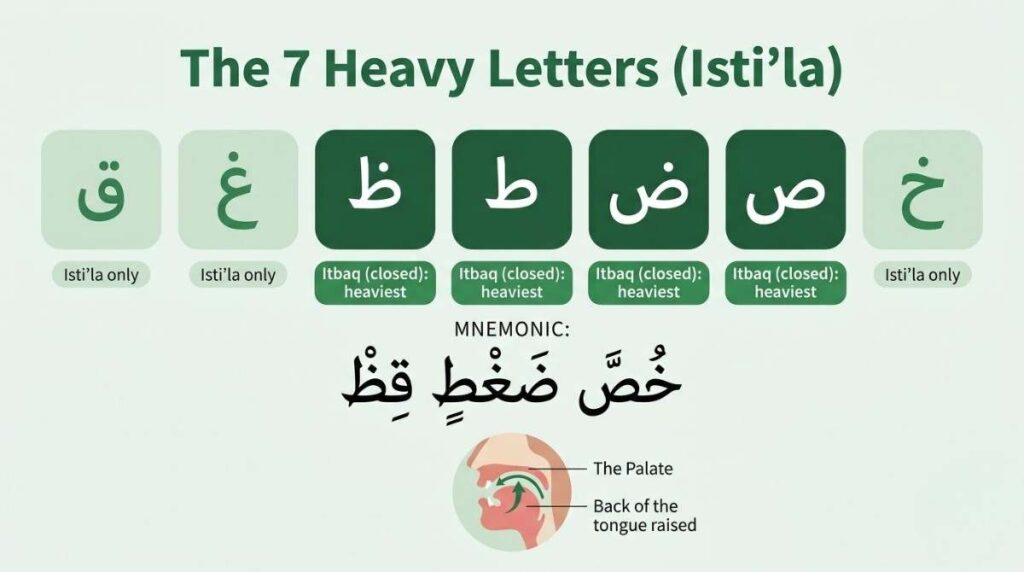
4. Itbaq (الإطباق) vs. Infitah (الانفتاح) — Closed vs. Open
Itbaq (“closure”) means the whole tongue presses up against the roof of the mouth, sealing it almost completely. It only applies to four letters — the strongest of the Isti’la group — and is why these four are considered the heaviest sounds in the alphabet. Infitah (“opening”) is every other letter, where the tongue stays away from the palate.
- Itbaq letters (4): ص ض ط ظ.
- Infitah letters: every remaining letter.
5. Idhlaq (الإذلاق) vs. Ismat (الإصمات) — Fluent vs. Restrained
Idhlaq (“fluency”) describes letters produced at the very tip of the tongue or the lips — the parts of the mouth that move most freely — which makes them easy to pronounce in quick succession. Ismat (“restraint”) is every other letter. This pairing is treated as a secondary characteristic by some scholars rather than a core sifah, but it’s still taught in most curricula because it explains why certain letter combinations feel easier to say than others.
- Idhlaq letters (6): ف ر م ن ل ب — mnemonic “فِرَّ مِنْ لُبّ”.
- Ismat letters: the remaining 23 letters.
The 7 Unpaired Characteristics
These seven qualities don’t have an opposite — a letter either has the quality or it simply doesn’t apply to it.
- Safeer (الصفير) — “whistling.” A sharp, hissing sound on س ص ز.
- Qalqalah (القلقلة) — “echo/bounce.” A small bounce of sound on ق ط ب ج د whenever one is sakin, covered in full in our dedicated Qalqalah guide.
- Leen (اللين) — “softness.” Applies to و and ي only when they are sakin and preceded by a fatha, giving a smooth, gliding sound.
- Inhiraf (الانحراف) — “deviation.” The tongue deviates slightly toward another part of the mouth when producing ل and ر.
- Takreer (التكرير) — “trilling.” The tip of the tongue vibrates slightly for ر. This quality is taught as something to control and minimize, not exaggerate — an over-rolled raa is one of the most common sifaat mistakes.
- Tafashshi (التفشي) — “spreading.” Air spreads across the mouth when pronouncing ش.
- Istitalah (الاستطالة) — “elongation.” The articulation point of ض stretches along the side of the tongue and palate, making it one of the harder letters for non-native speakers to isolate — see our makharij practice exercises for drills that target it directly.
Sifaat Lazimah vs. Sifaat Aaridah
Everything above belongs to sifaat lazimah — “permanent” characteristics that never change, no matter where the letter appears in a word. Tajweed also recognizes a second category, sifaat aaridah — “incidental” qualities that appear only in certain contexts, such as the extra ghunnah that appears during idgham or ikhfa, or the way a raa’s heaviness can shift depending on its vowel. Unlike the 17 lazimah qualities, scholars don’t use one single fixed list for sifaat aaridah — they’re better understood as context-driven effects layered on top of the core 17, and they’re usually taught rule-by-rule (as in our guides to tajweed rules for beginners) rather than memorized as a standalone list.
Common Mistakes When Sifaat Are Ignored
⚠️ What Learners Get Wrong Most Often
- Flattening the heavy letters. Pronouncing خ ص ض غ ط ق ظ with the lightness of an Istifal letter strips the recitation of its intended heaviness.
- Over-rolling the raa. Takreer is meant to be a slight, controlled vibration — not a dramatic trill.
- A flat, whistle-less Safeer. س ص ز need their sharp, hissing edge; without it they start to sound closer to ث or ت.
- No audible Qalqalah bounce on ق ط ب ج د when they’re sakin — or, in the other direction, an exaggerated, vowel-like bounce.
- Confusing same-makhraj letters like ت/د/ط or ث/ذ/ظ, because the sifaat (not the exit point) are what actually separate them.
How to Practice Sifat al-Huroof
Sifaat are rarely learned well from a book alone, because the whole point is an acoustic quality — something you need to hear corrected, not just read about. A practical order that works for most students:
- Get comfortable with makharij first, using a makharij al-huroof chart as a reference.
- Learn Isti’la/Istifal (heavy vs. light) next — it has the biggest audible impact on recitation and fixes the most common beginner mistake.
- Add Qalqalah, Safeer, and Ghunnah-related qualities, since these come up constantly in everyday recitation.
- Finish with the finer pairs — Hams/Jahr, Shiddah/Rakhawah, Itbaq/Infitah, Idhlaq/Ismat — which refine pronunciation rather than fix major errors.
- Have a qualified teacher listen live and correct you letter by letter — this is the single fastest way to fix a sifah that “sounds right” to your own ear but isn’t.
Get Your Sifaat Corrected Live, One-on-One
A free trial class with one of our Ijazah-certified Tajweed teachers is the fastest way to find out which sifaat you’re missing — no obligation, just honest feedback on your recitation.
Book Free Trial Class →Frequently Asked Questions
Makharij al-huroof is WHERE a letter is produced in the mouth or throat — its exit point. Sifat al-huroof is HOW that letter is produced — qualities like whether the breath is voiced or whispered, whether the sound is heavy or light, and whether it stops or flows. Several letters share the same makhraj and are only told apart by their sifaat.
Seventeen characteristics (sifaat lazimah) in the classification used across mainstream Tajweed curricula: five opposite pairs (ten qualities) plus seven unpaired, unique qualities that don’t have an opposite.
The seven letters of Isti’la — خ ص ض غ ط ق ظ — are the letters pronounced with a heavier, fuller mouth quality. Isti’la is one of the five paired sifaat, with Istifal (the lighter quality found in every other letter) as its opposite.
Not all at once. Most teachers introduce sifaat gradually alongside makharij, starting with the qualities that fix the most common mistakes — Isti’la/Istifal (heavy vs. light letters), Qalqalah, and Safeer — before moving on to finer distinctions like Idhlaq/Ismat.
Yes. Because sifaat are about the exact quality of a sound, they’re best corrected live, one-on-one, with a teacher listening in real time rather than from a book alone — which is the format used in our Tajweed classes.
Related Tajweed Guides

Written by Ustaz Ahmad Raza
Senior Quran & Tajweed Instructor · Specializes in Makharij, Sifaat & Recitation Correction
Ustaz Ahmad Raza focuses on the technical side of Tajweed — makharij, sifaat, and the rules that follow from them — helping students move past “it sounds about right” to a recitation corrected letter by letter.
Meet our teaching team →