
This post contains affiliate links.
Published: July 17, 2026 · ⏱ 9 min read · Ustaz Imran Qadri, Tajweed & Makharij Instructor
What Are Makharij Al Huroof?
Makharij al huroof (مخارج الحروف) means the articulation points of the Arabic letters — the exact physical spot in the throat, mouth, tongue, lips, or nasal cavity where each of the 29 letters is produced. This makharij al huroof chart is the same one we hand new students in their first month at Suffah, before we move into tajweed rules like noon sakinah or madd, because none of those rules matter if the base letter itself is coming from the wrong place.
Arabic is unusual among languages in how precisely this is mapped out. Classical scholars didn’t just describe letters by sound — they identified 17 distinct exit points across 5 regions, and every single letter is assigned to one. Change the exit point even slightly, and you often change the letter entirely. Sa (س) and Sad (ص) sound almost identical to an untrained ear, but they come from different points and carry different weight — and in the Quran, that difference sometimes changes the meaning of the word.
Why Makharij Matters More Than Most Students Realize
Parents often ask us why we spend the first several weeks on makharij instead of moving straight into reading. The honest answer: every tajweed rule taught afterward assumes the student can already produce the correct base letter. If a student says Ain (ع) like Hamza (ء), no amount of madd or ghunnah training will fix that — the foundation itself is off, and it becomes a habit that’s much harder to unlearn later than to build correctly the first time.
وَرَتِّلِ الْقُرْآنَ تَرْتِيلًا
Wa rattilil-Qur’āna tartīlā
“And recite the Qur’an with measured, clear recitation.”
Source — Surah Al-Muzzammil, 73:4
This ayah is the classical basis scholars cite for tajweed as a whole, and makharij is where “clear recitation” starts — literally, at the point the sound leaves the body. For a broader look at how makharij fits into the rest of tajweed, see our complete tajweed rules list for beginners.
The 5 Main Articulation Regions
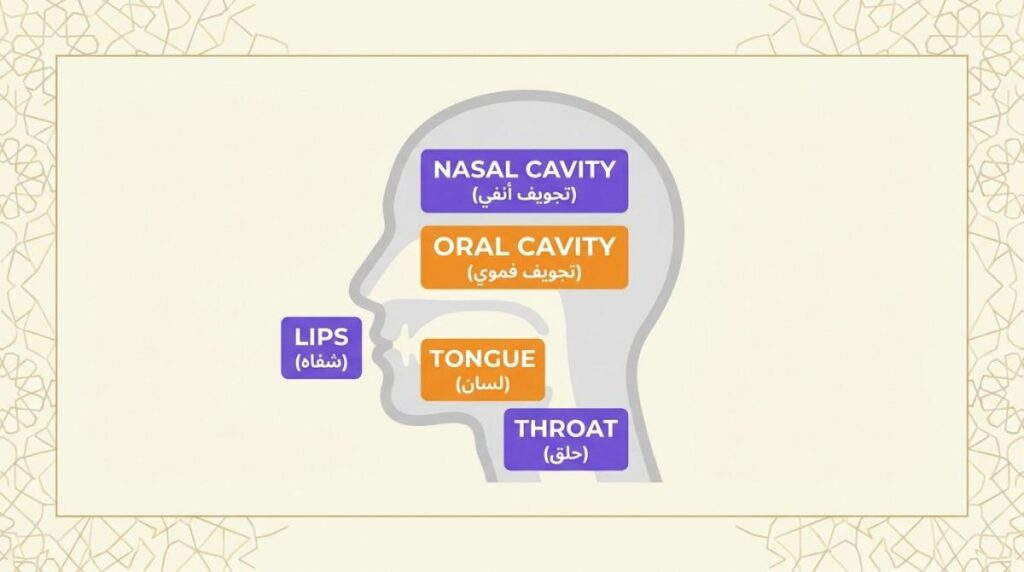
Every Arabic letter belongs to one of five broad regions. We teach these five first, as a mental map, before drilling individual letters — students remember the group faster than 29 isolated points.
The 5 Makharij Regions at a Glance
| Region (Arabic) | English Name | Letter Count |
|---|---|---|
| Al-Jawf (الجوف) | The oral/throat cavity | 3 (long vowels) |
| Al-Halq (الحلق) | The throat | 6 letters |
| Al-Lisan (اللسان) | The tongue | 18 letters |
| Al-Shafatan (الشفتان) | The two lips | 4 letters |
| Al-Khaishoom (الخيشوم) | The nasal cavity | Ghunnah (nasal sound), not a standalone letter |
The Principle
Learn the region before the letter. Once a student knows a sound comes “from the throat” versus “from the tip of the tongue,” isolating the exact letter inside that region becomes far easier.
Complete Makharij Chart — All 29 Letters
This is the full makharij al huroof chart we ask students to print and keep next to their Qaida or Quran during daily practice. It lists every letter, its region, and its exact point.
Full Chart — Letter, Region, Exact Point
| Letters | Region | Exact Articulation Point |
|---|---|---|
| ا و ي (madd letters) | Al-Jawf | Open oral cavity, no contact point |
| ء ه | Al-Halq (far throat) | Deepest part of the throat |
| ع ح | Al-Halq (mid throat) | Middle of the throat |
| غ خ | Al-Halq (near throat) | Closest part of throat to mouth |
| ق | Al-Lisan | Back of tongue against soft palate |
| ك | Al-Lisan | Just below Qaf’s point |
| ج ش ي | Al-Lisan | Middle of tongue against hard palate |
| ض | Al-Lisan | Edge of tongue against upper molars |
| ل | Al-Lisan | Edge of tongue against upper gum ridge |
| ن | Al-Lisan | Tip of tongue, just below Lam’s point |
| ر | Al-Lisan | Tip of tongue, slightly further back than Noon |
| ط د ت | Al-Lisan | Tip of tongue against base of upper front teeth |
| ص ز س | Al-Lisan | Tip of tongue near lower front teeth |
| ظ ذ ث | Al-Lisan | Tip of tongue between the front teeth |
| ف | Al-Shafatan | Inside of lower lip against upper front teeth |
| و ب م | Al-Shafatan | Both lips together |
| م ن (with ghunnah) | Al-Khaishoom | Nasal passage — 2-count nasal sound |
Hear the Chart, Not Just Read It
A chart tells you where a letter comes from — it can’t tell you if you’re saying it right. Book a free trial and one of our tajweed teachers will check your makharij live, letter by letter.
Book Free Trial Class →Al-Halq: The 6 Throat Letters
The throat letters — Hamza (ء), Haa (ه), Ain (ع), Haa (ح), Ghain (غ), and Khaa (خ) — split into three sub-points: far, middle, and near throat. These are the letters that don’t exist in Hindi or Urdu phonetics in the same form, which is why they’re often the hardest for students who grew up speaking those languages at home.
In our experience, Ain (ع) and Haa (ح) cause the most confusion, because students substitute the nearest sound they already know — usually turning Ain into a plain Alif and Haa into the softer Hindi “h” sound. Both are wrong, and both change the meaning of words in the Quran. We drill these with 20 to 30 repetitions per session, isolated from any word, until the muscle position becomes automatic.
Al-Lisan: The 18 Tongue Letters
The tongue is responsible for more letters than any other region — 18 in total, spread across 10 distinct points from the back of the throat to the tip of the tongue at the front teeth. This is also where the heavy-light letter pairs live, and where most of the corrections we make in class actually happen.
⚠️ Watch For These Tongue-Letter Mix-Ups
- Sa (س) vs Sad (ص) — Sad is heavier and pulled back; saying it like Sa flattens the sound and can change word meaning.
- Ta (ت) vs Toa (ط) — Toa is heavier with a fuller mouth; treating it like Ta drops the required emphasis.
- Dal (د) vs Dhad (ض) — Dhad comes from the side of the tongue against the molars, not the front teeth like Dal.
- Zaa (ز) vs Zoa (ظ) — Zoa is a throat-forward, heavy version; substituting Zaa softens the letter incorrectly.
Al-Shafatan: The 4 Lip Letters
Faa (ف), Waw (و), Baa (ب), and Meem (م) come from the lips. Faa is produced with the inner lower lip against the upper front teeth, while Waw, Baa, and Meem come from both lips meeting. These are generally the easiest region for students to master — most get the lip letters correct within the first week — but Waw still trips up students who confuse the consonant Waw with the long vowel Waw from Al-Jawf; they look identical in writing but come from different regions entirely.
Common Makharij Mistakes We See in Class
After years of teaching this to Hindi and Urdu-speaking students specifically, a handful of patterns repeat almost every time:
- Merging the three throat letter groups. Students often pronounce all six throat letters from roughly the same spot instead of distinguishing far, mid, and near throat.
- Skipping ghunnah on Noon and Meem. The 2-count nasal sound gets dropped entirely, especially at the end of words.
- Flattening the heavy letters. Qaf, Sad, Dhad, Toa, Zoa, and Ghain all require tafkheem (heaviness) — students trained in Hindi/Urdu phonetics tend to pronounce them like their lighter counterparts.
- Rushing past Dhad (ض). Often called the hardest letter in Arabic for non-native speakers — even some Arabic speakers get this one wrong without training.
These four patterns are just the headline version. For a full breakdown of nine specific makharij mistakes — what each one sounds like, why it happens, and the exact drill that fixes it — see our guide to common makharij mistakes beginners make.

How to Practice Makharij at Home
Between lessons, we ask students to run a short daily drill rather than trying to review everything at once:
- Pick one region from the chart above — start with Al-Shafatan (lips) if you’re new, or Al-Halq (throat) if you’re correcting an existing habit.
- Say each letter in that region 20 to 40 times in isolation, without vowels, focused only on the contact point.
- Record yourself on your phone once a week and compare it to a teacher’s recitation of the same letters — most people can’t hear their own makharij mistakes in real time.
- Move to the next region only once a teacher confirms the current one is correct, not once it “feels” right to you.
This is also where most self-taught students plateau. A chart can tell you where the letter comes from; it can’t tell you whether your tongue is actually in the right place. That correction loop — say it, get corrected, say it again — is the part a printed chart can’t replace, and it’s the reason we build the first month of every new student’s schedule around live makharij checks rather than independent reading. For a printable, region-by-region drill sheet to run through this loop between lessons, see our makharij al huroof practice exercises worksheet.
If your child or you haven’t started letter recognition yet, begin with our guide to Madani Qaida before working through this chart — Qaida builds letter recognition first, and makharij refinement layers on top of it. And if you’re evaluating who should be teaching this to your child, our guide on what an ijazah certification actually means explains what to look for in a tajweed teacher’s credentials.
Get Your Makharij Checked, Free
Our first trial class is a live makharij assessment — no cost, no obligation, just an honest read on where you or your child stand.
Book Free Trial Class →The 17 Precise Articulation Points, Region by Region
The 5 regions above are the map most students learn first, but classical scholars actually identify 17 precise points within them, each governing one specific letter or a small cluster. In Al-Halq alone there are 3 points — deepest throat (Hamza, Ha), middle throat (Ain, Haa), and near throat (Ghain, Kha) — which is why lumping all six throat letters together is the single most common beginner mistake we correct in class. Al-Lisan carries 10 of the 17 points on its own, which is also why the tongue region takes longest to master and is where most heavy/light letter confusion (Sa/Sad, Ta/Toa, Dal/Dhad) actually lives.
Frequently Asked Questions
Makharij al huroof means the exact points in the mouth, throat, or nose where each Arabic letter is produced. Every letter has a fixed origin point — the back of the throat, the tip of the tongue against the teeth, the lips — and pronouncing a letter from the wrong point changes the sound, and sometimes the meaning of the word.
Scholars group the articulation points into 5 main regions — the oral cavity (jawf), the throat (halq), the tongue (lisan), the two lips (shafatan), and the nasal cavity (khaishoom) — which break down further into 17 specific points covering all 29 Arabic letters.
You can learn the theory — which region each letter comes from — from a chart or book on your own. But correcting your actual pronunciation requires a teacher listening live, because most people cannot hear their own makharij mistakes; the difference between letters like Sa (س) and Sad (ص) is a physical mouth position you need someone else to check.
Makharij is one part of Tajweed, not the whole subject. Tajweed covers makharij (where letters originate), sifaat (the qualities of each letter), and rules like noon sakinah, madd, and waqf. Makharij is usually taught first because every other tajweed rule depends on pronouncing the base letter correctly.
Most students recognize all 5 regions and can name each letter’s point within 2 to 3 weeks. Actually correcting the pronunciation of harder letters — the throat letters and the heavy letters — typically takes 2 to 4 months of regular, corrected practice with a teacher.
In our classes, the letters students struggle with most are Ain (ع) and Haa (ح) from the throat, and the heavy-light pairs like Sa/Sad (س/ص), Ta/Toa (ت/ط), and Dal/Dhad (د/ض), because these pairs sound close to non-native ears but come from different points and carry different weight (qalqalah and tafkheem).
Yes. The full chart in this article covers all 5 regions and 29 letters and is designed to be printed and kept next to your Quran or Qaida during daily practice.

Written by Ustaz Imran Qadri
Tajweed & Makharij Instructor · 9 Years Experience · Makharij, Sifaat, Beginner Correction
Ustaz Imran focuses the first month of every new student’s schedule on makharij before moving into reading fluency, believing that correcting pronunciation habits early saves years of unlearning later. He has spent 9 years specifically working with Hindi and Urdu-speaking students on the throat and heavy letters that don’t exist in their native phonetics.
Meet our teaching team →