

This post contains affiliate links.
Published: August 28, 2026 · ⏱ 9 min read · Ustaz Imran Qadri, Tajweed & Makharij Instructor
Before You Start: What This Worksheet Assumes
These makharij al huroof practice exercises pick up where theory ends. If you haven’t yet worked through the regions and articulation points themselves, start with our complete makharij al huroof chart first — it explains what each of the 5 regions is and which of the 29 letters belongs to it. This guide assumes you already know, roughly, that Ain comes from the throat and Meem comes from the lips, and focuses entirely on drilling those letters until producing them correctly stops requiring conscious thought.
Print this page, or just the drill tables, and keep it next to your Qaida or Quran. Every table below is built the same way: the letters, a handful of drill words to say them in, and a repetition count — the same format we hand new students in their first few weeks at Suffah.
Why Makhaarij Al Huroof Practice Beats Reading the Chart Alone
We see the same pattern every term: a student can point to the chart and correctly say “Qaf comes from the back of the tongue,” and then mispronounce Qaf the very next time it appears in a word. Knowing where a letter comes from and actually producing it from that point are two different skills, and only one of them is built by reading. The second is built by repetition — saying the letter, in isolation, dozens of times, until the muscle memory takes over from the conscious knowledge.
The Principle
Drill one region at a time, in isolation, before mixing regions together. Students who jump straight into full ayat without isolating individual letters first tend to plateau far longer than students who drill narrow and repeat often.
That’s the structure of this worksheet. Each region below gets its own table of drill words, ordered from the letters students usually find easiest to the ones that take the longest to correct — so you can work through them in the order most classes actually teach them.
Al-Halq: Throat Letter Drills
The six throat letters — Hamza (ء), Haa (ه), Ain (ع), Haa (ح), Ghain (غ), and Khaa (خ) — don’t exist in the same form in Hindi or Urdu phonetics, which is why they’re usually the first real challenge for students coming from those languages. Work through each sub-group separately rather than mixing all six together on day one.
Throat Drill Table — 20–30 Reps Per Letter, 10–15 Per Word
| Sub-Point | Letters | Isolated Drill | Drill Word |
|---|---|---|---|
| Far throat | ء ه | أَ أَ أَ \/ هَ هَ هَ | أَحَدٌ (aḥad), اللّهُ (Allah) |
| Mid throat | ع ح | عَ عَ عَ \/ حَ حَ حَ | عَلَمَ (ʻalama), حَمدٌ (ḥamd) |
| Near throat | غ خ | غَ غَ غَ \/ خَ خَ خَ | غَيْر (ghayr), خَيْر (khayr) |
Ain (ع) and Haa (ح) cause the most confusion in our classes, because students substitute the nearest sound they already know — usually turning Ain into a plain Alif and Haa into the softer Hindi “h.” Both change the meaning of words in the Quran when they slip into recitation. Isolate this pair specifically and drill it for a full week before moving on if it feels shaky.
Al-Lisan: Tongue Letter Drills (Including the Heavy/Light Pairs)
The tongue produces more letters than any other region — 18 in total — which makes Al-Lisan the largest and slowest part of any makhaarij al huroof practice plan. It’s also where the heavy-light letter pairs live, and where most of the corrections we make in class actually happen. Break this region into three smaller drill sets rather than attempting all 18 letters in one sitting.
Tongue Drill Table — Set 1: Back & Middle Tongue
| Letters | Point | Drill Word |
|---|---|---|
| ق | Back of tongue, soft palate | قَلْب (qalb) |
| ك | Just below Qaf’s point | كَبِير (kabīr) |
| ج ش ي | Middle tongue, hard palate | جَنَّة (jannah), شَمْس (shams) |
Tongue Drill Table — Set 2: Heavy/Light Pairs
| Pair | Light Drill Word | Heavy Drill Word |
|---|---|---|
| س \/ ص | سَلام (salām) | صِراط (ṣirāṭ) |
| ت \/ ط | تَمْر (tamr) | طَيّْب (ṭayyib) |
| د \/ ض | دَار (dār) | ضَالِّين (ḍāllīn) |
Say the light letter and the heavy letter back to back, out loud, several times before drilling the word: sa…sad, sa…sad. The contrast is what trains your ear and mouth to feel the difference, rather than drilling each letter in a vacuum. Dhad (ض) is the letter our Hindi and Urdu-speaking students take longest to correct — often called the hardest letter in Arabic for non-native speakers — so don’t be discouraged if it needs more sessions than the rest of this table.
A Worksheet Can’t Hear You — A Teacher Can
These drills tell you what to practice. They can’t tell you if your tongue is actually landing in the right place. Book a free trial and one of our tajweed teachers will listen to your makharij live, letter by letter.
Book Free Trial Class →Tongue Drill Table — Set 3: Lam, Noon, Ra & Interdentals
| Letters | Point | Drill Word |
|---|---|---|
| ل | Tongue edge, upper gum ridge | لَيْل (layl) |
| ن \/ ر | Tongue tip, just below Lam | نَار (nār), رَبّ (rabb) |
| ظ ذ ث | Tip between front teeth | ثَمَر (thamar), ذَهَب (dhahab) |
Al-Shafatan: Lip Letter Drills
Faa (ف), Waw (و), Baa (ب), and Meem (م) are usually the easiest region to master — most students get these right within the first week — so use this table as a quick daily warm-up before moving into the harder regions above.
Lip Drill Table — 15–20 Reps Per Word
| Letter | Point | Drill Word |
|---|---|---|
| ف | Lower lip against upper teeth | فَتْح (fatḥ) |
| و | Both lips, rounded | وَلَد (walad) |
| ب | Both lips together | بَيْت (bayt) |
| م | Both lips, with ghunnah | مَاء (māʼ) |
The one trap in this region: consonant Waw (و) in Walad is not the same sound as the long vowel Waw in a word like Nūr. They’re written identically but come from different regions entirely — lips for the consonant, open oral cavity (Al-Jawf) for the vowel. Say both back to back a few times so the difference is clear before moving on.
How to Use the Free Printable Worksheet
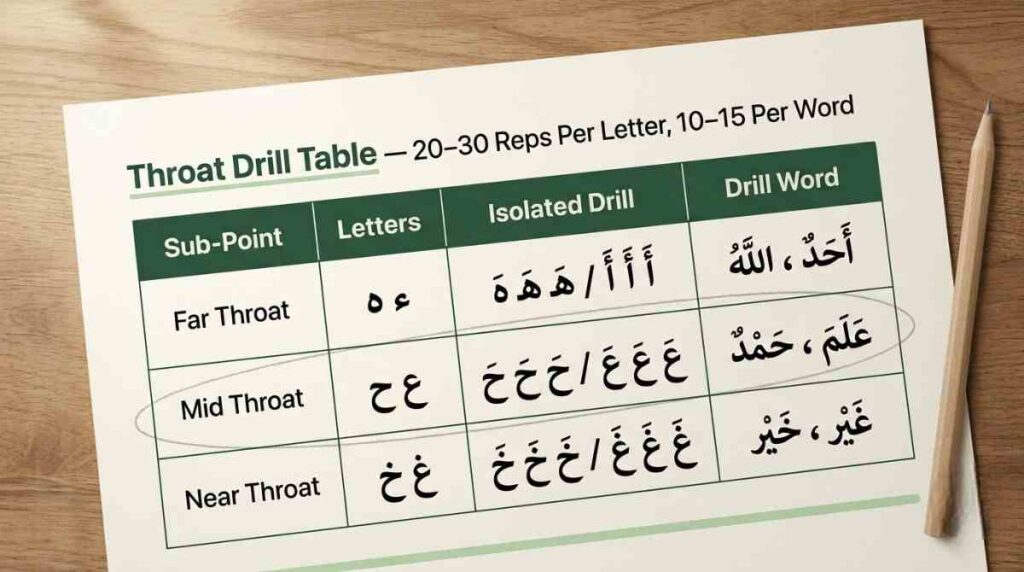
Every table on this page is designed to print cleanly on its own — use your browser’s print function and select just the pages with the tables if you want a compact worksheet rather than the full article. Here’s the routine we recommend for using it:
- Print or screenshot one region’s table at a time — don’t try to work through all three regions in a single session.
- Keep a pencil next to it. Circle any letter or drill word that felt wrong as you said it, so you know exactly what to bring to your next class.
- Re-print a fresh copy each week rather than reusing the same marked-up sheet — a clean sheet makes it easier to tell if last week’s trouble letters have actually improved.
- Once a whole table goes a full week with nothing circled, move to the next region.
A 10-Minute Daily Practice Routine

- Minutes 1–4: Pick one region’s table and say each letter in isolation 20 to 30 times, no vowel attached, focused only on the contact point.
- Minutes 5–7: Move to that region’s drill words, repeating each one 10 to 15 times at a normal speaking pace.
- Minutes 8–9: Record a short clip on your phone and listen back — most self-correction happens here, not while you’re actually reciting.
- Minute 10: Circle any letter that still felt off on your printed worksheet, and note it for your next class.
Ten focused minutes a day beats an hour once a week. The muscle memory that makhaarij al huroof practice is actually building only forms through frequent, short repetition — long, infrequent sessions let the correct position slip between practices.
Common Mistakes During Makharij Practice
⚠️ Watch For These While Drilling
- Drilling all three regions in one sitting. This blurs the distinct contact points instead of building clean muscle memory for each one — isolate one region per session.
- Skipping the isolated-letter step. Jumping straight to drill words without saying the bare letter first makes it harder to isolate exactly where the sound should start.
- Practicing only in silence, never out loud with volume. Throat letters especially need real breath support to land on the correct point — whispering hides mistakes.
- Never recording yourself. Almost no one can accurately judge their own Ain, Haa, or Dhad in real time without listening back afterward.
If a letter still won’t cooperate after a few weeks of this kind of focused drilling, that’s normal — not a sign you’re doing something wrong. Some letters, particularly Dhad and the throat pair Ain/Haa, take most students months rather than weeks. What matters is that the drilling is isolated, daily, and short, and that a teacher checks your progress regularly rather than you guessing on your own indefinitely.
For the full theory behind every region and all 29 letters before or alongside these drills, go back to our makharij al huroof chart. If you want to see exactly which mistakes these drills are designed to fix, read our guide to common makharij mistakes beginners make. And once your base letters feel solid, the natural next step is our noon sakinah and tanween practice exercises, since those four rules assume the underlying letters are already being produced correctly.
Get Your Makharij Checked, Free
Our first trial class is a live makharij assessment — no cost, no obligation, just an honest read on where you or your child stand, and which of these drill tables to start with.
Book Free Trial Class →Frequently Asked Questions
Pick one region — throat, tongue, or lips — and drill only the letters in that region for the day. Say each letter in isolation 20 to 30 times with no vowel attached, focused purely on where in the mouth or throat it starts, then move to the short drill words for that region. Record yourself on your phone once a week and compare it against a teacher’s recitation of the same letters, because most self-taught students cannot hear their own makharij mistakes in real time.
Yes. This entire guide is formatted to be printed and used as a worksheet — each region’s drill table can be printed on its own page and kept next to your Qaida or Quran during daily practice, with space to note which letters still need correction.
We ask students to repeat each isolated letter 20 to 30 times before moving to drill words, and each drill word 10 to 15 times. Fewer repetitions than that and the muscle position never becomes automatic; more than that in one sitting and fatigue starts to distort the sound, which is why short daily sessions beat long infrequent ones.
You can identify which region a letter should come from and drill it consistently on your own, but correcting the exact contact point — whether your tongue is a few millimetres too far forward or back — usually requires someone else listening live. Recording yourself closes part of the gap, but a teacher catching the error the moment it happens is faster and prevents the wrong habit from settling in.
In our classes, the throat letters Ain (ع) and Haa (ح) and the heavy-light tongue pairs — Sa\/Sad (س\/ص), Ta\/Toa (ت\/ط), and Dal\/Dhad (د\/ض) — take the most repetitions to correct, because they sound close to non-native ears but come from different points and carry different weight.
Most students can recite an isolated letter correctly within a few sessions of focused drilling. Making that correct sound automatic inside real recitation — without pausing to think about it — typically takes 2 to 4 months of short daily practice, longer for the throat and heavy letters than for the lip letters.

Written by Ustaz Imran Qadri
Tajweed & Makharij Instructor · 9 Years Experience · Makharij, Sifaat, Beginner Correction
Ustaz Imran built this worksheet from the same drill tables he hands new students in their first month at Suffah, having found that isolated, repeated practice corrects makharij far faster than reading about articulation points alone. He works closely with Hindi and Urdu-speaking students on the throat and heavy letters that don’t exist in their native phonetics.
Meet our teaching team →