

This post contains affiliate links.
Published: October 9, 2026 · ⏱ 8 min read · Ustaz Ahmad Raza, Senior Quran & Tajweed Teacher
📖 In This Guide
- What Is Qalqalah in Tajweed?
- The 5 Qalqalah Letters — and the “Qutb Jadd” Mnemonic
- Qalqalah Sughra (Minor) — Inside a Word
- Qalqalah Kubra (Major) — Stopping at the End
- Why Only These 5 Letters Need It
- Common Mistakes Beginners Make
- How to Practice Qalqalah Properly
- FAQ
What Is Qalqalah in Tajweed?
Qalqalah in Tajweed (قلقلة) literally means “vibration” or “echoing.” In Tajweed, it refers to the small, controlled bounce of sound that happens when one of five specific letters carries a sukoon (ْ) — no vowel of its own — either in the middle of a word or at the end of one when a reciter stops there. Instead of the letter simply cutting off in silence, its articulation point releases with a brief, audible echo.
If you’ve already worked through our guides on Noon Sakinah and Tanween and Meem Sakinah, Qalqalah will feel different in one important way: it isn’t about what letter comes after the sakin letter. It’s a property of the letter itself — only five letters in the entire Arabic alphabet ever produce this echo, regardless of what follows them.
The 5 Qalqalah Letters — and the “Qutb Jadd” Mnemonic
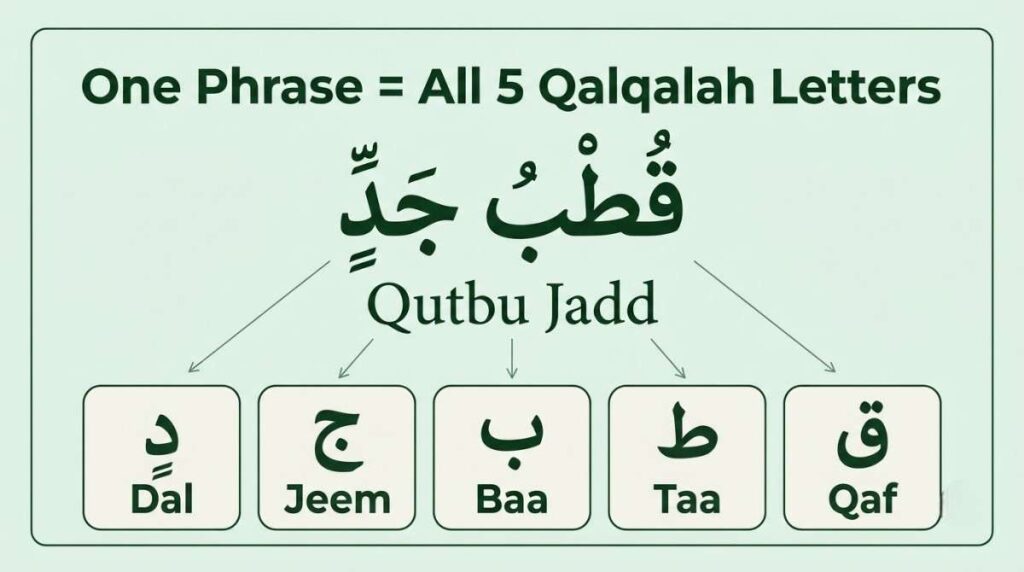
Only these five letters ever carry Qalqalah:
| Letter | Arabic | Transliteration |
|---|---|---|
| Qaf | ق | q |
| Taa | ط | ṭ |
| Baa | ب | b |
| Jeem | ج | j |
| Dal | د | d |
Arabic teachers have long bundled these five letters into a single short phrase so students never have to memorise them as a bare list: قُطْبُ جَدٍّ (“Qutbu Jadd”). Say the phrase out loud and you’re pronouncing all five Qalqalah letters in one breath — ق, ط, ب, ج, د. Most Tajweed teachers introduce this mnemonic in the very first lesson on the topic, and it’s worth memorising before anything else here.
Qalqalah Sughra (Minor) — Inside a Word
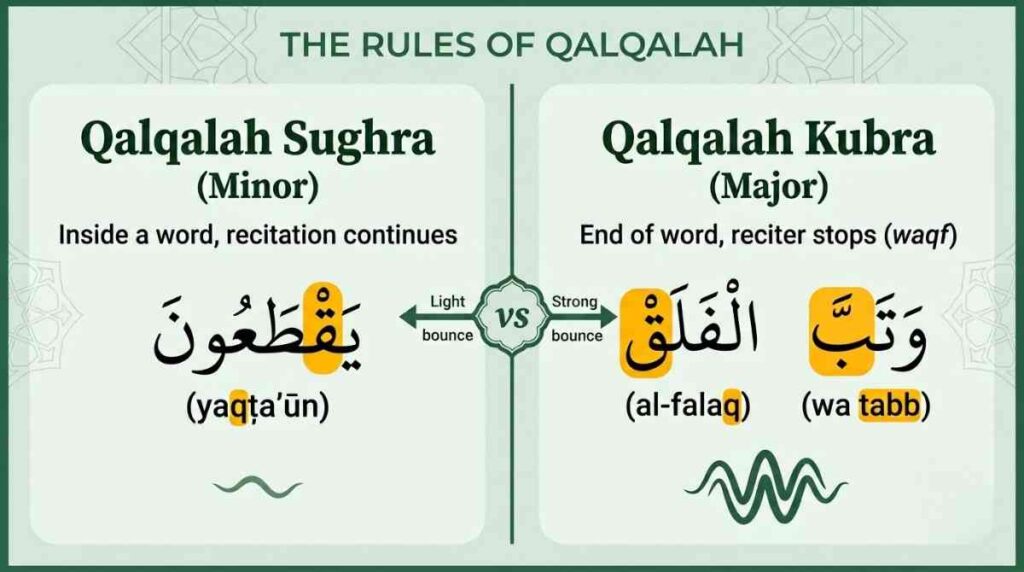
Qalqalah Sughra (“minor” or “small”) happens when a Qalqalah letter carries a sukoon in the middle of a word, while recitation continues straight through without stopping. Because the reciter doesn’t pause, the echo stays light and brief — present, but not emphasised.
- يَقْطَعُونَ (yaqṭa’ūn) — the ق carries sukoon mid-word; a light bounce, then straight into the next syllable.
- يَطْمَعُونَ (yaṭma’ūn) — same pattern with ط.
- يَجْعَلُونَ (yaj’alūn) — same pattern with ج.
- يُدْخِلُونَ (yudkhilūn) — same pattern with د.
Notice the shape in every example: the Qalqalah letter sits quietly in the middle, sukoon and all, and the word simply keeps moving — the bounce is there if you listen for it, but it never interrupts the flow.
Qalqalah Kubra (Major) — Stopping at the End
Qalqalah Kubra (“major” or “large”) happens when a Qalqalah letter sits at the end of a word and the reciter chooses to stop (waqf) there. Because the natural vowel is dropped at the stop, the letter effectively becomes sakin right at that instant — and since there’s nothing after it to soften the release, the echo comes out noticeably stronger and longer than Sughra’s light touch.
- الْفَلَقْ (al-falaq) — stopping at the end of this word (as in Surah Al-Falaq) leaves the ق with a firm, clearly audible bounce.
- وَتَبَّ (wa tabb) — the closing word of the first verse of Surah Al-Masad. Here the ب carries a shaddah (doubling) as well as the stop — which is why most reciters make this one of the strongest, most pronounced Qalqalah sounds in the entire Qur’an.
That last example points to a detail some teachers add as a refinement rather than a separate rule: when the stopped Qalqalah letter also carries a shaddah, the echo is stronger still than an ordinary Kubra case. Most students are simply taught the two-level Sughra/Kubra model above, with this shaddah case treated as “Kubra, but firmer” rather than a third named category — that’s the version we’d recommend learning first.
Why Only These 5 Letters Need It
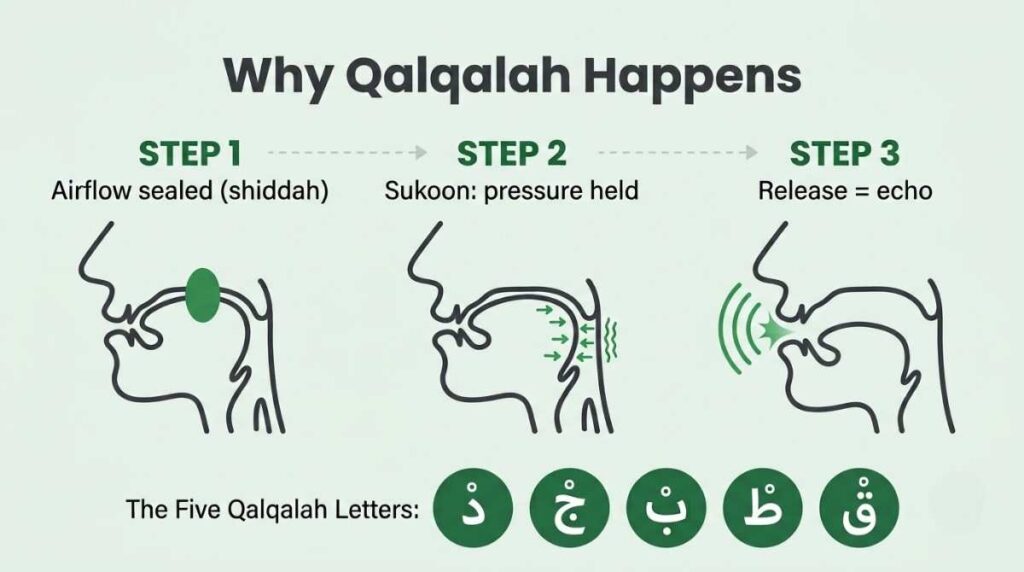
Tajweed scholars group Arabic letters by shared articulation qualities (sifaat), and one of those qualities is shiddah — a complete, momentary stoppage of airflow at the letter’s articulation point, the opposite of letters where air keeps flowing freely. Qaf, Taa, Baa, Jeem and Dal all sit among this group of “stopping” letters. When one of them carries a sukoon, there’s a brief seal of airflow that has to be released — and that release is exactly what produces the audible bounce. Letters that don’t fully stop the airflow simply have nothing to release, which is why Qalqalah is unique to these five and never appears anywhere else in the alphabet.
This is also why Qalqalah pairs so naturally with the articulation-point work in our Makharij al-Huroof Chart — getting the exact closure point right for each of these five letters is most of what makes their Qalqalah sound clean rather than forced.
Common Mistakes Beginners Make
- Turning the echo into an extra vowel. The single most common error: over-emphasising the bounce until it sounds like a short “a,” “i,” or “u” has been added after the letter. Qalqalah is a controlled vibration at the articulation point, not a new syllable.
- Pronouncing it so softly it disappears. The opposite mistake — treating the sukoon as a plain, silent stop with no bounce at all, especially in Sughra cases where it’s easy to rush through the middle of a word.
- Only applying it at the end of words. Because Kubra (the stronger, word-final case) is the more dramatic and memorable of the two, beginners often apply Qalqalah only when stopping and forget it applies just as much — just more lightly — to every Sughra case in the middle of a word.
- Pushing the echo from the chest instead of the articulation point. Qalqalah comes from a clean release at the letter’s own articulation point, not from an extra puff of breath or exhalation — forcing air from the chest makes the sound harsh rather than controlled.
How to Practice Qalqalah Properly
- Drill the five letters in isolation first. Say each of ق, ط, ب, ج, د with a sukoon on its own, aiming for a light, consistent bounce before you ever meet them inside a word.
- Practice Sughra and Kubra separately. Read a few mid-word examples focusing only on a light touch, then switch to practicing stopping deliberately on word-final Qalqalah letters to feel the stronger Kubra bounce.
- Record yourself and listen back. It’s easy to feel like you’re bouncing the letter correctly while actually adding a vowel sound — hearing it played back makes the difference obvious much faster than reciting alone.
- Fold it into a daily routine. Our 15-Minute Daily Tajweed Practice Routine already rotates through Noon Sakinah, Madd and Waqf drills — Qalqalah fits naturally alongside them as a short, focused five-minute block.
- Get live correction. The line between a clean Qalqalah and an accidental extra vowel is subtle enough that most learners need a teacher listening in real time to catch it consistently.
Once Qalqalah feels automatic, it sits naturally alongside the rest of our complete Tajweed Rules Reference — many verses combine Qalqalah with Noon Sakinah or Meem Sakinah rules within the very same word.
FAQ
How many Qalqalah letters are there?
Five: ق (Qaf), ط (Taa), ب (Baa), ج (Jeem) and د (Dal) — remembered together through the phrase “Qutbu Jadd” (قُطْبُ جَدٍّ).
What’s the difference between Qalqalah Sughra and Qalqalah Kubra?
Sughra (minor) happens when a Qalqalah letter carries sukoon in the middle of a word during continuous recitation — the bounce is light. Kubra (major) happens when a Qalqalah letter ends a word and the reciter stops there — the bounce is noticeably stronger because there’s nothing after it to soften the release.
Does Qalqalah add a vowel sound after the letter?
No — this is the single most common beginner mistake. Qalqalah is a controlled vibration at the letter’s own articulation point, not a short “a,” “i,” or “u” sound added afterward. The letter should still sound sakin (voweless); it simply has an audible bounce to it.
Why do only these five letters have Qalqalah?
All five share a quality Tajweed scholars call shiddah — a complete stoppage of airflow at their articulation point. When one of them carries a sukoon, releasing that stoppage naturally produces an echo. Letters that don’t fully stop the airflow have nothing to release, so they never need this treatment.
Is Qalqalah stronger when the letter has a shaddah?
Yes. A Qalqalah letter that carries both a shaddah (doubling) and a stop — like the ب in وَتَبَّ at the end of the first verse of Surah Al-Masad — produces a firmer, more pronounced echo than an ordinary Kubra case. Most students are taught this as “a stronger version of Kubra” rather than as a separate named rule.
Want a teacher to listen to your Qalqalah live and tell you honestly whether you’re bouncing the letter or accidentally adding a vowel? Book a free trial Tajweed class with Suffah Quran Academy and get feedback on your recitation from day one.