
Published: September 27, 2026 · ⏱ 9 min read · Ustaz Muhammad Saad, Hifz Instructor
Already leaning toward online one-on-one? See live IST timings, teacher options and INR-friendly pricing on our Online Quran Classes India page →
Why This Decision Feels So High-Stakes
Among Indian Muslim families, sending a child to a residential Hifz madrasa is one of the most emotionally weighty decisions a parent makes — up there with choosing a school or arranging a marriage. It is also one of the few Islamic education decisions that genuinely divides opinion within the same community, sometimes within the same extended family. One relative may credit their own years at a boarding madrasa with everything good in their religious life; another may describe it as the hardest and loneliest stretch of their childhood. Both can be telling the truth about their own experience.
Online one-on-one Hifz has only become a credible alternative in the last several years, which means many parents weighing this decision today did not have it as an option when they were evaluating their own Islamic education, or their older children’s. This guide lays out what each path actually involves — not to tell you which is right, since that depends on your specific child and household, but to give you the honest comparison most conversations skip.
What a Residential Hifz Madrasa Actually Offers
A full-time residential programme typically means three to five hours of dedicated Hifz instruction a day, six days a week, inside a structured routine that also includes the five daily prayers, basic Islamic studies, and communal living with other Hifz students. As our guide on realistic Hifz timelines by age lays out, that volume of daily contact time is what lets a full-time residential programme typically complete Hifz in roughly 2.5 to 4 years — meaningfully faster than any part-time schedule, online or local, can match.
The other thing a residential setting offers is immersion that is genuinely hard to replicate at home: a child surrounded entirely by peers doing the same thing, with no competing pull from school homework, screens, or a household’s normal daily noise. For some children, particularly those who struggle to self-motivate in a busy home, that immersion is the single biggest advantage of the residential model.
What it asks of a family is significant: the child lives away from home, often for months at a stretch between visits depending on the madrasa’s policy; the quality of food, supervision, and pastoral care varies considerably between institutions and is difficult to evaluate from the outside; and the parents’ day-to-day involvement in their child’s religious formation shifts almost entirely to the madrasa staff for the duration.
What Online One-on-One Actually Offers
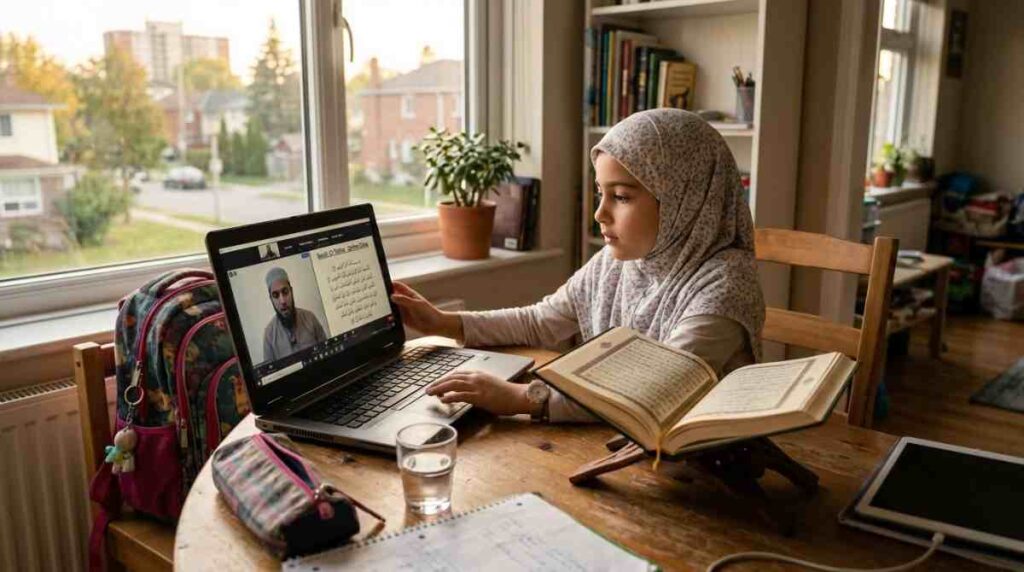
Online one-on-one Hifz keeps the child living at home, attending their regular school, and sleeping in their own bed — with Quran memorization added as a structured daily commitment rather than a full-time replacement for the rest of their life. A typical online Hifz schedule runs 3 to 4 sessions a week, 45 to 75 minutes each, which our timeline guide places at roughly 4 to 7 years to complete Hifz for a child following it consistently — longer than the residential route, but without the separation.
The Trade-Off in One Sentence
Residential trades separation for speed; online one-on-one trades speed for keeping your child home, in their own school, under your own daily supervision.
What online asks of a family is different, not smaller: real daily discipline at home, since there is no institutional structure carrying the child through a slow week; a parent who is willing to be the accountability holder between sessions, especially for younger children; and patience with a longer timeline, since without daily hours of contact time, memorization simply accumulates more slowly.
Side by Side: What Each Path Asks of Your Family
| Residential Madrasa | Online One-on-One | |
|---|---|---|
| Typical completion time | ~2.5–4 years | ~4–7 years |
| Where the child lives | At the madrasa, away from home | At home, as usual |
| Regular school | Usually paused or run alongside the madrasa’s own curriculum | Continues as normal |
| Daily Hifz contact time | 3–5 hours, 6 days/week | 45–75 minutes, 3–4 days/week |
| Parent’s daily role | Largely handed to madrasa staff | Active — supervising home revision |
| Best suited to | A child who thrives with full immersion and structure away from home | A family that wants Hifz alongside normal school and home life |
Why Your Child’s Age Changes the Answer
Age matters more in this decision than in almost any other schooling choice. A 7 or 8-year-old’s attention span, emotional readiness for extended separation, and ability to self-advocate if something is wrong are simply different from a 13 or 14-year-old’s. Many of the Hifz teachers we work with are cautious about recommending residential placement much before age 10 to 12, specifically because of the separation question — not because younger children cannot memorize (they often memorize beautifully, as our age-by-age Hifz expectations guide covers), but because the residential format itself asks a lot of a very young child.
For a child in the 6 to 9 range, online one-on-one at home, moving at the slower and more forgiving pace realistic for that age, is what most of the teachers we work with would recommend as the lower-risk starting point — with a residential intensive kept open as a later option once the child is older and the family has a clearer sense of their temperament for it.
Questions to Ask Before Choosing Either
⚠️ If You’re Considering a Residential Madrasa
- Have you visited in person and met the actual teachers your child would have? A madrasa’s reputation and its day-to-day reality on the ground are not always the same thing.
- Have you spoken directly with current parents, not just the madrasa administration, about food, health care, and how homesickness is actually handled?
- What is the visitation and communication policy — how often can you see or speak with your child, and is that frequency something your child can realistically manage?
- Is your specific child, not children in general, someone who tends to thrive with structure and distance, or someone who needs a parent nearby to stay emotionally steady?
If you are leaning toward online instead, the equivalent honest questions are about whether your household can sustain daily discipline without an institution enforcing it: is there a consistent quiet time and space at home for revision, is at least one parent able to hold the child accountable between sessions, and is the family prepared for a timeline that runs several years longer than a residential intensive would.
A Middle Path Some Families Choose
Not every family treats this as a strict either-or. Some choose a shorter residential intensive during the long summer school holidays — a concentrated few weeks or a couple of months of full immersion — paired with online one-on-one sessions to maintain revision and add new memorization during the regular school year. This isn’t the right fit for every child, since it means coordinating between two different teachers and two different environments, but for a family that wants some of the immersion benefit without full-year separation, it’s a real middle option worth discussing with both the madrasa and an online teacher directly, rather than assuming it has to be one or the other for the entire Hifz journey.
How to Get Started With Online One-on-One
If online one-on-one feels like the right starting point for your family, the process is straightforward:
- Message us on WhatsApp or book a free trial class at an IST-friendly time — no payment required.
- A Hifz-qualified, ijazah-certified teacher assesses your child’s current level and Arabic reading fluency.
- You agree on a realistic weekly schedule — typically 3 to 4 short sessions a week around school.
- Progress and retention are reviewed with you regularly, using the age-appropriate pace covered in our Hifz expectations guide.
See if Online Hifz Fits Your Household
A real trial class at an IST-friendly time, with a Hifz-qualified teacher — no card required, no obligation to continue.
Book Free Trial Class → Chat on WhatsApp →Frequently Asked Questions
Neither is universally better — a full-time residential programme typically completes Hifz faster (roughly 2.5 to 4 years) because of daily contact hours, while online one-on-one keeps the child at home and usually takes 4 to 7 years at a part-time pace. The right choice depends on the child’s age, temperament, and how much the family values keeping them at home during these years.
The most commonly raised concern among Indian parents is the emotional and developmental cost of extended separation at a young age, along with variability in the quality of supervision, food, and daily care between different madrasas. Families considering this route are generally advised to visit in person and speak directly with current parents before enrolling.
Yes. One-on-one online Hifz with a qualified, ijazah-certified teacher and consistent daily revision at home produces the same outcome as an in-person programme — a fully memorized and retained Quran — it simply takes longer per week of contact time than a full-time residential schedule.
Some do. A common pattern is a shorter residential intensive during school holidays paired with online one-on-one sessions during the school year, though this requires coordinating between two teachers and is not the right fit for every child.
Final Thoughts
There is no universally correct answer here, whatever any single relative’s strong opinion suggests. A residential madrasa can be a genuinely formative, positive experience for the right child, and online one-on-one can produce a complete, well-retained Hafiz without ever separating a family. The honest starting point is your own child — their age, their temperament, and how your household actually functions — rather than which path a cousin’s child took, or which one carries more social weight in your community.
Related Guides

Written by Ustaz Muhammad Saad
Hifz Instructor · 6 Years Experience · Hifz, Revision, Tajweed
Ustaz Muhammad Saad has worked with Hifz students from age 6 to their 40s, both in residential and online settings, and believes the right format is a question about the specific child in front of him — never a one-size-fits-all recommendation.
Meet our teaching team →