

This post contains affiliate links.
Published: July 15, 2026 · ⏱ 10 min read · Ustaz Muhammad Saad, Hifz Instructor
One of the most common sources of stress in Hifz programs is not actually the memorization itself — it is the gap between what parents expect and what normal progress looks like. A parent who expects their 8-year-old to memorize a page per day will experience every normal week as a failure. A parent who knows that 3 pages per week is a healthy pace for their child’s age can respond to slow weeks with appropriate calm rather than alarm.
This article is specifically about expectations — what normal Hifz progress looks like at each age stage, what slow-but-healthy looks like, and what actually signals that something needs to change. For the broader question of overall timelines and the variables that affect them, see our guide on how long it takes to become a Hafiz. This article goes deeper into the age-specific picture that parents and students need most.
Why Realistic Expectations Matter More Than Timelines
Hifz is one of the few educational commitments where the journey itself is considered an act of worship — not just the completion. A child who spends five years in sincere Hifz, even if they complete it at age 14 rather than 12, has spent five years in a relationship with the Quran that shapes their character, their Arabic awareness, and their Islamic identity in ways that are not reducible to a completion date.
When expectations are unrealistic, parents do damage that good teaching cannot fully undo: children associate Hifz with pressure and disappointment rather than with spiritual growth, and that association often lasts long after the memorization is complete. The most common cause of children stopping Hifz midway is not inability — it is sustained pressure applied to normal, healthy progress that has been misread as failure.
Knowing what normal looks like, age by age, is the most practical thing a parent can bring to a Hifz journey.
Ages 6–8: The Early Start
What to Expect at Ages 6–8
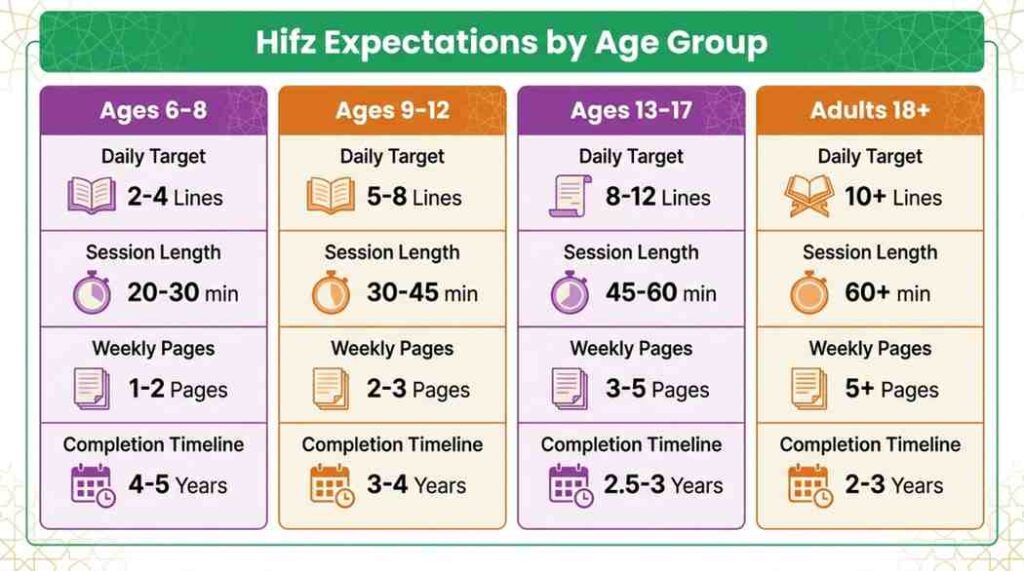
| Realistic new memorization | 3–8 lines per day (not pages) |
| Session length | 15–20 minutes maximum |
| Weekly page target | 1–2 pages per week |
| Typical completion timeline | 5–7 years |
| Biggest challenge | Attention span, not memory |
Starting Hifz at age 6 or 7 is common and in many ways ideal — but the early years look very different from what parents often expect. At this age, the child cannot sustain a 45-minute Hifz session productively. The brain’s sustained attention capacity at age 7 peaks at around 15 to 20 minutes of focused cognitive work, and pushing beyond that produces frustration rather than memorization.
The good news is that what does get memorized at this age tends to stick with remarkable strength. The early surahs — Al-Fatiha, the short surahs of Juz Amma — memorized at age 6 or 7 are typically the most solidly retained parts of a student’s Hifz for life. The investment is real, even when the daily pace looks small.
Parents of very young Hifz students should measure progress in months and years, not in weekly page counts — and should treat the daily habit itself as the achievement at this stage, not the quantity memorized.
Ages 9–12: The Optimal Window
What to Expect at Ages 9–12
| Realistic new memorization | Half page to 1 full page per day |
| Session length | 30–45 minutes productively |
| Weekly page target | 3–5 pages per week |
| Typical completion timeline | 3–5 years |
| Biggest challenge | Maintaining motivation in the long middle (juz 10–20) |
This age group is where Hifz moves fastest and where the combination of memory capacity, attention span, and manageable competing commitments aligns most favorably. A 10-year-old who has been memorizing since age 7 often hits a genuine stride in this window — pages that took weeks to memorize at age 7 now take days.
The critical pitfall at this stage is rushing. When progress accelerates, some parents and teachers respond by increasing the new memorization target aggressively — adding more pages per day, reducing revision time to make room. This approach almost always causes a retention crisis around juz 12 to 15, when the student realizes that large portions of earlier memorization have faded while they were focused on accumulating new pages.
The 60/40 revision split remains essential even when progress feels fast. Especially when progress feels fast.
Ages 13–17: The Teenage Stretch
What to Expect at Ages 13–17
| Realistic new memorization | Half page per day (exam periods: less) |
| Session length | 30–60 minutes when focused |
| Weekly page target | 2–4 pages per week |
| Typical completion timeline | 4–6 years from start |
| Biggest challenge | School exams, social life, motivation dips |
Teenage Hifz gets an unfair reputation for being particularly difficult — the reality is more nuanced. Teenagers who have been in Hifz since childhood often hit their most productive years in this window, because they have both the memory foundation and the self-discipline that younger children lack. The difficulty is external rather than internal: school exam seasons, peer social pressures, and the natural identity questioning of adolescence all compete with Hifz in ways that primary school age did not.
The most effective approach with teenagers is giving them ownership of their Hifz journey rather than managing it entirely for them. A teenager who understands why they are memorizing — not just that their parents want them to — sustains commitment through hard periods in a way that externally managed pressure cannot produce.
Exam periods deserve a specific mention: reducing new memorization targets during exam preparation is not failure. Maintaining revision only, without adding new pages, for two to four weeks around major exams is a sensible adjustment that keeps the Hifz alive without piling onto an already stressed student. A complete pause is harder to restart than a reduced pace.
Adults 18+: The Long Game
What to Expect at Adults 18+
| Realistic new memorization | Quarter to half page per day |
| Session length | 30–60 minutes (Fajr time ideal) |
| Weekly page target | 1–3 pages per week |
| Typical completion timeline | 7–12 years (part-time) |
| Biggest challenge | Competing life commitments, comparison to faster students |
For a deeper treatment of adult Hifz specifically — what is harder, what is easier, and how to structure daily practice — see our dedicated adult Hifz program guide. The single most important expectation calibration for adult students is this: 1 to 3 new pages per week of solidly retained memorization is excellent progress. It is not slow. It is the rate that, maintained consistently, produces a completed Hafiz within a realistic timeframe.
What a Normal Weekly Pace Looks Like
Across all age groups, a week of Hifz is not seven identical days of identical progress. A realistic normal week looks like this:
- Two to three days of genuinely productive new memorization — pages or lines that stick after the session
- One to two days where new memorization is harder than usual — the student is tired, distracted, or the page is particularly dense
- One day of revision only — no new material, just consolidating what was memorized earlier in the week
- Possibly one missed day — illness, school event, family obligation
This is a normal week. It does not mean the student is falling behind or the program is failing. It means Hifz is happening in a real life with real variation, which is exactly what long-term success looks like.
Slow Progress vs a Real Problem — How to Tell the Difference
This is the question parents most need answered and most rarely get a direct answer to. Here is the clearest framework available:
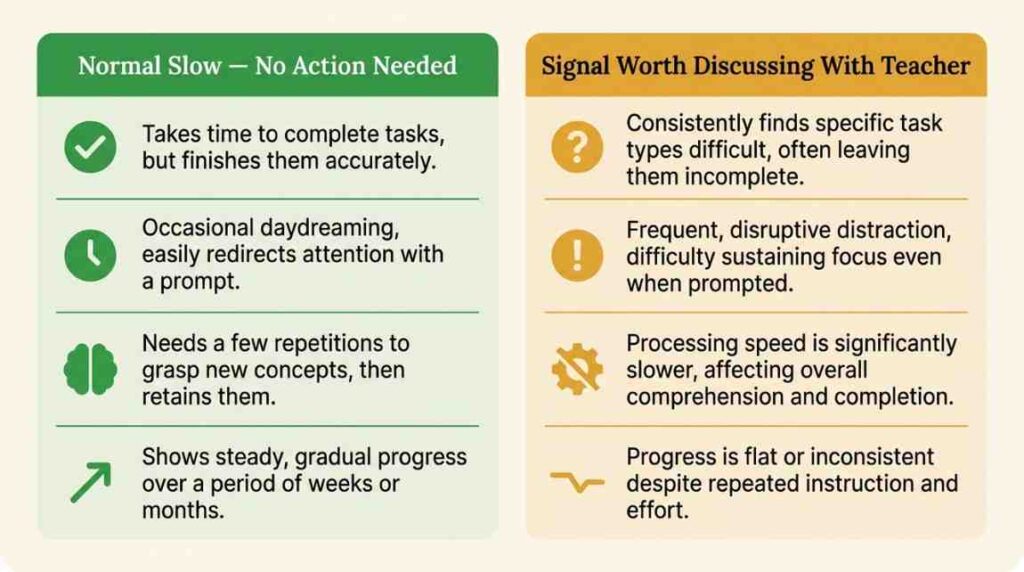
Normal Slow vs Signal of a Problem
| Normal Slow (No Action Needed) | Signal Worth Discussing With Teacher |
|---|---|
| Slow week during school exams | New pages not retained after 48 hours consistently |
| One difficult page that takes two weeks | Previously solid pages fading across the board |
| Motivation dip in months 6–12 | Student showing significant anxiety or distress around sessions |
| Slower pace at the dense surahs (Baqarah, Al Imran) | No new memorization for more than a month, no identified reason |
| Inconsistency during family travel | Teacher changes with no overlap or handover plan |
The most important signal to watch is retention, not pace. A student who memorizes slowly but retains what they memorize solidly is on a healthy trajectory regardless of how many weeks a page takes. A student who accumulates pages quickly but cannot recite last month’s memorization reliably has a retention problem that will compound — and needs the program structure reviewed urgently, not praised for fast progress.
The Parent’s Role at Each Stage
The parent’s role shifts meaningfully as the child ages through the Hifz journey — and misreading which role is needed at which stage is one of the most common sources of friction:
- Ages 6–8: The parent is primarily the environment — creating the routine, sitting with the child, keeping sessions short and positive, and absorbing the slow progress without projecting anxiety onto the child.
- Ages 9–12: The parent shifts to supporter and accountability holder — listening to daily revision, tracking whether revision is actually happening, and communicating with the teacher when something seems off.
- Ages 13–17: The parent becomes a background presence — available, supportive, and not hovering. A teenager who is monitored too closely resists Hifz as parental control rather than embracing it as personal achievement.
- Adults: Self-directed entirely, with a teacher as the only external accountability — parental involvement at this stage is irrelevant unless the adult student specifically requests it.
Want to Know if Your Child’s Hifz Pace Is on Track?
Book a free trial class with our Hifz instructors — we will assess your child’s current memorization, retention, and revision routine and give you an honest picture of where they stand.
Book Free Trial Class →Timeline by Programme Type, and Yearly Milestones
Age isn’t the only variable — how the programme is structured changes the timeline substantially. A full-time madrasa programme (6 sessions/week, 3–5 daily hours) typically completes Hifz in 2.5–4 years. Intensive part-time (5–6 sessions/week, 1.5–2 daily hours) runs 3–5 years. Regular part-time (3–4 sessions/week, 45–75 daily minutes) — the most common online setup — runs 4–7 years. Weekend-only programmes stretch to 7–12 years, since there simply isn’t enough weekly contact with the material to keep the forgetting curve at bay.
For a child aged 9–12 with one hour of daily practice and two supervised classes a week, a realistic year-by-year picture looks like: Year 1 — 3 to 5 juz memorized, fluency and a basic revision system established. Year 2 — 7 to 10 juz, revision workload noticeably heavier, a common motivation dip around juz 8–10. Year 3 — 12 to 16 juz, where consistent students visibly separate from inconsistent ones. Year 4 — 18 to 24 juz. Year 5 — completion, for students who held the pace. The middle stretch (roughly juz 10–20) is where most students hit their hardest patch, because the volume of material needing daily revision keeps growing even as new memorization continues — plan for it rather than being surprised by it.
Frequently Asked Questions
For a child starting at age 7, a realistic expectation is 5 to 7 years of consistent part-time study. Sessions should be short — 15 to 20 minutes maximum — and progress measured in months rather than weekly page counts. What is memorized at this age tends to be extremely durable.
A 10-year-old starting Hifz is in the optimal memorization window. With daily practice and a qualified teacher, a realistic timeline is 3 to 5 years. At this age, half a page to a full page per day is a healthy and achievable daily target once the routine is established.
For teenagers starting Hifz at ages 13 to 17, a realistic expectation is 4 to 6 years. School and exam pressures create real competition for practice time, but teenagers have stronger self-discipline than young children when properly motivated and given ownership of the journey.
A normal healthy pace for a child aged 9 to 12 with daily practice is approximately 2 to 4 new pages per week, accounting for revision alongside new memorization. Weeks with school exams or illness will naturally produce less — this is expected and not a problem.
Discuss with the teacher when: the student consistently cannot retain new pages beyond 48 hours; previously solid pages are rapidly fading across the board; the student shows significant distress around sessions; or there has been no new memorization for more than a month without an identified reason. Occasional slow weeks are normal and not cause for concern.
Final Thoughts
The most useful thing a parent can carry into a Hifz journey is a clear picture of what normal looks like at their child’s specific age — not a general timeline, not someone else’s child’s pace, but the realistic weekly target and the reasonable variation around it that applies to a child of this age, at this stage of the journey.
Hifz is measured in years. The weeks that feel slow are not the story — the years of consistent presence with the Quran are. A child who memorizes steadily, retains solidly, and maintains a positive relationship with the process across five or six years is succeeding, regardless of whether they hit any particular monthly target.
Start Your Child’s Hifz Journey With the Right Expectations
Book a free trial class — our Hifz instructors will assess your child’s current level and help you set realistic, age-appropriate expectations from day one.
Claim Your Free Trial →
Written by Ustaz Muhammad Saad
Hifz Instructor · 6 Years Experience · Hifz, Revision, Tajweed
Ustaz Muhammad Saad has worked with Hifz students from age 6 to their 40s. He believes that most Hifz journeys that end prematurely end because of unrealistic expectations applied to normal progress — not because of inability. Setting the right expectations at the beginning is, in his view, as important as finding the right teacher.
Meet our teaching team →