
This post contains affiliate links.
Estimated reading time: 12 minutes
Table of contents
- The Core Question: What Produces Results?
- Qualification and Teacher Quality
- One-on-One vs. Group Teaching
- Access to Qualified Teachers
- Female Teachers for Girls
- Scheduling and Flexibility
- Transport, Time, and Practicality
- The Classroom Experience and Human Presence
- Parent Visibility and Accountability
- Cost
- The Honest Summary
- When Local Classes Might Be Better
- When Online Classes Are Clearly Better
- How to Make the Decision
- Frequently Asked Questions
- The Right Choice Is the One That Gets Your Child Learning
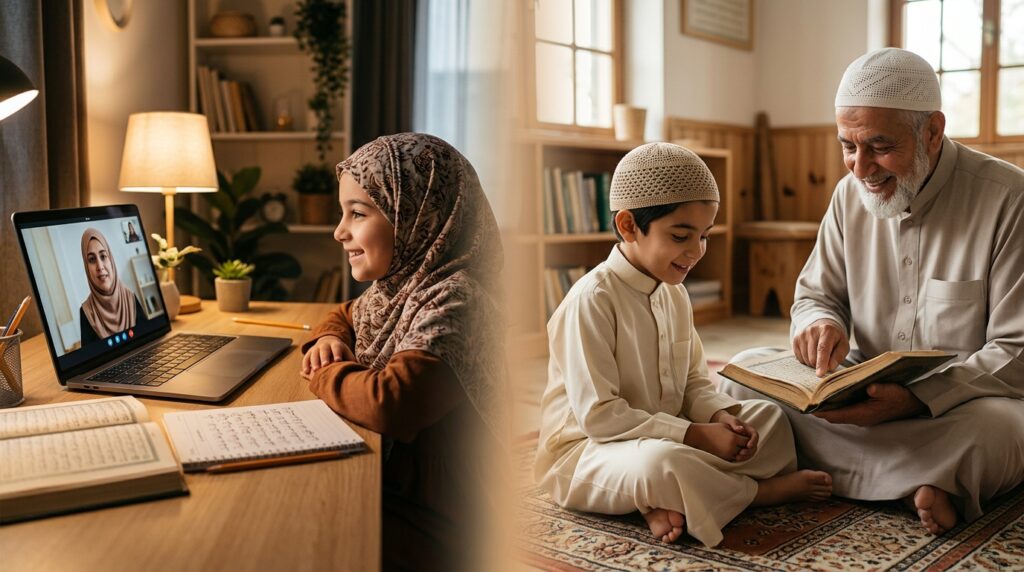
If you are a Muslim parent living in the West, you have probably faced this question in some form.
Maybe you searched for a local Quran teacher and found that options were limited, far away, or fully booked. Maybe you found a local option but were not entirely satisfied. Maybe you have heard good things about online Quran classes but are not sure whether they can match what a teacher in the room provides.
This comparison is written to help you make that decision clearly — without any pressure in either direction.
We run an online Quran academy. We will say that upfront. But we also know that online learning is not the right answer for every child in every situation — and we would rather you make the right decision for your family than the wrong one for ours.
With that said, here is the honest comparison.
The Core Question: What Produces Results?
Before comparing formats, it helps to establish what actually produces results in Quran education — because both online and local classes can succeed or fail depending on the same underlying factors.
What produces results in Quran learning:
A qualified, Ijazah-certified teacher. Not just someone who can recite Quran reasonably well, but someone who has been formally certified, whose credentials are verifiable, and who knows how to teach — not just recite.
One-on-one instruction. For children learning to read and recite, individual attention is significantly more effective than group settings. The teacher needs to hear each child recite and correct each child’s specific mistakes.
Consistency. Regular sessions — ideally two to three times per week — with limited interruptions and the same teacher throughout.
Parental involvement. The single biggest predictor of progress is what happens at home between sessions. A child whose parents listen to their revision progresses faster than one who practices alone.
Both online and local classes can deliver all four of these — or fail to deliver them. The format is not the determining factor. The quality of the teacher and the structure of the programme are.
With that as the baseline, here is how the two formats compare across the areas that matter most to parents.
Research on online versus in-person learning outcomes, documented by the Education Endowment Foundation, confirms that the quality of instruction matters significantly more than the delivery medium. URL: https://educationendowmentfoundation.org.uk/ AttributesQualification and Teacher Quality
Local classes: Quality varies enormously. In many Western cities and towns, the local Quran teacher is often a well-meaning individual from the community — sometimes very qualified, sometimes not. Credentials are not always displayed, and parents do not always know what questions to ask. Mosques sometimes have structured programmes with qualified teachers; community-based and home teachers are more variable.
Online classes: Quality also varies — but reputable online academies publish their teacher qualifications clearly and can be asked to verify them. A well-run online academy will have Ijazah-certified teachers whose credentials are documented and verifiable. The ability to compare multiple academies before committing — without geographic constraint — means parents have more choice and more leverage.
Verdict: Neither format guarantees quality — but online academies that publish credentials clearly give parents more transparency and more choice. Ask any teacher — online or local — for evidence of Ijazah certification.
One-on-One vs. Group Teaching
Local classes: Many local Quran teachers — particularly mosque-based programmes — teach children in groups. This is traditional and community-building, but it means each child gets limited recitation time. In a group of eight to ten children, a child may recite for only a few minutes per session.
Online classes: Reputable online academies typically offer one-on-one sessions as their primary model. Every minute of the session is focused on your child — their specific pronunciation errors, their specific pace, their specific level.
Verdict: Online classes, when structured as one-on-one sessions, are significantly more effective per session than group local classes. If a local teacher offers one-on-one sessions, this advantage disappears.
Studies of mosque-based Islamic education programmes in the UK, including research cited by the National Association of Muslim Schools (https://www.nams.org.uk/), consistently identify class size as a limiting factor in individual student progress.Access to Qualified Teachers
Local classes: Dependent entirely on geography. Muslim families in areas with large communities — parts of London, Birmingham, Bradford, Houston, Toronto, Sydney — may have multiple qualified options nearby. Families in smaller towns or rural areas may have very few, or none.
Online classes: Geography does not matter. A family in a small Scottish town has access to the same qualified teachers as a family in East London. A family in rural Canada or suburban Australia can access teachers they could not otherwise find.
Verdict: Online classes win decisively on access. For families in areas without strong local options, online is not a compromise — it is an upgrade.
Female Teachers for Girls
Local classes: Many local teachers and mosque programmes do not have qualified female scholars readily available. Families who need a female teacher for their daughter may find it difficult or impossible to source one locally.
Online classes: Reputable online academies typically have qualified female teachers on staff as a standard offering. Matching a girl with a female scholar is straightforward.
Verdict: Online classes are significantly better for families who need — or prefer — female teachers for their daughters.
Scheduling and Flexibility
Local classes: Fixed time slots, usually at the teacher’s location or mosque. If your child has a school event, a sports commitment, or a family circumstance on that day — the class is typically missed. Rescheduling is often not possible.
Online classes: Sessions are scheduled around your family’s life. Morning, evening, weekend — whatever works for your time zone and your routine. Rescheduling is typically possible with sufficient notice. For families in the UK, USA, Canada, and Australia, where time pressures are significant, this flexibility is a meaningful practical advantage.
Verdict: Online classes are more flexible. For busy families — which is most families — this reduces the number of missed sessions, which directly impacts progress.
Transport, Time, and Practicality
Local classes: Getting a child to a local teacher requires transport — a parent’s time and energy, often in the evening after school or work. For families with multiple children, this multiplies. In winter months, in areas with poor public transport, or in families where both parents work full-time, this is a genuine practical obstacle.
Online classes: No transport required. The child sits at home. The parent does not need to leave the house. A session can happen during a lunch break, after school, or on a weekend morning without disrupting the family’s logistics.
Verdict: Online classes save significant time and logistical effort. For many families, this is the deciding factor.
The Classroom Experience and Human Presence
Local classes: A teacher physically present in the room creates a different energy than a screen. Some children — particularly younger ones — respond better to a physical presence. The relationship feels more immediate. For children who struggle with screen engagement, local classes may produce better focus.
Online classes: Younger children (under 6) sometimes find video calls less engaging than physical presence. A child who struggles to engage with a screen for any reason will have difficulty in online classes. However, most children above age 6 adapt quickly to online learning — particularly when the teacher is warm, experienced, and knows how to hold attention through a screen.
Verdict: This is the one area where local classes have a genuine advantage for some children — particularly very young or screen-averse learners. For most children above age 6, online teaching by a skilled teacher is fully effective.
Parent Visibility and Accountability
Local classes: Parents typically drop their child off and collect them. They have limited visibility into what happened in the class, how their child recited, or what the teacher covered. Progress is reported informally, if at all.
Online classes: In an online session, a parent can sit nearby or in the same room without disrupting the class. Reputable academies provide recorded sessions that parents can review. Regular progress reports tell parents specifically where their child is strong and where they need more work.
Verdict: Online classes offer significantly more transparency for parents who want to stay informed about their child’s learning.
Cost
Local classes: Costs vary widely. Private one-on-one local teachers typically charge £15-40 per session in the UK, $20-50 in the USA. Mosque group programmes are often subsidised and cheaper — but group settings, as noted above, provide less individual attention.
Online classes: Typically range from $40-80 per month for two to three sessions per week with a qualified teacher. This is often more affordable than private one-on-one local tuition, while providing the same individual attention.
Verdict: Online classes are generally more affordable than private local one-on-one tuition, and comparable to or slightly more than subsidised mosque group programmes — while offering individual attention that group programmes cannot.
The Honest Summary
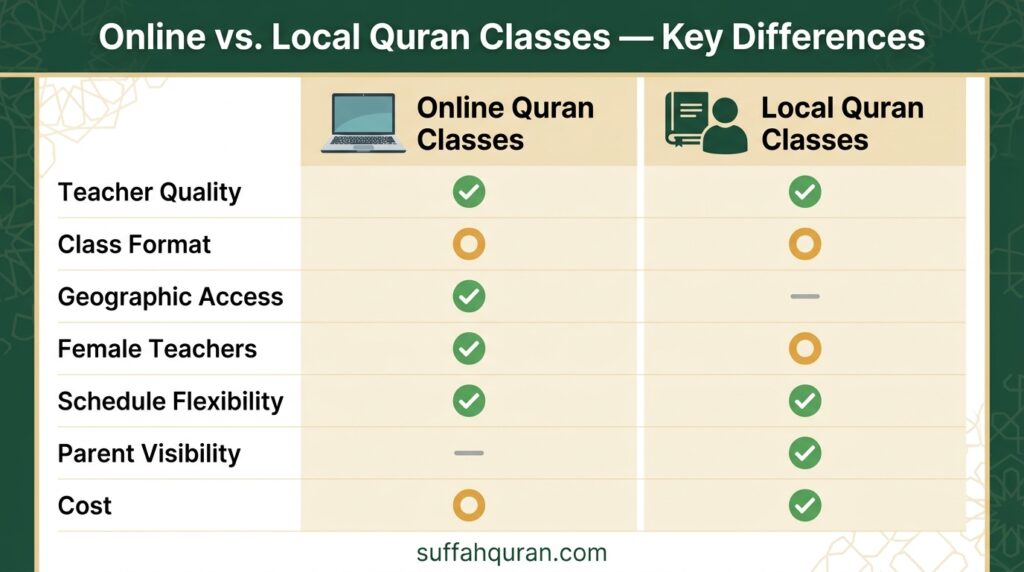
| Factor | Online Classes | Local Classes |
|---|---|---|
| Teacher quality | Varies — but credentials more verifiable | Varies — credentials often less transparent |
| One-on-one instruction | Standard in good academies | Often group-based in mosque programmes |
| Geographic access | No limitation | Limited by location |
| Female teachers | Readily available | Often difficult to source |
| Scheduling flexibility | High | Low — fixed slots |
| Practical convenience | Very high — no transport | Requires transport and parental time |
| Human/physical presence | Screen-based | Physical presence in room |
| Parent visibility | High — recordings, reports | Low — typically none |
| Cost | Mid range | Wide range — subsidised to expensive |
Bottom line: For most Muslim families in Western countries — particularly those in areas without strong local provision, those with daughters needing female teachers, and those with busy schedules — online Quran classes with a qualified academy provide better results, more flexibility, and more accountability than the typical local alternative.
The exception is very young children (under 6) who struggle with screens, or families in areas with excellent, accessible, and affordable one-on-one local provision.
When Local Classes Might Be Better
In the interest of genuine honesty, here are the situations where local classes may be the right choice:
Your child is under 5 and struggles significantly with screens. A physical teacher in the room is more engaging for some very young children. If your child cannot maintain focus on a video call, start with in-person and transition online when they are ready.
You have a highly qualified, Ijazah-certified, one-on-one local teacher nearby. If you have found a teacher who is genuinely qualified, teaches individually, and is accessible and affordable — that is an excellent option. Do not move online for the sake of it.
Your child learns best with physical presence and face-to-face interaction. Some children — particularly those with certain learning differences — benefit more from a physical learning environment. You know your child.
When Online Classes Are Clearly Better
You cannot find a qualified teacher locally. This applies to the majority of Muslim families outside major city centres in the UK, USA, Canada, and Australia.
Your daughter needs a female teacher. Finding a qualified female Quran teacher locally is difficult in most areas outside large Muslim communities.
Your schedule is irregular or demanding. If work, school activities, and family life make fixed local appointments difficult to maintain consistently, online flexibility produces more consistent attendance — and consistent attendance produces faster progress.
You want visibility into your child’s learning. If you want to know specifically what your child is learning, how they are progressing, and what needs work — a well-structured online academy provides this in a way local classes rarely do.
You are outside a major city or in a country with limited local provision. Online access to qualified teachers is simply not available any other way.
How to Make the Decision
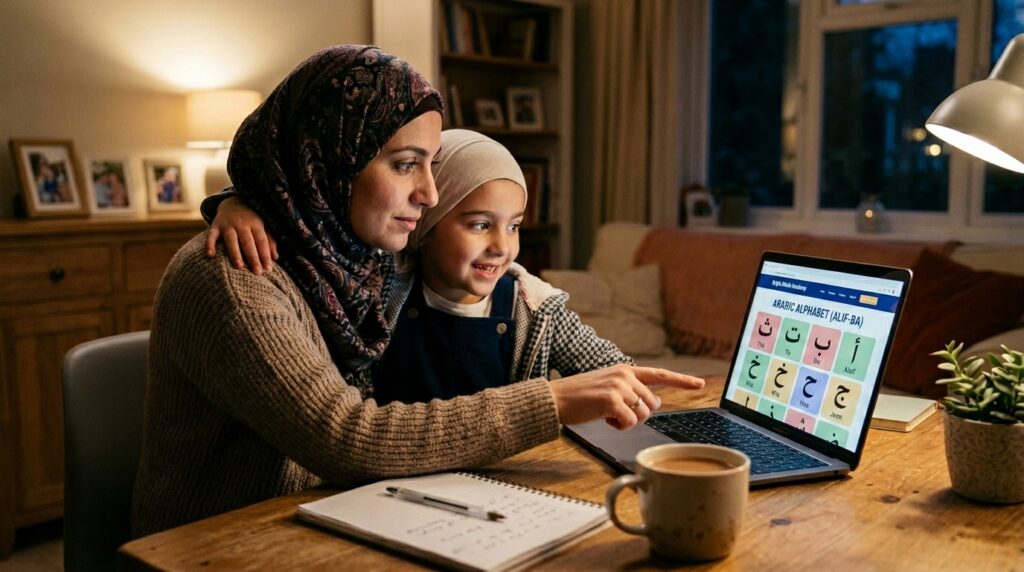
Ask yourself these four questions:
- Is there a qualified, Ijazah-certified, one-on-one teacher available locally? If yes — visit them, assess them, and decide based on quality. If no — online is the better option.
- Does my daughter need a female teacher? If yes — online is almost certainly easier to source.
- Can my family maintain a fixed local schedule consistently? If the answer is uncertain — online flexibility will produce better attendance and faster progress.
- How old is my child, and how do they engage with screens? Under 6 and screen-averse — consider in-person first. Over 6 and comfortable with screens — online is fully effective.
If you are still unsure — book a free trial class online. It costs nothing and gives you real information that no amount of research can provide.
Book a free trial class at Suffah Quran Academy — no payment required
Frequently Asked Questions
Most children over the age of 6 adapt quickly to online Quran classes when the teacher is skilled at engaging through a screen. Children under 5 or 6 sometimes find video calls harder to focus on — for them, a physical teacher may produce better early engagement. By age 6-7, online learning is fully effective for most children.
Ask directly for evidence of Ijazah certification — not just a claim of experience. Reputable academies will provide documentation. Also ask how many students the teacher has taught, how long they have been teaching online, and whether sessions are recorded. A teacher confident in their credentials will answer all of these easily.
It depends on the quality and format of the mosque class. If your child is in a group of eight to ten students and getting limited recitation time — supplementing with or switching to one-on-one online sessions is likely to accelerate their progress significantly. If the mosque class offers individual attention from a qualified teacher, it may be working well.
Yes — with daily sessions, a structured Sabaq-Sabqi-Manzil revision system, and strong parental involvement at home. Read our complete guide on what Hifz ul Quran involves (/what-is-hifz-ul-quran/) before deciding on a programme.
A device with a working camera and microphone — a tablet, laptop, or desktop computer. A stable internet connection. A quiet place to sit. A copy of the relevant learning material (Madani Qaida or Quran). That is all.
Two to three sessions per week is the recommended starting point for most children. Two is the minimum for consistent progress. Three produces noticeably faster results for motivated children. Daily sessions are used in Hifz programmes. Fewer than two sessions per week results in too much forgetting between classes.
The Right Choice Is the One That Gets Your Child Learning
This comparison exists to help you make a clear decision — not to sell you on online learning at any cost.
If you have an excellent local teacher, use them. If you do not — or if the local option does not meet the quality standards your child deserves — online learning with a reputable, qualified academy is not a compromise.
For most Muslim families in the West, it is the best available option.
At Suffah Quran Academy, we offer one-on-one sessions with Ijazah-certified teachers, female scholars on staff, recorded classes, regular progress reports, and flexible scheduling across all time zones.
Your child’s first class is free.