

This post contains affiliate links.
Published: July 10, 2026 · ⏱ 10 min read · Ustaz Hamza Siddiqui, Hifz Support Instructor
The question “am I too old for Hifz?” gets asked by adults of almost every age — by someone who is 22 and feels like they missed the childhood window, by someone who is 35 and worries their memory is past its peak, and by someone who is 50 and has carried the intention for decades but never started. In almost every case, the concern is the same: they assume that whatever made childhood memorization possible has passed.
This article answers that question honestly — not to encourage everyone into Hifz regardless of circumstances, but to give adults a realistic picture of what it actually involves, what is harder than they expect, and what is easier than they assume.
The Direct Answer: Yes, It Is Realistic
Adults memorize the Quran every day — in their 20s, 30s, 40s, and well beyond. Scholars have completed Hifz in their 50s and 60s. The Islamic tradition has never placed an upper age limit on memorization of the Quran, and there is no neurological or religious basis for one.
What is accurate is that adult Hifz takes longer than childhood Hifz for most people. The timeline is realistic — it is just a different timeline. An adult working full-time who commits to a daily practice routine should expect a Hifz journey measured in years, not months. That is not a discouragement — it is the honest context that allows a person to commit without being surprised or derailed by what the journey actually looks like.
What Is Genuinely Harder About Adult Hifz
Being honest about the real difficulties is more useful than minimizing them:
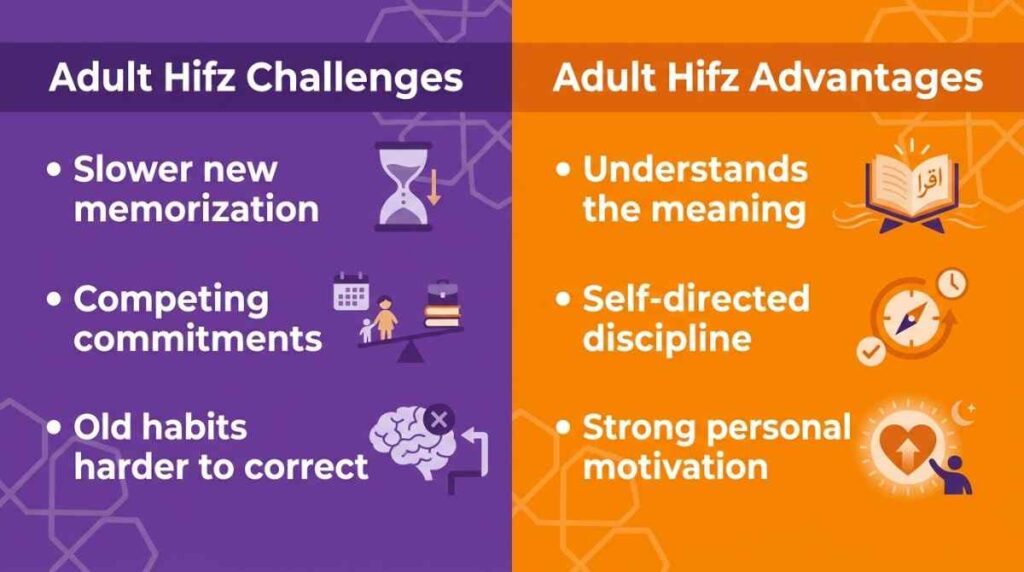
- New memorization is slower. The brain’s ability to form new long-term memories from repeated exposure — the mechanism at the core of Hifz — is measurably faster in children aged 9 to 12 than in adults. An adult who can memorize a page in three days may be doing exactly as well as their neurology allows, even if a child memorizes the same page in one.
- Competing commitments are real. Work, family, sleep, and social obligations all compete for the daily practice time that Hifz requires. An adult who misses five days of practice in a week loses progress that a supervised child in a structured program would not.
- Motivation fluctuates over years. A multi-year commitment sustained purely on initial enthusiasm is almost always going to hit flat stretches. Adults who approach Hifz as a spiritual obligation rather than an achievement project tend to weather those flat stretches better than those who started with high energy and no deeper grounding.
- Old habits of recitation are harder to unlearn. An adult who has been reciting Quran with certain mispronunciations for twenty years will find those habits more resistant to correction than a child building correct habits from scratch. Getting recitation properly checked before beginning Hifz is more urgent for adults than for children.
What Adults Actually Have That Children Don’t
This side of the equation is consistently underestimated, including by adults themselves:
- Understanding of meaning. An adult who understands — even partially — what the ayat they are memorizing say retains them significantly better than someone memorizing sounds without semantic connection. Understanding Arabic meaning, or even having read a translation, creates mental anchors that make memorization stickier. This is a genuine and significant advantage over young children.
- Self-directed discipline. A child needs external accountability — a parent, a teacher, a program structure — to maintain daily practice. An adult who genuinely decides to do something can build and sustain a habit without being supervised. This is a real advantage once the habit is established.
- Emotional investment. Adults who choose Hifz as adults have usually wrestled with the intention seriously before starting. That genuine personal investment sustains commitment through difficult months in a way that a child who was enrolled by parents sometimes cannot match.
- Control over scheduling. A working adult can protect thirty minutes of Fajr time for Hifz in a way that a child’s school schedule does not always allow. Adults who identify and guard a fixed daily window for Hifz practice — particularly early morning — often find their consistency better than they expected.
Realistic Adult Hifz Timeline
Adult Hifz Timeline by Daily Practice
| Daily Practice Time | Estimated Timeline | Notes |
|---|---|---|
| 30 minutes | 10–15+ years | Slow but sustainable — valid if consistent |
| 45–60 minutes | 7–10 years | Realistic target for most working adults |
| 1.5–2 hours | 5–7 years | Achievable for adults with flexible schedules |
| 3+ hours (semi-full-time) | 3–5 years | Possible for those on sabbatical or retired |
These timelines assume consistent daily practice — not two or three days a week. An adult who practices forty-five minutes every single day will outpace one who does two-hour sessions twice a week, because Hifz retention is built through daily repetition, not periodic intensity.
How Many Pages Per Day Is Realistic
Most adults who ask this question are hoping to hear “one page a day” — because that would mean completing all 604 pages of the Quran in under two years. That number is possible for some adults in ideal conditions, but for most working adults with Arabic not being their first language, a more honest and sustainable target is:
- Half a page of new memorization per day — alongside thorough revision of the pages already memorized
- Starting with less is fine. Building the daily habit first and then gradually increasing the target as the routine becomes established is far more effective than starting aggressively and burning out in month three
- Quality over quantity. A quarter page memorized to the point of being recitable without looking is worth far more than a full page half-remembered
For context: at half a page of solid new memorization per day, excluding revision time, an adult would complete the Quran’s 604 pages in approximately three and a half years of uninterrupted daily practice. Add revision time, missed days, and the natural slower pace of adult memorization, and seven to ten years is the more honest full-journey estimate for most people.
The Biggest Adult Hifz Mistakes
- Treating weekends as the main practice time. Three hours on Saturday and nothing Monday through Friday is one of the most reliable ways to stall adult Hifz. The brain consolidates memorization through daily repetition, not weekly doses.
- Skipping revision to focus on new pages. The same revision problem that affects children affects adults — except adults are often more driven to “make progress” by adding pages and more tempted to deprioritize revision of what they already have.
- Not getting recitation verified before starting. Memorizing with incorrect Tajweed for years and then having to relearn correct pronunciation after is significantly harder than getting it right from the beginning. Adults who have been reciting informally for years should get their recitation properly checked before beginning Hifz memorization.
- Expecting childhood pace from an adult memory. Comparing progress to a cousin who completed Hifz at age 10 or to an ambitious Hifz timeline found online is the fastest route to discouragement. Adult Hifz has its own pace, and that pace is legitimate.
- No teacher accountability. Adults who try to do Hifz entirely on their own — without a teacher checking their memorization regularly — accumulate errors silently that become harder and harder to correct later. A teacher who listens to recitation at least weekly is not optional for adult Hifz, it is what makes the memorization reliable.
How to Structure Adult Hifz for Success
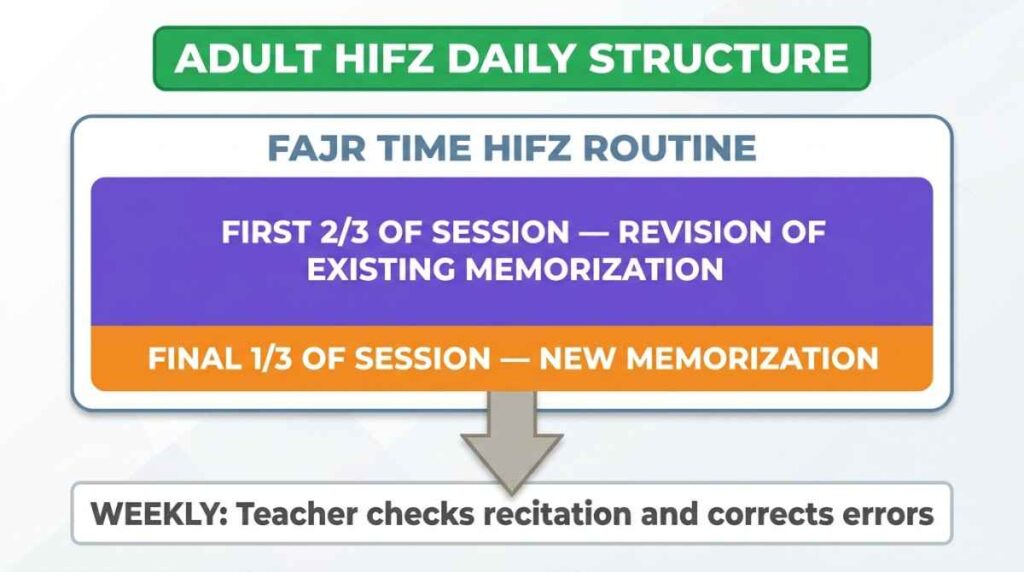
The structure that consistently works for adult students across different ages and life situations:
- Fix a daily time and protect it. Fajr time — the thirty to sixty minutes after Fajr prayer before the day begins — is the most commonly reported effective window for adult Hifz. The mind is fresh, distractions are minimal, and the spiritual context supports the work.
- Split the session: revision first, new material second. Spend the first two-thirds of practice time revising what was already memorized, then the remaining third on new material. This feels counterintuitive — new pages feel like progress, revision feels like maintenance — but retention over years depends on it.
- Work with a teacher weekly at minimum. Even a single thirty-minute session per week where a teacher listens to recitation and corrects errors prevents the silent accumulation of mistakes that ruins months of independent practice.
- Track progress concretely. A simple notebook or app noting which pages were memorized and when they were last revised gives visibility into which parts of the memorized Quran need attention — and stops older pages from quietly slipping away unnoticed.
- Connect the memorization to salah. Reciting newly memorized surahs and passages in daily prayers is the most natural and effective reinforcement available. What is used in salah is retained far more reliably than what is only recited in practice sessions.
Ready to Start Adult Hifz With a Structured Plan?
Book a free trial class — our Hifz instructors will assess your current recitation level and help you build a realistic, sustainable Hifz plan for where you are now.
Book Free Trial Class →Frequently Asked Questions
Yes. Adults complete full Hifz at any age — in their 20s, 30s, 40s and beyond. The timeline is longer than for children but completion is absolutely achievable. The biggest factor is not age — it is daily consistency maintained over years.
Initial memorization of new material is generally slower for adults than for children aged 9 to 12. However adults have significant compensating advantages: stronger discipline, better understanding of meaning, control over their own schedule, and greater personal motivation.
For a working adult with 45 to 60 minutes of daily practice, a realistic Hifz timeline is 7 to 10 years. Adults who can dedicate 1.5 to 2 hours daily may complete it in 5 to 7 years. Consistency matters more than session length.
A consistent daily schedule rather than intensive irregular sessions, a structured revision system from day one, and understanding the meaning of what is being memorized — which significantly aids retention. Weekly teacher accountability is essential, not optional.
Yes. Online one-on-one Hifz programs are particularly well suited for adults because they allow scheduling around work and family commitments and eliminate commute time. Suffah Quran Academy offers one-on-one Hifz programs for adult students.
There is no such age. Scholars have completed memorization of the Quran well into their 50s and 60s. The only genuine limiting factor is whether a person can commit to daily practice consistently over a long period — which is a question of commitment, not age.
A realistic and sustainable target for most adults is half a page to one page of new memorization per day alongside thorough revision. Starting with less than half a page is fine — building the daily habit first is more important than the target size.
Final Thoughts
Adult Hifz is not a lesser version of childhood Hifz — it is a different journey with different challenges and different advantages, ultimately leading to the same destination. The adults who complete it are not the ones with the best memory or the most free time — they are the ones who built a daily habit, stayed patient with a slower pace than they initially hoped for, and had a teacher who kept their memorization accurate along the way.
The question is not whether it is realistic. It is. The question is whether you are ready to commit to a daily practice that will span years — and whether you have the structure around you to make that commitment hold. For context on what a well-run Hifz program looks like from the inside, see our guide on what Hifz ul Quran involves, and for an honest breakdown of timelines across age groups, see how long Hifz actually takes.
The Right Time to Start Is Now
Book a free trial class at Suffah Quran Academy — we will assess your current level honestly and help you build a Hifz plan that fits your actual life.
Claim Your Free Trial →
Written by Ustaz Hamza Siddiqui
Hifz Support Instructor · 5 Years Experience · Hifz Support, Revision
Ustaz Hamza Siddiqui specializes in supporting students through the long middle of Hifz — the revision-heavy stretches that test commitment. He has worked with adult students across age groups and believes the adults who succeed are never the ones with the best memory, but always the ones with the most consistent daily habit.
Meet our teaching team →