
This post contains affiliate links.
Published: June 12, 2026 · ⏱ 9 min read · Ustaz Zaid Farooqui, Online Quran Tutor
If you have never learned Quran online before, you probably have a few questions. Does it actually work? What do you need? Where do you start? What does a class look like?
This guide answers all of them — in plain language, without jargon, and without assuming you already know anything about how online Quran learning works.
Does Online Quran Learning Actually Work?
Yes — and for most people in the UK, USA, Canada, and Australia, it is the most practical and often the best available option.
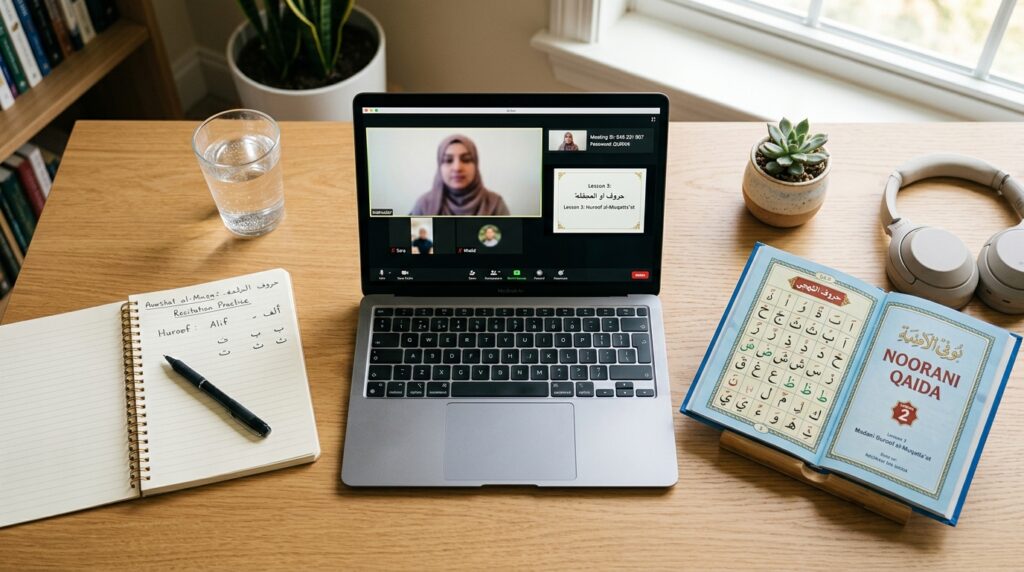
The concern most beginners have is whether real correction can happen through a screen. It can. A qualified teacher on a video call can hear every letter you recite, identify every error, and correct it immediately — the same way they would in person. The correction happens through sound, not touch. And sound travels perfectly well over the internet.
What online learning adds that in-person often cannot provide: flexibility of scheduling, access to qualified teachers regardless of your location, one-on-one sessions as the standard (rather than group classes), and recorded sessions that you or your child can review.
For a detailed comparison of online vs local Quran classes, read our honest comparison guide.
What You Need to Get Started
The technical requirements are minimal. Here is exactly what you need:
| Item | Details | Notes |
|---|---|---|
| Device | Laptop, desktop, or tablet | Phone screen too small for young children |
| Camera | Built-in or external webcam | Teacher needs to see mouth and face for correction |
| Microphone | Built-in or headset | Clear audio is critical — teacher must hear recitation accurately |
| Internet | Stable broadband or Wi-Fi | Sit close to router if connection is weak |
| Platform | Zoom or Skype (most common) | Install and test before first class |
| Book | Madani Qaida or Quran | Teacher advises which edition after first assessment |
| Space | Quiet room or corner | Minimal background noise — teacher needs clear audio |
That is everything. No special software, no expensive equipment, no prior knowledge required. If you have a laptop and a stable internet connection, you are ready to begin.
Which Course to Start With
Your starting point depends on your current level. Here is exactly where each type of beginner begins:
Cannot read Arabic at all → Madani Qaida
This is the foundation course that takes you from zero — learning individual Arabic letters — through vowel marks, reading rules, and connected text, until you can read Arabic script. Most adults complete it in 3-5 months. Children aged 5-7 in 6-9 months. For a full breakdown, read our guide on what Madani Qaida teaches.
Know the alphabet but cannot read connected text → Madani Qaida (midway)
A qualified teacher will assess your letter knowledge in the first session and begin Madani Qaida from the appropriate stage — skipping letters you already know and focusing on vowel marks, rules, and connected reading.
Can read but Tajweed is incorrect → Tajweed Course
If you can read Arabic text but your pronunciation is inconsistent or your Tajweed rules are not applied, a dedicated Tajweed course is the right starting point. See our Tajweed course page for details.
Can read well and want to memorise → Hifz Programme
Hifz requires fluent reading with correct Tajweed as a prerequisite. If you or your child meet this standard, read our guide on what Hifz ul Quran involves before beginning.
Not sure where you are → Free Trial Assessment
Book a free trial class. The teacher will assess your level in the first session and tell you exactly where to begin. This is the most efficient starting point — no guessing, no wasted time.
How to Choose the Right Teacher
The teacher is the most important variable in how fast you progress and how accurately you learn. Three things to confirm before committing:
Ijazah certification. Ask directly: “Does this teacher hold an Ijazah in Quran recitation?” A teacher with Ijazah has had their recitation formally verified through a chain of transmission going back to the Prophet ﷺ. A teacher without Ijazah may be competent — but their recitation has not been independently verified. For a full explanation of what Ijazah means and how to verify it, read our guide: What Is an Ijazah?
One-on-one sessions. Confirm that the class is exclusively between you or your child and the teacher — not a group. Tajweed correction requires the teacher to hear each student individually. Group settings cannot provide this. For a comparison, read our guide on one-on-one vs group Quran classes.
A free trial before payment. Any reputable academy will offer a free trial class before asking for commitment. This lets you hear the teacher, see the format, assess the fit — before any financial decision.
What Happens in a First Session
Knowing what to expect removes the anxiety of the unknown. A first online Quran session typically follows this structure:
Minutes 1–5: Introduction and connection. The teacher introduces themselves, asks a few warm questions (your name, age, where you are from), and creates a comfortable atmosphere. A good teacher does not jump straight into content in the first minutes.
Minutes 5–15: Level assessment. The teacher asks you to read some Arabic — either a few letters from a Qaida if you are a beginner, or a passage from the Quran if you have some existing knowledge. They are listening for your letter production, vowel mark accuracy, Tajweed application, and overall fluency.
Minutes 15–25: First content. Based on the assessment, the teacher introduces a small amount of new material — 2-3 letters if you are a complete beginner, or begins working through an area that needs correction. The amount is deliberately small — no teacher should try to cover everything in a first session.
Minutes 25–30: Close and next steps. The teacher summarises what was covered, gives a small home practice task, and confirms the next appointment. The session ends warmly.
For a more detailed guide on what to look for in a first class, read: What to Expect in Your Child’s First Online Quran Class.
How Many Sessions Per Week
Two to three sessions per week is the recommended frequency for most students.
- 2 sessions/week: Minimum for consistent progress. Suitable for busy adults and younger children. Progress is steady but measured.
- 3 sessions/week: Ideal for most students. Noticeably faster progress than 2. The sweet spot for children balancing school with Quran.
- 4–5 sessions/week: For students with specific goals — exam preparation, preparing for Hifz, or adults who want to progress quickly. Requires more home practice to match the pace.
- Daily (5–6 sessions/week): Standard for Hifz programmes. Not typically recommended for general Quran reading — consistency matters more than volume at that stage.
Whatever frequency you choose, consistency across weeks and months matters more than any single week’s intensity. A student who attends 2 sessions every week for a year will outpace one who attends 5 sessions for a month and then disappears for three.
How to Make Faster Progress
The most effective things — beyond choosing the right teacher and attending consistently — are:
Daily home practice of 10–15 minutes. Review what was covered in the last class. Read back the letters, words, or passage introduced. This single habit consistently produces 30–50% faster progress. For a detailed breakdown of why, read our guide on how long it takes to learn to read the Quran.
Use the learning in Salah. Recite the newly learned Surahs or passages in your daily prayers. The repetition embeds them more deeply than any other practice method. Adults praying five times daily have 17 opportunities per day to practise their recitation without any extra time commitment.
Play Quran recitation at home. Passive exposure to correct recitation — playing a skilled reciter in the background during meals, commuting, or quiet moments — builds letter and word recognition over time, with zero active effort.
Ask your teacher for specific homework. After each session, ask: “What specifically should I practise before our next class?” A good teacher will give you a precise task — not “revise everything” but “practise the Noon Sakinah rules in these three verses.” Targeted practice is more effective than unfocused review.
Special Notes for Children
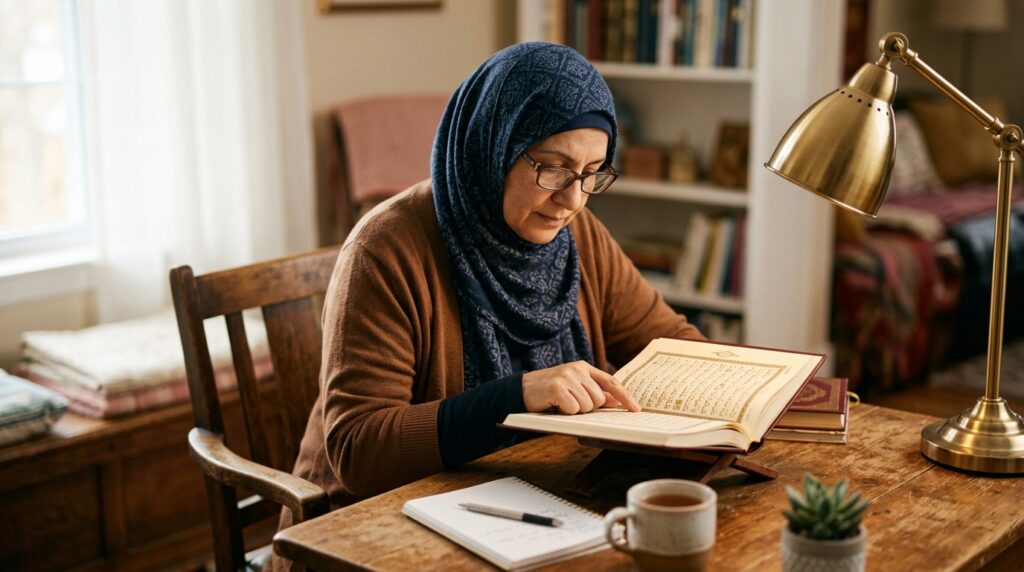
Stay nearby during class. For children under 10, a parent should be present in the same room — not actively involved, but present. It reassures the child and gives the parent visibility into the lesson.
Session length by age. Children aged 4-5: 20-25 minutes. Ages 6-8: 25-30 minutes. Ages 9+: 30-45 minutes. A session that ends while the child still has energy is more valuable than a longer session where the child has disengaged.
Sit the child at a desk, not on a sofa. The physical setup signals to the child that this is a structured learning activity. A child at a proper desk focuses better than one on a comfortable sofa. Small detail, meaningful difference.
Ask about safeguarding. Before enrolling your child, ask the academy: are sessions recorded? Is a parent welcome to be present? What is your safeguarding policy? A reputable academy answers all three immediately and confidently.
For a complete guide to children’s online Quran learning, read: How to Choose an Online Quran Academy.
Ready to Start? The First Class Is Free
Book a free trial at Suffah Quran Academy. Ijazah-certified teachers. One-on-one sessions. Female teachers available. Your level is assessed in the first session and your learning path is confirmed — at no cost.
Book Free Trial Class →Frequently Asked Questions
Yes — online one-on-one Quran learning with a qualified teacher is highly effective. The teacher hears your recitation in real time via video call and corrects errors immediately. The key is choosing an academy with Ijazah-certified teachers and one-on-one sessions, not group classes.
A device with camera and microphone (laptop, tablet, or desktop), stable internet, a quiet space, and a copy of Madani Qaida or Quran depending on your level. The teacher advises on the correct book after the first assessment. No prior Arabic knowledge required to begin.
Complete beginners start with Madani Qaida — a structured programme teaching Arabic letters, vowel marks, and basic reading from zero. Those who can read but have Tajweed errors start with a Tajweed correction course. Those wanting memorisation need Quran reading fluency first, then Hifz. A free trial assessment confirms the right starting point.
Two to three sessions per week is recommended. Two is the minimum for consistent progress. Three produces noticeably faster results. Hifz programmes require near-daily sessions. Consistency across months matters more than intensity in any single week.
Yes — with proper safeguarding. All classes are via video call with parents welcome to be present. Sessions are recorded for parents to review. A parent should be in the same room for young children. Ask any academy about their safeguarding policy before enrolling a child.
The Best Time to Start Is Now
Everything you need is already in place. The device, the internet connection, the willingness to learn — you have them. What remains is simply to begin.
The free trial class exists for exactly this moment. No commitment, no payment, no preparation required beyond booking it. Meet a qualified teacher, experience a real session, and find out what your specific learning path looks like.
Start Your Quran Journey Today
One free class. No payment. No commitment. A qualified teacher assesses your level and confirms your learning path in 30 minutes.
Book Free Trial Class →
Written by Ustaz Zaid Farooqui
Online Quran Tutor · 7 Years Experience · Online Quran Teaching, Qaida · Urdu, Hindi, English
Ustaz Zaid Farooqui has 7 years of experience teaching international students through online classes. His lessons focus on consistency, clear explanation, and easy understanding. He has guided hundreds of complete beginners through their first steps in Quran learning, working with students across the UK, USA, Canada, Australia, and beyond.
Meet our teaching team →