
This post contains affiliate links.
Published: June 18, 2026 · ⏱ 8 min read · Suffah Quran Academy
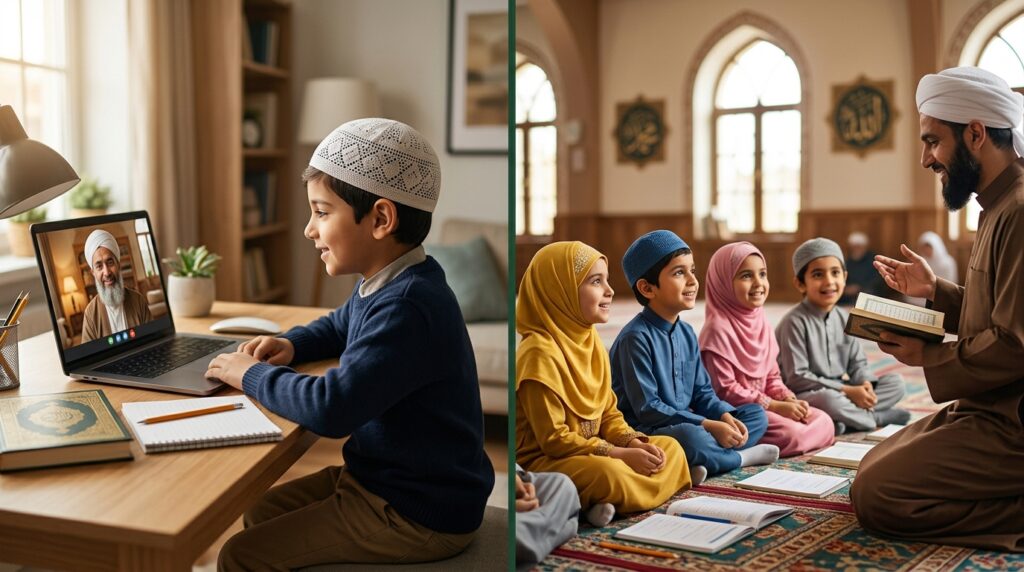
If your child currently attends a group Quran class at the local mosque, you have probably wondered at some point: is this actually working? Are they learning as much as they could?
And if you are considering online Quran classes — where one-on-one instruction is the standard model — you may be asking the opposite question: does it really matter that there is no group? Is the community element important? Is a child sitting alone with a teacher on a screen missing something?
Both questions deserve honest answers. This guide gives them — comparing both formats across every factor that actually matters for a child’s Quran education.
The Core Difference
Before the detailed comparison, one number explains the essential difference.
In a group Quran class with eight students and one teacher, each child gets approximately 3 to 5 minutes of active recitation time per hour. The rest of the time, they are waiting, listening to other students recite, or doing quiet revision.
In a one-on-one class, every minute belongs to your child. Every correction is directed at their specific error. Every explanation answers their specific confusion. Every piece of encouragement is for something they specifically did.
Tajweed is a practical skill. It is developed through recitation — and through immediate correction of each individual reciter’s specific mistakes. Those mistakes are not the same across eight children. They are individual.
That is the core of the difference. Everything below expands on it.
How Group Classes Work — And What They Cannot Do
Group Quran classes — typically found in mosques and community centres — usually involve one teacher managing between six and fifteen students simultaneously. The structure varies, but most follow one of two models:
Sequential recitation: Each student recites briefly in turn while the teacher listens and the others wait or do quiet revision. The teacher’s attention is divided across all students.
Simultaneous recitation: All students recite quietly at the same time, with the teacher circulating. The teacher catches errors as they pass by each student — briefly, without extended correction.
Both models have real value. They create community. Children see peers at similar stages and are motivated by shared learning. The mosque environment carries spiritual significance. And for many families — particularly in areas without accessible private tutors — the mosque class is the primary route to Quran education.
But both models have structural limitations that are not a reflection of the teacher’s ability — they are a reflection of arithmetic. One teacher. Many students. The individual attention available to each child is limited by the number of children in the room.
Specifically, group classes cannot:
- Provide consistent real-time correction of each child’s specific Tajweed errors. A teacher circulating among fifteen students catches some errors some of the time. They cannot catch all errors for all students all the time.
- Adjust pace individually. A child who is ready to move faster must wait. A child who needs more time feels the pressure of the group moving on. Both children are disadvantaged by the group’s average pace.
- Focus on one child’s weakness. If your child consistently struggles with a specific letter — Ain, for instance — a group teacher cannot spend fifteen minutes on that one sound without the rest of the class sitting idle.
How One-on-One Classes Work
In a one-on-one Quran class — whether in person or online — the teacher’s entire session is dedicated to one student.
This means:
- Every minute of recitation is heard and evaluated.
- Every error is caught — not just the ones that happen to occur when the teacher is nearby.
- The correction is specific: not “that was wrong” but “that letter should come from here — try it again.”
- The pace is set by the child: faster when they are ready, slower when they need more time, without any group dynamic creating artificial pressure.
- The teacher learns the student — their specific errors, their learning style, what encouragement works, what causes anxiety. Over weeks and months, this individual knowledge produces teaching that is genuinely tailored.
For children learning Tajweed — where the errors are individual and the correction must be immediate — this is not a luxury. It is the most effective learning structure available.
Factor-by-Factor Comparison
| Factor | One-on-One | Group |
|---|---|---|
| Recitation time per session | Full session | 3–5 minutes |
| Tajweed correction | Every error, every session | Some errors, some sessions |
| Pace | Tailored to the child | Set by the group average |
| Teacher’s knowledge of the child | Deep and individual | Limited across many students |
| Community and peers | Absent | Present |
| Shy or anxious children | Low pressure environment | Performance in front of peers |
| Cost | Mid-range | Often subsidised / lower |
| Progress speed | Significantly faster | Slower |
| Best for Tajweed accuracy | Yes | Depends on group size |

When Group Classes Can Work Well
Group classes are not without value — and there are specific situations where they work genuinely well:
As a community supplement. Children who have one-on-one instruction for their core Quran learning can benefit from attending a mosque group class as well — for the community element, the peer motivation, and the Islamic environment that group settings provide.
For advanced students. A child who has already developed strong Tajweed through individual instruction can participate in group recitation — where the correction demands are lower — without significant disadvantage.
For children who struggle with isolation. Some children genuinely do better in group settings — they are motivated by peers, they find one-on-one instruction intimidating, or they simply enjoy the social element of learning alongside others. For these children, a small, well-managed group with a qualified teacher can be effective.
Very small groups (2–3 students). A group of two or three with a qualified teacher is almost as effective as one-on-one, and preserves some of the peer dynamic. This is different from a class of twelve.
When One-on-One Is Clearly the Better Choice
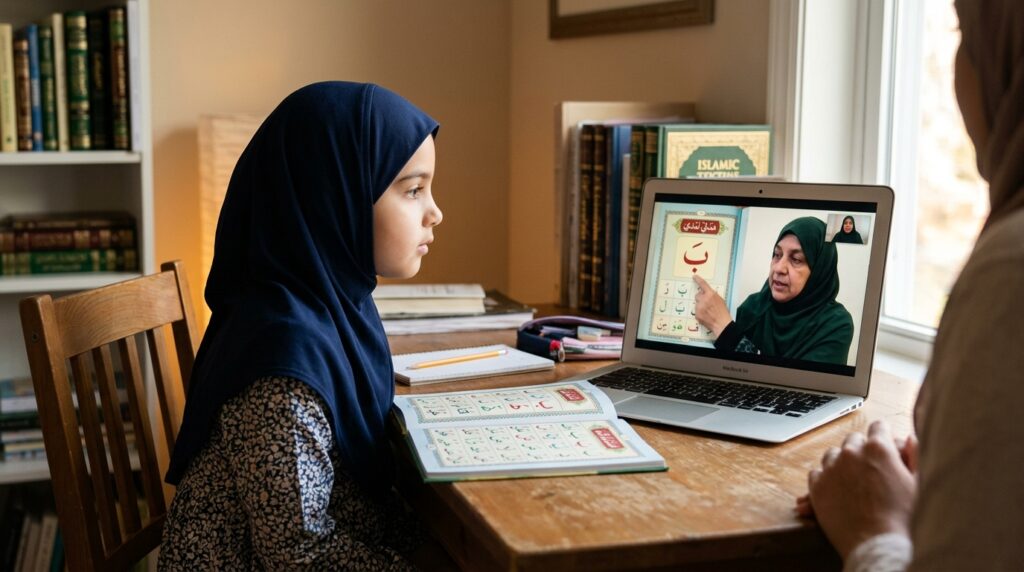
When your child is at the beginning stages. The foundation of Quran reading — Arabic letters, vowel marks, basic Tajweed — is best built through individual instruction. Errors embedded at this stage are the hardest to correct later. One-on-one teaching at the beginning stages is an investment in every stage that follows.
When your child has specific errors that are not being corrected. If your child has been in a group class for six months and is still making the same Tajweed errors, the group format is not providing the correction they need. Individual instruction addresses this directly.
When your child is shy or anxious. Group settings require a child to perform in front of peers. For naturally shy children, this creates anxiety that gets in the way of learning. A one-on-one class removes the performance element entirely — it is just the child and the teacher.
When Hifz (memorisation) is the goal. Hifz requires the teacher to hear every recitation, every day, and correct every error. This is structurally impossible in a group setting. Hifz requires one-on-one instruction — always.
When you want visibility into your child’s progress. In a one-on-one online class, you can sit nearby, watch a recorded session, or receive a progress report that tells you specifically what your child learned, what errors were corrected, and what to practise at home. Group classes rarely provide this level of information.
Can You Combine Both?
Yes — and many families do this successfully.
The most common combination: one-on-one online classes for structured Quran learning and Tajweed correction, plus the mosque group class for community, Islamic environment, and peer learning.
The online one-on-one sessions do the work that group classes structurally cannot — individual correction, tailored pace, specific error identification. The mosque class provides what a screen session cannot — community, the mosque environment, and the social fabric of Islamic learning.
When combining, it is worth communicating between the two teachers — so that what is being corrected in the one-on-one sessions is reinforced, rather than contradicted, in the group setting.
At Suffah Quran Academy, our teachers are happy to discuss how online sessions can complement your child’s existing mosque class — and how to make both work together effectively.
Book Your Child’s Free Trial Class
One session. No payment. Meet the teacher, experience the format, and see for yourself what individual attention produces in 30 minutes.
Book Free Trial →Frequently Asked Questions
For children learning to read and recite Quran, one-on-one instruction is significantly more effective. Tajweed requires the teacher to hear each child recite and correct their specific errors in real time. In a group of eight children, each child recites for approximately three minutes per hour. In a one-on-one class, every minute is focused on that child’s specific errors, pace, and level.
Mosque group classes are typically subsidised by the community and a single teacher manages multiple students simultaneously, which makes them affordable and accessible. The group format reflects traditional community teaching structures. However, affordability and tradition do not change the fact that individual correction time is significantly reduced in group settings.
Group classes can build community, create peer motivation, and provide a structured Islamic environment. They are better than no Quran education. However, for developing correct Tajweed and making consistent individual progress, one-on-one instruction consistently produces better outcomes because the teacher can focus entirely on one child’s specific errors and pace.
Subsidised mosque group classes are typically less expensive than one-on-one online sessions. However, one-on-one online classes are generally more affordable than private in-person tuition. The comparison is not just cost — it is cost relative to learning outcomes. A child who attends one-on-one classes twice a week typically progresses faster than one attending group classes three times a week.
Many families successfully combine both. The mosque class provides community and Islamic environment; the one-on-one online sessions provide individual correction and faster progress. If the mosque class is the child’s only Quran education and they are not progressing or developing correct Tajweed, adding or switching to one-on-one sessions is worth serious consideration.
The Bottom Line
If your goal is a child who can recite Quran with correct Tajweed, who progresses consistently, and whose specific errors are caught and corrected — one-on-one instruction is the format that delivers this.
Group classes have their place. They provide community, they are accessible, and for many families they are the entry point into Quran education. But for the work of individual correction — which is the core of Tajweed teaching — they are structurally limited by the number of students in the room.
At Suffah Quran Academy, every class is one-on-one. Every session is your child and their teacher — no waiting, no sharing, no group pace. The first session is completely free.
See the Difference For Yourself
Book a free trial class — no payment, no commitment. Your child meets the teacher, recites, receives correction, and you see exactly what individual attention looks like in practice.
Book Free Trial Class →![[Teacher Name] — Ijazah-certified Quran teacher at Suffah Quran Academy](https://suffahquran.com/wp-content/uploads/[teacher-photo].jpg)
Written by Ustaz Yusuf Khan
Ijazah-Certified Quran Teacher | Online Teaching Specialist
Ustaz Yusuf Khan has taught Quran in both group and one-on-one formats over 9 years, and has seen firsthand how the format affects a child’s progress, confidence, and relationship with the Quran. [He teaches exclusively one-on-one at Suffah Quran Academy.
Meet our teaching team →