This post contains affiliate links.
Estimated reading time: 12 minutes
Table of contents
- What Does Hifz ul Quran Mean?
- What Does Islamic Tradition Say About Hifz?
- What Hifz Actually Involves — The Reality
- How Long Does Hifz Take?
- What Age Is Best to Start Hifz?
- The Role of Parents in Hifz — What You Actually Need to Do
- Is an Online Hifz Programme Effective?
- What to Look for in a Hifz Programme
- Signs Your Child Is Ready for Hifz
- Frequently Asked Questions
- One Final Word for Parents
Of all the goals a Muslim family can set for their children, Hifz ul Quran is among the most profound.
To have your child memorise the entire Quran — to carry Allah’s words within them, completely, for the rest of their life — is a dream that many Muslim parents hold quietly, sometimes for years before they know how to pursue it.
This guide is for those parents.
It explains what Hifz actually is, what it demands from your child and from your family, how long it realistically takes, and what you need in place before you begin. It is written honestly — because Hifz is a serious commitment, and parents who begin with clear eyes are the ones whose children succeed.
What Does Hifz ul Quran Mean?
The word Hifz (حفظ) means preservation or memorisation in Arabic. Hifz ul Quran is the complete memorisation of the Quran — all 114 Surahs, 6,236 verses, 77,430 words.
A person who has completed Hifz is called a Hafiz (masculine) or Hafiza (feminine) — a title that carries deep honour in Muslim communities worldwide.
This is not partial memorisation of favourite Surahs. It is the entire Quran, committed to memory with correct recitation and Tajweed, preserved to a level where it can be recited accurately without looking at the text.
The preservation of the Quran through Huffaz (plural of Hafiz) is one of the most remarkable features of Islamic civilisation. For over 1,400 years, the Quran has been preserved not just in written form but in the hearts and minds of millions of people — an unbroken chain of memorisers stretching from the Companions of the Prophet (peace be upon him) to today.
When your child becomes a Hafiz, they join that chain.
What Does Islamic Tradition Say About Hifz?
The spiritual status of Hifz is rooted deeply in Hadith:
The Prophet Muhammad (peace be upon him) said: “The one who memorised the Quran shall come on the Day of Judgement and Quran shall say: O Lord, decorate him. So he will be adorned with a crown of dignity. Then it will say: O Lord, give him more. So he will be given a garment of dignity. Then it will say: O Lord, be pleased with him. So He will be pleased with him. Then it will be said to him: Recite and rise, and for every verse, you will be given an additional reward.” (Tirmidhi)
The Quran also intercedes on the Day of Judgement for the one who recited and memorised it. And the parent of a Hafiz is given a crown of light to wear in the hereafter — a mercy extended beyond the child to the family that made the memorisation possible.
These are not small matters. They are the reason Muslim families across the world — from Pakistan to the UK, from Egypt to Canada — pursue Hifz for their children with such dedication.
What Hifz Actually Involves — The Reality
It is important that parents understand what Hifz actually demands, because the romantic vision of a child effortlessly memorising the Quran is not the full picture.
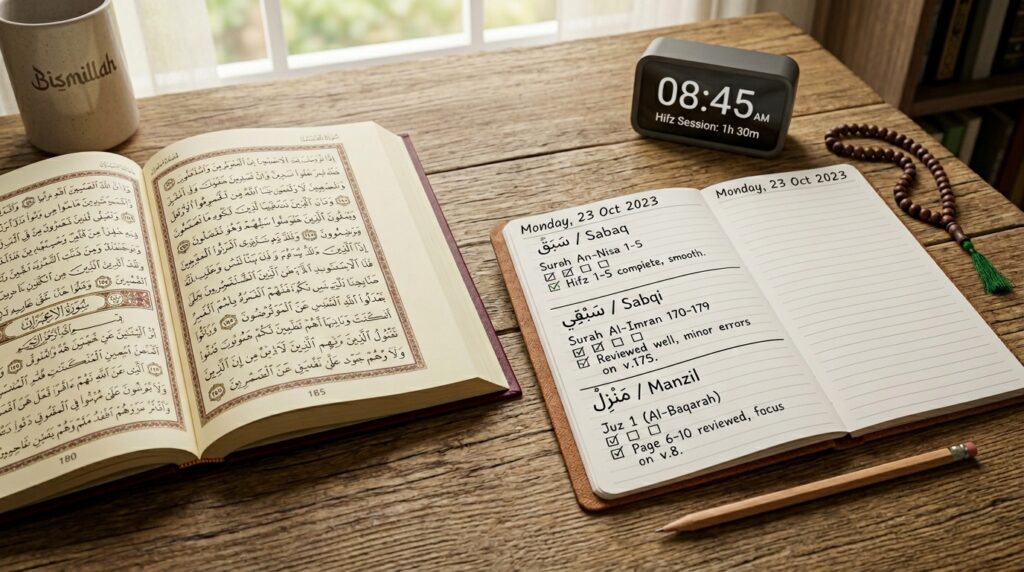
Hifz is a disciplined, daily practice over an extended period. It involves three types of work:
Sabaq (سبق) — New Lesson. Each day, the student memorises a new portion of the Quran — typically half a page to one page, depending on the student’s capacity and stage. This new portion is recited to the teacher until it is accurate.
Sabqi (سبقی) — Recent Revision. The student also revises the sections memorised in the recent past — typically the last seven to fifteen days of work. This ensures that new memorisation does not cause recently learned portions to be forgotten.
Manzil (منزل) — Long-Term Revision. The student revises older, longer-memorised portions — typically a full Juz (chapter) or more per day. This is what preserves the entire memorised Quran over time and prevents the early portions from fading as later portions are added.
This three-part daily structure — Sabaq, Sabqi, Manzil — is the backbone of every serious Hifz programme in the world. It is what separates Hifz that lasts a lifetime from Hifz that fades within months.
How Long Does Hifz Take?
This is one of the most common questions parents ask — and the most common source of unrealistic expectations.
The honest answer: most children complete Hifz in 3 to 6 years, with intensive daily programmes at the shorter end and part-time programmes at the longer end.
Here is a more detailed breakdown:
Full-time Hifz (5-6 days per week, 2-3 hours daily): Typical completion time: 2.5 to 4 years Best for: Children in dedicated Hifz schools or madrasas, or families who can structure the day significantly around Hifz
Part-time Hifz (3-4 sessions per week, 45-60 minutes daily): Typical completion time: 4 to 6 years Best for: Children who attend mainstream school alongside Hifz, or online Hifz programmes
Weekend-only Hifz: Typical completion time: 7 to 10 years Note: This pace is very slow and often results in excessive forgetting between sessions. Not generally recommended as the primary mode.
The biggest factor in completion time is not intelligence — it is daily consistency. A child who memorises a small amount every single day, without breaks, will almost always outpace a child who works intensively for a few days and then stops.
What Age Is Best to Start Hifz?
Most Hifz teachers recommend starting between 7 and 10 years old — after the child can read Arabic fluently with correct Tajweed.
Here is why that age range matters:
Before age 7: Most children have not yet established fluent Quran reading. Attempting Hifz before a child can read Arabic fluently creates serious difficulties — they cannot self-correct, they cannot verify their memorisation, and errors become embedded.
Ages 7-10: This is widely considered the ideal window. Memory is highly plastic at this age. Children who begin here typically progress at the fastest pace relative to effort, and their memorisation tends to be most durable.
Ages 10-14: Still an excellent time to begin. Progress is slightly slower than for younger children in terms of raw memorisation speed, but comprehension of what is being memorised is often better.
Ages 14 and above: Hifz remains possible and is pursued successfully by many teenagers and adults. The memory is somewhat less plastic than in childhood, but strong motivation and disciplined practice can produce excellent results.
The non-negotiable prerequisite — at any age — is fluent Quran reading with correct Tajweed. A child who cannot read Arabic correctly should not begin Hifz until this is established.
Read about our Madani Qaida course — the starting point for children who cannot yet read Arabic
The Role of Parents in Hifz — What You Actually Need to Do
Here is something that surprises many parents: the success of a child’s Hifz depends significantly on the parents — not just the teacher.
A Hifz teacher works with the child for one to three hours per day. But there are twenty-one to twenty-three other hours in the day. What happens in those hours determines whether the memorisation sticks.
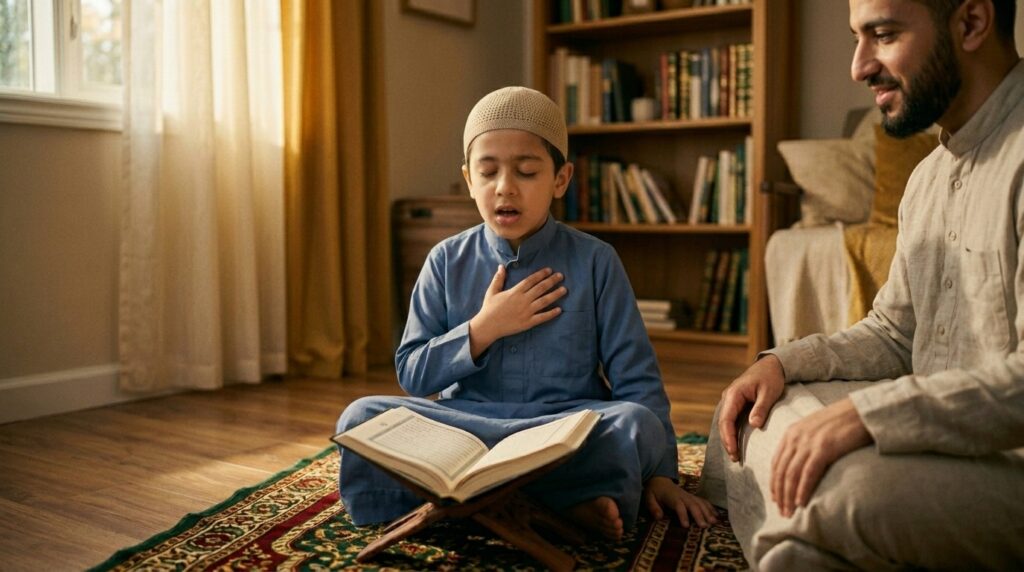
Daily listening is essential. The most important thing a parent can do is listen to their child recite the new memorisation every day — ideally twice: once after the class and once before the next class. You do not need to know the Quran yourself to do this. You simply need to listen while your child recites from memory, without looking at the text.
Create a revision routine. The Manzil (long-term revision) often falls on the child to manage. Building a routine — a specific time of day when the child sits and revises a Juz — prevents the older memorisation from fading.
Protect the memorisation time. Hifz children are often pulled in many directions — school activities, extracurriculars, family events. Parents who successfully bring their children through Hifz are typically those who treat the memorisation time as protected — non-negotiable on ordinary days.
Connect the child to the spiritual purpose. Children who understand why they are doing this — who have been told, simply and honestly, what it means to carry the Quran in their heart — are more resilient when the work gets hard. And it will get hard. Make the purpose part of the conversation.
Monitor for burnout. Hifz is a long journey. Children who are pushed too hard, shamed for forgetting, or given no time to simply be children, sometimes develop negative feelings toward the Quran that can last years. A sustainable pace is always better than a punishing one.
Is an Online Hifz Programme Effective?
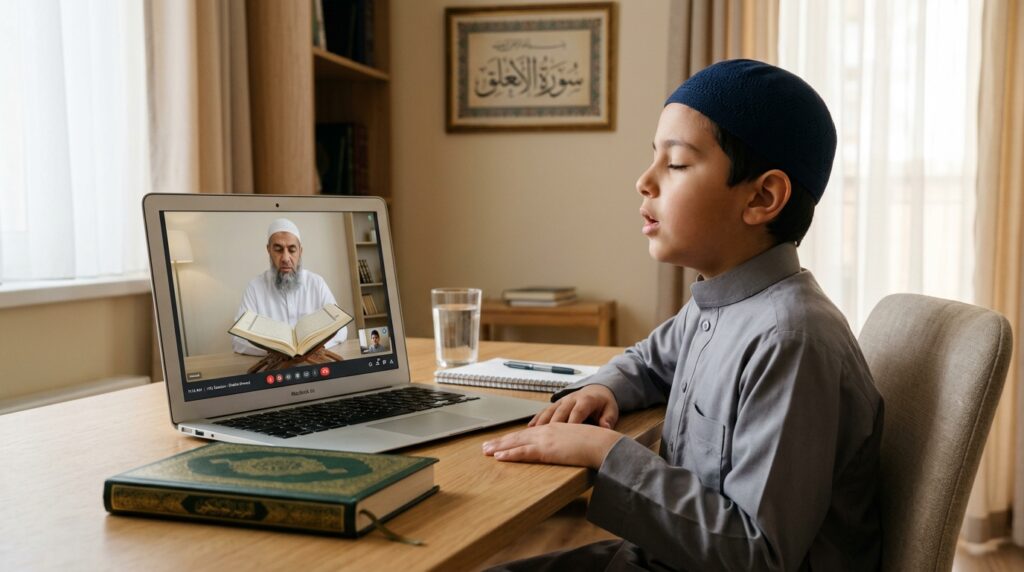
Online Hifz programmes are a relatively recent development — and the results have genuinely surprised many in the Islamic education world.
The concern parents typically have is whether the accountability and correction of an in-person teacher can be replicated online. The honest answer is: with the right structure, yes — largely.
What online Hifz can do well:
- Daily one-on-one sessions with a dedicated Hifz teacher
- Real-time correction of recitation via video call
- Flexible scheduling that works around mainstream school
- Access to qualified teachers regardless of where the family lives
- Recorded sessions that parents can review
What in-person Hifz has that online does not fully replicate:
- The immersive environment of a dedicated Hifz school
- Peer accountability among students at similar stages
- The physical presence of the teacher as a role model
For families in the UK, USA, Canada, and Australia where dedicated full-time Hifz schools are not always accessible or practical, a structured online Hifz programme — with daily sessions and strong parental involvement at home — produces real, lasting results.
The key is the teacher’s qualifications and the structure of the programme, not the medium of delivery.
Learn more about our Hifz ul Quran programme at Suffah Quran Academy
What to Look for in a Hifz Programme
Not all Hifz programmes are equal. Here is what separates programmes that produce lasting Huffaz from those that produce Hifz that fades:
A teacher with Hifz experience — not just Quran teaching experience. Teaching Hifz is a specific skill. A teacher who is excellent at teaching Quran reading is not necessarily equipped to manage the Sabaq, Sabqi, and Manzil system effectively. Ask specifically: “How many students have you taught through to completion of Hifz?”
Daily or near-daily sessions. Anything less than four sessions per week creates too much forgetting between classes for most children. Five to six sessions is ideal. If a programme offers only two or three sessions per week and claims your child will complete Hifz in three years, be cautious.
A structured revision system. The programme should explicitly use Sabaq, Sabqi, and Manzil — or an equivalent structured revision approach. If the teacher cannot explain their revision system, the memorisation will not last.
Progress tracking. Parents should receive regular updates on which portions have been memorised, which are in revision, and where the child is strong or weak.
Realistic expectations. A programme that promises Hifz completion in an unrealistic timeframe is optimising for enrollment, not for your child’s actual success.
Signs Your Child Is Ready for Hifz
Before beginning a Hifz programme, confirm your child meets these readiness criteria:
They can read Quran fluently with correct Tajweed. This is non-negotiable. A child who struggles with basic reading will not be able to memorise correctly.
They can sit and focus for 45-60 minutes. Hifz sessions for children are longer than basic Quran reading sessions. The child needs to be able to sustain focus.
They are emotionally willing. A child who is being forced into Hifz against their will may memorise for a time, but rarely completes the full journey. Ideally, the child understands and accepts what they are committing to.
The family is ready. Hifz is a family commitment, not just a child’s commitment. If the parents are not in a position to provide daily listening, routine, and support, the child’s chances of success diminish significantly.
Frequently Asked Questions
A Hafiz is someone who has memorised the entire Quran from memory. A Qari is someone who recites the Quran with mastery of Tajweed — often used to describe someone who recites beautifully and correctly. A Hafiz typically develops strong Qari skills as part of the Hifz process, but the two terms describe different achievements.
Yes — absolutely. Female Huffaz have an equally honoured status in Islam. Many of our teachers at Suffah are female scholars who completed their own Hifz and now teach it. For families who want their daughters to learn from a female teacher, this is important to confirm with any academy you consider.
Life circumstances change. A child who begins Hifz and then stops — due to school, health, family circumstances, or simply not being ready — has not failed. The portions they memorised remain a blessing, and they can return to Hifz at any point. Many Huffaz completed their memorisation in stages over years.
Understanding the meaning of what is being memorised is beneficial — it deepens the connection to the words and can aid in memorisation. But it is not a prerequisite. Many Huffaz memorise the Quran before learning Arabic comprehension, and many then pursue translation study later.
A teacher who has themselves completed Hifz, who uses the Sabaq-Sabqi-Manzil system, who has successfully guided other students to completion, and who understands how to pace a child without burning them out. At Suffah Quran Academy, our Hifz teachers have completed their own Hifz and have experience guiding children through the full journey.
Yes. Many adults pursue and complete Hifz — it takes longer than for young children but is absolutely achievable with consistency and a good teacher. The prerequisite of fluent Quran reading with Tajweed applies equally to adults. Read our guide on starting Quran learning as an adult (/how-to-start-learning-quran-as-an-adult/) as a starting point.
One Final Word for Parents
Hifz is not a competition. It is not a trophy to display or a milestone to achieve on a timeline set by comparison with other families.
It is a relationship between your child and the Book of Allah — a relationship that, if nurtured with patience and love, will last their entire life and extend its blessings to everyone around them.
The families whose children complete Hifz are not the families who pushed hardest. They are the families who stayed consistent, stayed patient, kept the spiritual purpose alive, and trusted a qualified teacher to guide the process.
If that is the kind of family you want to be — begin with a conversation.
Book a free trial class to discuss Hifz with one of our teachers → No payment. No commitment. Just an honest conversation about whether your child is ready, and what the journey would look like.