This post contains affiliate links.
Published: July 26, 2026 · ⏱ 8 min read · Ustaz Abdul Hannan, Arabic, Islamic Studies & Hadith Instructor
A Question Worth a Real Answer
Ask most Muslims why learning the Quran matters, and the answer is usually a version of “because we’re told to.” That’s true, but it’s an unsatisfying answer, and it’s not really what the sources say. The importance of learning Quran is spelled out with unusual specificity in both the Quran and the hadith — not as a vague obligation, but as something tied to rank, reward, and a particular kind of closeness that the Prophet Muhammad ﷺ described in concrete terms.
We wrote this the way we’d actually explain it to a parent or new adult student sitting across from us — with the specific texts, not just the sentiment.
What the Quran Itself Says About Learning It
One verse comes up more than any other in this conversation, and it’s repeated word for word four separate times in Surah Al-Qamar — a structural choice scholars point to as deliberate emphasis.
وَلَقَدْ يَسَّرْنَا الْقُرْآنَ لِلذِّكْرِ فَهَلْ مِن مُّدَّكِرٍ
Wa laqad yassarnal-Qur’āna liddhikri fahal mim muddakir
“And We have certainly made the Qur’an easy for remembrance, so is there any who will remember?”
Source — Surah Al-Qamar, 54:17 (repeated at 54:22, 54:32, and 54:40)
The claim here is specific: the Quran has been made accessible, not reserved for scholars or fluent Arabic speakers. Any difficulty a student feels early on is a normal part of learning any skill — not evidence that the Quran itself is out of reach for them.
Hadith on the Merit of Learning and Teaching Quran
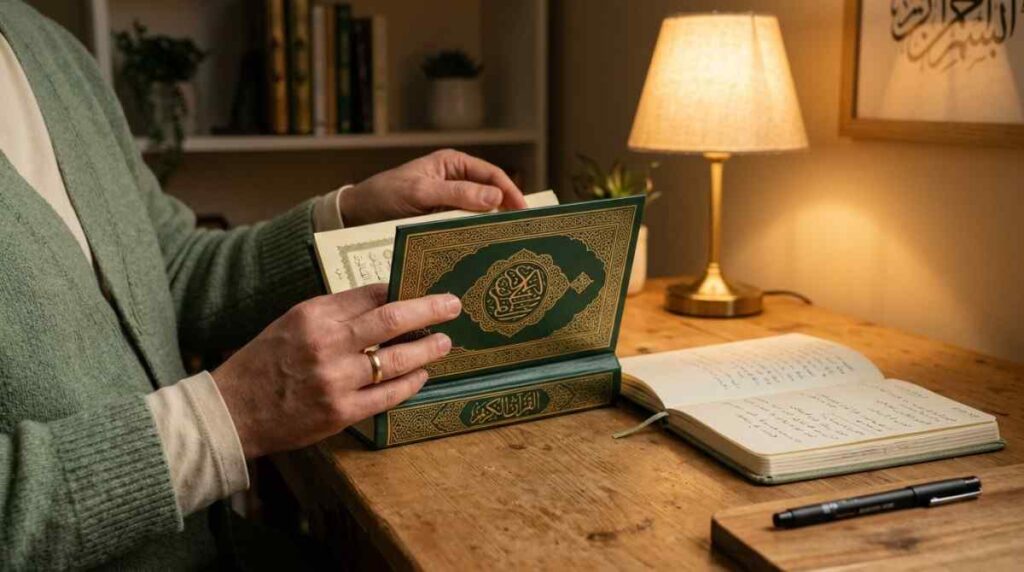
The most frequently cited hadith on this topic is short, direct, and worth sitting with rather than skimming past:
خَيْرُكُمْ مَنْ تَعَلَّمَ الْقُرْآنَ وَعَلَّمَهُ
Khayrukum man ta’allamal-Qur’āna wa ‘allamahu
“The best among you (Muslims) are those who learn the Qur’an and teach it.”
Source — Sahih al-Bukhari, 5027
Notice the hadith pairs two actions, not one — learning it and teaching it. It’s not describing the Quran as something to privately hold onto; the highest description of a Muslim’s relationship with it includes passing it on. This is part of why we structure classes at Suffah around students eventually being able to guide their own children or peers, not just complete a personal course.
A second hadith addresses reward directly, describing what’s said to a memorizer of the Quran on the Day of Judgment:
“It will be said to the companion of the Qur’an: Recite and rise (in rank), and recite as you used to recite in the world, for your rank will be at the last verse you recite.”
Source — Abu Dawud, 1464; Tirmidhi, 2914
Parents sometimes ask us whether partial memorization “counts” if a child doesn’t complete a full hifz program. This hadith is one of the texts we point to directly — the rank described is tied to how much a person actually recites and retains, not an all-or-nothing outcome.
Start Where You Are, Not Where You Think You Should Be
Whether you’re beginning letter recognition or picking Quran back up after years away, our free trial class starts with an honest assessment of where you stand.
Book Free Trial Class →The Dua Muslims Make When Beginning to Learn
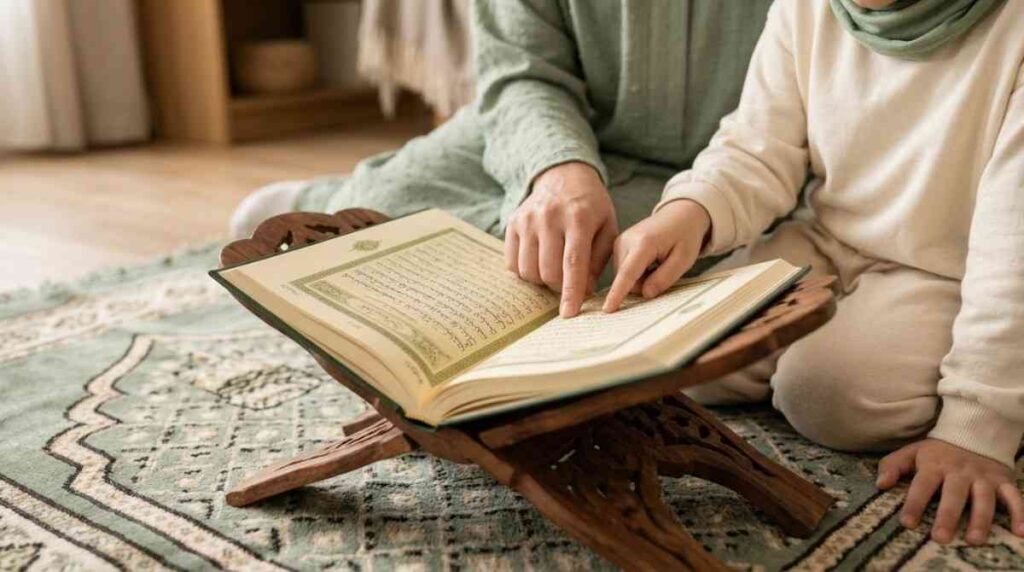
Alongside these texts, there’s a short dua many students and teachers recite before starting a Quran lesson, taken directly from the Quran itself:
رَبِّ زِدْنِي عِلْمًا
Rabbi zidni ‘ilma
“My Lord, increase me in knowledge.”
Source — Surah Ta-Ha, 20:114
We ask new students to say this before their first lesson, and many continue reciting it before every session afterward. It’s short enough to memorize immediately, and it reframes learning as something requested from Allah rather than purely a personal effort.
What Changes When You Actually Understand What You’re Reading
We’ve noticed a specific shift in students once they move from simply reciting Arabic accurately to understanding even a portion of what they’re reading. Recitation on its own carries real reward, but comprehension changes the experience of prayer, of daily recitation, and of moments where a specific verse becomes personally relevant rather than abstract.
This is why we don’t treat correct pronunciation as the finish line. It’s the necessary first stage — but students who continue toward meaning, even informally through translation and basic tafsir, describe a different relationship with the text than those who stop at fluent recitation alone.
Common Reasons People Delay Starting
We hear the same handful of reasons from adults who come to us years, sometimes decades, later than they’d wanted to start:
- “I feel like it’s too late for me.” Most adult students we teach are between 25 and 55, starting from zero.
- “I don’t have time for a full program.” Consistent short sessions matter more than long, irregular ones — we structure classes around 20 to 30 minutes, a few times a week.
- “I’m embarrassed I can’t read Arabic as an adult.” This is far more common than people assume, and it isn’t treated as unusual in our classes.
- “I want my child to learn first, then I’ll start.” Many parents end up learning alongside their children instead of waiting.
What “Learning” the Quran Actually Involves
“Learning Quran” isn’t one single skill — it typically layers in this order:
- Letter recognition and reading — usually through Qaida, building from individual letters to connected words.
- Fluency — reading full passages smoothly and correctly, without sounding out each word.
- Tajweed — applying correct pronunciation rules (makharij, noon sakinah, waqf, and more) so recitation matches the Prophet’s ﷺ own recitation as closely as possible.
- Memorization (optional but highly rewarded) — committing portions or the full Quran to memory, known as hifz.
- Meaning and reflection — understanding the content through translation and tafsir.
A student doesn’t need to complete every stage to benefit — each layer carries its own value. For a full picture of what memorization specifically involves, see our guide to what hifz-ul-Quran actually means.
Starting at Any Age
Neither the Quran nor the hadith attaches an age requirement to any of this. We’ve taught children as young as 5 and adults in their 60s, and the underlying process — letter recognition, then fluency, then tajweed — doesn’t change based on age, only the pacing does. If you’re deciding between a one-on-one or group setting for a child, our comparison of one-on-one versus group Quran classes walks through what to consider.
The texts above don’t describe learning Quran as a box to check once. They describe an ongoing relationship — recite, rise, recite again — that keeps building for as long as a person stays engaged with it. Wherever you’re starting from, the starting point itself isn’t the part that matters most.
Begin With a Free Trial Class
No pressure, no assumptions about where you should already be — just an honest first lesson to see what starting looks like for you.
Book Free Trial Class →Frequently Asked Questions
Learning the Quran is important because it is described in both the Quran and hadith as a source of guidance, reward, and closeness to Allah unlike any other act of learning. The Prophet Muhammad ﷺ described learning and teaching the Quran as the mark of the best among Muslims, and the Quran itself states it has been made easy to learn and remember for anyone who sincerely tries.
Surah Al-Qamar repeats the verse “And We have certainly made the Qur’an easy for remembrance, so is there any who will remember?” four times (54:17, 22, 32, 40), emphasizing that Allah has removed unnecessary difficulty from learning it. Separately, hadith describe specific rewards, including a companion of the Quran being told on the Day of Judgment to recite and rise in rank for every verse memorized (Abu Dawud, 1464; Tirmidhi, 2914).
A commonly recited dua when beginning or continuing Quran study is “Rabbi zidni ‘ilma” (رَبِّ زِدْنِي عِلْمًا), meaning “My Lord, increase me in knowledge,” from Surah Ta-Ha, 20:114. Many students and teachers recite it before starting a lesson.
Learning to read the Quran means mastering correct pronunciation and tajweed so the Arabic text is recited accurately. Understanding its meaning is a separate, additional layer — studying tafsir (explanation) and, ideally, learning enough Arabic to grasp the text directly rather than relying solely on translation. Both are valuable, and most students start with correct reading before moving into deeper meaning.
No. There is no hadith or Quranic text suggesting a cutoff age for beginning, and in our own classes we regularly teach adults starting from zero. The commitment required is different from a child’s, but the process — letter recognition, then fluency, then tajweed — is the same regardless of age.
The Prophet Muhammad ﷺ said, “The best among you (Muslims) are those who learn the Qur’an and teach it” (Sahih al-Bukhari, 5027). This hadith is widely cited as the foundational statement on the merit of both learning and teaching the Quran together, not learning alone.
Written by Ustaz Abdul Hannan
Arabic, Islamic Studies & Hadith Instructor · 7 Years Experience · Hadith, Arabic Grammar, Tafsir Basics
Ustaz Abdul Hannan teaches Arabic and Islamic studies alongside Quran recitation, believing students retain their motivation longer when they understand the textual basis for why they’re learning, not just the mechanics of how. He draws directly from hadith and tafsir in his teaching rather than relying on general encouragement.
Meet our teaching team →