

Published: September 28, 2026 · ⏱ 8 min read · Ustaz Ahmad Raza, Senior Quran & Tajweed Teacher
📖 In This Guide
- What Is Meem Sakinah?
- The Three Rules at a Glance
- Rule 1: Idgham Shafawi (Merging)
- Rule 2: Ikhfa Shafawi (Concealment)
- Rule 3: Izhar Shafawi (Clear Pronunciation)
- Meem Sakinah vs Noon Sakinah — Why the Names Are So Similar
- Common Mistakes Beginners Make
- How to Practice Meem Sakinah Properly
- FAQ
What Is Meem Sakinah?
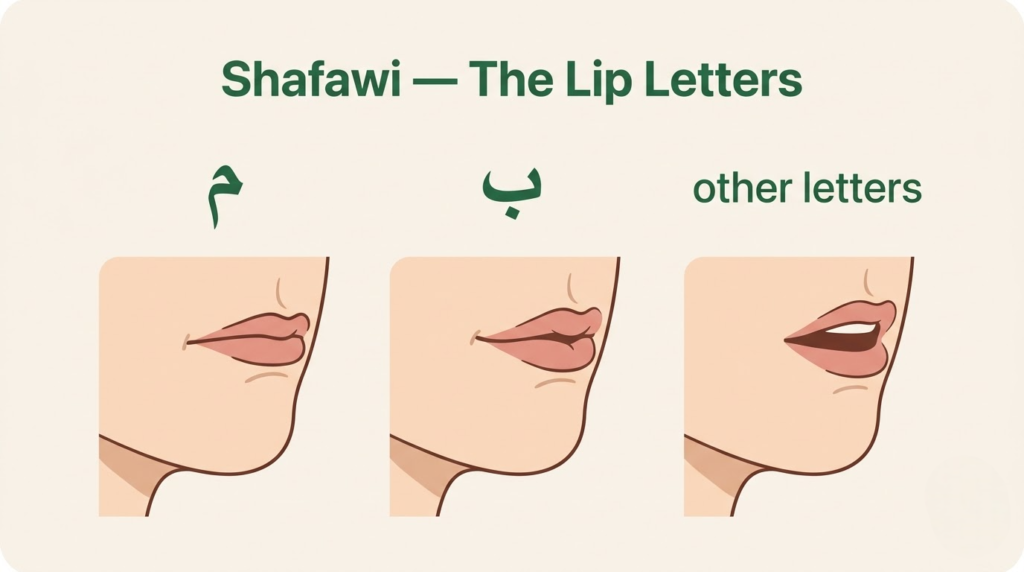
Meem Sakinah (مْ) is simply the letter Meem (م) carrying a sukoon — the small circle (ْ) that means the letter has no vowel of its own and makes no independent sound until it connects to whatever comes next. You’ll meet it constantly in the Qur’an, both in the middle of words (لَكُمْ مَا — lakum maa) and at the end of words followed immediately by the next word.
If you’ve already worked through our Noon Sakinah and Tanween rules, this guide will feel very familiar — Meem Sakinah is governed by the same logic (the letter immediately after it decides what happens), just with a shorter, simpler set of only three rules instead of four.
The Three Rules at a Glance
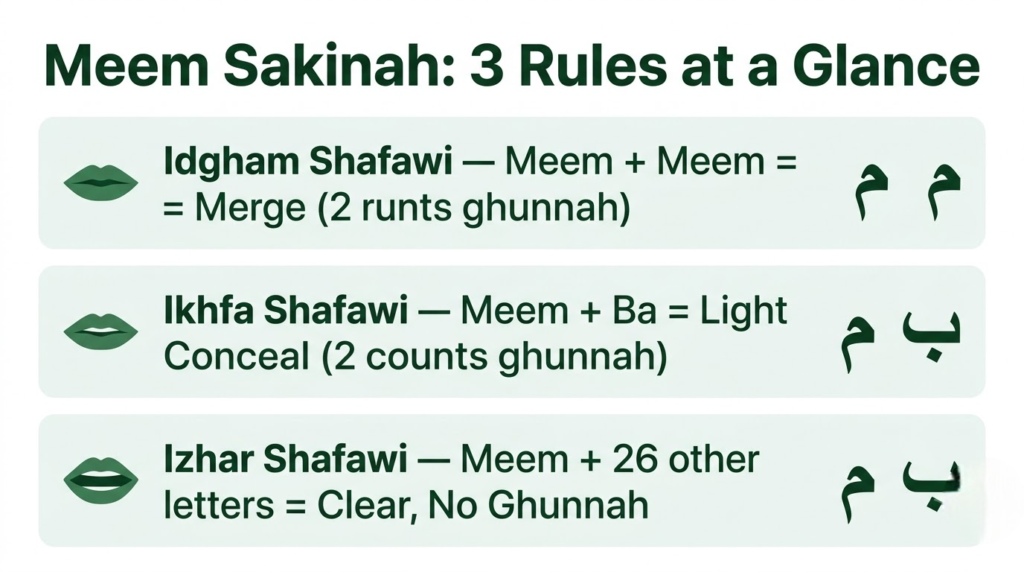
Which rule applies depends entirely on the single letter that follows the Meem Sakinah:
| Rule | Arabic | Triggered By | What Happens | Ghunnah |
|---|---|---|---|---|
| Idgham Shafawi | إدغام شفوي | Meem (م) only | Merges fully into the following Meem | ~2 counts |
| Ikhfa Shafawi | إخفاء شفوي | Ba (ب) only | Lightly concealed, lips barely closed | ~2 counts |
| Izhar Shafawi | إظهار شفوي | All 26 other letters | Pronounced clearly, no change | None |
Note the word “Shafawi” (شفوي) in all three names — it means “labial” or “of the lips,” because Meem itself is a labial letter (both lips close to produce it). This is exactly why the rule set is named differently from Noon Sakinah’s rules, even though the underlying logic — look at the next letter, apply the matching rule — is identical.
Rule 1: Idgham Shafawi (Merging)
Trigger: only when Meem Sakinah is followed by another Meem (م).
What happens: the two Meems merge into a single, emphasized Meem sound carried with ghunnah (the nasal resonance) for approximately 2 counts. There’s no separate “first Meem, second Meem” — they become one held sound.
- Example: لَكُمْ مَا (lakum maa) — the silent Meem at the end of لَكُمْ merges directly into the Meem that opens مَا, producing one held, nasalized Meem rather than two separate ones.
Rule 2: Ikhfa Shafawi (Concealment)
Trigger: only when Meem Sakinah is followed by Ba (ب) — and this is the only letter that triggers it.
What happens: the lips come together lightly for the Meem — not a firm, complete closure as in normal pronunciation — while a light nasal ghunnah is held for roughly 2 counts before releasing into the Ba. The Meem is present, just softened and partially concealed rather than fully articulated.
- Example: تَرْمِيهِمْ بِحِجَارَةٍ (tarmeehim bihijaaratin) — the Meem at the end of تَرْمِيهِمْ, followed directly by Ba, is lightly concealed with ghunnah rather than snapped shut.
Because Ba and Meem are both produced at the lips, this rule exists for the same reason Iqlaab exists in the Noon Sakinah rules — two lip-based sounds colliding directly would be awkward to pronounce cleanly without a brief, softened transition between them.
Rule 3: Izhar Shafawi (Clear Pronunciation)
Trigger: any of the remaining 26 Arabic letters — everything except Meem and Ba.
What happens: the Meem is pronounced fully and clearly, with the lips closing completely, and no ghunnah is added or prolonged. This is the default, “no special treatment needed” case — and because 26 of the 28 letters fall into it, Izhar Shafawi is by far the most common of the three rules in everyday recitation.
- Example: وَهُوَ السَّمِيعُ الْبَصِيرُ (wa huwa as-sameeu al-baseer) — and عَلَيْهِمْ وَعَلَى (alayhim wa alaa), where the Meem before Waw is pronounced cleanly with no merging or concealment.
Common mistake to watch for: some learners carry over a nasal sound before Waw or Fa out of habit from Ikhfa Shafawi. Izhar Shafawi should be clean — the lips close for the Meem and release immediately, with no lingering nasal tail.
Meem Sakinah vs Noon Sakinah — Why the Names Are So Similar
Students who learn Noon Sakinah first often ask whether Meem Sakinah is “the same thing, just with a different letter.” The underlying logic is the same — a silent letter, and a rule that depends on what follows it — but the two rule sets are genuinely different in scope:
- Noon Sakinah has four rules (Izhar, Idghaam, Iqlaab, Ikhfaa) spread across all 28 letters, because Noon is produced from the tip of the tongue and interacts differently with letters from every part of the mouth.
- Meem Sakinah has only three rules, because Meem is a labial letter — it only needs special treatment from the two other letters produced at or near the lips (Meem itself, and Ba). Every other letter gets the same clear treatment (Izhar Shafawi), which is why that one rule covers 26 letters at once instead of the 15 spread across Noon Sakinah’s Ikhfaa.
In short: fewer rules, but the same discipline of checking the next letter every time before deciding how to pronounce the Meem.
Common Mistakes Beginners Make
- Skipping the ghunnah in Idgham Shafawi. Because it’s “just merging two of the same letter,” beginners sometimes rush through it as a plain double-Meem instead of holding the nasal sound for its full 2 counts.
- Fully closing the lips in Ikhfa Shafawi. The concealment is meant to be light — a firm, complete Meem closure here is closer to Izhar than Ikhfa, and it’s one of the more frequently corrected habits in one-to-one classes.
- Adding unnecessary ghunnah to Izhar Shafawi. The opposite error — carrying a lingering nasal tail into a letter that should be pronounced cleanly, especially before Waw or Fa.
- Confusing it with Noon Sakinah’s Iqlaab. Both Ikhfa Shafawi and Iqlaab involve a Ba — but Iqlaab converts a Noon into a Meem sound, while Ikhfa Shafawi is about an existing Meem being softened before a Ba. They sound similar but start from different letters entirely.
This pairs closely with the labial letters covered in our Makharij al-Huroof Chart — Meem, Ba, and Waw are the three lip letters (Al-Shafataan), so getting their articulation point right makes all three Meem Sakinah rules easier to feel rather than just memorise.
How to Practice Meem Sakinah Properly
- Start with the trigger letters, not the sentences. Since there are only two special-case letters (Meem and Ba) instead of Noon Sakinah’s split across 22, Meem Sakinah is genuinely quicker to internalise — drill just those two triggers first.
- Practice the 2-count ghunnah out loud. Hold a nasal “mm” sound for a steady 2 counts before moving on, so your ear recognises the length before you apply it inside a verse.
- Hunt for one rule at a time in a short surah. Read through a familiar surah looking only for Meem-followed-by-Meem, then only for Meem-followed-by-Ba, before mixing all three rules together.
- Fold it into a daily routine. Our 15-Minute Daily Tajweed Practice Routine already includes a dedicated Meem Sakinah day alongside Noon Sakinah, Madd, and Waqf drills.
- Get live correction. The difference between a properly light Ikhfa Shafawi and an accidentally full Izhar is subtle enough that most learners need a teacher listening in real time to catch it consistently.
Once these three rules feel automatic, they combine naturally with everything in our complete Tajweed Rules Reference, and with the elongation timing covered in Madd Rules in Tajweed — many verses call on Meem Sakinah, Madd, and Noon Sakinah rules within the same few words.
FAQ
How many rules does Meem Sakinah have?
Three: Idgham Shafawi (merging, triggered only by Meem), Ikhfa Shafawi (concealment, triggered only by Ba), and Izhar Shafawi (clear pronunciation, triggered by every other letter).
What is the difference between Ikhfa Shafawi and Idgham Shafawi?
Idgham Shafawi fully merges the Meem Sakinah into a following Meem — the two become one held sound. Ikhfa Shafawi only lightly conceals the Meem before a following Ba — the Meem is softened, not merged away, and the lips only lightly touch rather than closing firmly.
Why is it called “Shafawi”?
Shafawi (شفوي) means “labial” — of the lips. All three Meem Sakinah rules are named this way because Meem itself is a labial letter, and the only two letters that change its treatment (Meem and Ba) are also produced at or near the lips.
Is Meem Sakinah easier to learn than Noon Sakinah?
Most students find it faster to memorise, since it has three rules instead of four and only two special trigger letters (Meem and Ba) instead of Noon Sakinah’s letters spread across every articulation point. The two rule sets are usually taught back-to-back for exactly this reason.
Does Meem Sakinah apply the same way in every word?
Yes — unlike Noon Sakinah’s same-word exception for Idghaam, Meem Sakinah’s rules apply consistently whenever the trigger letter follows, whether the Meem and the next letter are in the same word or the Meem ends one word and the next word begins with Meem or Ba.
Want a teacher to listen to your Meem Sakinah rules live and correct the ghunnah length in real time? Book a free trial Tajweed class with Suffah Quran Academy and get feedback on your recitation from day one.