
This post contains affiliate links.
Published: July 7, 2026 · ⏱ 10 min read · Ustaz Zaid Farooqui, Online Quran Tutor
A parent searching for an online Quran academy for their child today faces a genuinely difficult problem: there are hundreds of options, most have professional-looking websites, all claim qualified teachers and structured programs, and almost none of them make it easy to verify those claims before you hand over payment and your child’s time.
This guide is written from the inside — from the perspective of someone who has seen what distinguishes academies parents stay with from ones they leave after two months. It covers what actually matters, what reviews reveal when you read them carefully, and the specific red flags that are consistently easy to miss until it’s too late.
Why Choosing an Online Quran Academy Is Harder Than It Should Be
The core problem is that quality in Quran education is genuinely hard to assess from the outside. Unlike hiring a maths tutor — where a few test questions reveal competence quickly — evaluating a Quran teacher requires knowing enough about Tajweed and correct recitation to identify errors, which most parents don’t have unless they’ve had formal training themselves.
This information gap is what unqualified or low-quality academies rely on. A confident-sounding website, generic testimonials, and a low introductory price can sustain enrollment long enough for parents to realize the quality isn’t there — by which time the child has already developed incorrect habits that a better teacher will need to spend time undoing.
What to Actually Look For
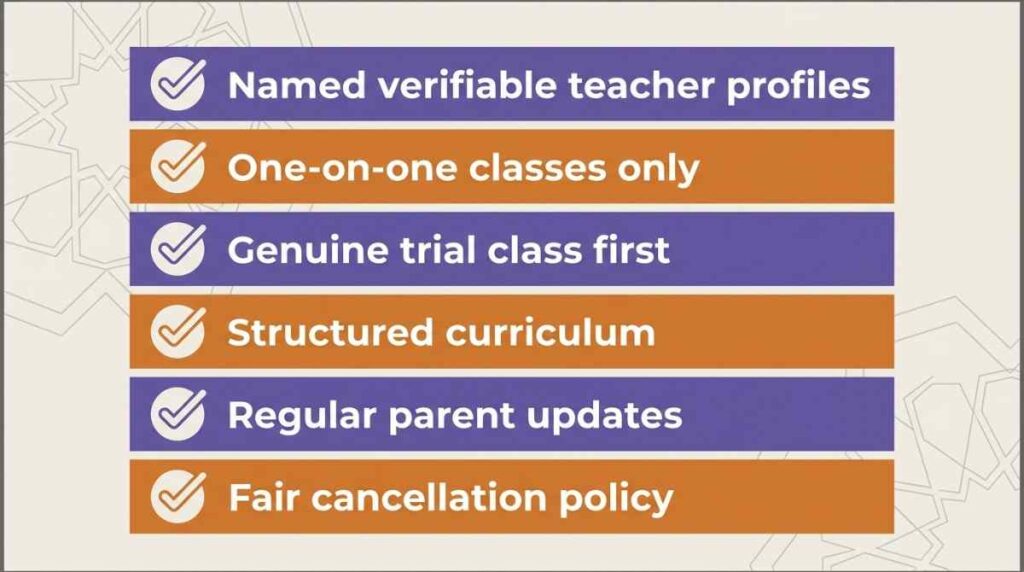
- Named, verifiable teacher profiles. Not “our team of 50+ certified teachers” — actual named teachers with stated qualifications that can be asked about directly.
- One-on-one classes, not group sessions. Tajweed correction requires a teacher to hear your child specifically. A group of five students on a Zoom call cannot receive the same quality of pronunciation feedback as a solo student.
- A genuine trial class before any payment. Not a demo video — a real live class with the actual teacher your child will be assigned to.
- Structured curriculum with clear progression stages. Noorani Qaida → Nazra → Tajweed → Hifz is a logical sequence. An academy that cannot describe its own curriculum in specific terms has probably not thought carefully about it.
- Regular parent progress updates. Monthly reports, weekly check-ins, or accessible teacher communication — any structured method of keeping parents informed about their child’s actual progress.
- A clear, fair cancellation and refund policy. Academies confident in their quality don’t need to trap parents in long-term payment commitments with no exit option.
Teacher Credentials: The Non-Negotiable
Every serious Quran academy should be able to answer these two questions about every teacher on its roster, immediately and specifically:
- Where did this teacher receive their Quran education? — An institution, a named madrasah, or a qualified scholar whose own credentials are traceable. “She is highly qualified” is not an answer.
- Has this teacher’s recitation been formally verified? — An Ijazah is the strongest form of verification, but at minimum there should be a specific teacher or institution that has checked and certified the recitation.
If an academy cannot answer both questions specifically for your child’s assigned teacher, that is not a minor gap — it is the central question of whether the person correcting your child’s Quran recitation is actually qualified to do so.
The Trial Class Test
A trial class is the most reliable evaluation tool available to a parent — more useful than reviews, more reliable than credentials on paper, and more informative than any sales conversation with an enrollment advisor.
During the trial class, watch for these specifically:
- Does the teacher correct mistakes in real time, or let errors pass? A teacher who doesn’t correct during a trial — when they’re at their best — will not correct consistently in regular classes either.
- Does the teacher explain what was wrong and how to fix it, or just repeat the correct version? Real Tajweed teaching involves identifying which rule is being broken, not just modelling correct sound.
- Does the lesson have a clear structure? Even a trial class should show a beginning, some progression, and an end — not just open-ended recitation with occasional comments.
- How does your child feel at the end? A child who leaves a trial class slightly excited, or at least comfortable, is giving you signal. A child who seems anxious or flat is giving you different signal.
Red Flags That Are Easy to Miss
⚠️ Watch For These Before You Enroll
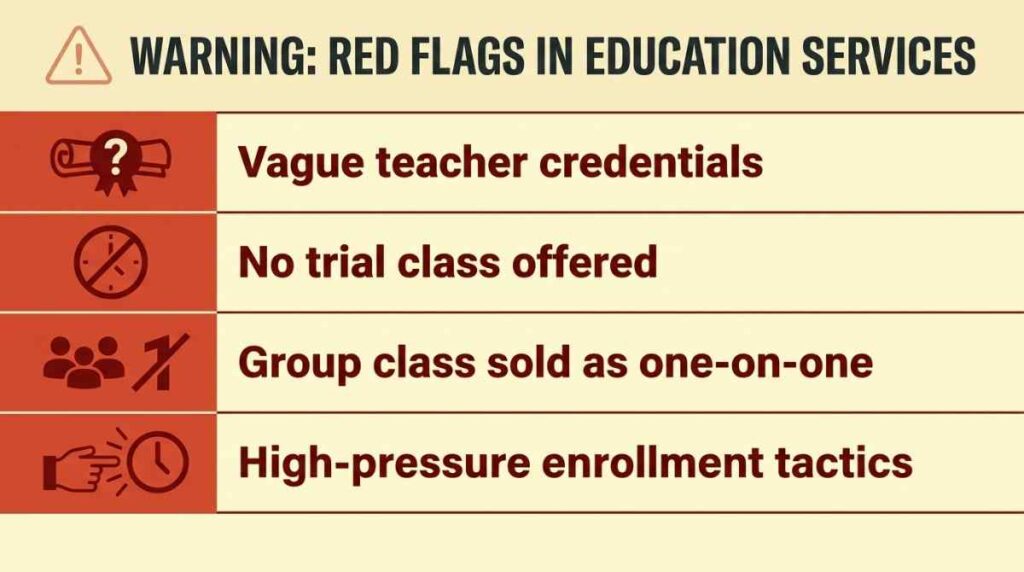
- Vague teacher profiles — “Certified and experienced” without naming the certification or the institution.
- No trial class option — Any academy that asks for payment before allowing a real live trial class with the actual assigned teacher.
- Extremely low pricing — Teachers willing to work for very low rates are often not the ones with verified Ijazah credentials and years of teaching experience.
- Group classes sold as one-on-one — Read the small print. Some academies advertise “personalized learning” while actually running three-to-five student group classes.
- High-pressure enrollment calls — “This price is only available today” from an online Quran academy is a sales tactic, not a genuine limitation.
- No structured parent communication — If the academy has no stated system for keeping parents updated on progress, assume they don’t have one.
- Frequent teacher changes — Consistency matters enormously in Quran learning. An academy with high teacher turnover transfers that instability directly to your child’s learning.
What Real Parent Reviews Actually Reveal
Generic five-star reviews that say “excellent academy, highly recommend” tell you almost nothing. The reviews worth reading are specific — they mention the teacher by name, describe what changed in the child’s recitation, and sometimes mention how problems were handled when they occurred.
When reading reviews for any academy, look specifically for:
- How long the reviewer has been with the academy. A three-month positive review is much weaker signal than a two-year review. Honeymoon period satisfaction is easy to generate — sustained long-term enrollment is harder to fake.
- What specifically improved. “My daughter’s Tajweed improved significantly” is more credible than “great teachers.” What improved? Her makharij? Her ghunnah? Her waqf? Specific details suggest the reviewer is real and paying attention.
- Whether negative reviews were responded to professionally. Every academy gets occasional negative feedback. How they respond to it publicly reveals more about their actual culture than the positive reviews do.
- Pattern of complaints. Multiple reviews mentioning teacher changes, schedule disruptions, or unresponsive management in the same time period suggest a systemic issue, not one-off incidents.
Questions to Ask Before You Enroll
- “What are the specific qualifications of the teacher who will be assigned to my child?”
- “Is this class one-on-one or shared with other students?”
- “How will I receive updates on my child’s progress, and how often?”
- “What is your policy if we need to change teachers?”
- “What is your cancellation and refund policy?”
- “Can I sit in on a class after enrollment, not just the trial?”
A well-run academy answers all six without hesitation. Evasiveness on any of them — particularly teacher qualifications and cancellation policy — is worth treating as decisive information.
See What a Trustworthy Quran Academy Looks Like
Book a free trial class at Suffah Quran Academy — meet your child’s assigned teacher, ask every question on this list, and decide with full information.
Book Free Trial Class →Safeguarding: Video Calls, Recordings, and Written Policy
Beyond teacher quality, there is a second category of question worth asking before you enrol — and it gets skipped far more often than it should: how the academy protects your child during the class itself.<\/p>
- Every session should be video, not audio-only.<\/strong> Video call is the baseline standard for child safety in online learning — it gives both you and the academy visual accountability that a voice call cannot. If an academy suggests audio-only is acceptable, or that the camera can be turned off, that is a gap worth asking about directly.<\/li>
- You should be welcome in the room at any time, without notice.<\/strong> A teacher with nothing to hide welcomes a parent sitting nearby or stepping into view mid-class. If an academy asks you to schedule your presence in advance, treat that as a signal worth exploring further.<\/li>
- Sessions should be recorded and available to you on request.<\/strong> A recording lets you review exactly what happened in a class — it protects your child and gives the teacher accountability at the same time. \”We don’t record for privacy reasons\” is not a satisfying answer; recording and privacy are not in conflict.<\/li>
- There should be a written safeguarding policy — not just a verbal assurance.<\/strong> A specific, written policy covering what teachers can and cannot do, how a concern gets reported, and what happens next is the structure that makes a parent’s concern taken seriously. \”We take safety very seriously\” without a policy behind it is not the same thing.<\/li> <\/ul>
At Suffah, every class is video call, parents are welcome at any time with no notice required, sessions are recorded and available on request, and our safeguarding policy is written and available to any parent who asks for it before enrolling.<\/p>
Frequently Asked Questions
What should I look for when choosing an online Quran academy?Look for verified teacher credentials (Ijazah or formal certification), a structured one-on-one teaching format, a genuine trial class before commitment, clear and consistent scheduling, and transparent parent communication. Avoid academies that cannot name their teachers’ qualifications specifically or that push enrollment without a trial period.
How do I know if an online Quran academy is trustworthy?A trustworthy academy will show you real teacher profiles with verifiable credentials, offer a genuine trial class with no pressure to enroll immediately, give you direct access to your child’s assigned teacher, and provide regular progress updates. Vague teacher profiles, no trial option, and pressure to pay upfront are all warning signs.
Are online Quran classes as effective as in-person classes for children?Online Quran classes can be equally effective when they are one-on-one, taught by a qualified teacher with verified credentials, held on a consistent schedule, and include regular live pronunciation correction. Group video calls or pre-recorded lessons are far less effective than live one-on-one sessions.
What are red flags to avoid when choosing a Quran academy?Key red flags include: vague or unverifiable teacher credentials, no option for a trial class, group classes presented as one-on-one, no regular parent progress updates, extremely low pricing that suggests underqualified teachers, high-pressure sales tactics before enrollment, and no clear refund or cancellation policy.
Final Thoughts
The right online Quran academy is not necessarily the most polished website or the most affordable monthly rate — it is the one whose teachers are verifiably qualified, whose classes are genuinely one-on-one, and whose communication with parents is honest enough to tell you when your child is falling behind rather than only when things are going well.
Use this guide as a filter before you commit. The questions above take ten minutes to ask and can save months of your child’s learning time. If you want to see what our approach looks like in practice, our one-on-one vs group classes guide explains exactly why we teach the way we do — and our free trial class lets you verify it directly.
Ready to See the Difference Firsthand?
Book a free trial class — no commitment, no pressure, just a real class with a real qualified teacher.
Claim Your Free Trial →
Written by Ustaz Zaid Farooqui
Online Quran Tutor · 7 Years Experience · Online Teaching, Qaida, Beginner Quran
Ustaz Zaid Farooqui has been teaching Quran online for seven years and has seen — from the inside — what makes online Quran education work and what makes it fail. He believes parents deserve an honest picture of what to look for, not just a sales pitch dressed as advice.
Meet our teaching team → - You should be welcome in the room at any time, without notice.<\/strong> A teacher with nothing to hide welcomes a parent sitting nearby or stepping into view mid-class. If an academy asks you to schedule your presence in advance, treat that as a signal worth exploring further.<\/li>