

Published: July 20, 2026 · ⏱ 8 min read · Ustaz Imran Qadri, Tajweed & Makharij Instructor
Quick Recap: The 4 Rules at a Glance
These noon sakinah practice exercises assume you already understand the theory behind the 4 rules. If you need the full explanation first, our existing guide to noon sakinah and tanween rules covers the definitions in depth — this article picks up from there and focuses entirely on drilling the sounds until they’re automatic.
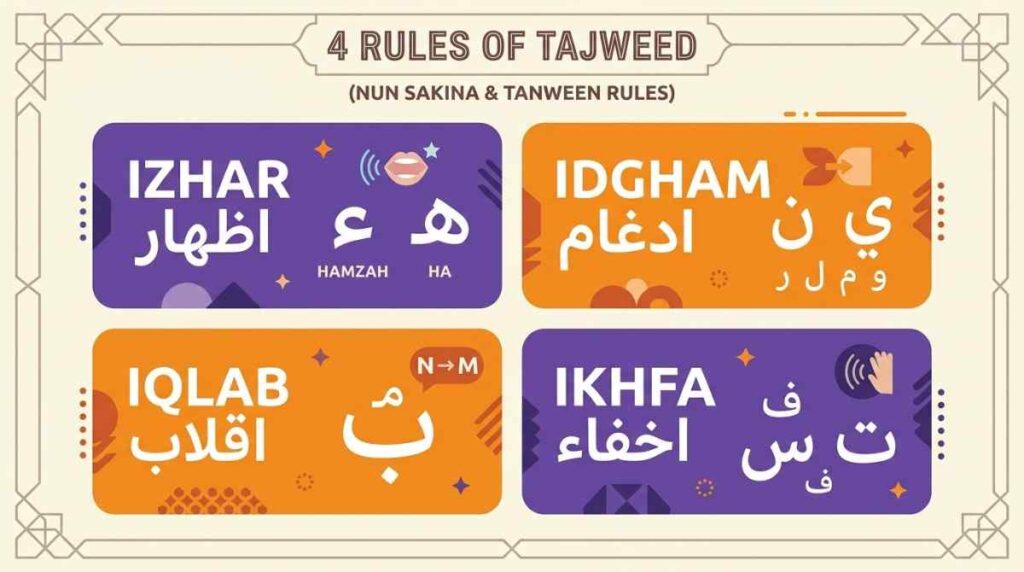
The 4 Rules, Trigger Letters, and Sound
| Rule | Trigger Letters | What Happens |
|---|---|---|
| Izhar (إظهار) | ء ه ع ح غ خ | Noon sound pronounced clearly, no change |
| Idgham (إدغام) | ي ن م و ل ر | Noon sound merges into the next letter |
| Iqlab (إقلاب) | ب | Noon sound converts to a light meem |
| Ikhfa (إخفاء) | ص ذ ث ك ج ش ق س د ط ز ف ت ض ظ | Noon sound hidden with a nasal hum |
Why Practice Exercises Matter More Than Definitions
We see this pattern constantly: a student can recite the 4 rules perfectly when asked, and then apply none of them correctly while actually reading. Knowing that ikhfa exists is not the same as producing the hidden nasal sound automatically, mid-sentence, without stopping to think about it. That gap only closes through repetition.
The Principle
Drill one rule in isolation until it’s automatic before mixing it with the others. Combining all 4 rules too early is the single biggest reason students plateau on this topic.
Izhar Practice: Clear Release Drill Words
Izhar is usually the easiest rule to internalize, because nothing changes — the noon sound is simply pronounced clearly and fully before one of the six throat letters. Practice by isolating the noon-plus-throat-letter combination and repeating it 10 to 15 times before reading it inside a full word.
Drill combinations: مَنْ آمَنَ (man āmana), يَنْهَوْنَ (yanhawna), مِنْ عِلْمٍ (min ‘ilmin), عَذَابٌ أَلِيمٌ (tanween + hamza). Focus on a crisp, complete noon sound with no blending into the next letter at all.
Idgham Practice: With and Without Ghunnah
Idgham splits into two distinct sounds, and treating them the same is one of the most common practice mistakes we correct:
- Idgham with ghunnah (before ي ن م و) — the noon merges into the next letter while holding a 2-count nasal hum. Drill words: مَنْ يَقُولُ (man yaqūlu), مِنْ نِعْمَةٍ (min ni’matin).
- Idgham without ghunnah (before ل ر only) — a complete merge with no nasal sound at all. Drill words: مِنْ رَبِّهِمْ (mir-rabbihim), هُدًى لِلْمُتَّقِينَ (hudal-lil-muttaqīn).
Practice the two categories on separate days at first. Mixing them too early makes it harder to hear the difference between “hold the hum” and “merge with no hum at all.”
Practice Alone Only Gets You So Far
Ghunnah length and merge quality are hard to self-judge. Book a free trial and we’ll listen to your idgham and ikhfa application directly.
Book Free Trial Class →Iqlab Practice: The One-Letter Rule
Iqlab has only one trigger letter — ب — which makes it the easiest to spot but one of the trickier ones to execute smoothly, since it requires converting the noon sound into a light meem sound with ghunnah before actually pronouncing the ba.
Drill words: مِنْ بَعْدِ (mim ba’di — noon becomes meem), سَمِيعٌ بَصِيرٌ (samī’um baṣīr), أَنْبِئْهُمْ (ambi’hum). Focus on the lips closing for the meem sound before the ba is released, with a light 2-count nasal hum held through the transition.
Ikhfa Practice: The Largest Rule Group
With 15 trigger letters, ikhfa takes the longest to feel natural. The noon sound is neither fully pronounced (like izhar) nor fully merged (like idgham) — it’s held in a hidden, nasalized position for roughly 2 counts, with the mouth already shaping toward the next letter.
Because 15 letters is a lot to drill evenly, we break ikhfa into 3 smaller batches of 5 letters each per week rather than attempting all of them at once. Sample drill words: مِنْ قَبْلُ (min qablu), أَنْتُمْ (antum), عَنْ صَلَاتِهِمْ (an ṣalātihim). Record yourself and check that the noon never fully disappears or fully sounds out — the hidden middle ground is the entire skill.
A 10-Minute Daily Practice Routine
- Minutes 1–3: Warm up with 10 to 15 repetitions of one rule’s drill words in isolation, no vowels beyond what’s needed.
- Minutes 4–6: Read 3 to 5 full ayat that contain that rule multiple times, applying it inside real recitation rather than isolated words.
- Minutes 7–8: Record a short clip on your phone and listen back — most self-correction happens here, not while actually reciting.
- Minutes 9–10: Note any word where you hesitated or got it wrong, and bring it to your next class for a teacher to check live.
Common Mistakes During Practice
⚠️ Watch For These While Drilling
- Practicing all 4 rules together too soon. This blurs the distinct sounds instead of building clean muscle memory for each one.
- Dropping ghunnah length inconsistently. The 2-count hum in idgham with ghunnah and ikhfa often shortens under pressure — count it out loud at first.
- Only practicing isolated words, never full ayat. Rules behave differently once surrounded by other words and normal recitation pace.
- Skipping the recording step. Almost no one can accurately judge their own ikhfa or ghunnah quality in real time without listening back.
These 4 rules sit on top of solid makharij — if throat and tongue letters aren’t yet accurate, ikhfa and idgham will be inconsistent no matter how much you drill. Our complete makharij al huroof chart is worth reviewing first if letter pronunciation still feels shaky. And for the full theory behind these 4 rules before you start drilling, see our tajweed rules list for beginners.
Most students who commit to this kind of daily, isolated drilling notice the difference within a few weeks — not because the rules got easier, but because the sounds stopped requiring conscious thought.
Get Your Noon Sakinah Application Checked
Book a free trial class and a teacher will listen to your izhar, idgham, iqlab, and ikhfa live — and tell you exactly where to focus next.
Book Free Trial Class →Frequently Asked Questions
Noon sakinah is a noon letter (ن) with a sukoon, meaning it carries no vowel and appears as a fixed letter within or at the end of a word. Tanween is a double vowel mark (ً ٌ ٍ) at the end of a word that produces a similar ن sound without an actual noon letter being written. Both trigger the exact same four rules — izhar, idgham, iqlab, and ikhfa — based on the letter that follows.
Fifteen letters trigger ikhfa, making it the largest of the four rule groups. They are commonly grouped for memorization as: ص ذ ث ك ج ش ق س د ط ز ف ت ض ظ.
Idgham with ghunnah applies before the four letters ي ن م و and merges the noon sound into the next letter while holding a 2-count nasal hum. Idgham without ghunnah applies only before ل and ر, merging completely into the next letter with no nasal sound held at all.
Iqlab applies exclusively before the letter ب (ba), where the noon sakinah or tanween sound is physically converted into a light meem sound with ghunnah before pronouncing the ba. This is a unique conversion rule rather than a merging or hiding rule, which is why it stands alone as a single-letter category.
Pick one rule at a time, isolate 8 to 10 drill words that use it, and repeat each word 10 to 15 times focusing only on that rule’s sound — clear release for izhar, merging for idgham, meem conversion for iqlab, or the held nasal hum for ikhfa. Once a rule feels automatic in isolation, apply it inside full ayat with a teacher checking your application.
Most students can recognize and name all 4 rules within 1 to 2 weeks. Applying them smoothly and automatically during live recitation, without pausing to think, typically takes 6 to 10 weeks of regular guided practice, since ikhfa in particular takes longer to feel natural given its 15 different trigger letters.

Written by Ustaz Imran Qadri
Tajweed & Makharij Instructor · 9 Years Experience · Makharij, Sifaat, Beginner Correction
Ustaz Imran builds every noon sakinah unit around isolated drilling before full-ayah application, having found that students who skip the isolation step tend to blur the four rules together for months longer than necessary. He works closely with beginner and intermediate students on turning tajweed theory into automatic habit.
Meet our teaching team →