
This post contains affiliate links.
Published: November 3, 2026 · ⏱ 8 min read · Ustaz Ahmad Raza, Senior Quran & Tajweed Teacher
📖 In This Guide
- What Is Izhar (Izhar Halqi) in Tajweed?
- Why Izhar Is the Baseline of the Four Noon Sakinah Rules
- The Six Throat Letters (Huroof al-Halq)
- Why These Six Letters, Specifically
- How to Pronounce Izhar in Tajweed Correctly
- A Traditional Mnemonic for the Letters
- Izhar in Real Ayahs (With References)
- Common Mistakes Beginners Make
- A 30-Second Self-Test
- FAQ
What Is Izhar (Izhar Halqi) in Tajweed?
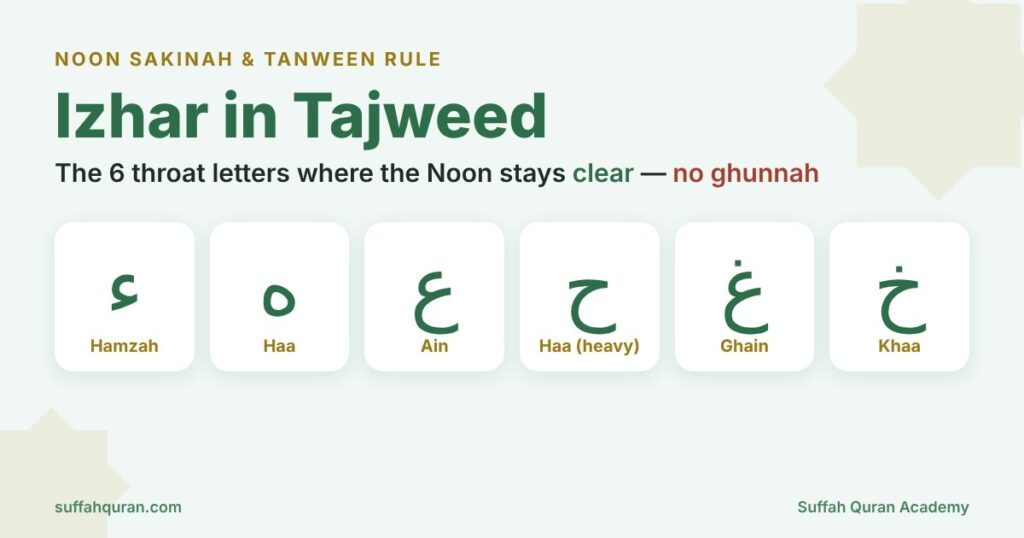
Izhar (إظهار) literally means “to make clear” or “to show plainly.” Izhar in Tajweed is the rule that applies when Noon Sakinah (نْ) or Tanween is followed by one of six specific letters pronounced from the throat. Unlike the other three Noon Sakinah outcomes, nothing is merged, concealed, or converted — the Noon or Tanween is simply pronounced fully and clearly, exactly as it’s written, with no nasal hum carried into the next letter.
Because the trigger letters all come from the throat (halq in Arabic), this specific case is called Izhar Halqi — “throat clarity” — to distinguish it from a second form (Izhar Shafawi, which concerns Meem Sakinah and is covered in our Meem Sakinah Rules guide). This article is about Izhar Halqi specifically, since that’s what “Izhar” almost always means when discussed alongside Idgham, Iqlab, and Ikhfa.
This is one of the four outcomes covered in our full Noon Sakinah and Tanween rules guide — alongside Idgham, Iqlab, and Ikhfa. It gets its own guide here because, despite being the “simplest” rule in the sense that nothing changes, it’s also the rule most often pronounced sloppily: readers who’ve drilled Ikhfa’s nasal hum or Iqlab’s hidden Meem sometimes carry that same softness into Izhar by habit, when the whole point of Izhar is that no softness belongs there at all.
Why Izhar Is the Baseline of the Four Noon Sakinah Rules
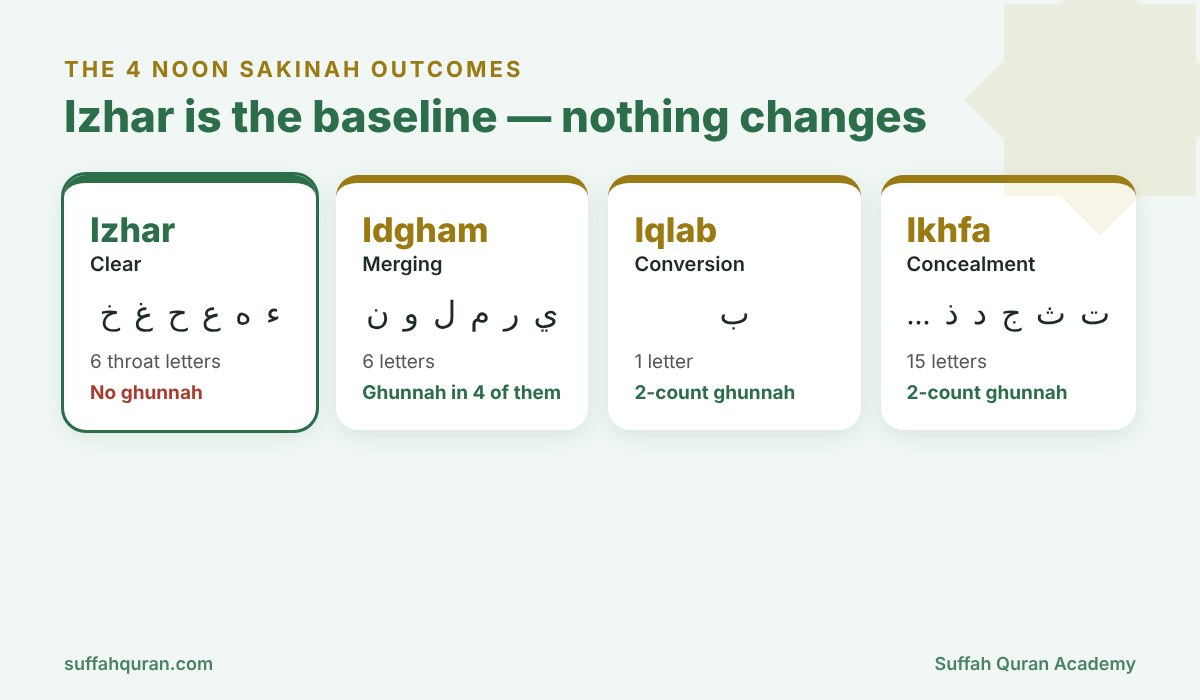
Seeing all four Noon Sakinah outcomes side by side shows why Izhar is really the “default” against which the other three are defined:
- Izhar Halqi (clear pronunciation) — the Noon is pronounced fully and plainly, before the six throat letters. No nasal hold at all.
- Idgham (merging) — the Noon’s sound disappears entirely into the next letter.
- Iqlab (conversion) — the Noon is replaced by a hidden Meem sound before a following Baa.
- Ikhfa (concealment) — the Noon is neither pronounced nor merged, but held as a nasalized hum.
Idgham, Iqlab, and Ikhfa all involve changing the Noon’s sound in some way — merging it, converting it, or softening it with ghunnah. Izhar is the one case where nothing happens to the Noon at all; it’s read exactly as it’s written, with its own clear makhraj (articulation point), the same way you’d pronounce any other letter in the word. That’s precisely why it’s taught first in most Tajweed curricula and sits at the top of our own Tajweed Rules Reference — every other Noon Sakinah rule is really describing an exception to this baseline.
The Six Throat Letters (Huroof al-Halq)
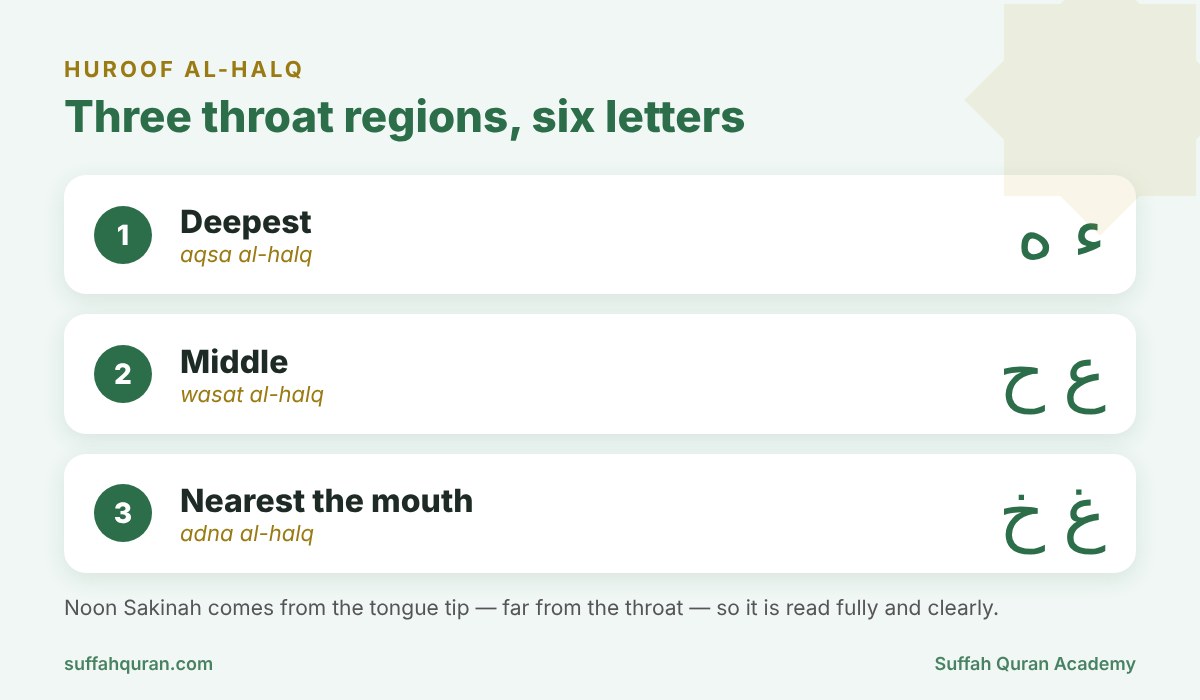
Izhar Halqi applies only when Noon Sakinah or Tanween is directly followed by one of these six letters — no others trigger it:
| Letter | Arabic | Throat region |
|---|---|---|
| Hamzah | ء | Deepest part of the throat (aqsa al-halq) |
| Haa (light) | ه | Deepest part of the throat (aqsa al-halq) |
| Ain | ع | Middle of the throat (wasat al-halq) |
| Haa (heavy) | ح | Middle of the throat (wasat al-halq) |
| Ghain | غ | Nearest the mouth (adna al-halq) |
| Khaa | خ | Nearest the mouth (adna al-halq) |
Notice the three throat regions, deepest to nearest: Hamzah and the light Haa come from the very back of the throat; Ain and the heavy Haa sit in the middle; Ghain and Khaa are closest to the mouth, bordering the makharij covered in our 17 articulation points guide. All six are grouped together in Tajweed precisely because they share this one articulation zone — the throat — which is what separates them cleanly from the Noon’s own makhraj at the tip of the tongue.
Why These Six Letters, Specifically
Noon Sakinah is articulated at the tip of the tongue, against the gum ridge — nowhere near the throat. Because the six throat letters sit so far from the Noon’s own makhraj, there’s no natural tendency for the two sounds to blend, the way there is with letters articulated closer to the tongue (which is what makes Idgham and Ikhfa necessary for other letters). Since there’s no risk of the sounds merging by accident, Tajweed simply calls for the Noon to be pronounced in full — no concealment is needed to keep the two sounds distinct, because distance already does that work.
How to Pronounce Izhar in Tajweed Correctly
Getting Izhar right is less about adding a technique and more about not adding one:
- Pronounce the Noon or Tanween fully, from its own makhraj at the tip of the tongue — don’t soften, shorten, or rush it.
- Add no ghunnah (nasal hold) beyond the Noon’s own natural, brief nasal quality. This is the single most important point: Izhar carries none of the extended 2-count nasal hold that Ikhfa, Iqlab, and Idgham with ghunnah all require.
- Move cleanly into the throat letter without a pause, a glottal catch, or blending the two sounds together.
A simple self-check: if you can clearly hear a distinct “n” sound (not a hum) immediately followed by the throat letter, with no lingering nasal resonance in between, you’re reading Izhar correctly. If the two sounds blur together or you feel a nasal buzz stretching between them, you’ve likely drifted toward Ikhfa’s technique by habit.
A Traditional Mnemonic for the Letters
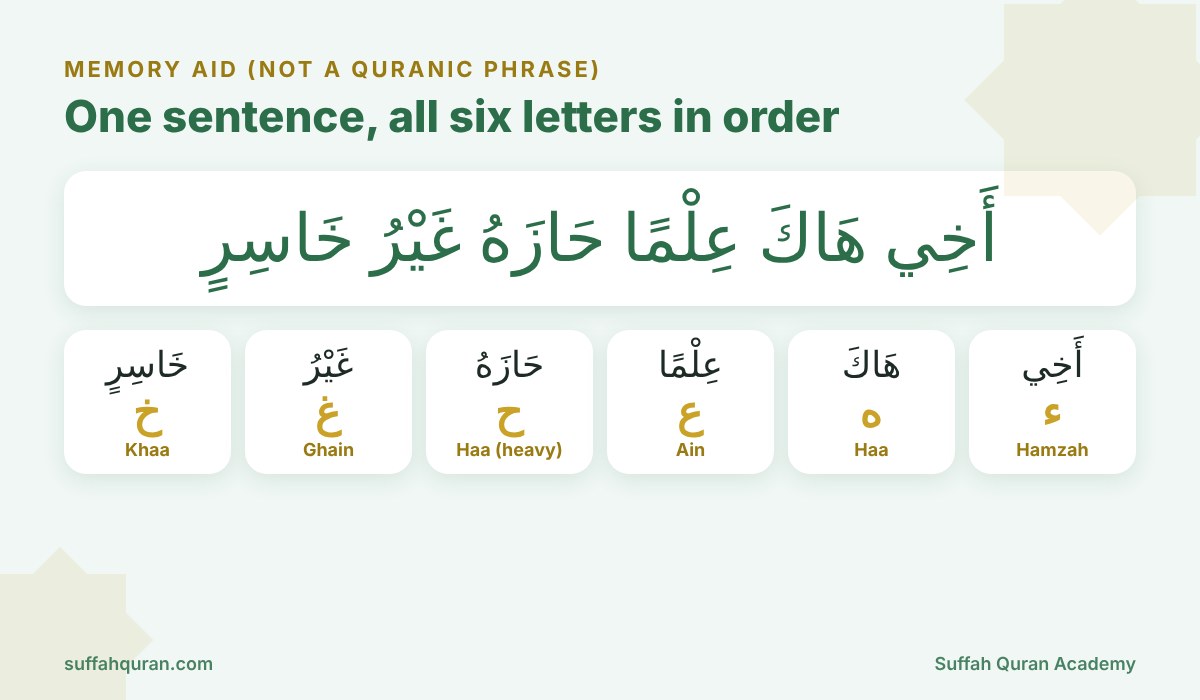
Tajweed teachers commonly use a short Arabic sentence to help students recall all six throat letters in the correct order, from the deepest part of the throat to the point nearest the mouth:
أَخِي هَاكَ عِلْمًا حَازَهُ غَيْرُ خَاسِرٍ
Each word begins with one of the six throat letters, in order: أَخِي (Hamzah), هَاكَ (Haa, light), عِلْمًا (Ain), حَازَهُ (Haa, heavy), غَيْرُ (Ghain), خَاسِرٍ (Khaa). It isn’t a Quranic phrase — just a memory aid — but it’s a useful way to drill the full set and the articulation order in one go, the same way “Qutb Jadd” works for the five Qalqalah letters.
Izhar in Real Ayahs (With References)
Because the six throat letters are common, Izhar is one of the most frequent Noon Sakinah outcomes in the Quran — most students encounter it within their very first surahs. One verified example for each letter:
- Hamzah — Surah An-Naba’ 78:16 — وَجَنَّاتٍ أَلْفَافًا (“…and luxuriant gardens”), where the Tanween on jannatin is pronounced fully before alfafan.
- Haa, light — Surah Al-A’raf 7:168 — وَمِنْهُمْ دُونَ ذَٰلِكَ (“…and among them are others”), where the Noon Sakinah inside min-hum is pronounced clearly within a single word.
- Ain — Surah Yunus 10:27 — مَا لَهُم مِّنَ اللَّهِ مِنْ عَاصِمٍ (“…they will have no protector from Allah”), where the Noon Sakinah of min is pronounced fully before ‘aasimin.
- Haa, heavy — Surah Al-Baqarah 2:225 — وَاللَّهُ غَفُورٌ حَلِيمٌ (“…and Allah is Forgiving and Forbearing”), where the Tanween on ghafoorun is pronounced clearly before haleem.
- Ghain — Surah Al-Hijr 15:47 — وَنَزَعْنَا مَا فِي صُدُورِهِم مِّنْ غِلٍّ (“…and We will remove whatever is in their breasts of resentment”), where the Noon Sakinah of min is pronounced fully before ghillin.
- Khaa — Surah Quraysh 106:4 — وَآمَنَهُم مِّنْ خَوْفٍ (“…and made them secure from fear”), where the Noon Sakinah of min is pronounced fully before khawfin.
In every one of these, the Noon or Tanween carries no special sign of its own, unlike Iqlab’s small meem. In Madinah-print Mushafs, Izhar does show visually: the Noon has a clear sukoon on it, and the two Tanween marks sit stacked directly on top of each other (in Idgham and Ikhfa they are staggered). Indo-Pak prints follow different conventions, so check the symbol key in your own Mushaf.
Common Mistakes Beginners Make
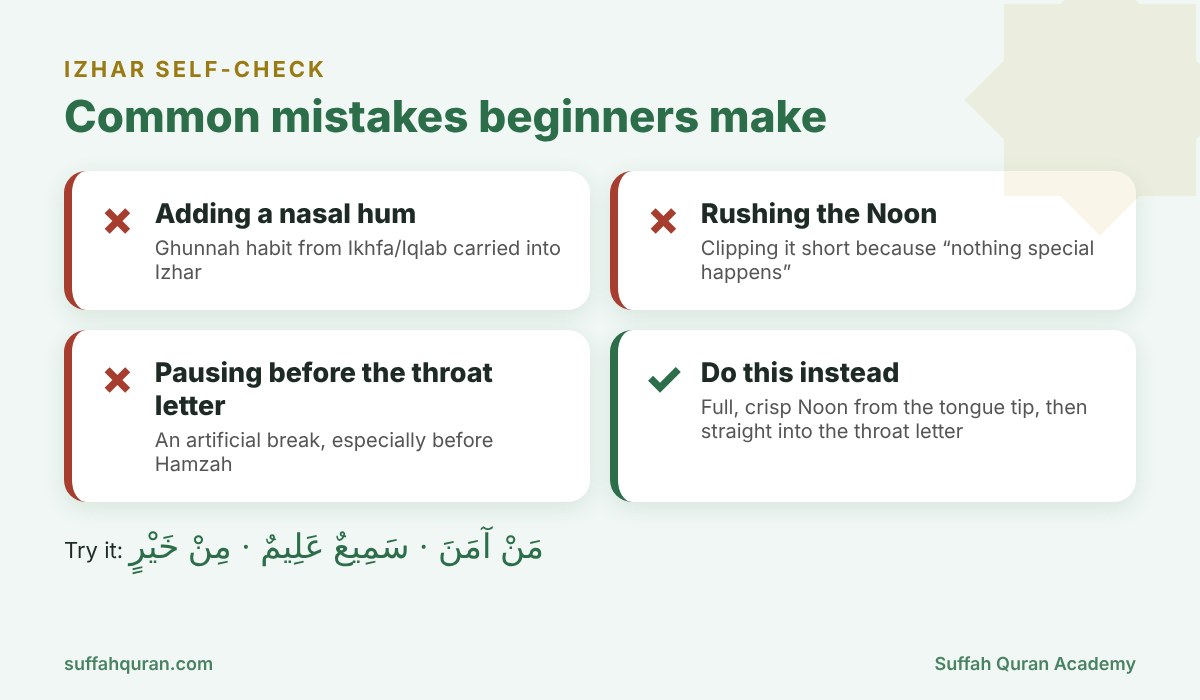
- Adding an unintended nasal hum. Carrying over the 2-count ghunnah habit from Ikhfa or Iqlab practice into Izhar, where no extended nasal hold belongs at all.
- Rushing the Noon. Because “nothing special happens,” some readers clip the Noon short instead of giving it its full, clear articulation.
- Inserting a glottal stop or pause. Especially before Hamzah, some beginners add an artificial break between the Noon and the throat letter instead of moving cleanly from one to the other.
- Confusing Izhar Halqi with Izhar Shafawi. The six-throat-letter rule here is a Noon Sakinah rule; the similarly-named Meem Sakinah case (covered in our Meem Sakinah Rules guide) has different trigger letters entirely.
A 30-Second Self-Test
Read these three phrases aloud and check that you pronounce the Noon or Tanween fully and clearly, with no nasal hum carried into the throat letter: مَنْ آمَنَ, سَمِيعٌ عَلِيمٌ, and مِنْ خَيْرٍ. If each one comes out as a crisp, distinct Noon sound followed immediately by the throat letter — no hum, no merge, no hidden Meem — you’ve got Izhar down.
This kind of rule-by-rule drilling is what our Sabaq Sabqi Manzil review system is built around — catching a stray nasal hum or a rushed Noon before it becomes a habit. Once Izhar feels automatic, it slots neatly alongside Idgham, Iqlab, and Ikhfa in the rest of our complete Tajweed Rules Reference.
FAQ
What is Izhar in Tajweed?
Izhar (Izhar Halqi) is the Noon Sakinah/Tanween rule that applies when one of six throat letters follows. The Noon or Tanween is pronounced fully and clearly, with no merging, concealment, or added nasal hold.
What are the six throat letters (huroof al-halq)?
Hamzah (ء), light Haa (ه), Ain (ع), heavy Haa (ح), Ghain (غ), and Khaa (خ) — two letters from each of the throat’s three regions: deepest, middle, and nearest the mouth.
Does Izhar have a ghunnah (nasal hold)?
No. Izhar is the one Noon Sakinah outcome with no extended nasal hold at all — the Noon keeps its own brief, natural sound, unlike Ikhfa, Iqlab, and Idgham with ghunnah, which all carry a fixed 2-count nasal hum.
Is Izhar marked in the Mushaf the way Iqlab is?
Not with a special letter like Iqlab’s small meem. In Madinah-print Mushafs, though, Izhar is visible: the Noon carries a clear sukoon and the Tanween marks are stacked directly on top of each other, while Idgham and Ikhfa use staggered Tanween. Indo-Pak prints differ, so check the symbol key in your own Mushaf.
What’s the difference between Izhar Halqi and Izhar Shafawi?
Izhar Halqi is a Noon Sakinah/Tanween rule triggered by the six throat letters, covered in this guide. Izhar Shafawi is a separate Meem Sakinah rule with different trigger letters, covered in our Meem Sakinah Rules guide.
Want a teacher to listen to your Izhar live and confirm you’re not carrying a stray nasal hum into it? Book a free trial Tajweed class with Suffah Quran Academy and get feedback on your recitation from day one.

Written by Ustaz Ahmad Raza
Senior Quran & Tajweed Teacher · 8 Years Experience · Tajweed, Nazra Quran, Madani Qaida · Urdu, Hindi, English
Ustaz Ahmad Raza has been teaching Quran and Tajweed for 8 years and holds an Ijazah in Quran recitation with Tajweed. He wrote this guide to help students hear the difference between a clean, fully pronounced Noon and the nasal hum of the other Noon Sakinah rules.
Meet our teaching team →