This post contains affiliate links.
Published: July 8, 2026 · ⏱ 10 min read · Ustaz Imran Qadri, Tajweed Expert
If a teacher has ever stopped you mid-recitation for a letter that sounded perfectly fine to you, the problem probably wasn’t your fluency — it was Makhaarij: the exact physical point in your mouth, throat, or nose that letter is supposed to come from. Every language uses a specific set of sounds, and every sound is produced from a specific physical location. In Arabic, this system is called Makhaarij al-Huroof — the articulation points of the letters.
For non-native Arabic speakers learning Tajweed, Makhaarij is where most errors originate — and it’s not a cosmetic issue. A letter produced from the wrong point does not simply sound slightly different — it produces a different letter, changing words and meaning. The letter Qaaf (ق) produced from the Kaaf (ك) position sounds like a different letter entirely. The Ain (ع) produced without its throat constriction sounds like a glottal stop — a completely different phoneme.
This guide breaks down the complete Makhaarij system in plain terms — all 17 articulation points, all 29 letters — with the physical descriptions, region-by-region breakdowns, and real examples that finally make each one learnable, not just memorable.
Looking for a quick-reference chart instead? This guide explains why each letter is produced where it is, region by region. For a scannable chart of all 29 letters mapped to their Makhraj, see our Makharij Al Huroof Chart.
What Are Makhaarij al-Huroof?
Makhaarij (مخارج) is the plural of Makhraj (مخرج), meaning exit point or place of emergence. Al-Huroof (الحروف) means the letters. Together, Makhaarij al-Huroof refers to the specific locations from which each Arabic letter emerges — the precise physical point where the airflow is shaped into a distinct sound.
Classical Tajweed scholars, building on the work of Arabic grammarians and phoneticians going back to Khalil ibn Ahmad al-Farahidi in the 8th century, identified 17 primary articulation points governing all 29 Arabic letters. These 17 points are organised into 5 main regions.
Why Makhaarij Matter for Correct Recitation
The relationship between Makhaarij and Tajweed rules is foundational. Every Tajweed rule about how letters interact — Noon Sakinah rules, Madd, Qalqalah — assumes that the underlying letters are being produced correctly from their proper points. If the base letters are wrong, applying rules on top of them produces a recitation that is still incorrect.
Consider the Noon Sakinah Izhar rule: Noon is pronounced clearly before throat letters (ء ه ع ح غ خ). The reason for this rule is that the Noon’s articulation point (front of the mouth, near the nasal passage) is far from the throat letters’ articulation points. The distance between the two points makes assimilation impossible — so Izhar (clear pronunciation) is the natural result.
This demonstrates how Makhaarij knowledge underlies and explains Tajweed rules — rather than the rules being arbitrary, they reflect the physical realities of Arabic phonetics. Understanding Makhaarij makes Tajweed rules logical, not just memorised.
The 5 Main Regions of Articulation
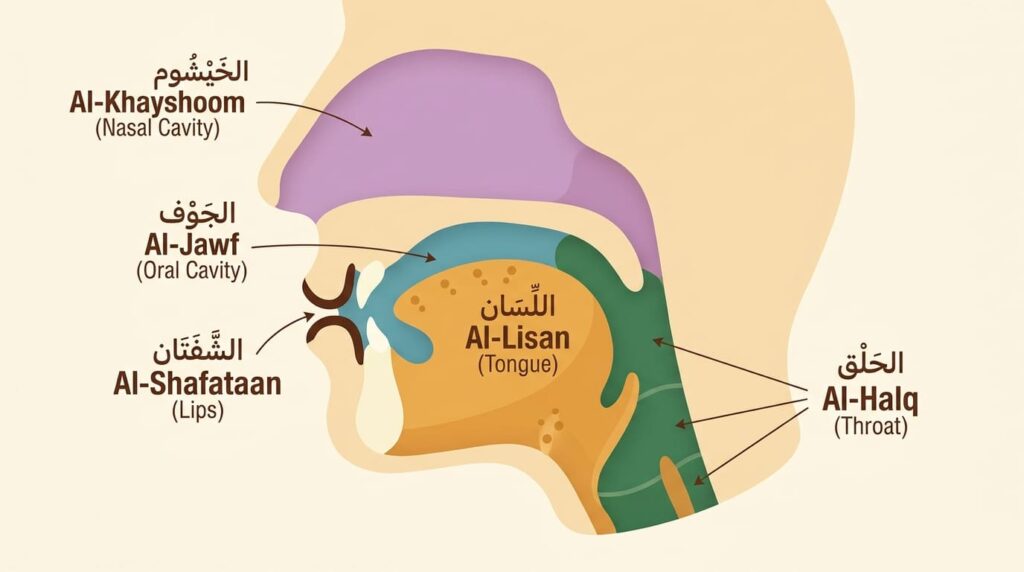
| Region | Arabic Name | Points | Letters |
|---|---|---|---|
| Oral cavity (empty space) | Al-Jawf | 1 | ا و ي (Madd letters) |
| Throat | Al-Halq | 3 | ء ه ع ح غ خ |
| Tongue | Al-Lisan | 10 | ق ك ج ش ي ض ل ن ر ط د ت ص ز س ظ ذ ث |
| Lips | Al-Shafataan | 2 | ف ب م و |
| Nasal cavity | Al-Khayshoom | 1 | Ghunnah (nasal quality of ن and م) |
Region 1: Al-Jawf — The Oral Cavity
Al-Jawf (الجوف) refers to the empty space inside the mouth and throat — the open cavity through which air passes. This region produces the three Madd letters when they appear as extended vowel sounds:
- Alif (ا) — the long “aa” sound, produced with an open mouth and the tongue flat
- Waw (و) — the long “oo” sound, produced with rounded, protruded lips
- Ya (ي) — the long “ee” sound, produced with lips spread and tongue raised toward the palate
These are not consonants — they are extended vowel sounds that resonate through the open oral cavity. Their “articulation point” is the open space itself, which is why they are sometimes described as having no single fixed point.
Region 2: Al-Halq — The Throat
Al-Halq (الحلق) — the throat — contains three articulation points, producing six letters. These are the six letters that trigger Izhar in the Noon Sakinah rules.
The deepest throat (Aqsal Halq):
- Hamzah (ء) — a glottal stop produced by closing and reopening the vocal cords. The sound in the English words “uh-oh” between the two syllables.
- Ha (ه) — a breathy, aspirated “h” produced from the vocal cords. Like exhaling onto cold hands — soft, open, effortless.
The middle throat (Wasatal Halq):
- Ain (ع) — a voiced pharyngeal fricative. The throat muscles constrict and release with the vocal cords engaged. One of the most distinctive and most commonly mispronounced Arabic letters for non-native speakers.
- Haa (ح) — the voiceless counterpart to Ain. Same physical constriction of the throat — but without voice. Sounds like a pushed, emphatic “h” from deep in the throat. Distinct from the softer Ha (ه).
The upper throat closest to the mouth (Adnal Halq):
- Ghain (غ) — a voiced velar/uvular fricative. The back of the tongue approaches the uvula, producing a vibrating sound. Similar to the French “r” in certain pronunciations.
- Kha (خ) — the voiceless counterpart to Ghain. Same back-of-throat position, without voice. Like clearing the throat gently.
Region 3: Al-Lisan — The Tongue
Al-Lisan (اللسان) — the tongue — is the most productive articulation region, with 10 distinct points producing 18 letters. The tongue is divided into sections: root, back, middle, front, blade, and tip. Different combinations of tongue position and contact with teeth, gums, or palate produce different letters.
Back of tongue (Aqsal Lisan):
- Qaaf (ق) — the back of the tongue contacts the soft palate (uvula area). Deeper than Kaaf. A resonant, heavy “k” sound felt at the very back of the throat-mouth junction.
- Kaaf (ك) — the back of the tongue contacts the hard palate. Slightly further forward than Qaaf. Similar to English “k” but slightly more back than the standard English position.
Middle of tongue (Wasat al-Lisan):
- Jeem (ج) — middle of tongue contacts middle of hard palate. Like English “j” but with fuller contact.
- Sheen (ش) — middle of tongue near (not touching) middle palate, producing a “sh” sound.
- Ya (ي) — as a consonant (not Madd), middle of tongue approaches middle palate producing a “y” sound.
One side or both sides of tongue (Haafat al-Lisan):
- Dhad (ض) — one or both sides of the tongue touch the upper molars. This is the most unique letter in Arabic — no other language has this sound. Heavy, lateral, and distinctly Arabic.
- Lam (ل) — the front edge of the tongue contacts the upper gum ridge across its full width.
Tip of tongue (Taraf al-Lisan) — various points:
- Noon (ن) — tongue tip touches upper gum ridge. Nasal resonance through the nose.
- Ra (ر) — tongue tip taps the upper gum ridge with a slight trill. Heavier than the English “r.”
- Taa (ط), Daal (د), Taa (ت) — tongue tip contacts the back of upper teeth/gum ridge. Taa is heavy (Tafkheem); Taa and Daal are light (Tarqeeq).
- Saad (ص), Zaa (ز), Seen (س) — tongue near (not touching) upper teeth. Saad is heavy; Seen and Zaa are light.
- Dhaa (ظ), Dhaal (ذ), Thaa (ث) — tongue tip placed between or just behind the teeth. Interdental or dental fricatives.
Region 4: Al-Shafataan — The Lips
Al-Shafataan (الشفتان) — the two lips — produce four letters across two articulation points.
Lower lip and upper teeth:
- Fa (ف) — the inner edge of the lower lip contacts the tips of the upper front teeth. Like English “f.” A light letter (Tarqeeq).
Both lips together:
- Baa (ب) — both lips come together firmly and release. Like English “b.”
- Meem (م) — both lips come together firmly. Like English “m.” With nasal resonance from Al-Khayshoom.
- Waw (و) — as a consonant (not Madd), lips round and protrude slightly without touching. Like English “w.”
Region 5: Al-Khayshoom — The Nasal Cavity
Al-Khayshoom (الخيشوم) — the nasal cavity — does not produce a letter on its own. Instead, it contributes the quality of Ghunnah (nasal resonance) to specific letters and rules.
The nasal cavity is the articulation point for:
- The Ghunnah (nasal sound) of Noon (ن) and Meem (م) when they carry a Shaddah
- The Ghunnah in Ikhfaa (concealment of Noon Sakinah)
- The Ghunnah in Iqlaab (substitution of Noon before Baa)
- The Ghunnah in Idghaam with Ghunnah
A practical test for Ghunnah: gently pinch your nose while producing a Noon with Shaddah (إنَّ). If the sound changes noticeably, you are using Al-Khayshoom correctly. If it barely changes, the nasal cavity is not engaged.
The Hardest Letters for Non-Native Speakers
Based on the most common errors in students from English, Urdu, and other non-Arabic backgrounds, these letters require the most focused attention:
Ain (ع) — The voiced pharyngeal fricative. No equivalent in English or Urdu. Requires a throat constriction and release that most non-native speakers have never performed for linguistic purposes. Must be heard from a qualified teacher and imitated repeatedly. Read more in our guide on common Tajweed mistakes.
Haa (ح) — Often confused with Ha (ه). The physical difference: Haa requires active throat constriction (middle throat), while Ha is effortless and breathy (deep throat). The contrast is between effort and ease in the same throat region.
Qaaf (ق) — Commonly replaced by Kaaf (ك). The difference is the position of the back of the tongue — Qaaf is at the uvula, Kaaf is at the hard palate. Feeling this difference requires deliberate experimentation with back-of-tongue placement.
Dhad (ض) — The most unique letter in Arabic. The lateral tongue contact with molars produces a heavy, full sound unlike anything in other languages. Often mispronounced as Dhaa (ظ) or a heavy Daal (د).
Saad (ص), Taa (ط), Dhaa (ظ) — The heavy counterparts to Seen, Taa (ت), and Dhaal (ذ). The heaviness comes from Tafkheem — the back of the mouth raises. Producing the light versions correctly and then applying Tafkheem is the most reliable path to distinguishing them.
All of these require direct demonstration and correction from a qualified teacher. Written descriptions can orient the learner — but the ear and the teacher’s real-time feedback are what produce correct Makhaarij.
Work on Your Makhaarij With a Qualified Teacher
Ustaz Imran Qadri specialises in Tajweed rules and Makharij correction. Book a free trial class — your specific letter errors are identified and corrected in real time.
Frequently Asked Questions
Makhaarij al-Huroof means the articulation points of Arabic letters — the specific locations in the mouth, throat, and nasal cavity from which each Arabic letter is produced. There are 17 primary articulation points governing all 29 Arabic letters, organised into 5 main regions: Al-Jawf (oral cavity), Al-Halq (throat), Al-Lisan (tongue), Al-Shafataan (lips), and Al-Khayshoom (nasal cavity).
Classical Tajweed scholars identify 17 primary Makhaarij for the 29 Arabic letters. These are grouped into 5 main regions: Al-Jawf (1 point), Al-Halq/throat (3 points), Al-Lisan/tongue (10 points), Al-Shafataan/lips (2 points), and Al-Khayshoom/nasal cavity (1 point).
Every Arabic letter has a specific articulation point. If a letter is produced from the wrong point, it sounds like a different letter, changing the words of the Quran. Correct Makhaarij ensures each letter is distinct and accurate — the physical foundation on which all other Tajweed rules depend.
Six Arabic letters come from the throat: Hamzah (ء) and Ha (ه) from the deepest throat, Ain (ع) and Haa (ح) from the middle throat, and Ghain (غ) and Kha (خ) from the upper throat. These are the same six letters that trigger the Izhar rule in Noon Sakinah — the Noon is pronounced clearly before them because the articulation points are far apart.
You can study the theory of Makhaarij from written guides — understanding which region each letter comes from and physical descriptions. However, correctly producing difficult letters like Ain, Haa, Qaaf, and Dhad requires a teacher who can demonstrate and hear whether your attempts are correct. Written descriptions guide; a teacher confirms accuracy.
The Physical Foundation of Every Letter
Makhaarij al-Huroof is not an advanced topic reserved for scholars. It is the foundational layer of Tajweed — the physical reality that every other rule builds on top of.
A reciter who produces each letter from its correct Makhraj speaks Arabic letters the way they were revealed — distinct, precise, and unmistakeable. That precision is what the Quran deserves, and what the Prophet ﷺ demonstrated.
Study the regions. Practise the difficult letters. And work with a teacher who can hear the difference between a Qaaf and a Kaaf, between an Ain and a glottal stop — and correct you until the right sound comes naturally.
Get Your Letter Articulation Corrected
Book a free trial Tajweed class. Our Ijazah-certified teachers will identify which letters you are producing incorrectly and guide you to the correct Makhraj — in real time, in your actual recitation.

Written by Ustaz Imran Qadri
Tajweed Expert · 9 Years Experience · Tajweed Rules, Makharij · Urdu, Hindi
Ustaz Imran Qadri specialises in improving Quran pronunciation and Makharij. With 9 years of experience teaching Tajweed to students ranging from beginners to advanced reciters, he has helped hundreds of students learn to produce Arabic letters from their correct articulation points — transforming their recitation at its most fundamental level.