
This post contains affiliate links.
Published: August 26, 2026 · ⏱ 9 min read · Ustaz Abdul Hannan, Arabic, Islamic Studies & Hadith Instructor
What Is Mawlid al-Nabi, and Why Does It Matter for Kids?
Mawlid al-Nabi marks the birth of Prophet Muhammad ﷺ, observed by many Muslim communities around the world on or near the 12th of Rabi al-Awwal. Families approach the day differently — some hold gatherings, some keep it quiet, and scholars themselves differ on whether formal celebration is encouraged or best avoided. That disagreement is real, but it isn’t really what this article is about.
What almost every Muslim parent agrees on is this: children benefit from knowing the seerah — the story of the Prophet’s ﷺ life. Whatever a family’s view on the date itself, Mawlid season is a natural, low-pressure prompt to sit down and actually tell that story, rather than assuming it will be picked up somewhere along the way. That’s the practical use of this guide: seerah content for children, organized by age, that a parent or teacher can use whether or not the household marks Mawlid formally.
لَا يُؤْمِنُ أَحَدُكُمْ حَتَّى أَكُونَ أَحَبَّ إِلَيْهِ مِنْ وَالِدِهِ وَوَلَدِهِ وَالنَّاسِ أَجْمَعِينَ
Lā yu’minu ah̩aduk̩um h̩attā akūna ah̩abba ilayhi min wālidihi wa waladihi wan-nāsi ajma’īn
“None of you truly believes until I am more beloved to him than his father, his child, and all of mankind.”
Source — Sahih al-Bukhari, 15
Love in this hadith isn’t sentimental — it’s tied to knowing enough about someone to actually love them for who they were. A child can’t love a name they’ve never heard a story about. That’s the real argument for seerah education: it’s not extra content bolted onto Islamic studies, it’s the part that makes the rest of it make sense.
When Is Mawlid al-Nabi in 2026?
12 Rabi al-Awwal 1448 AH falls on Tuesday, 25 August 2026 according to the Umm al-Qura calendar used in Saudi Arabia. Because the Islamic calendar is lunar and many communities confirm each month by direct moon sighting rather than pre-set calculation, some countries — including India and Bangladesh — may observe the date a day later, on 26 August 2026.
If your family or local mosque follows a moon-sighting announcement, it’s worth checking your regional Islamic authority closer to the date rather than relying on a fixed calendar app, since a ±1 day shift is normal and not a sign of any error. Whichever date your community settles on, the content below works the same either way — none of it depends on the exact calendar date.
Start With the Seerah, Not Just the Date
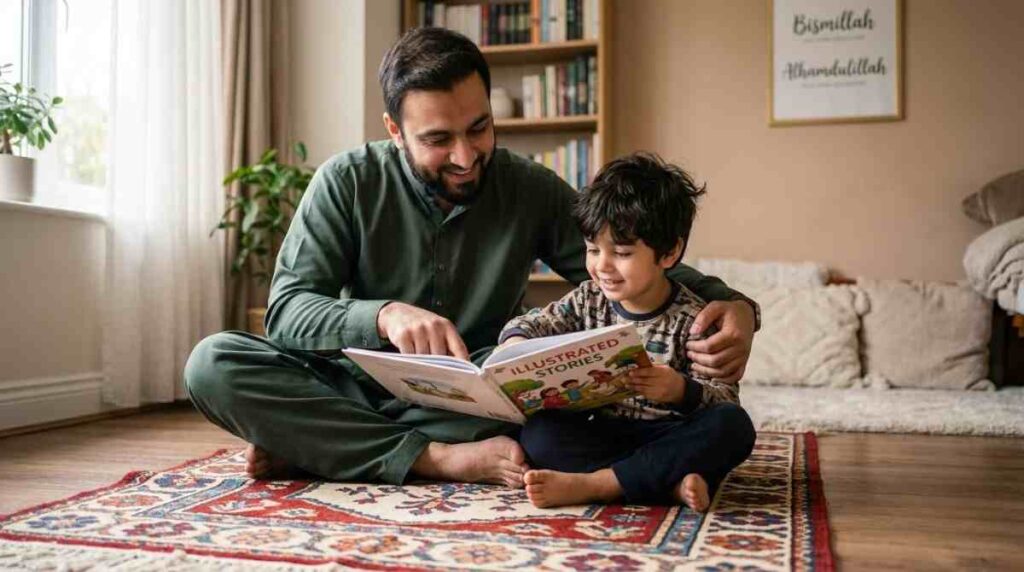
A common mistake we see, even in well-meaning households, is treating Mawlid as an event on the calendar rather than an entry point into a much bigger body of knowledge. The seerah isn’t one story — it’s a full biography spanning roughly 63 years, covering childhood, family life, early revelation, migration, community-building, conflict, and eventual death. Trying to compress all of that into one day’s conversation usually backfires; kids either get overwhelmed or retain almost nothing specific.
What works better, in our experience teaching seerah alongside Quran and hadith, is treating Mawlid as a yearly checkpoint rather than a one-time lesson. Pick one chapter of the story each year — the birth and early life one year, the first revelation the next, the migration to Madinah after that — and let a child’s understanding of the Prophet ﷺ build gradually over several years rather than arriving all at once. That approach also matches how children actually process biography: in scenes and characters, not timelines.
The Birth Story: What to Tell Young Children (Ages 4–7)

For younger children, resist the urge to include every name, date, and genealogical detail. A handful of concrete, sensory facts is enough to anchor the story:
- He was born in Makkah. A city in Arabia, in a family respected for looking after visitors to the Ka’bah.
- His father, Abdullah, had already passed away. He never met his father — a detail many children connect with instinctively, especially if they know someone who has lost a parent.
- His grandfather, Abdul Muttalib, and later his uncle Abu Talib cared for him. He grew up loved and protected, even without his own parents present for most of his childhood.
- Even before he became a Prophet, people trusted him completely. His community gave him the title “Al-Amin” — the trustworthy one — because of how he treated people and handled their belongings.
That last point is worth lingering on with young children. It reframes the Prophet ﷺ from an abstract, distant figure into someone whose character was noticed and named by ordinary people long before revelation began. Kids relate to being known for something — ask a 5-year-old what they’d want to be known for, and the conversation tends to go further than a straight recitation of facts ever would.
Character Before Chronology: What Kids Actually Remember
If a child forgets which year the Hijrah happened but remembers that the Prophet ﷺ was gentle with a crying child, patient with a rude stranger, or fair even to people who disliked him — that’s not a lesser outcome. It’s the point. The seerah is, first, a record of character, and only secondarily a timeline of events.
إِنَّمَا بُعِثْتُ لِأُتَمِّمَ مَكَارِمَ الْأَخْلَاقِ
Innamā bu’ithtu li-utammima makārimal-akhlāq
“I was only sent to perfect noble character.”
Source — Al-Adab Al-Mufrad, 273 (graded hasan by Al-Albani)
We use this hadith often with families because it gives a simple filter for choosing which seerah stories to tell first: pick the ones that model a specific, nameable trait a child can practice that same week — honesty, patience, kindness to animals, gentleness with the elderly, keeping promises. A story with a clear behavioral takeaway sticks; a story told purely for historical completeness usually doesn’t, at least not at this age.
Seerah Fits Alongside Quran Learning, Not Instead of It
Our Quran classes for kids weave seerah and character lessons into recitation and memorization sessions, so children connect what they’re reading to who they’re reading about.
Explore Kids’ Quran Classes →Seerah Milestones by Age: A Simple Roadmap
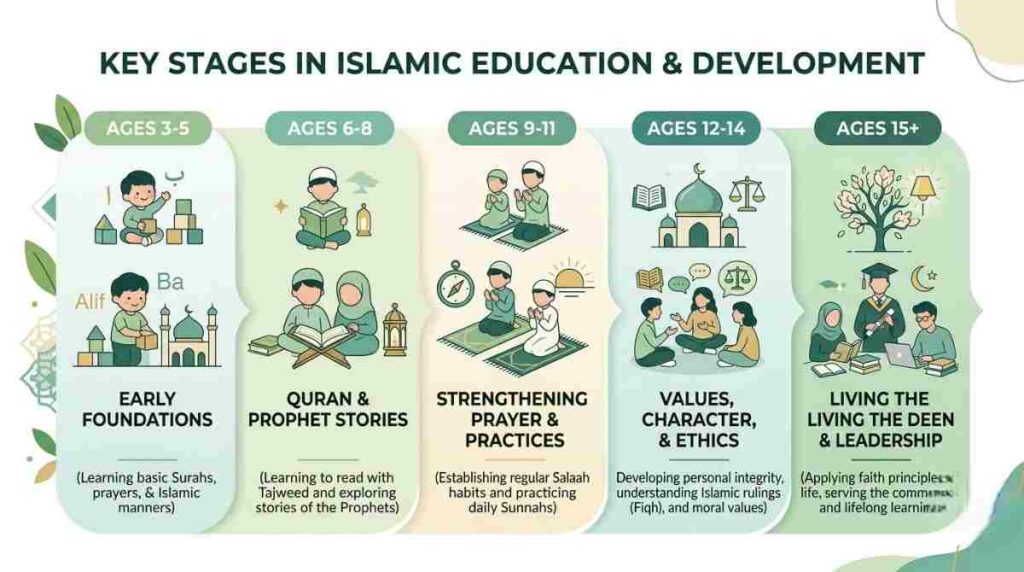
There’s no single correct curriculum, but a rough age-based progression helps avoid both underexplaining to older children and overwhelming younger ones:
- Ages 3–5 — Single traits, no timeline. Short, standalone stories about kindness, honesty, and gentleness. No dates, no names beyond immediate family.
- Ages 6–8 — Simple sequence. Birth, childhood with his grandfather and uncle, being known as Al-Amin, marriage to Khadijah, and the first revelation in the Cave of Hira — told as a loose story arc, not memorized dates.
- Ages 9–11 — Cause and effect. Early opposition in Makkah, the migration (Hijrah) to Madinah, and why it happened — introducing the idea that following the truth sometimes came with real difficulty and sacrifice.
- Ages 12–14 — Context and complexity. Treaties, the building of the early Muslim community in Madinah, how disputes were resolved, and how the Prophet ﷺ treated non-Muslims and former enemies — material that supports more mature discussion.
- Ages 15+ — Primary sources. Direct reading from seerah works such as Ar-Raheeq Al-Makhtum or Ibn Hisham’s biography, alongside hadith collections, so teenagers start engaging with sources rather than only retellings.
This mirrors how we sequence other subjects at Suffah — the same way a child moves from Qaida to fluent recitation to tajweed in stages, seerah knowledge deepens in layers rather than arriving complete on day one. For families building a broader Islamic studies routine alongside this, our guide on why learning the Quran matters covers the same age-appropriate, source-based approach applied to Quran study specifically.
Simple Ways to Mark Mawlid al-Nabi at Home

Whatever your family’s view on formal Mawlid celebration, the day itself can be used simply as a prompt — not an obligation, not a production. A few low-effort options that tend to work well with children:
- Read one seerah story together. Pick a single episode rather than attempting a full biography in one sitting.
- Choose one trait to practice that week. Tie it explicitly back to the story — “the Prophet ﷺ was patient with people who were rude to him, so this week we’re going to practice staying calm when someone upsets us.”
- Have younger children draw a scene from the story. A drawing of the Cave of Hira, the migration, or Al-Amin returning something borrowed reinforces the story visually.
- Send salawat together. A short, simple sending of blessings upon the Prophet ﷺ before bed is easy for even very young children to join in on.
- Ask open questions rather than testing recall. “What do you think it felt like to be given the name Al-Amin?” invites more genuine engagement than “What year was the Prophet ﷺ born?”
None of this requires special materials, a large gathering, or a particular position on how Mawlid should be observed. The consistency of coming back to the seerah — this year and every year after — matters far more than how elaborate any single observance is.
Give Your Child a Foundation in Quran and Seerah Together
Our free trial class starts with an honest look at where your child is now, whether that’s their first Arabic letter or their first full surah.
Book Free Trial Class →Mawlid season comes and goes on the calendar every year, but the value of knowing the Prophet’s ﷺ story doesn’t expire once the date passes. Whether your family marks the 25th, the 26th, or simply uses the season as a nudge to open a seerah book together, the goal is the same one the hadith above points to — a child who doesn’t just recognize the name Muhammad ﷺ, but actually knows, and can describe, the person behind it.
Frequently Asked Questions
Mawlid al-Nabi refers to the observance of the birth of Prophet Muhammad ﷺ, traditionally marked on or around the 12th of Rabi al-Awwal in the Islamic calendar. For many Muslim families it is less a fixed ritual than an occasion to revisit and retell the seerah — the story of the Prophet’s ﷺ life — with children.
12 Rabi al-Awwal 1448 AH corresponds to Tuesday, 25 August 2026 on the Umm al-Qura calendar. Because the Islamic calendar depends on moon sighting, some countries that rely on direct lunar observation may mark it a day later, on 26 August 2026. Families should check their local moon-sighting authority or mosque for the confirmed date in their region.
Scholars hold differing views on formal Mawlid celebrations, and it is not an obligation in Islam. What is agreed upon across all views is the value of studying the seerah itself — the Prophet’s ﷺ life, character, and example are core to Islamic education regardless of how, or whether, a family marks the date itself. This article focuses on that shared ground: teaching children the seerah.
Children can begin hearing simple seerah stories from around age 3 or 4, focused on gentleness, honesty, and kindness rather than dates or genealogy. From around age 7 or 8, children can follow a loose chronology of major events, and by the early teenage years they can handle the historical and social context in more depth.
Keep it to a few concrete, sensory details a young child can picture: he was born in Makkah, into the family of his grandfather Abdul Muttalib, and his father Abdullah had passed away before he was born. Pair the story with one character trait — for example, that even as a baby he was known within his community as trustworthy — rather than listing every historical detail at once.
Simple, low-pressure options include reading one seerah story together, picking a single Prophetic character trait to practice as a family that week, writing or drawing something the Prophet ﷺ did that a child admires, and sending durood (sending blessings upon the Prophet ﷺ) together before bed. None of these require special preparation — consistency matters more than scale.

Written by Ustaz Abdul Hannan
Arabic, Islamic Studies & Hadith Instructor · 7 Years Experience · Hadith, Arabic Grammar, Tafsir Basics
Ustaz Abdul Hannan teaches Arabic and Islamic studies alongside Quran recitation, believing students retain their motivation longer when they understand the person and the textual basis behind what they’re learning, not just the mechanics of how. He draws directly from hadith and seerah sources in his teaching rather than relying on general encouragement.
Meet our teaching team →