
This post contains affiliate links.
Published: October 16, 2026 · ⏱ 9 min read · Ustaz Ahmad Raza, Senior Quran & Tajweed Teacher
📖 In This Guide
- What Is Ikhfa Haqiqi?
- Why Ikhfa Sits Between Izhar and Idgham
- The 15 Trigger Letters
- The Three Degrees: Aqrab, Awsat, Ab’ad
- How Long to Hold the Ghunnah
- Ikhfa Haqiqi vs. Ikhfa Shafawi
- Common Mistakes Beginners Make
- A 60-Second Self-Test
- FAQ
What Is Ikhfa Haqiqi?
Ikhfa (إخفاء) literally means “concealment” or “hiding.” Ikhfa Haqiqi — “true” or “real” concealment — is the rule that applies when Noon Sakinah (نْ) or Tanween is followed by one of 15 specific letters. Instead of pronouncing the Noon clearly (as in Izhar) or merging it completely into the next letter (as in Idgham), you hold a nasal sound that sits deliberately between the two: the tongue does not touch the Noon’s point of articulation, but the sound isn’t dropped either — it’s concealed, with the ghunnah (nasal resonance) carrying it through.
This is the rule our full Noon Sakinah and Tanween rules guide covers as one of four, alongside Izhar, Idgham, and Iqlab. Ikhfa Haqiqi gets its own guide here because it has the most trigger letters of any Noon Sakinah rule by far — 15 out of 29 Arabic letters — and because beginners consistently ask the same follow-up question once they’ve learned the letter list: does Ikhfa sound the same across all 15 letters, or not? It doesn’t, and that’s what this guide is really about.
Why Ikhfa Sits Between Izhar and Idgham
It helps to see all three Noon Sakinah outcomes side by side:
- Izhar Halqi (clear pronunciation) — the Noon is pronounced fully and plainly, used before the six throat letters.
- Idgham (merging) — the Noon’s sound disappears entirely into the next letter, used before Yaa, Noon, Meem, Waw, Laam, or Ra.
- Ikhfa Haqiqi (concealment) — neither of the above. The tongue stays clear of the Noon’s articulation point, but the sound is held as a nasalized hum rather than dropped, used before the 15 letters below.
That middle position is exactly why these 15 letters don’t belong with Izhar’s six throat letters or Idgham’s six merging letters — they’re everything left over, and concealment is how Arabic phonetics naturally handles a Noon followed by any of them.
The 15 Trigger Letters
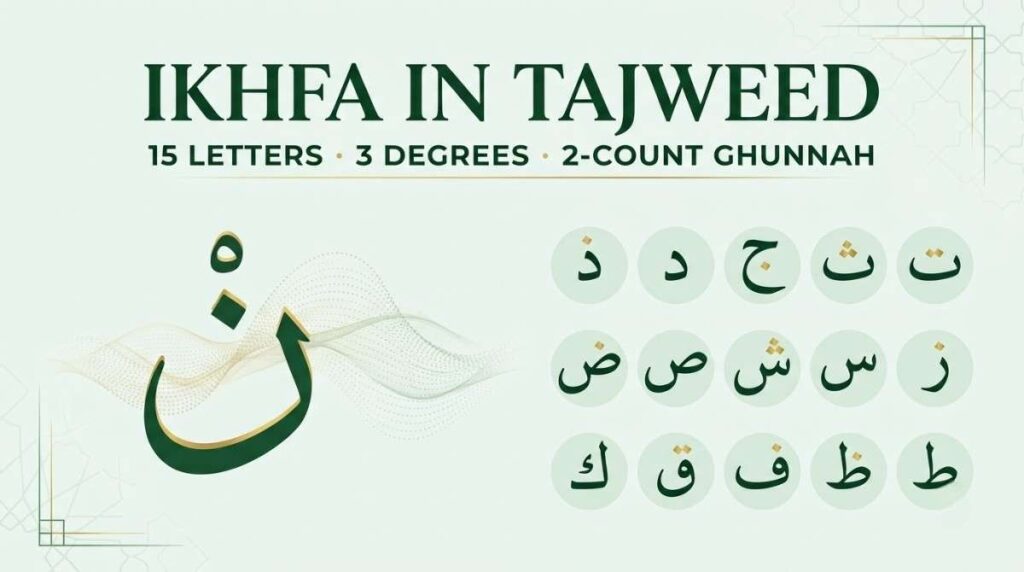
Ikhfa Haqiqi applies when Noon Sakinah or Tanween is followed by any one of these 15 letters:
ت ث ج د ذ ز س ش ص ض ط ظ ف ق ك
That’s exactly half the Arabic alphabet’s 28 letters (plus Hamzah, 29 in total) used in Noon Sakinah rules. It’s by far the largest letter group of the four Noon Sakinah rules — which is exactly why treating “Ikhfa” as one uniform sound is the biggest oversimplification beginners make. The next section breaks the 15 letters into three groups that actually sound a little different from each other.
The Three Degrees: Aqrab, Awsat, Ab’ad
Classical Tajweed texts split the 15 Ikhfa letters into three degrees based on how close each letter’s articulation point (makhraj) is to the Noon’s own makhraj (the tip of the tongue, just behind the upper front teeth). The closer the following letter’s makhraj is to the Noon’s, the more the concealment leans toward Idgham; the farther it is, the more it leans toward Izhar.
| Degree | Letters | Why | What It Sounds Like |
|---|---|---|---|
| Ikhfa Aqrab (nearest) | ت د ط | Makhraj very close to the Noon’s own articulation point | Strongest, clearest ghunnah — leans slightly toward Idgham |
| Ikhfa Awsat (middle) | ث ج ذ ز س ش ص ض ظ ف | Makhraj neither close nor far from the Noon’s | The standard, textbook-balanced ghunnah |
| Ikhfa Ab’ad (farthest) | ق ك | Makhraj at the back of the tongue, far from the Noon’s | Lightest ghunnah — leans slightly toward Izhar |
Most learners only ever memorize the flat list of 15 letters and never get told this part — which is fine for passing a written test, but it’s the reason a teacher will often say a student’s Ikhfa “sounds a bit off” on ق or ك specifically, even though the student is technically following the rule. The fix isn’t a different rule; it’s lightening the ghunnah slightly for just those two letters.
How Long to Hold the Ghunnah
As with every ghunnah-carrying rule, the hold is a fixed 2 counts (harakat) — the same duration covered in detail in our guide to Ghunnah in Tajweed. This duration does not change across Ikhfa’s three degrees above. What changes between Aqrab, Awsat, and Ab’ad is the clarity or “weight” of the nasal resonance, not how long you hold it. A common beginner error is to assume a “lighter” letter like ق also means a shorter hold — it doesn’t; it’s still a full 2 counts, just with a gentler nasal quality.
Ikhfa Haqiqi vs. Ikhfa Shafawi
It’s easy to mix these two up because they share the word “Ikhfa,” but they’re triggered by completely different letters:
- Ikhfa Haqiqi — triggered by Noon Sakinah or Tanween, followed by any of the 15 letters above. “Haqiqi” (true/real) distinguishes it as the primary, Noon-based form of Ikhfa.
- Ikhfa Shafawi — triggered by Meem Sakinah, followed only by Ba (ب). “Shafawi” means “labial” — the concealment happens with the lips lightly, not fully, closed. This is one of the three Meem Sakinah rules covered in our Meem Sakinah rules guide.
Both carry the same 2-count ghunnah and both sit between clear pronunciation and full merging — the difference is entirely about which letter (Noon or Meem) is being concealed, and which single letter triggers it in the Meem Sakinah case versus 15 letters in the Noon Sakinah case.
Common Mistakes Beginners Make
- Pronouncing the Noon too clearly. If the tongue touches the gum ridge the way it would for Izhar, the concealment is lost — this is the single most common correction teachers make.
- Merging it like Idgham. The opposite error — dropping the nasal trace entirely and sliding straight into the next letter as if it were a merging rule.
- Treating all 15 letters identically. As covered above, Aqrab letters (ت د ط) and Ab’ad letters (ق ك) call for a slightly different weight of ghunnah, not a uniform sound across all 15.
- Shortening the hold. The 2-count duration doesn’t flex by letter or by how fast the rest of the verse is being recited.
A 60-Second Self-Test
Say each of these five phrases out loud and name which Ikhfa degree applies — Aqrab, Awsat, or Ab’ad: مِنْ تَحْتِهَا, مِنْ قَبْلِ, مِنْ شَرِّ, أَنْفُسَكُمْ, and مِنْ جَاءَ. If you can identify ت as Aqrab, ق as Ab’ad, and ش, ف, and ج as Awsat — and adjust the weight of your ghunnah accordingly on each one — you’ve gone beyond just memorizing the 15-letter list.
Drills like this are exactly what our Sabaq Sabqi Manzil review system is built around — testing one rule at a time against real examples rather than reading about it once and moving on. Once Ikhfa Haqiqi feels automatic, it fits naturally into the rest of our complete Tajweed Rules Reference.
FAQ
What is Ikhfa Haqiqi in Tajweed?
Ikhfa Haqiqi is the Noon Sakinah/Tanween rule that applies when one of 15 specific letters follows. The Noon’s sound is concealed — neither pronounced clearly nor fully merged — and held as a 2-count nasal ghunnah.
How many letters trigger Ikhfa Haqiqi?
15 letters: ت ث ج د ذ ز س ش ص ض ط ظ ف ق ك. These split into three degrees — Aqrab (ت د ط), Awsat (the remaining ten middle letters), and Ab’ad (ق ك) — based on how close each one’s makhraj is to the Noon’s.
What’s the difference between Ikhfa Haqiqi and Ikhfa Shafawi?
Ikhfa Haqiqi is triggered by Noon Sakinah or Tanween followed by any of 15 letters. Ikhfa Shafawi is a Meem Sakinah rule, triggered only by a following Ba (ب), with the concealment happening at the lips rather than the tongue.
How long is the ghunnah held in Ikhfa Haqiqi?
A fixed 2 counts (harakat), the same duration as every other ghunnah-carrying Tajweed rule. This doesn’t change across the three degrees — only the clarity of the nasal sound shifts slightly by letter.
Does Ikhfa sound the same for all 15 letters?
Not quite. Letters closest to the Noon’s own makhraj (ت د ط) carry a slightly stronger, clearer ghunnah, while the two farthest letters (ق ك) carry a slightly lighter one. The ten letters in between take the standard, textbook-balanced ghunnah. The 2-count duration stays the same throughout.
Want a teacher to listen to your Ikhfa live and tell you whether you’re leaning too far toward Izhar or Idgham? Book a free trial Tajweed class with Suffah Quran Academy and get feedback on your recitation from day one.