

This post contains affiliate links.
Estimated reading time: 12 minutes
Table of contents
- Before the Techniques: Two Prerequisites That Nothing Can Replace
- Technique 1: The Three-Repetition Method (Sabaq Method)
- Technique 2: Chunking — Memorize in Small Units, Then Link Them
- Technique 3: Visual Memory — Use the Same Mushaf Throughout
- Technique 4: Recitation in Salah — The Most Underused Practice Tool
- Technique 5: The Listening Method — Passive Absorption Before Active Memorization
- Technique 6: Spaced Repetition — The Science of What Makes Memory Last
- Technique 7: Teaching What You Have Memorized
- Technique 8: Fixing Mistakes Immediately — Do Not Let Errors Sit
- How Long-Term Retention Works — The Manzil Principle
- Special Considerations for Adults
- Frequently Asked Questions
- The Techniques Are the Map. Consistency Is the Journey.
Memorizing the Quran is not a mystery. It is not a gift that some people have and others do not. It is a skill — and like every skill, it responds to the right techniques applied consistently over time.
What separates students who complete Hifz from those who struggle is not talent or intelligence. It is almost always method. The right technique, applied every day, produces results. The wrong technique, no matter how hard a student works, produces frustration.
This guide covers the techniques that actually work — for children working through a structured Hifz programme, for adults beginning memorization later in life, and for anyone who wants to strengthen and retain what they have already memorized.
Before the Techniques: Two Prerequisites That Nothing Can Replace
Before any memorization technique will work, two things must be in place. Without these, even the best techniques will produce disappointing results.
Prerequisite 1: You Must Be Able to Read the Passage Correctly Before Memorizing It
This is the most commonly violated rule in Quran memorization — and it causes more wasted effort than anything else.
Many students try to memorize a verse before they can read it correctly. They repeat it until it “sticks” — but what sticks is an incorrect version. The error is then embedded in the memorization and becomes very difficult to remove later.
The rule is absolute: before you memorize any portion of the Quran, you must be able to read it correctly, with proper Tajweed, from the page — fluently, without hesitation. Only then should you begin memorizing it.
If you cannot yet read Arabic fluently, establish that first. Everything else comes after.
Prerequisite 2: Consistency Matters More Than Volume
A student who memorizes half a page every day, without exception, will complete the Quran. A student who memorizes two pages some days and nothing for the rest of the week will not — because what is memorized without consistent reinforcement is quickly forgotten.
The quantity memorized per session matters far less than the frequency. Daily is the minimum for meaningful Hifz progress. Twice daily is better. The size of each session can be small — but it must be regular.
Technique 1: The Three-Repetition Method (Sabaq Method)
This is the foundational memorization technique used in every serious Hifz school worldwide — and it is the basis of the Sabaq component of the Sabaq-Sabqi-Manzil system.
How it works:
Step 1: Read the new portion three times from the page, looking at the text, with full attention to correct pronunciation.
Step 2: Look away from the page and recite the portion once from memory. If you cannot, look at the page, identify where you went wrong, and repeat Step 1.
Step 3: Repeat Step 2 until you can recite the portion once without looking.
Step 4: Increase the repetitions. Most teachers recommend 20-40 repetitions of the new portion within the same session — alternating between looking and not looking — until the passage is solid.
Step 5: Wait 10-15 minutes. Then try to recite it again without looking. If it holds, the short-term memorization is established.
Why it works: Repetition builds the neural pathways that store memory. The alternation between looking and reciting tests retrieval — which is what actually strengthens memory, not just repetition.
Technique 2: Chunking — Memorize in Small Units, Then Link Them
Trying to memorize a full page at once is one of the most common mistakes beginners make. The brain handles small chunks far better than large blocks.
How it works:
Divide the day’s portion into units of one or two lines. Memorize the first unit using the Three-Repetition Method. Then memorize the second unit. Then recite both together. Then memorize the third unit. Then recite all three together.
This progressive linking — sometimes called the “chain method” — means each new unit is immediately connected to what came before it. By the end of the session, the entire day’s portion is linked as a continuous sequence, not a series of disconnected fragments.
For children: Chunks should be smaller — sometimes a single line or even half a line at a time, depending on age and attention span. The linking approach works the same way, but at a smaller scale.
Technique 3: Visual Memory — Use the Same Mushaf Throughout
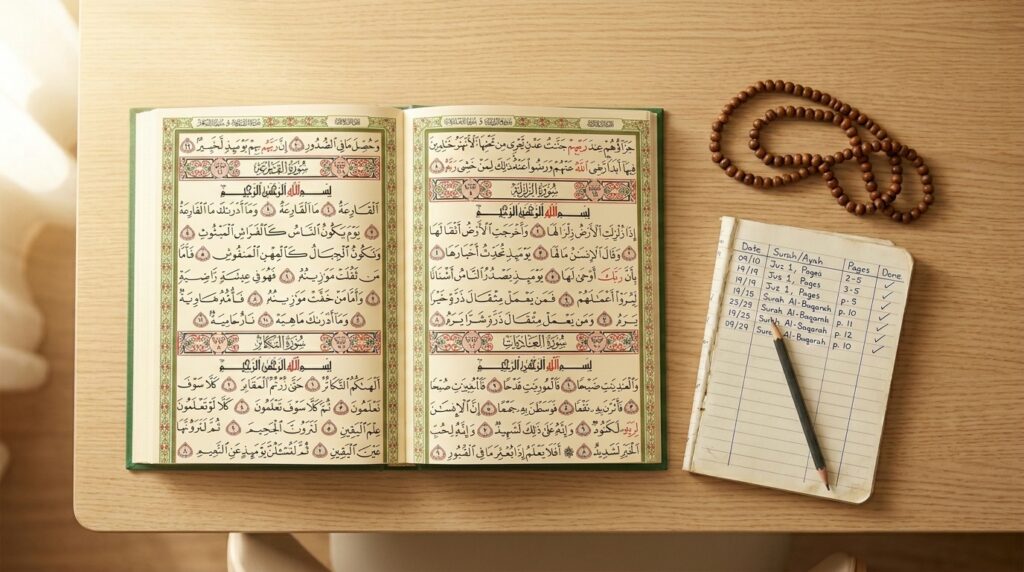
This technique is often overlooked — but experienced Hifz teachers consider it essential.
The brain memorizes the Quran partly through visual encoding — which page, which column, which position on the page a particular verse appears. When a student can “see” in their mind where a verse sits on the page, retrieval becomes significantly easier and more reliable.
This only works if the student uses the same Mushaf consistently throughout their entire Hifz journey. Switching between different editions — which have different layouts, different line breaks, different pagination — disrupts the visual memory and forces re-learning.
The recommended Mushaf: Most Hifz teachers recommend the 15-line Madina Mushaf — the edition printed by the King Fahd Complex in Medina. Every Juz begins on the right-hand page, the lines are consistent, and it is the most widely used Hifz edition globally.
For online students: Use a physical copy of this Mushaf for memorization — not a screen. Screens change brightness, orientation, and font size. A physical book provides a consistent visual reference that the brain can encode reliably.
Technique 4: Recitation in Salah — The Most Underused Practice Tool
Every Muslim prays at least seventeen rakats per day. Every rakat includes Quran recitation.
Most people recite the same short Surahs in every prayer — often the same three or four they have known for years. This is a missed opportunity of significant proportions.
Students who recite their new memorization in their daily prayers — deliberately, with attention, using the newly memorized portion — report significantly faster retention and stronger long-term durability.
How to apply it:
In Fajr, recite the new Sabaq (day’s memorization) in the first rakat. In Dhuhr, recite it again. In Asr, recite the previous day’s portion (Sabqi practice). In Maghrib, recite an older memorized section (Manzil practice).
This integrates the three-part revision system into the daily prayer structure — and makes every Salah an act of both worship and Hifz.
Technique 5: The Listening Method — Passive Absorption Before Active Memorization
Before attempting to memorize a new portion, listen to it recited correctly by a skilled reciter — multiple times, ideally the night before beginning to memorize it.
This technique works because the brain begins processing and encoding information during the pre-memorization listening phase. Students who listen to the next day’s Sabaq before sleeping often find the memorization significantly easier the following morning.
Practical application:
Use a reliable Quran app — Quran.com or similar — to play the portion to be memorized the following day. Listen to it three to five times in the evening: while cooking, before sleeping, during a walk. Pay attention to the sound, the rhythm, the natural pauses.
The next morning, when you sit down to memorize, the passage will already feel partially familiar. The active memorization then reinforces what passive absorption has already begun.
For children: Playing the next day’s portion while the child falls asleep — at low volume, on repeat — is a technique many Hifz families use. The sleeping brain continues to process auditory input, and children often wake with a surprising familiarity with what was played the night before.
Technique 6: Spaced Repetition — The Science of What Makes Memory Last
Memorizing something once and then not reviewing it for two weeks is almost guaranteed to result in forgetting. This is not a personal failing — it is how human memory works. The forgetting curve is steep and fast.
Spaced repetition is the deliberate practice of reviewing memorized material at increasing intervals — reviewing it again just before it would naturally be forgotten.
Practical application for Hifz:
Day 1: Memorize the new Sabaq — review it 5 times in that session. Day 2: Review the previous day’s Sabaq before beginning today’s new portion. Days 3-7: Include the previous week’s portions in daily review. Weeks 2-4: Review the previous month’s portions as Manzil — longer accumulated sections.
This is exactly the logic behind the Sabaq-Sabqi-Manzil system that every serious Hifz programme uses. The system is not arbitrary tradition — it is a precise application of the principles of memory science, refined over centuries of teaching experience.
Technique 7: Teaching What You Have Memorized

One of the most effective ways to solidify memorization is to teach it — or to recite it to someone else.
When you recite to a listener — a parent, a sibling, a spouse — you engage retrieval in a way that private practice does not fully replicate. The slight pressure of performing for an audience, the need to produce the correct verse without looking, the immediate feedback when something is wrong — all of these strengthen the memorization.
For children in online Hifz programmes, the daily teacher session serves this function. The child recites to the teacher — without looking — and the teacher corrects any errors immediately. This is the core of effective Hifz.
At home, parents who listen to their child’s daily Sabaq are providing the same function. You do not need to know the Quran yourself — you simply need to follow in the Mushaf while the child recites from memory, and note when they look at the page when they should not.
Technique 8: Fixing Mistakes Immediately — Do Not Let Errors Sit
When a mistake is made in recitation — a wrong letter, a missed Sukoon, an incorrect Madd — it must be corrected immediately and specifically, and the corrected version must be repeated enough times to replace the error in memory.
Many students hear a correction, acknowledge it, and then move on — without repeating the correct version enough times to actually change the memorization. The error remains, and reappears the next time.
The rule: For every error corrected, recite the corrected portion at least ten times before moving on. This is not excessive — it is the minimum needed to begin replacing the incorrect neural pathway with the correct one.
For teachers: Immediate correction is more important than smooth recitation. A teacher who lets errors pass to maintain flow is embedding those errors in the student’s permanent memorization.
How Long-Term Retention Works — The Manzil Principle
All of the techniques above address short and medium-term memorization. But the ultimate goal of Hifz is retention over a lifetime — being able to recite the full Quran accurately decades after completing it.
The mechanism for this is the Manzil — the long-term revision component that requires reciting older memorized sections daily, alongside the new Sabaq and recent Sabqi.
A student who has memorized 10 Juz must recite portions of all 10 regularly — not just the most recently memorized ones. This is demanding, but it is the only thing that prevents the early memorization from fading as later portions are added.
Practical Manzil structure:
Divide the memorized portion into 7 roughly equal sections. Recite one section each day, cycling through all sections once per week. As memorization grows, the daily Manzil section grows with it — but the weekly cycle remains consistent.
This is the practice that produces Huffaz who can recite fluently thirty years after completing their memorization — as opposed to those whose Hifz fades within a few years of completion.
Special Considerations for Adults
Adults memorizing the Quran face specific challenges that differ from children’s:
Less plastic memory. Adult memory is less fluid than a child’s. This means more repetitions are typically needed to reach the same level of initial encoding. Compensate with more repetitions per session and more frequent review.
Stronger comprehension. Adults who understand the meaning of what they are memorizing — even at a basic level — often find the memorization more meaningful and therefore more durable. Learning the basic translation of your current memorization portion alongside the Hifz itself is worth the extra time.
Busier schedules. Adult learners rarely have the dedicated Hifz time that children in full-time programmes have. Identify the 30-45 minutes of your day that is most reliably available — and protect it. Consistency matters more than quantity per session.
Greater self-awareness. Adults can apply the techniques in this guide more deliberately than children can. Use that capacity. Be intentional about which technique you are applying and why. Track your progress. Adjust when something is not working.
Frequently Asked Questions
For children in structured Hifz programmes with daily sessions, typically 3-7 years depending on intensity. For adults with consistent daily practice of 30-45 minutes, typically 5-10 years for complete Hifz. Read our complete guide on how long it takes to memorize the Quran for full detail by programme type.
For beginners, half a page (approximately 7-8 lines in the 15-line Mushaf) per day is a sustainable starting point. Experienced Hifz students may manage a full page or more. The rule is: never add new memorization until the previous day’s portion is fully solid. Quality of retention always matters more than volume.
Most Hifz teachers recommend early morning — after Fajr prayer — as the best memorization time. The mind is fresh, distractions are minimal, and the blessings of the early morning hour (Barakah of Fajr) support the work. Evening is second best — after Isha, with the listening technique applied before sleeping.
Almost certainly insufficient review — specifically Sabqi and Manzil revision. New memorization without consistent review of previous portions leads to a cycle of memorizing and forgetting. Focus more sessions on reviewing what you have already memorized before adding new material.
You can progress alone using the techniques in this guide. But a qualified teacher who listens to your recitation and corrects errors in real time is not optional for serious Hifz. Errors embedded in memorization without correction become permanent — and you cannot identify your own pronunciation errors reliably without an external listener. A teacher is the most important investment in your Hifz journey.
The Techniques Are the Map. Consistency Is the Journey.
No technique in this guide will produce results without daily application over months and years. That is not a discouraging fact — it is a clarifying one.
You do not need talent. You do not need extraordinary memory. You need the right method, applied every day, with a qualified teacher to correct what your own ear cannot catch.
At Suffah Quran Academy, our Hifz teachers are themselves Huffaz — they know every technique in this guide from the inside, and they apply them individually to each student’s pace and capacity.
Book a free trial Hifz class to discuss your memorization goals → No payment. No commitment. A real session with a teacher who has walked this journey themselves.