
This post contains affiliate links.
Table of contents
- Why Tajweed Matters More Than Most Parents Realise
- What Is Tajweed? (Simple Definition)
- The 4 Main Areas of Tajweed
- Is Tajweed Obligatory?
- Tajweed vs. Tarteel: What’s the Difference?
- Common Tajweed Mistakes Beginners Make
- Can You Learn Tajweed Online? (Honest Answer)
- How Long Does It Take to Learn Tajweed?
- How to Start Learning Tajweed: A Clear Path
- What Makes a Tajweed Teacher Qualified?
- Frequently Asked Questions
- The Right Foundation for a Lifetime of Recitation
If you’ve ever heard someone recite the Quran beautifully — their voice flowing smoothly, every letter perfectly placed — you’ve heard Tajweed in action.But what exactly is Tajweed? And does it
really matter if your child — or you — learns it properly?
This guide answers both questions clearly. No Arabic degree required.
Why Tajweed Matters More Than Most Parents Realise
Before we define Tajweed, let’s start with why it exists.
The Quran was not revealed as a written text first. It was spoken — recited by the Angel Jibreel (AS) to the Prophet Muhammad ﷺ, who then recited it to his companions exactly as he heard it. That oral tradition — the precise sounds, the exact pronunciation — was considered so important that an entire science developed around preserving it.
That science is Tajweed.
When a letter is mispronounced in Quran recitation, it can change the meaning of the word entirely. Arabic is a language where small differences in sound carry enormous differences in meaning. A word meaning “mercy” can become a word meaning something else entirely with one incorrect sound.
This is not a trivial concern. It is why scholars across centuries treated Tajweed as an obligation — not an optional refinement — for anyone reciting the Quran.

What Is Tajweed? (Simple Definition)
The word Tajweed (تجويد) comes from the Arabic root meaning to make better or to do well.
In practice, Tajweed is the set of rules that govern how each letter of the Quran should be pronounced — where in the mouth or throat the sound originates, how long certain sounds are held, when letters merge or change, and when to pause.
Think of it this way: every language has rules of pronunciation that native speakers follow naturally. Arabic, and specifically Quranic Arabic, has these rules written down and codified — so that anyone, Arab or non-Arab, can learn to recite the way the Prophet ﷺ recited.
That codified system is Tajweed.
The 4 Main Areas of Tajweed
Tajweed covers several areas. For beginners, these are the four most important:
1. Makhaarij al-Huroof (Points of Articulation)
Every Arabic letter originates from a specific point in the mouth, throat, or nasal passage. Makhaarij refers to these exact points of origin.
For example, some letters come from the tip of the tongue touching the upper teeth. Others come from deep in the throat. Non-Arab learners often substitute familiar sounds from their own language — which changes the letter entirely.
Learning the correct Makhraj (singular) for each letter is the foundation of everything else in Tajweed.
For a visual reference of Arabic letter articulation points, this Arabic phonetics resource provides a clear diagram for each letter.
2. Sifaat al-Huroof (Characteristics of Letters)
Beyond where a letter originates, each letter has characteristics — whether it is heavy or light, whether it echoes, whether it flows or stops. These Sifaat determine the quality of the sound, not just its position.
3. Rules of Noon Sakinah and Tanween
These are some of the most commonly tested Tajweed rules. Noon Sakinah (ن with no vowel) and Tanween (double vowel endings) have four possible pronunciations depending on the letter that follows them:
- Idghaam (merging)
- Ikhfaa (hiding)
- Iqlaab (converting)
- Izhaar (clear pronunciation)
4. Rules of Madd (Prolongation)
Madd refers to how long certain vowel sounds are held. Some are held for 2 counts, others for 4, others for 6. Holding them for the wrong length — or not at all — is one of the most common Tajweed mistakes in recitation.
Is Tajweed Obligatory?
This is a question many parents and beginners ask. The scholarly consensus is:
Reciting with correct Tajweed is obligatory (Fardh) for anyone reciting the Quran — at least to the level of avoiding clear mistakes that change meaning.
Learning all the detailed rules to the level of a scholar is considered Fardh Kifayah — an obligation on the Muslim community as a whole, not every individual.
But for everyday recitation — in Salah, in Hifz, in personal reading — every Muslim is expected to avoid the errors that change the meaning of Allah’s words.
Allah says in the Quran:
“And recite the Quran with measured recitation.” (Al-Muzzammil: 4)
The Arabic word used — tarteel — is directly tied to the principles of Tajweed.
For a detailed scholarly discussion on the ruling of Tajweed, IslamQA provides a comprehensive explanation with references.
Tajweed vs. Tarteel: What’s the Difference?
These two terms are often confused.
Tajweed refers to the rules — the technical system of correct pronunciation.
Tarteel refers to the manner of recitation — slow, measured, clear. It is reciting with Tajweed applied, at a deliberate pace.
Tarteel is what you do. Tajweed is how you do it correctly.
When the Quran instructs us to recite with Tarteel, it is instructing us to apply Tajweed in our recitation — slowly enough that every rule can be properly observed.
Common Tajweed Mistakes Beginners Make
These are the errors that Quran teachers correct most frequently in new students:
Incorrect Makhraj. Replacing an Arabic letter with the closest-sounding letter from their native language. This is especially common for non-Arab speakers.
Ignoring Madd rules. Short vowels being held too long, or long vowels being cut short. This changes the rhythm and often the meaning of the verse.
Missing Ghunnah. Ghunnah is the nasal sound that appears with Noon and Meem in certain positions. Many beginners recite through it without realising.
Incorrect Waqf (stopping). Stopping at the wrong place in a verse — or continuing when you should pause — can change the meaning of what is being recited.
Merging letters that should be clear. Idghaam rules are sometimes over-applied, merging letters that should be pronounced distinctly in their context.
The good news: all of these are correctable — often relatively quickly — with a qualified teacher who can hear your recitation and correct mistakes in real time.
Can You Learn Tajweed Online? (Honest Answer)
Yes — but with one important condition: you need a teacher who can actually hear you recite.
Tajweed cannot be learned from a book alone. You can study the rules theoretically — and that’s valuable — but the actual skill is in applying those rules to your own voice, and having someone who knows better tell you when you’re getting it wrong.
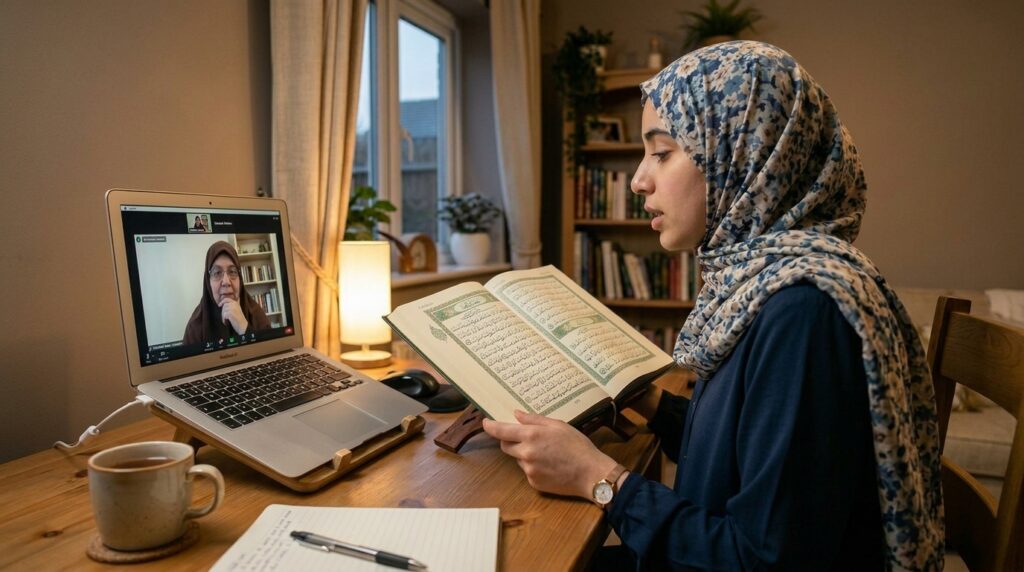
This is exactly why one-on-one online Tajweed classes work well. A qualified teacher listens to your recitation, identifies specific errors, and corrects them in the moment. Over time, your muscle memory adjusts and correct pronunciation becomes natural.
What does not work as well: group classes where your individual recitation gets little airtime, or self-study apps with no human feedback.
If you are serious about learning Tajweed properly, you need consistent one-on-one time with an Ijazah-certified teacher.
How Long Does It Take to Learn Tajweed?
This depends on your starting point and how consistently you practice. But here are realistic benchmarks:
Complete beginners (non-Arabic readers): First learn to read Arabic fluently (typically 3–6 months with Madani Qaida), then begin Tajweed rules — another 6–12 months to reach a solid standard.
Those who can already read Arabic: 3–6 months of focused Tajweed study to correct major errors and build consistent application.
Hifz students: Tajweed is built in throughout the memorisation process — it is learned alongside the verses being memorised.
Consistent practice is the biggest factor. Two or three focused sessions per week with a teacher produces far better results than occasional hour-long sessions.
How to Start Learning Tajweed: A Clear Path
Step 1 — Can you read Arabic? If not, start with Madani Qaida. This teaches Arabic letters, their sounds, and basic joining — the foundation without which Tajweed cannot be applied. See our Madani Qaida course →
Step 2 — Learn Makhaarij first. Before any rules, your teacher should help you produce each Arabic letter from its correct point of articulation. This alone corrects a large percentage of recitation errors.
Step 3 — Learn the most common rules. Noon Sakinah and Tanween rules, Madd rules, and Ghunnah are the highest-impact rules for everyday recitation. Master these before moving to more complex topics.
Step 4 — Apply while reciting Quran. Rules are not learned in isolation — they are learned through recitation. Your teacher assigns portions of the Quran for you to practice applying the rules you’ve learned.
Step 5 — Be corrected consistently. This is why the teacher is irreplaceable. Progress in Tajweed comes through correction — hearing your errors named, understanding why they’re errors, and practicing the correct version until it becomes habit.
If your child is just beginning and cannot yet read Arabic,
read our guide on the right age and starting point for children.
See our full Tajweed course → Or view all Quran courses →
What Makes a Tajweed Teacher Qualified?
Not everyone who can recite the Quran well can teach Tajweed well. Look for:
Ijazah in Tajweed recitation. This certifies that the teacher has been evaluated by a qualified scholar and their chain of transmission is sound. It is the gold standard credential.
Experience teaching non-native speakers. Diagnosing Tajweed errors in students whose native language is English, Urdu, or French is a different skill from teaching native Arabic speakers.
Patience and clarity in explanation. Tajweed errors are often habitual and take time to correct. A teacher who becomes frustrated or moves too fast will not produce confident students.
At Suffah Quran Academy, all our Tajweed teachers hold Ijazah certification and have experience working with students from the UK, USA, Canada, Australia, India, and Pakistan.
Book a free trial class — meet your teacher before committing →
Frequently Asked Questions
No. Tajweed is for anyone who recites the Quran — in Salah, in daily reading, in any context. Hifz students apply it intensively, but every Muslim who recites benefits from learning correct pronunciation.
Yes — and the earlier the better. Children who learn to read Quran without Tajweed often develop habits that take longer to correct later. Adding Tajweed study alongside or immediately after basic reading is ideal.
Absolutely. Many adult students come to us specifically to correct years of habitual errors. It takes consistent practice, but it is entirely achievable — and the improvement in recitation quality is significant and noticeable.
These refer to two different transmission chains (Riwayaat) of the Quran. Most Muslims outside of North and West Africa recite in the Hafs recitation — this is the version taught in virtually all online Quran academies, including Suffah.
No. Tajweed is about pronunciation — the sounds of the letters and their rules. You can learn correct Tajweed recitation without understanding the meaning of the Arabic. Understanding comes separately through Quran translation and tafseer study.
The Right Foundation for a Lifetime of Recitation
Tajweed is not a subject you study and then forget. It is a skill you build, refine, and carry into every Salah, every recitation, every moment you open the Quran.
Getting it right — with a qualified teacher, consistent practice, and patience — is one of the most valuable gifts you can give yourself or your child as a Muslim.
If you’d like to start, or to have your current recitation assessed by a qualified teacher, your first class at Suffah Quran Academy is completely free.
Book your free Tajweed trial class → No payment. No commitment. Just a real lesson.
Estimated reading time: 10 minutes