
Published: August 27, 2026 · ⏱ 10 min read · Ustaz Yusuf Khan, Advanced Tajweed & Fluency Instructor
New here? Read What Is an Ijazah? first for the background on what the certification actually means. This guide picks up from there with the practical steps to earn one yourself.
Most people who search for information about ijazah want to know what it is. This guide is for the smaller group who already know what an ijazah is and want the honest answer to a different question: how do I actually go about getting one, especially if I want to do it online?
There is surprisingly little practical guidance on this online. Most content either explains the concept in the abstract or promotes a specific course without walking through what the process genuinely involves week to week. This guide fills that gap — the real steps, in order, with realistic timelines and the requirements you will actually be held to.
Who Can Realistically Pursue an Online Ijazah?
You do not need to be a native Arabic speaker, a hafiz, or someone who grew up around Quran teachers to pursue an ijazah. What you do need is a working ability to read Quranic Arabic script and a genuine intention to reach a high standard of recitation. In practice, most people who start the ijazah track fall into one of three groups:
- Huffaz and advanced students who have already memorised or read through the Quran and want their recitation formally verified and certified.
- Adults who learned to read Quran later in life and, after several years of tajweed correction, want to take their recitation to a certified standard.
- Aspiring teachers who need the ijazah specifically because it is what allows them to teach recitation and, eventually, certify students of their own.
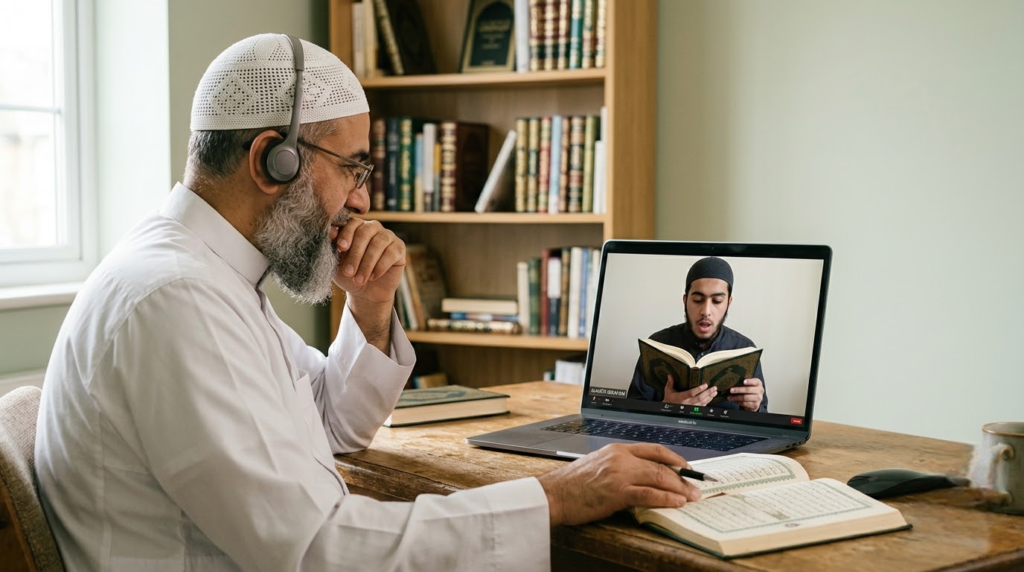
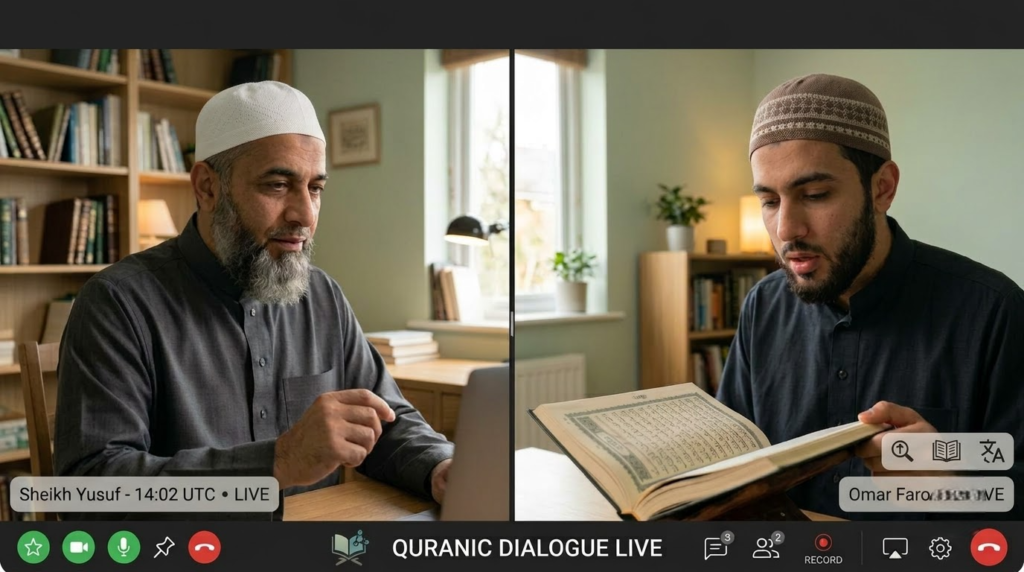
None of these groups needs to relocate or study in person. The recitation, correction, and evaluation that lead to an ijazah can all happen over video call, provided the teacher is genuinely listening and correcting in real time rather than working from a pre-recorded course.
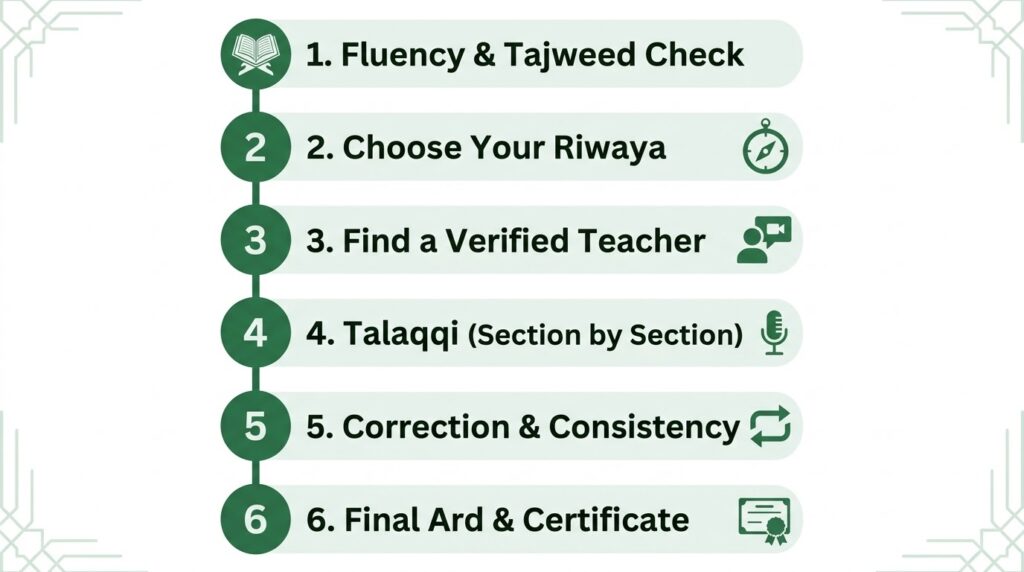
Step 1: Get Your Reading and Tajweed to the Required Standard
This is the step most people underestimate. You cannot begin the formal ijazah recitation process until you can already read the Quran fluently, with correct makharij (letter articulation points) and the core tajweed rules applied instinctively — not looked up rule by rule as you go.
If you are not there yet, this is not a setback — it is simply the honest starting point. Most students spend anywhere from several months to a couple of years working through fluency and tajweed correction before a teacher will agree to start the formal ijazah recitation. Our tajweed rules reference and makharij chart are useful starting points if you want to self-assess where your reading currently stands, though a teacher’s live correction is what actually closes the gaps a self-assessment cannot catch.
A Quick Honesty Check
If you still need to consciously think through tajweed rules while reading rather than applying them automatically, you are not yet ready for the formal ijazah recitation — and that is completely normal. Ask a qualified teacher for an honest assessment before committing to a schedule.
Step 2: Choose Your Riwaya
Before you begin, decide which Riwaya (recitation style) you are pursuing an ijazah in. For the vast majority of students worldwide, this is Riwayat Hafs an Asim — the style used in the standard Mushaf printed in Medina and followed by most Quran teachers and students globally. A smaller number of students, often from North or West Africa, pursue Warsh an Nafi instead, matching the Mushaf used in their region.
This choice matters because it determines which teacher you need — a teacher’s own ijazah and sanad are specific to a Riwaya, and they can only certify you in the same Riwaya they themselves hold. If you are unsure which chain of transmission and certification actually means in the first place, our full explanation of what an ijazah is covers the Sanad concept in more depth than we will repeat here.
Step 3: Find a Teacher Who Holds Their Own Verified Sanad
Not every teacher who holds an ijazah is automatically authorised to grant one to you. Some scholars grant their students an ijazah for their own recitation but do not extend explicit permission to pass certification on to others. Before committing to a teacher for the ijazah track specifically, ask directly:
- Do you hold your own ijazah with a documented Sanad, and in which Riwaya?
- Are you authorised by your own teacher to grant ijazah to your students?
- How many students have you certified through to a full ijazah previously?
- Will lessons be live, one-on-one recitation and correction — not a pre-recorded course?
A teacher who hesitates to answer these questions clearly, or who cannot describe their own Sanad, is not the right person to start this process with — regardless of how the certification is marketed. This is worth taking seriously: the ijazah you eventually receive is only as credible as the chain behind the person granting it.
Doing this entirely online is not a compromise. The scholarly consensus is that what matters is direct, live evaluation by a qualified teacher — not the medium. A teacher listening and correcting over video call is functionally the same process as sitting in front of them in person.
Step 4: Begin Talaqqi — Reciting the Quran Section by Section
Once a teacher agrees to take you through the ijazah process, the actual work begins: Talaqqi, reciting the Quran directly to your teacher in structured portions, most commonly by Juz or by a set number of pages per session, working from Surah Al-Fatiha through to An-Naas.
A typical session works like this: you recite a prepared portion aloud while your teacher listens closely, stopping you the moment an error occurs — a mispronounced letter, a missed ghunnah, an incorrect Madd length, a Waqf in the wrong place. You correct it on the spot and continue. The portion is not considered complete until you can recite it from start to finish without a correction needed.
This is slower than simply reading through the Quran once. It is meant to be. The entire purpose of the ijazah process is that nothing moves forward until it is genuinely correct.
Step 5: Correction, Repetition, and Consistency
Between sessions, the work is on you. Most teachers expect daily independent practice — reviewing the portion you are currently working through, listening to a reference Qari reciting the same section, and drilling any specific error your teacher flagged until it genuinely disappears rather than just improving temporarily.
Do not expect linear progress. It is completely normal to move through several Juz smoothly and then get stuck on a particular Surah for weeks because of one recurring articulation habit. This is not a sign you are unsuited to the process — it is simply what correcting deeply ingrained pronunciation habits actually looks like. Teachers who have taken students through to ijazah before will recognise this and adjust pacing accordingly rather than rushing you past an uncorrected error.
Not Sure Where Your Recitation Currently Stands?
Book a free trial class. Ustaz Yusuf Khan and our Ijazah-certified teachers will assess your reading and tajweed honestly and tell you what stage of the process you are actually ready for.
Book Free Trial Class →Step 6: The Final Ard and Receiving Your Certificate
Once every section of the Quran has been recited and corrected to your teacher’s satisfaction, many teachers require a final closing pass — sometimes a full recitation from memory or with the Mushaf, sometimes a spot-check across randomly selected passages from different parts of the Quran to confirm the standard held consistently throughout, not just in the sections most recently practised.
When your teacher is satisfied, they formally grant the ijazah: a written certificate, typically in Arabic, recording your name, your teacher’s name, the Riwaya you were certified in, and the Sanad connecting your teacher back through their own chain of teachers. This document — and your teacher’s willingness to have their name attached to it — is what makes the certification meaningful. It is also, from this point forward, your responsibility to preserve and pass on accurately if you go on to teach.
How Long Does It Actually Take?
This is the question every prospective student asks, and the honest answer is that it depends heavily on your starting point and consistency. The table below reflects realistic ranges we see across students at different starting levels, attending regular online sessions.
| Starting Level | Typical Weekly Commitment | Estimated Time to Ijazah |
|---|---|---|
| Already fluent, tajweed largely correct | 2 sessions, 30–45 min each | 12–24 months |
| Reads fluently, tajweed needs correction | 2–3 sessions, 30–45 min each | 6–12 months correction, then 18–30 months for the full ijazah track |
| New reader, starting from Qaida | 3+ sessions, 30 min each | 1–2 years to fluency and correct tajweed, then 2–3 years for the ijazah track |
Note: these are typical ranges, not guarantees. A student who attends inconsistently or skips daily practice will take meaningfully longer than these figures, regardless of natural ability. Anyone promising a guaranteed ijazah in a fixed number of weeks, regardless of your starting level, is not describing a genuine ijazah process.
Ijazah Requirements at a Glance
Pulling the steps above together, here is what you actually need to earn an ijazah in Quran recitation:
- Fluent, accurate reading of Quranic Arabic script, without needing to sound out letters or words.
- Correct, instinctive application of core tajweed rules — makharij, noon sakinah and tanween rules, madd, and waqf.
- A teacher with their own verified ijazah and Sanad in the Riwaya you are pursuing, who is explicitly authorised to certify students.
- Consistent weekly attendance over an extended period — this is not a course you complete in a single intensive block.
- Complete recitation of the entire Quran, section by section, corrected to your teacher’s satisfaction with no outstanding errors.
- A final closing assessment confirming the standard held consistently across the whole Quran, not only the most recently practised sections.
What Slows Most Students Down
Inconsistent attendance. Gaps of several weeks between sessions mean re-covering earlier ground rather than progressing, since accuracy fades without regular use.
Rushing past uncorrected errors. Students eager to move forward sometimes push a teacher to advance before a specific error is genuinely fixed. A good teacher will resist this — but it is worth knowing this instinct in yourself so you can work with your teacher’s pacing rather than against it.
No daily practice between sessions. Two sessions a week without any independent review between them is a much slower path than the same two sessions supported by 15–20 minutes of daily practice.
Switching teachers mid-process. Changing teachers partway through can mean starting significant portions over, since a new teacher will typically want to verify your recitation themselves before continuing someone else’s assessment — and your eventual Sanad only carries the chain of the teacher who actually certifies you.
Unrealistic marketing. Programmes advertising a guaranteed ijazah in a fixed short timeframe, regardless of starting level, are describing something other than the traditional process outlined above.
Start With a Structured Foundation
If your reading or tajweed still needs work before the formal ijazah recitation can begin, our one-on-one Tajweed Course is the structured starting point most students take first.
Book Free Trial Class →Frequently Asked Questions
There is no fixed industry price, because an ijazah is not a one-off product — it is the outcome of a long series of paid one-on-one lessons with a qualified teacher. Rather than a single course fee, budget for regular weekly sessions over one to three years, priced the same as any other one-on-one online Quran class. Be cautious of anyone advertising a flat fee for a guaranteed ijazah in a fixed short timeframe.
No. You need to be able to read Arabic script accurately and apply tajweed rules correctly, but conversational fluency in Arabic is not required. Many ijazah holders around the world are non-native Arabic speakers who learned to read and recite with precision without ever becoming conversationally fluent in the language.
Not directly. A complete beginner first needs to learn to read Arabic script (typically through a Qaida), then build fluency, then correct their tajweed to a reliable standard. Only once reading and tajweed are solid does the formal ijazah recitation process — reciting the full Quran section by section to a qualified teacher — actually begin.
Most students attend two structured sessions a week of 30 to 45 minutes with their teacher, plus independent daily practice of 15 to 30 minutes reviewing and preparing the next section. Consistency matters more than volume — a steady two sessions a week over two years will get you further than sporadic intensive bursts.
You do not lose the sections you have already recited and had corrected, but a long pause usually means your teacher will ask you to re-recite a portion of earlier material before continuing, since accuracy can slip without regular practice. Short pauses of a few weeks rarely require this; pauses of many months often do.
There is no fixed age limit. Teenagers and adults of any age can pursue an ijazah, provided their reading and tajweed reach the required standard first. It is less common for young children to begin the formal ijazah track itself, since the process demands sustained focus over a long recitation, though children can absolutely build toward it through earlier stages such as Qaida, fluency, and tajweed correction.
Your Ijazah Starts With the Next Session, Not Someday
The ijazah process rewards students who show up consistently far more than it rewards natural talent. There is no shortcut through it, but there is a clear, well-worn path — get your reading and tajweed to the required standard, find a teacher with a genuine, verified Sanad who is authorised to certify you, and commit to showing up week after week until the whole Quran has been recited and corrected to their satisfaction.
If you are still deciding whether this is the right path for you, our guide to what an ijazah is and why it matters covers the background in more depth. If you already know it is what you want, the next step is simply an honest assessment of where you currently stand.
Book a free trial class to have your recitation assessed → No payment, no commitment — just an honest starting point for your own ijazah journey.

Written by Ustaz Yusuf Khan
Advanced Tajweed & Fluency Instructor · Ijazah-Certified, Riwayat Hafs an Asim · 8 Years Experience · Urdu, Hindi, Arabic
Ustaz Yusuf Khan holds an ijazah in Quran recitation with tajweed in Riwayat Hafs an Asim and has personally taken students through the full ijazah process online, from initial tajweed correction through to final certification. He teaches advanced tajweed and fluency courses for teenagers and adults at Suffah Quran Academy, working with students across the UK, USA, Canada, and Australia.
Meet our teaching team →