

This post contains affiliate links.
Published: July 9, 2026 · 10 min read · Ustaz Muhammad Saad, Hifz Instructor
Almost every parent who contacts us about Hifz asks this question within the first conversation: how long will it take? It is a fair question — Hifz is a multi-year commitment, and families want to understand what they are signing up for before they begin.
The answer most academies give is a range — “three to five years” — delivered quickly and without context. That range is real, but without understanding what determines where a student lands within it, it is not very useful. This article gives the fuller picture: what the timeline actually looks like broken down by age and daily practice, what consistently slows students down, and how to tell whether a child’s current pace is normal or a sign something needs to change.
The Honest Answer First
For most students studying part-time — one or two classes a week online with daily practice at home — the realistic Hifz timeline is 3 to 7 years. That is a wide range, and every variable in that range is meaningful.
Students who complete Hifz in three years are typically young children (ages 7 to 10) with strong daily practice habits, consistent teacher-led revision, and supportive home environments. Students who take seven years or more are typically older beginners, adults with competing commitments, or students whose revision was not managed tightly enough in the early years — allowing forgotten pages to pile up silently.
One-year timelines exist but are almost entirely confined to full-time residential programs where students spend six to eight hours daily on Quran alone. For online, part-time, or home-based programs, one year is not a realistic target — and pushing toward it usually produces weak retention that requires years of re-revision afterward.
Hifz Timeline by Age
Realistic Hifz Timeline by Starting Age
| Starting Age | Realistic Timeline | Key Factor |
|---|---|---|
| Ages 6-8 | 4-6 years | Short attention span; slow start, faster middle |
| Ages 9-12 | 3-5 years | Peak memorization window — fastest typical timeline |
| Ages 13-17 | 4-6 years | School pressure and motivation dips are real factors |
| Ages 18-30 | 5-8 years | Discipline often stronger; initial memorization slower |
| Ages 30+ | 6-10+ years | Longer but absolutely achievable with consistency |
Ages 9 to 12 are widely considered the optimal Hifz window because memory retention is naturally strongest, the child is old enough to sit with focused attention, and new material sticks faster than at any other point in life. This is not a reason to panic if your child is outside this range — it is a reason to understand that approach and expectations need to adjust accordingly.
How Daily Practice Time Changes Everything
Of all the variables in the Hifz timeline, daily practice hours at home have the biggest impact on overall duration — far more than the number of weekly teacher sessions alone. A student who attends class three times a week but does no practice on off days will move at a fraction of the pace of a student who attends twice a week but practices thirty to forty-five minutes every single day.
Daily Practice vs Estimated Impact
| Daily Practice (Home) | Estimated Impact on Timeline |
|---|---|
| Less than 30 minutes | Revision falls behind — timeline extends significantly |
| 30-45 minutes | Minimum viable — slow but sustainable progress |
| 1 hour | Good pace — revision stays manageable |
| 1.5-2 hours | Strong pace — fastest realistic timeline for part-time |
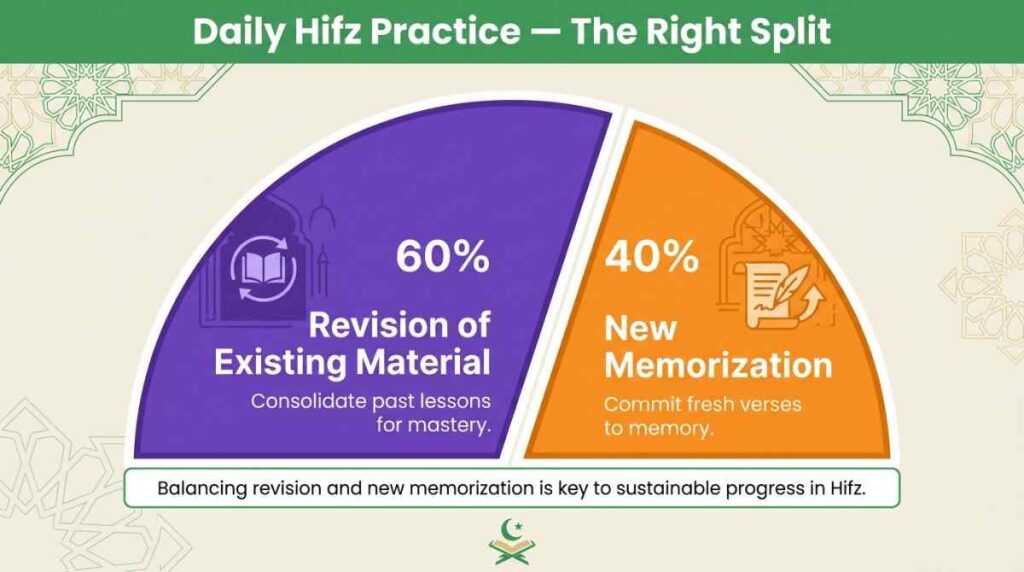
The practice split also matters: roughly 60% revision of existing memorized material and 40% new memorization. Students who invert this ratio — most practice time on new pages, very little on what they already know — see their older pages deteriorate even as newer ones accumulate.
What Actually Slows Hifz Down
After guiding students through Hifz across different age groups, the same causes of slow progress appear repeatedly — none of them are about intelligence or religious commitment:
- Inconsistent scheduling. Missing even two or three days a week consistently adds months to the overall timeline. Hifz rewards daily contact with the material above almost everything else.
- No structured revision system. Memorizing new pages without a systematic plan for revising older ones creates a growing backlog that eventually becomes the main problem.
- Changing teachers frequently. Every teacher has a different method and revision schedule. A child who changes teachers two or three times loses significant momentum each time.
- Rushing new memorization at the expense of retention. Adding new pages faster than the student can retain them reliably is one of the most common errors in self-directed Hifz.
- Starting Hifz before recitation is solid. A student who cannot read Arabic fluently before starting will memorize incorrect pronunciations that must be unlearned later.
The Revision Problem Nobody Warns You About
This is the single biggest hidden timeline factor in Hifz, and it catches almost every family off guard at some point in the journey.
As a student memorizes more of the Quran, the amount of previously memorized material needing daily revision grows continuously. A student who has memorized five juz now has five juz to revise. A student who has memorized fifteen juz has fifteen juz to revise — and still has fifteen more to memorize.
This is why the middle of Hifz — roughly juz 10 to 20 — is where most students hit their slowest and hardest stretch. Students who were not taught a structured revision system from the beginning often reach this point feeling like they are moving backward, because old pages are fading faster than they can refresh them.
A good Hifz teacher builds a rotating revision schedule from day one — not from the day the problem becomes visible. For more on what a structured Hifz program looks like, see our guide on what Hifz ul Quran involves.
Realistic Milestones by Year
For a child aged 9 to 12 with one hour of daily practice and two supervised classes per week — a realistic part-time online program — here is what progress typically looks like:
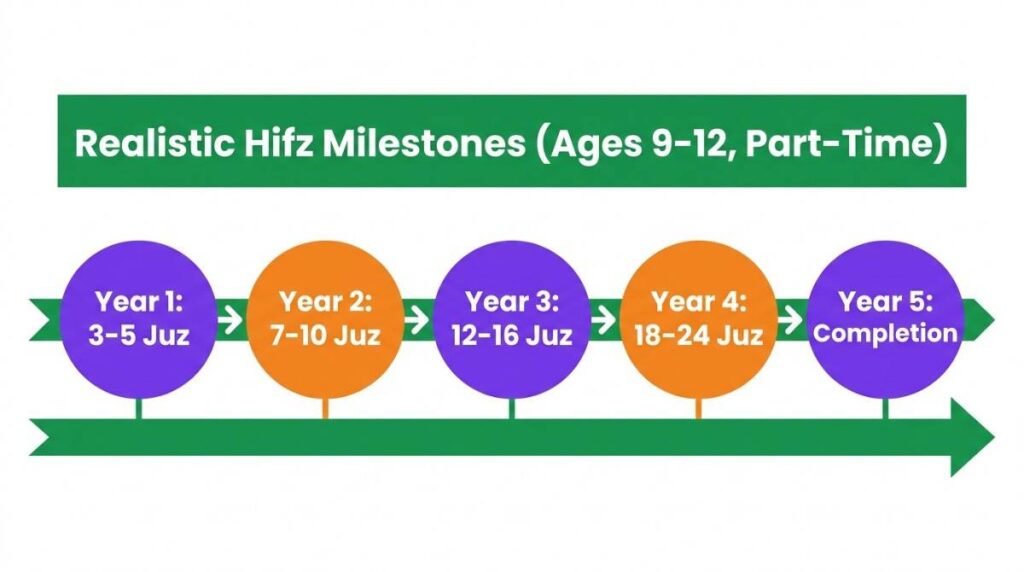
- End of Year 1: 3 to 5 juz memorized, recitation fluency strong, basic revision system established
- End of Year 2: 7 to 10 juz memorized, revision workload noticeably heavier, motivation dip common around juz 8 to 10
- End of Year 3: 12 to 16 juz — this is where consistent students separate from inconsistent ones
- End of Year 4: 18 to 24 juz if pace held, nearing the final stretch
- End of Year 5: Completion realistic for students who maintained consistency throughout
Signs Your Child Is on Track
- New memorization is being added at a consistent rate — even if slow, it is steady
- Previously memorized material can be recited with minimal prompting from the teacher
- The child can recite assigned juz without the Mushaf, not just with it open
- The teacher is giving structured revision assignments alongside new memorization, not just new pages
- The child’s relationship with the Quran feels positive rather than pressure-driven
Starting Hifz or Reviewing Your Child’s Current Pace?
Book a free trial class with our Hifz instructors — we will assess your child’s level and give you an honest picture of what their Hifz journey would look like.
Book Free Trial ClassFrequently Asked Questions
The realistic range is 3 to 7 years for most part-time students, depending on age, daily practice time, teacher quality, and consistency. Children aged 9 to 12 with one to two hours of daily practice typically complete Hifz in 3 to 5 years. Adults generally take 5 to 8 years or more.
Possible in full-time residential programs with 6 to 8 hours of daily study, but not realistic for part-time or online programs. Pushing for a one-year timeline usually produces weak retention requiring years of re-revision afterward.
Ages 9 to 12 are widely considered optimal because memory retention is naturally strongest, attention span is sufficient, and competing commitments are fewer. However Hifz can be successfully completed at any age with consistency and structure.
At minimum 1 hour daily, split between new memorization (40%) and revision of existing material (60%). Less than 30 minutes daily leads to revision falling behind and significantly extends the overall timeline.
Final Thoughts
Hifz is one of the longest commitments in a child’s Islamic education — and one of the most rewarding. The timeline is real and it varies, but the variable that matters most is not age or natural memory ability — it is daily consistency, maintained across months and years, supported by a teacher who manages revision as seriously as new memorization.
If your child is already in a program and you are unsure about their pace, a conversation with an experienced Hifz teacher is the most useful next step. For adults considering starting Hifz, our guide to adult Hifz programs covers the specific considerations for older students.
Ready to Start the Hifz Journey?
Book a free trial class — our Hifz instructors will assess your child’s current level and help plan a realistic structured path forward.
Claim Your Free Trial
Written by Ustaz Muhammad Saad
Hifz Instructor · 6 Years Experience · Hifz, Revision, Tajweed
Ustaz Muhammad Saad has guided students of all ages through Hifz programs, from young children completing their first juz to adults memorizing for the first time in their thirties. He believes honest timeline expectations set at the beginning save families from comparing their child’s journey to someone else’s.
Meet our teaching team