
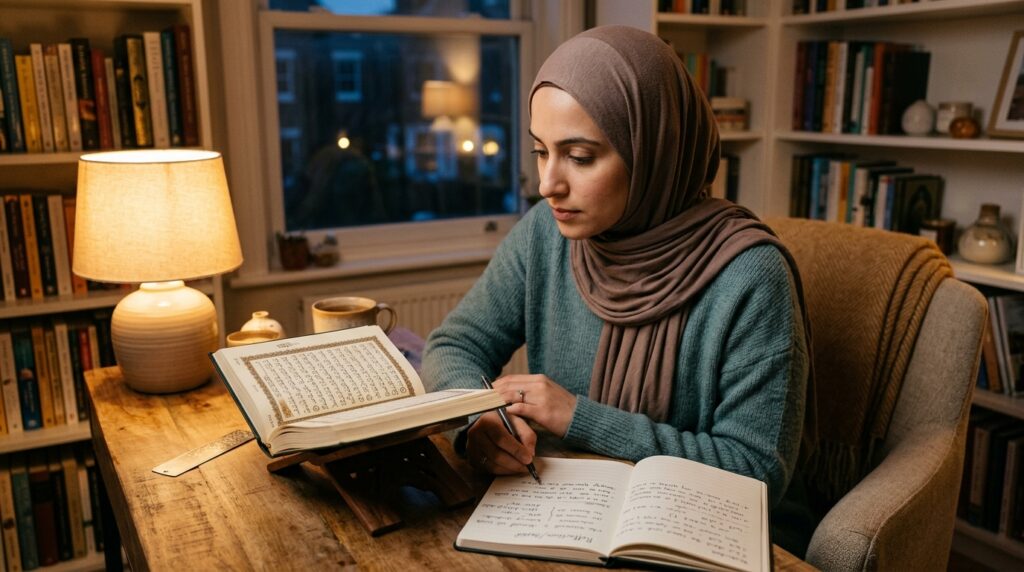
Published: September 20, 2026 · ⏱ 8 min read · Ustadah Ayesha Siddiqua, Female Quran Tutor
This question comes up often, usually phrased quietly: “Can I still do Hifz? I’m in my 30s, I have kids, and I never got the chance when I was younger.” There is already a good general answer on this site about starting Hifz as an adult — but a woman asking this question in her 30s or 40s is usually not worried about her memory. She is worried about whether a female teacher is realistically available, whether starting now means neglecting her household, and whether it is even appropriate to prioritise this for herself at this stage of life.
This article answers those specific concerns honestly, rather than repeating the general adult-Hifz advice that doesn’t quite address them.
The Honest Answer
Yes. There is no age limit on Hifz in Islamic tradition, and there is no rule — religious or practical — that says a woman past her 20s, with a household to run, cannot begin. Many women who start in their 30s, 40s, or later complete meaningful portions of the Quran, and some complete it in full. The Prophet ﷺ praised every sincere reciter regardless of when they began, and that applies fully to a woman starting later in life.
What is true — and worth saying plainly rather than glossing over — is that the shape of the journey is different for a woman managing a household than it is for, say, a university student or a retiree with open mornings. The pace has to be built around real constraints, not an idealised schedule. That’s a planning problem, not a reason to not start.
Why This Question Feels Different for Women
Our general guide on starting Hifz as an adult covers the memory-and-motivation side of adult memorisation well, and it applies to women too. But in practice, three concerns come up specifically — and mostly only — from women considering Hifz later in life:
- “Is there actually a female teacher available, or will I end up learning from a man?” — a real and reasonable concern, not an inconvenience to work around.
- “Am I being selfish, taking time for this when I have young children or a household to run?” — a concern that rarely comes up in general adult-Hifz content, which tends to assume a single working adult with flexible personal time.
- “Will people think it’s strange for a woman my age to be starting something children usually start?” — a social hesitation that has nothing to do with ability and everything to do with unnecessary self-consciousness.
None of these are really about whether Hifz is achievable. They’re about whether it’s arrangeable and whether it’s “allowed” for her to prioritise it — and the honest answer to both is yes.
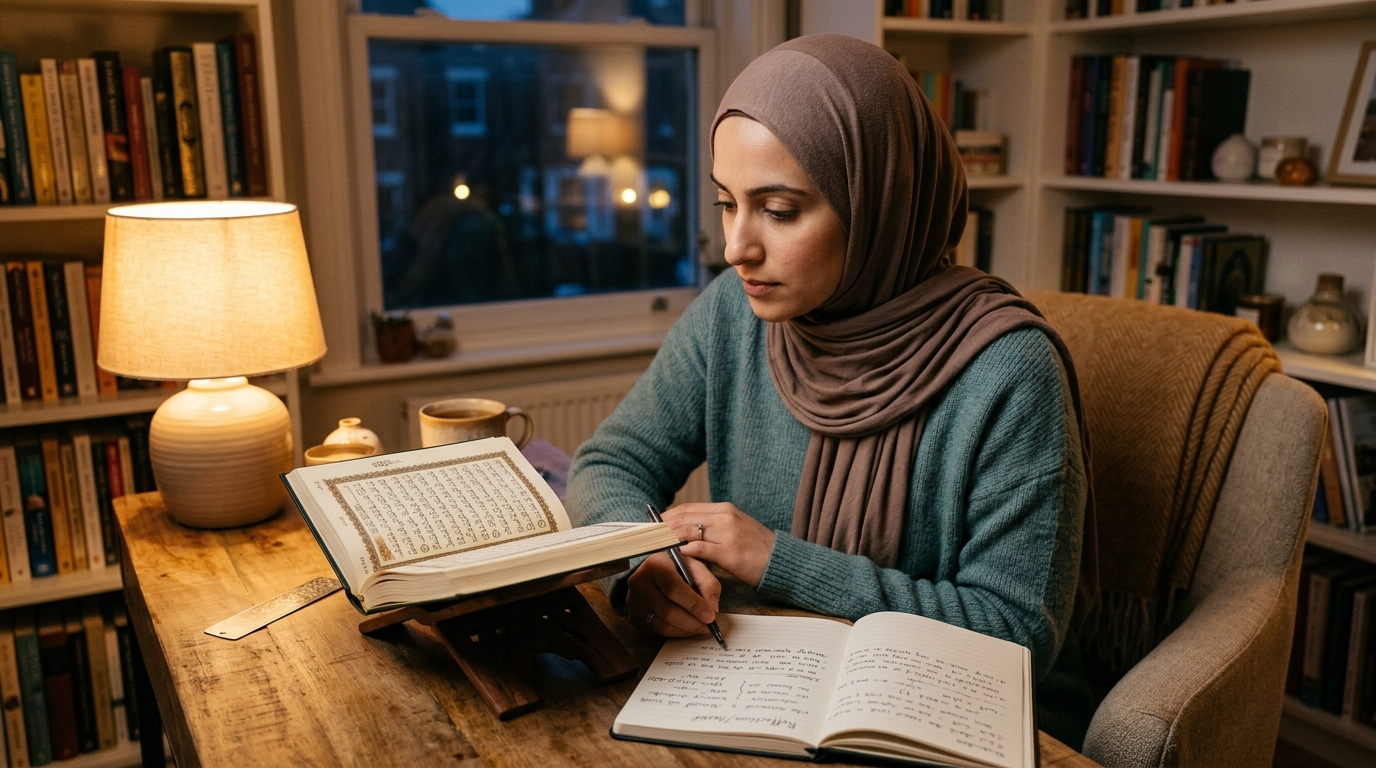
Finding a Female Teacher You’re Comfortable With
This is the single most common reason women hesitate before enrolling anywhere — not the memorisation itself. A one-on-one setting with a male teacher, even over video, is genuinely uncomfortable for many women, and it’s a legitimate preference, not an oversensitive one.
Request a female teacher explicitly when you book your free trial. Our female teachers, including hafizas who teach Hifz specifically, are background-checked and ijazah-certified in the same way as our male teachers, and classes are one-on-one, so your entire session is with your own teacher, not a mixed group. If you’re also involved in choosing a teacher for a daughter alongside your own learning, our guide on what actually makes a good female Hifz teacher covers the same questions worth asking for yourself: how she structures revision, how she handles a page you keep forgetting, and how she paces things when life gets in the way that week.
Fitting Hifz Around a Full Household
A woman managing young children, a household, and often a job as well does not have the same open blocks of time that general “adult Hifz” advice tends to assume. That’s a scheduling reality, not a disqualifying one.
What Actually Works for a Busy Household
- Anchor practice to a time that’s already yours. After Fajr, before the household wakes, or after the youngest child is asleep are the two windows most students in this situation report as realistic — not because they’re ideal, but because they’re the only genuinely quiet minutes in the day.
- Fifteen to twenty minutes is a real session, not a lesser one. A woman with less available time than a full-time student is not doing a smaller version of Hifz — she’s doing Hifz at the pace her actual life allows, which is the only pace that matters.
- Let revision ride alongside Salah. Newly memorised verses recited in your own daily prayers cost no extra time and reinforce memorisation more reliably than practice sessions alone.
- Say it out loud to your household. Children old enough to understand often adjust their own noise and expectations once they know “Ammi’s Quran time” is a real, protected slot — and it quietly models the habit for them too.
A Realistic Pace for a Busy Woman’s Life
Our general guide on adult Hifz timelines lays out the full pacing table by daily practice time, and the same numbers apply here — fifteen to twenty minutes of consistent daily practice puts full Hifz on a realistic multi-year timeline, and a shorter, achievable goal like Juz Amma or a handful of frequently-recited surahs is well within reach in a matter of months.
What’s worth adding specifically here: the women who sustain Hifz longest around a full household are rarely the ones who started with the most ambitious daily target. They’re the ones who picked a small, protected slot they could actually hold onto through a sick child, a busy week, or a stretch of disrupted sleep — and simply didn’t stop showing up to it.
How to Actually Begin
- Book a free trial class and request a female teacher explicitly — no payment required, and no obligation to continue.
- Your teacher assesses your current recitation and discusses what pace and starting point actually fit your household, not a generic template.
- You choose a fixed, protected time slot — early morning is the most commonly reported option among women balancing family responsibilities.
- Progress is reviewed with you regularly, with the plan adjusted around your actual life rather than an idealised one.
Start With a Free Trial — Female Teacher on Request
A real class with one of our female Hifz teachers, at a time that fits around your household — no card required.
Book Free Trial Class → Chat on WhatsApp →For current INR pricing across weekend, regular, and intensive tracks, see our fees and pricing page — kept in one place so it stays accurate rather than repeated across every article.
Frequently Asked Questions
Yes. There is no age limit on Hifz, and many women begin in their 30s, 40s, or later and go on to complete meaningful portions or the full Quran. The pace is simply different than it would be for a child or a full-time student — it needs to be built around your actual household and schedule.
Yes. Request a female teacher when you book your free trial and you’ll be matched with a background-checked, ijazah-certified female hafiza. Classes are one-on-one, so the entire session is with your own teacher.
No. Fifteen to twenty minutes of protected daily time for Hifz does not take away from a household — many students find it strengthens their patience and daily rhythm. Building the habit around an existing quiet window, such as after Fajr, means it doesn’t compete with family responsibilities.
Fifteen to twenty minutes of consistent daily practice is enough to make real, steady progress. It puts full Hifz on a realistic multi-year timeline, and a shorter goal like Juz Amma is achievable in a matter of months at that pace.
You need a solid, correct reading foundation before memorising, since reading errors become memorisation errors. If your recitation needs work first, your teacher will address that in the first few sessions before formal Hifz begins.
Final Thoughts
The honest answer is that your age and your household are not the obstacle you might think they are. The real obstacle is usually the belief that Hifz has to look a certain way — hours of free time, no distractions, starting young — before it “counts.” It doesn’t. Fifteen protected minutes after Fajr, with a female teacher you’re comfortable with and a realistic plan, is a genuine Hifz journey.
Take the First Step Today
Book a free trial class with a female Hifz teacher — an honest first session to see what a realistic plan for you actually looks like.
Book Free Trial Class → Chat on WhatsApp →
Written by Ustadah Ayesha Siddiqua
Female Quran Tutor · 5 Years Experience · Hifz, Noorani Qaida, Nazra
Ustadah Ayesha Siddiqua teaches Quran recitation and Hifz to students of different ages, including adult women beginning later in life, with a calm, structured approach that adapts pacing to the student in front of her rather than a fixed template.
Meet our teaching team →