
This post contains affiliate links.
Published: October 31, 2026 · ⏱ 9 min read · Ustaz Ahmad Raza, Senior Quran & Tajweed Teacher
📖 In This Guide
- What Is the Adab of Reciting the Quran, and Why Does It Matter Before Tajweed?
- Do You Need Wudu to Recite the Quran?
- Facing the Qibla, Posture, and Choosing a Good Place
- Before You Begin: Miswak and the Opening Words
- Reciting with Tarteel, Not Rushing
- Reflecting on the Meaning — and Why It’s Okay to Cry
- Sujud al-Tilawah: What to Do When You Reach a Prostration Verse
- Common Mistakes Beginners Make
- FAQ
What Is the Adab of Reciting the Quran, and Why Does It Matter Before Tajweed?
Adab (أدب) means etiquette or manners — and the adab of reciting the Quran refers to the outward and inward conduct a Muslim is encouraged to observe before, during, and after recitation. It sits alongside Tajweed rather than inside it: Tajweed governs how a letter sounds, while adab governs how you approach the words in the first place — your state of purity, your posture, your attention, and your heart.
Most of what follows is recommended (mustahabb) rather than obligatory — the Quran can genuinely be recited in many situations most scholars describe as permissible. But “permissible” and “best practice” are two different standards, and this guide walks through both: what is actually required, and what the majority of scholars encourage as the fuller, more complete way to approach the words of Allah.
Do You Need Wudu to Recite the Quran?
This is the single most common question beginners and parents ask, and the honest answer has two parts depending on what you mean by “recite.”
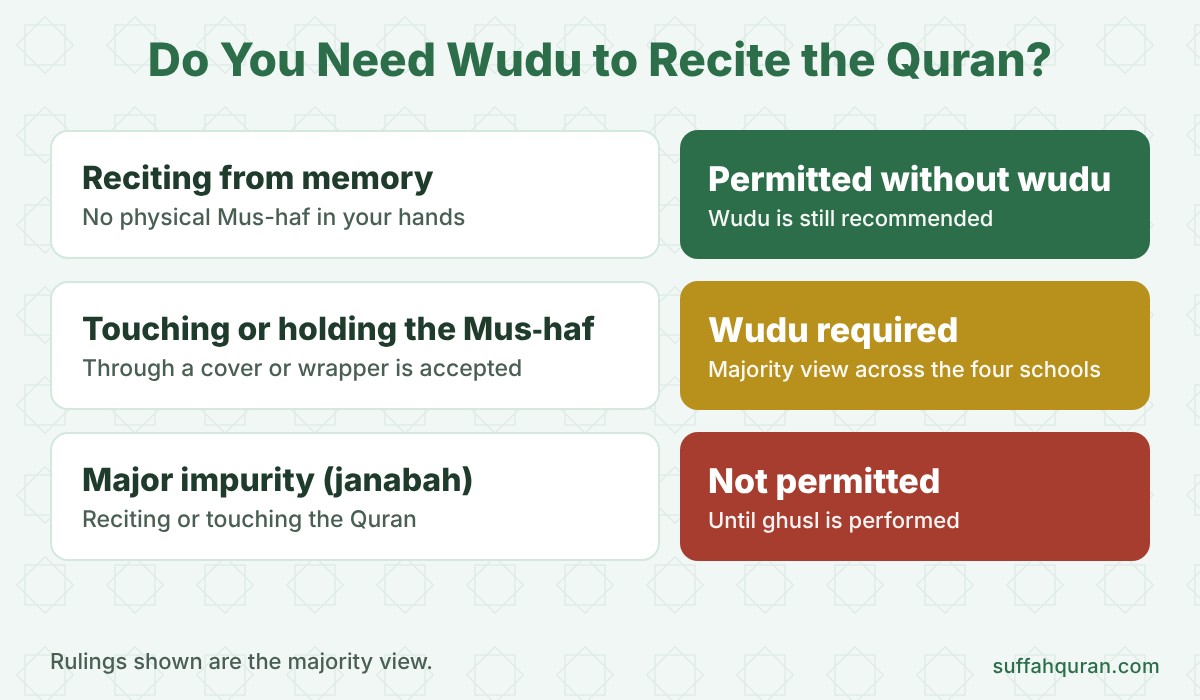
| Situation | Ruling (majority view) |
|---|---|
| Reciting from memory, not touching a physical Mus-haf | Permitted without wudu — ablution is still recommended as best practice |
| Touching or holding the physical Quran (the Mus-haf itself) | Most scholars across the four schools hold that wudu is required; carrying it through a cover, bag, or wrapper is an accepted workaround |
| Reciting or touching the Quran in a state of major impurity (janabah) | Not permitted, from memory or otherwise, until ghusl is performed |
The key piece of evidence scholars cite for requiring wudu to touch the Mus-haf is a hadith transmitted through ‘Amr ibn Hazm: “No one should touch the Quran except one who is pure.” This is sometimes placed alongside a separate, well-known hadith in which the Prophet ﷺ said the believer “never becomes impure” — but these two hadiths answer different questions. The second one, as scholars like al-Nawawi explain, is about a believer’s inherent spiritual state, not about whether wudu is needed for an act like touching the Mus-haf or praying. It doesn’t override the first.
For a student memorizing from a book, in a class, or on a tablet app, the practical takeaway is simple: reciting what you’ve already memorized, out loud or silently, doesn’t require wudu — but if you’re going to physically hold and read from the Mus-haf itself, making wudu first is the position the majority of scholars hold to, and it’s worth building as a habit from day one.
Facing the Qibla, Posture, and Choosing a Good Place
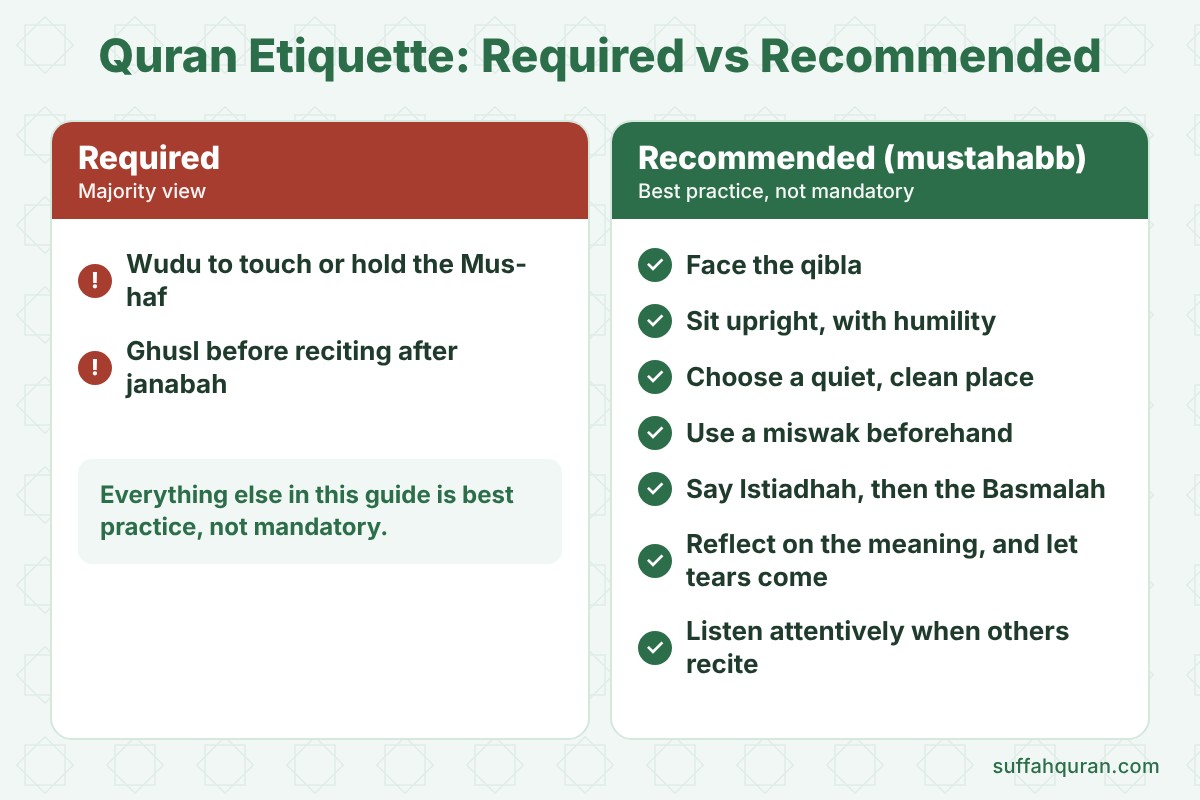
None of the points in this section are obligatory — the Quran can be recited in essentially any clean, respectful setting. But scholars consistently describe the following as the best way to recite, not merely an acceptable one:
- Facing the qibla is recommended, though not required. Many students simply sit the way they’d sit for prayer.
- Sitting upright, with humility and a lowered head, is the posture most teachers encourage — avoiding the relaxed, scanning posture people use for a novel or a news article.
- Casual postures are still permitted. Allah describes the believers in Surah Aali ‘Imran as those who remember Him “standing, sitting, and lying on their sides” (3:191), and there are reports of the Prophet ﷺ reciting while reclining. A tired student reading in bed hasn’t done anything wrong — sitting upright is simply the fuller, more attentive option when it’s available.
- A quiet, distraction-free place is recommended — the masjid is often held up as an ideal, but any clean, calm corner of the home works for daily practice.
For children especially, this is a useful point to be flexible about: insisting on a single “correct” posture before a young learner is comfortable with the words themselves can turn recitation into a chore. Build the respectful habits gradually, alongside the actual Tajweed rules, rather than all at once.
Before You Begin: Miswak and the Opening Words
Two small habits traditionally come right before the first word of recitation:
- Using a miswak (siwak) beforehand is recommended — cleaning the mouth is treated as a fitting way to prepare for speaking words as significant as the Quran.
- Saying Istiadhah, then the Basmalah, immediately before the first word of the surah. This is such a specific, detailed topic — when to say each one aloud versus silently, the four accepted ways of joining them, and the one surah that skips the Basmalah entirely — that it has its own place in our Tajweed Rules Reference, rather than being repeated here.
Reciting with Tarteel, Not Rushing
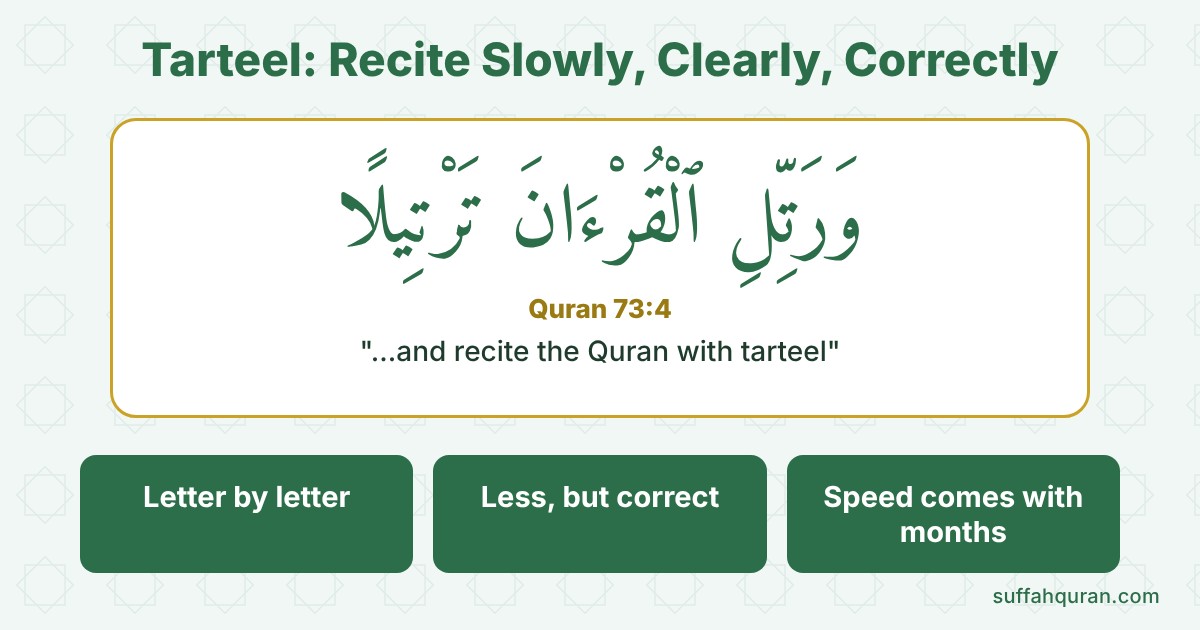
Tarteel (ترتيل) means reciting slowly, clearly, and with correct pronunciation — letter by letter, rather than racing toward the end of a page. Allah instructs this directly: “…and recite the Quran with tarteel” (Quran 73:4). It is the opposite of rushing through rules like elongation (madd) just to finish quickly.
In practice, tarteel is what makes every other Tajweed rule possible. A student who rushes through a 4- or 6-count elongation, for example, is skipping the exact habit tarteel asks for — see our Madd rules guide for how those elongations actually work. The goal isn’t reciting more of the Quran faster; it’s reciting less, correctly, and building speed naturally over months of practice rather than forcing it on day one.
Reflecting on the Meaning — and Why It’s Okay to Cry
Beyond correct pronunciation, scholars describe tafakkur — reflecting on the meaning of what’s being recited — as an important companion to the words themselves. Traditional guidance encourages a reciter to ask for mercy at verses describing Allah’s mercy, to seek forgiveness at verses about forgiveness, and to feel the weight of verses describing the fate of earlier nations who rejected the message.
Crying while reciting is described as recommended, not as something to suppress or feel embarrassed about — and scholars even encourage trying to bring tears, out of humility, when they don’t come naturally. For students (and parents) who feel self-conscious about an emotional reaction during recitation or in class, this is worth knowing: it is treated as a sign of a soft, receptive heart, not a loss of composure.
Listening attentively when someone else recites is treated the same way — described as recommended and rewarding in its own right, which is part of why group recitation and listening to a teacher model a verse before repeating it is such a core part of how Tajweed is actually taught.
Sujud al-Tilawah: What to Do When You Reach a Prostration Verse
Scattered through the Quran are specific verses that mention prostration to Allah, and the sunnah is to physically prostrate — briefly, outside of the regular prayer — when you recite or hear one of them recited (the Hanafi school holds it to be wajib). This single prostration is called Sujud al-Tilawah (سجود التلاوة), the “prostration of recitation.”
The most widely cited list has fifteen positions across the Quran, based on a hadith narrated by ‘Amr ibn al-‘As (reported by Abu Dawud and Ibn Majah, though scholars have discussed its chain). The four schools count slightly differently — Hanafi 14, Shafi’i 14, Hanbali 15 and Maliki 11 — mainly over Al-Hajj 22:77, Sad 38:24 and the three verses of the Mufassal section (An-Najm, Al-Inshiqaq and Al-‘Alaq):
| # | Surah | Ayah |
|---|---|---|
| 1 | Al-A’raf | 7:206 |
| 2 | Ar-Ra’d | 13:15 |
| 3 | An-Nahl | 16:49–50 |
| 4 | Al-Isra | 17:107–109 |
| 5 | Maryam | 19:58 |
| 6 | Al-Hajj | 22:18 |
| 7 | Al-Hajj (2nd) | 22:77 |
| 8 | Al-Furqan | 25:60 |
| 9 | An-Naml | 27:25–26 |
| 10 | As-Sajdah | 32:15 |
| 11 | Sad | 38:24 |
| 12 | Fussilat | 41:37–38 |
| 13 | An-Najm | 53:62 |
| 14 | Al-Inshiqaq | 84:21 |
| 15 | Al-‘Alaq | 96:19 |
Outside of prayer, performing Sujud al-Tilawah is simple: be in wudu and face the qibla (the four schools apply the same conditions as for prayer), say “Allahu Akbar,” go down into a single prostration (the same position used in prayer), and some reciters add a short dhikr before rising — there is no standing or tashahhud, and in the Hanafi and Maliki practice no closing salam (some Shafi’i and Hanbali scholars add one, so follow your own school). If you’re reciting silently or privately at home and reach one of these verses, you can pause, prostrate, and continue. It’s a small, physical acknowledgment built directly into the act of recitation itself, and it’s worth teaching to children early so the verse doesn’t catch them by surprise the first time a teacher prostrates mid-lesson. For the full verse-by-verse list and the differences between the schools, see our guide to Ayat al-Sajdah.
Common Mistakes Beginners Make
- Treating every point in this guide as equally obligatory. Facing the qibla, sitting a particular way, and using a miswak are all recommended, not required — confusing “best practice” with “mandatory” can make recitation feel like a list of rules to fear getting wrong, rather than an act of worship to grow into.
- Assuming any lack of wudu stops recitation entirely. It only affects touching the physical Mus-haf (per the majority view) — reciting from memory stays open at any time outside of major impurity.
- Rushing through tarteel to “get through” a page. Speed without accuracy undermines the very rules — like elongation and the letter-specific Tajweed rules — that tarteel exists to protect.
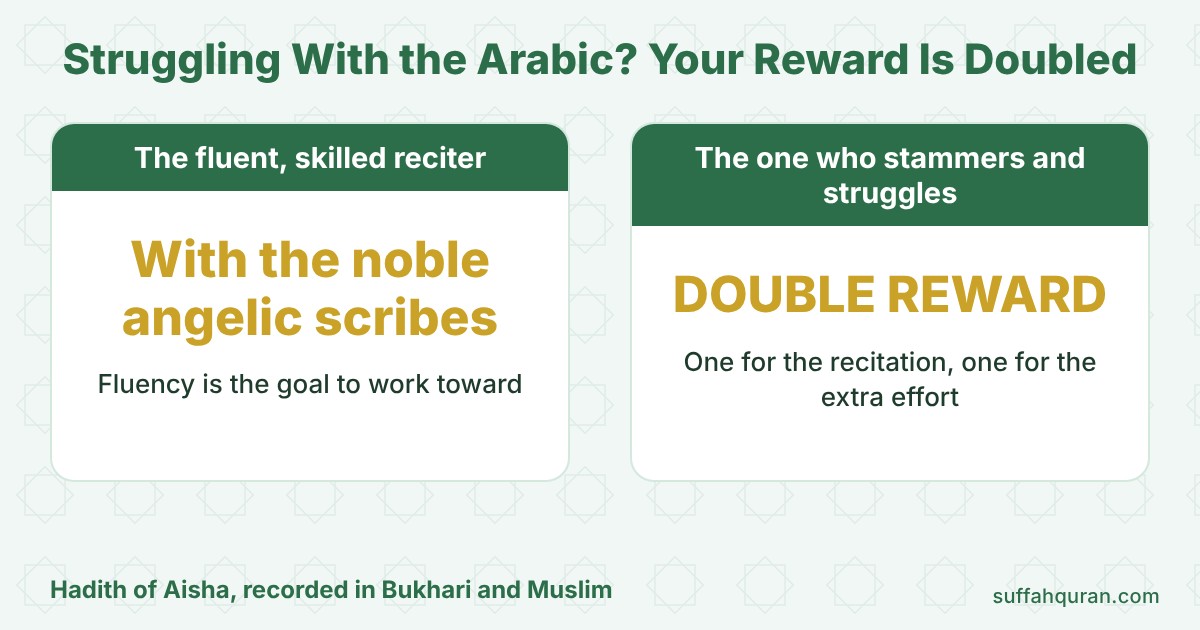
- Feeling discouraged by mistakes instead of encouraged to keep going. There’s a well-known hadith, narrated by Aisha and recorded in Bukhari and Muslim, that the reciter who is fluent and proficient will be in the company of the noble, honourable angelic scribes — and the one who recites with difficulty, stammering through it, still receives a double reward: one for the recitation, and one for the extra effort. Struggling with the Arabic as a beginner isn’t a setback to the reward — it’s part of it.
If mistakes and slow progress are the main source of frustration in your (or your child’s) recitation journey, our guide on common challenges in Quran memorization goes deeper into exactly this — what’s normal, what’s a signal to adjust the approach, and how to keep motivation steady over months, not just days.
FAQ
Do I need wudu to recite the Quran?
Not to recite from memory — that’s permitted without wudu, though ablution is still recommended as best practice. Touching or holding the physical Mus-haf is a different matter: most scholars across the four schools hold that wudu is required for that specifically.
Can I read the Quran on my phone or tablet without wudu?
This specific question is debated among contemporary scholars, since a screen isn’t the same physical object as a Mus-haf. Many take a cautious approach and still recommend wudu when reading Quran text on a device, though views differ — it’s worth asking a local scholar if you want a ruling specific to your situation.
Is it necessary to face the qibla while reciting?
No — it’s recommended, not required. The Quran can be recited facing any direction; facing the qibla is simply described as the better practice when it’s convenient to do so.
What should I do if I recite a Sujud al-Tilawah verse outside of prayer?
Pause, make sure you are in wudu and facing the qibla, say “Allahu Akbar,” perform one brief prostration the same way you would in prayer, then rise and continue your recitation. There is no standing or tashahhud, and whether to add a closing salam depends on your school.
Will I get less reward if I stumble over the Arabic as a beginner?
No — quite the opposite. The hadith recorded in Bukhari and Muslim describes a double reward for the reciter who struggles and stammers through the Quran: one for the recitation itself, and one for the extra effort it takes. Fluency is the goal to work toward, not a condition for the reward to count.
Want a teacher to help build these habits alongside correct Tajweed, right from your very first lesson? Book a free trial class with Suffah Quran Academy and start learning with proper guidance from day one.

Written by Ustaz Ahmad Raza
Senior Quran & Tajweed Teacher · 8 Years Experience · Tajweed, Nazra Quran, Madani Qaida · Urdu, Hindi, English
Ustaz Ahmad Raza has been teaching Quran and Tajweed for 8 years and holds an Ijazah in Quran recitation with Tajweed. He wrote this guide because new students often learn Tajweed’s sounds before anyone explains the etiquette around them — and the two are meant to be taught together.
Meet our teaching team →