
This post contains affiliate links.
Published: October 31, 2026 · ⏱ 9 min read · Ustaz Ahmad Raza, Senior Quran & Tajweed Teacher
📖 In This Guide
- What Is Ayat al-Sajdah?
- All 15 Sajdah Verses in the Quran (With References)
- Why the Count Differs Between Schools (11 to 15)
- Is Sujud al-Tilawah Obligatory or Recommended?
- How to Perform Sujud al-Tilawah, Step by Step
- What If You’re Reciting in a Group, or Can’t Prostrate Right Away?
- Does It Count If You Only Hear the Verse?
- FAQ
Every reciter eventually hits one of these moments mid-ayah: you’re reading through a Juz for Sabqi review, and suddenly the verse in front of you is talking about the heavens, the earth, and everything in them prostrating to Allah — and you remember, half a second too late, that this is one of those verses. The ones where you’re actually supposed to stop and prostrate — the Ayat al-Sajdah.
These are the Ayat al-Sajdah — the “verses of prostration” — and most students learn about them the awkward way, mid-recitation, rather than ahead of time. This guide covers exactly where they are, why scholars don’t all count the same number, whether prostrating is obligatory, and the simple steps to actually do it.
What Is Ayat al-Sajdah?
An Ayah al-Sajdah (plural: Ayat al-Sajdah) is a verse of the Quran that mentions prostration to Allah in a way that calls for the reciter — or listener — to physically prostrate on the spot. This single prostration is called Sujud al-Tilawah, “the prostration of recitation,” to distinguish it from the five daily prayers and from Sujud al-Shukr (a prostration of gratitude performed for good news, unrelated to recitation).
The practice goes back to the Prophet ﷺ himself. Multiple hadith report that he would prostrate when he reached these verses in recitation, and that the Sahabah who were listening prostrated along with him — which is also the basis for the ruling, discussed below, that hearing a Sajdah verse recited by someone else can obligate the same response as reciting it yourself. It’s one more example of why building a habit of learning the “why” behind a practice, not just the mechanics, matters so much — see our guide on hadith about learning the Quran for more on this principle.
All 15 Sajdah Verses in the Quran (With References)
The most widely cited list — based on a hadith from ‘Amr ibn al-‘As reported by Abu Dawud and Ibn Majah, though scholars have discussed its chain — gives fifteen positions across the Quran. Ten of these are accepted by all four schools; the rest carry some disagreement, covered in the next section.
| # | Surah | Ayah |
|---|---|---|
| 1 | Al-A’raf | 7:206 |
| 2 | Ar-Ra’d | 13:15 |
| 3 | An-Nahl | 16:49-50 |
| 4 | Al-Isra | 17:107-109 |
| 5 | Maryam | 19:58 |
| 6 | Al-Hajj | 22:18 |
| 7 | Al-Hajj (disputed — see below) | 22:77 |
| 8 | Al-Furqan | 25:60 |
| 9 | An-Naml | 27:25-26 |
| 10 | As-Sajdah | 32:15 |
| 11 | Sad (disputed — see below) | 38:24 |
| 12 | Fussilat | 41:37-38 |
| 13 | An-Najm | 53:62 |
| 14 | Al-Inshiqaq | 84:21 |
| 15 | Al-‘Alaq | 96:19 |
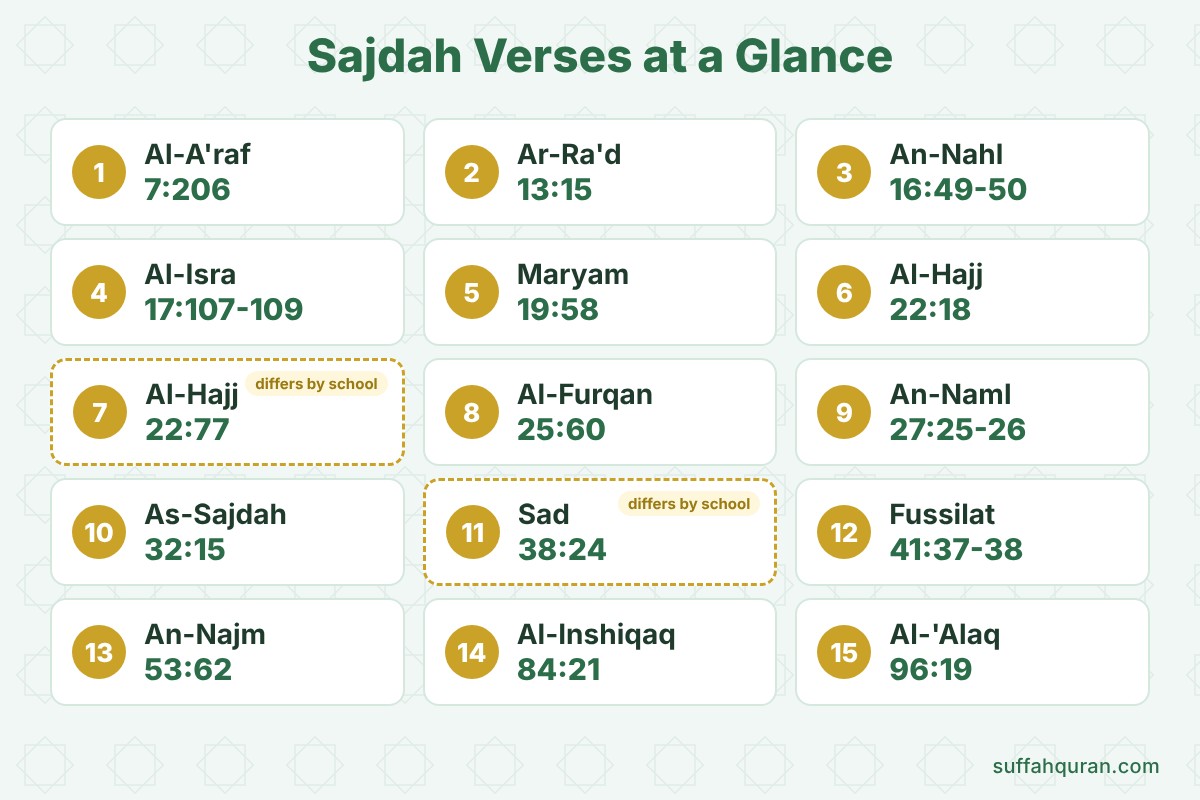
A few are easy to remember just by name: Surah As-Sajdah (32) is literally named after this practice, and Surah Al-‘Alaq (96) places its Sajdah on the very last ayah, right where most reciters finish the Surah in Salah or Hifz review.
Why the Count Differs Between Schools (11 to 15)
If you’ve seen a Mushaf or app that marks only 14 Sajdah positions instead of 15, that isn’t an error — it reflects a genuine, long-standing difference between the madhabs, centred on a handful of specific verses:
- Al-Hajj 22:77 — Surah Al-Hajj is unusual in having two Sajdah positions (22:18 and 22:77). The first is essentially undisputed. The second is the one scholars disagree on: some hold there’s no clear Sunnah establishing it as a recitation-Sajdah at all, while others note that several Companions are reported to have prostrated there.
- Sad 38:24 — this verse describes Dawud (David), peace be upon him, falling in repentance rather than describing creation prostrating to Allah the way the other fourteen do. Some scholars classify the prostration here as one of gratitude and repentance rather than a standard recitation-Sajdah; others — citing hadith evidence — keep it on the main list regardless.
- The three “Mufassal” verses (An-Najm 53:62, Al-Inshiqaq 84:21, Al-‘Alaq 96:19) — the Maliki school does not count these as Sajdah verses, which is a large part of why its total is 11 rather than 14 or 15.
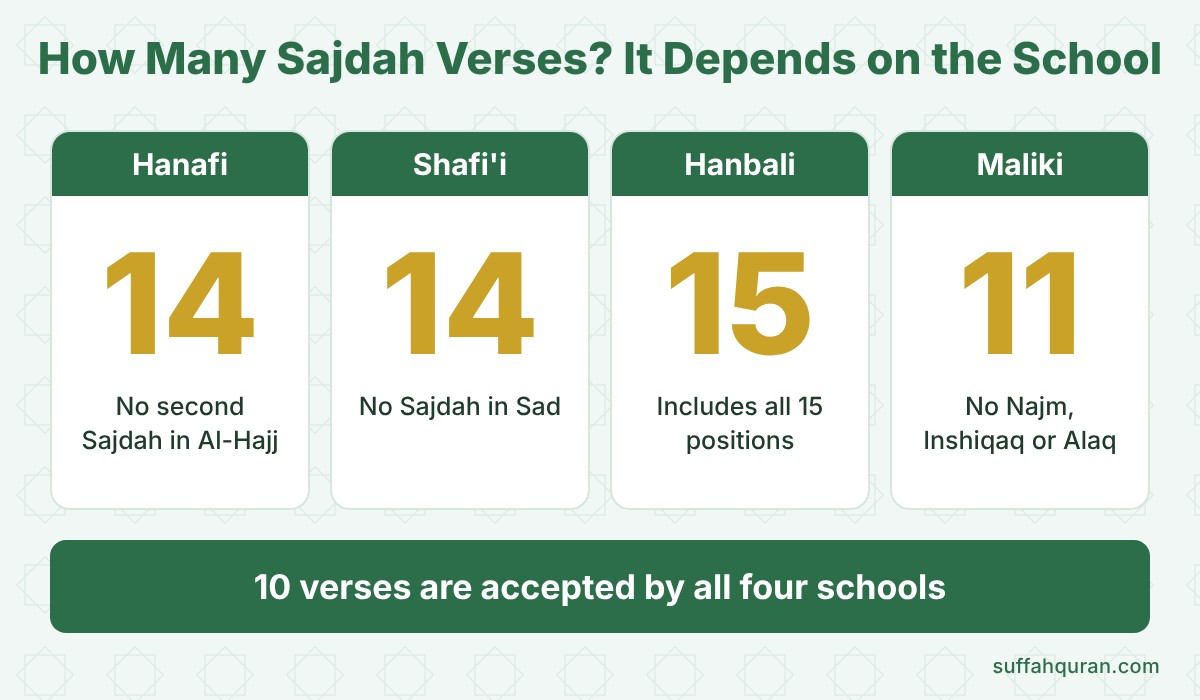
In practice, the usual school-by-school counts are: Hanafi 14 (no second Hajj Sajdah), Shafi’i 14 (no Sad), Hanbali 15, and Maliki 11 — which is why different printed Qurans and apps mark slightly different totals. Ten verses are prostrated at by all four schools without dispute. For the rest, follow whatever your own teacher, Mushaf edition, or school of thought directs, and ask your teacher if you’re unsure rather than guessing.
Is Sujud al-Tilawah Obligatory or Recommended?
This is itself a point where the schools diverge:
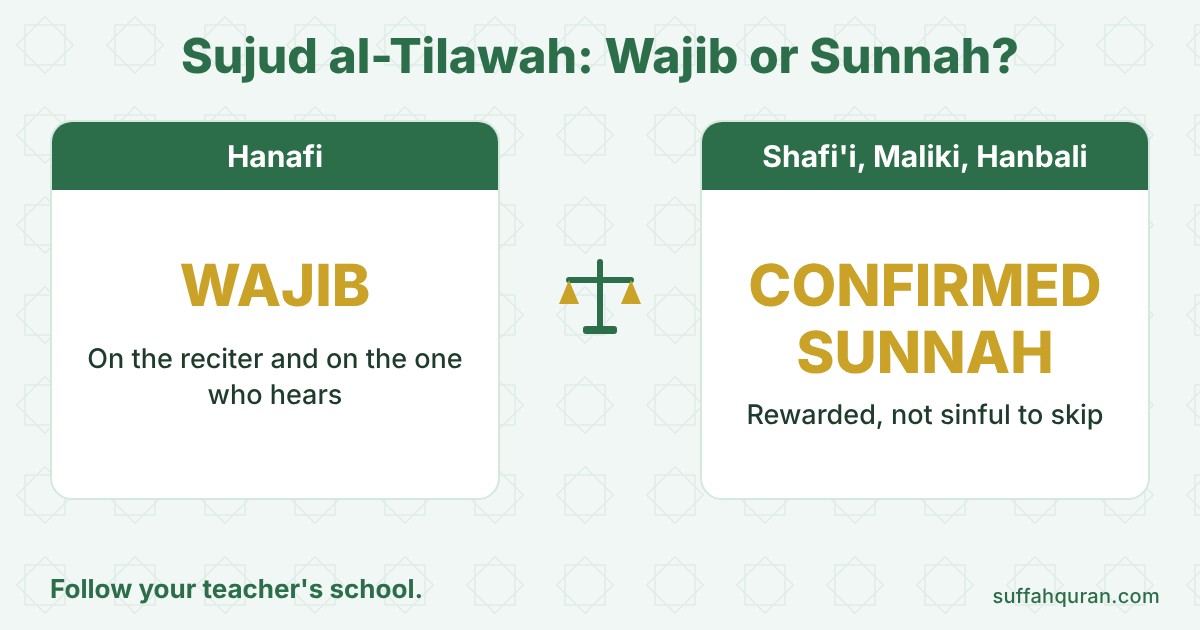
- Hanafi school: holds Sujud al-Tilawah to be wajib (obligatory) on both the reciter and an attentive listener, based on the imperative tone of verses like Al-Inshiqaq 84:21 (“so what is wrong with them that they do not believe, and do not prostrate…”).
- Shafi’i, Maliki, and Hanbali schools: hold it to be a confirmed sunnah — strongly encouraged and rewarded, but not sinful to skip. Part of the basis cited for this is that ‘Umar ibn al-Khattab is reported to have occasionally recited a Sajdah verse from the pulpit without prostrating, which these scholars take as evidence it isn’t strictly obligatory.
Whichever view you follow, the practical takeaway is the same: this is a Sunnah act with real reward attached, worth building into your recitation habit rather than treating as optional trivia. A well-known hadith (reported by Muslim, via Abu Hurairah) has the Prophet ﷺ explain that when a son of Adam recites a Sajdah verse and prostrates, Shaytan withdraws weeping, saying: “Woe to me — the son of Adam was commanded to prostrate, and he prostrated, so he will have Paradise; and I was commanded to prostrate, and I refused, so I will have the Fire.”
How to Perform Sujud al-Tilawah, Step by Step
Unlike a full prayer, this is a single, simple prostration — no standing and no tashahhud. Outside of Salah, the steps are:
- Be in a state of wudu and face the Qibla. The four schools treat these as conditions for Sujud al-Tilawah, as for Salah; a minority of scholars, including Ibn Taymiyyah, allow it without them, but doing both is the safest practice.
- Say “Allahu Akbar” as you lower yourself into the prostration — this is a confirmed Sunnah based on the practice of Ibn ‘Umar.
- Prostrate once, placing your forehead and nose on the ground exactly as you would in Salah.
- Glorify Allah while prostrating. At minimum, say “Subhana Rabbiyal-A’la” (Glory be to my Lord, the Most High) as you would in a prayer prostration. Many reciters also say the specific dua reported from the Prophet ﷺ via ‘Aishah: “Sajada wajhi lilladhi khalaqahu, wa shaqqa sam’ahu wa basarahu, bi hawlihi wa quwwatih” — “My face has prostrated to the One who created it, and split open its hearing and sight, by His power and might.”
- Rise, saying “Allahu Akbar” again, and continue your recitation from where you left off.
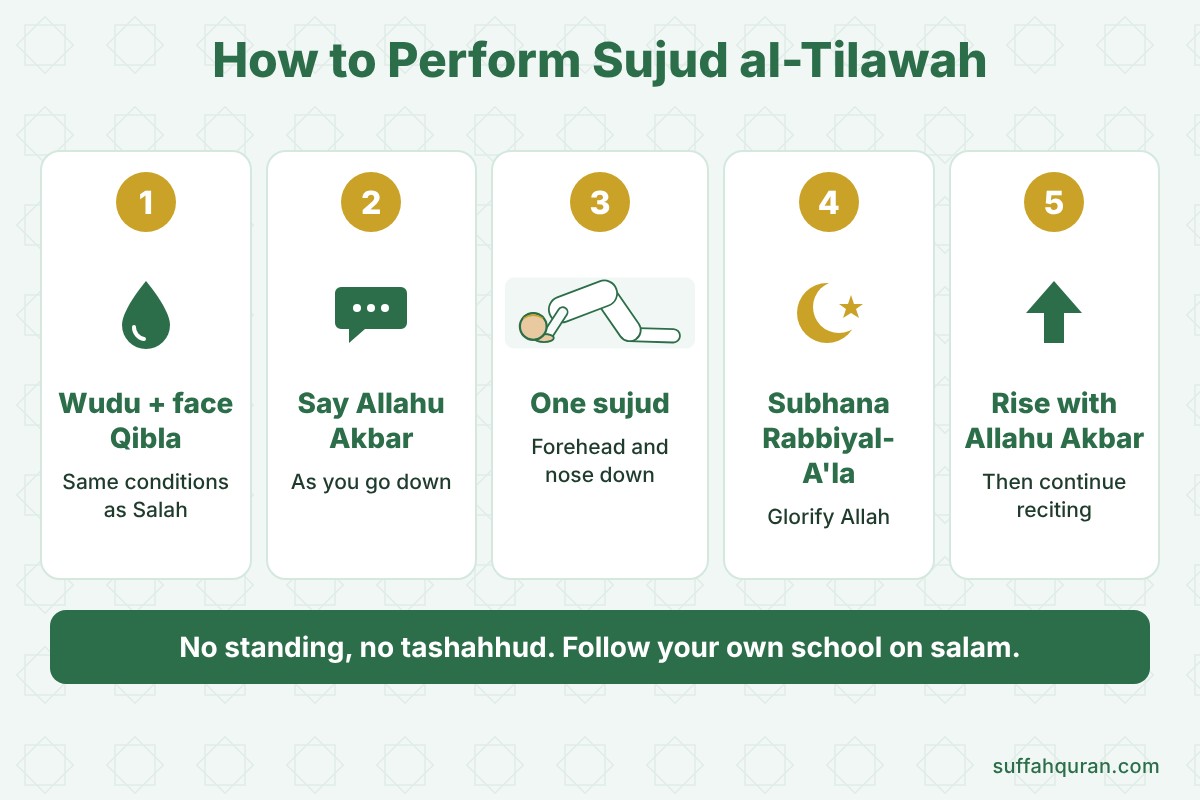
That’s it — no tashahhud, and in the Hanafi and Maliki practice no closing salam either (some Shafi’i and Hanbali scholars do add one, so follow your own school). If you’re already in Salah when you reach a Sajdah verse, the same brief prostration simply happens inside the prayer itself, between the recitation and the rest of that rak’ah.
What If You’re Reciting in a Group, or Can’t Prostrate Right Away?
A few situations come up often enough to plan for:
- You’re reciting from memory during Hifz review and lose your place after prostrating. This is normal — pause, take a moment to re-locate exactly where you stopped, and resume. It’s far better than skipping the Sajdah to avoid the interruption. If this keeps happening at the same spot, it’s worth flagging in your next Sabaq Sabqi Manzil review session so your teacher can help you build the pause into your memorisation naturally.
- You’re somewhere you genuinely can’t prostrate — on a train, in a meeting, somewhere unclean. The Sajdah isn’t lost; perform it as soon as you reasonably can afterward, in a suitable place.
- You’re the one leading recitation for a class or group. Pause clearly after the verse, say the takbir audibly enough for listeners to follow, and give everyone a moment to prostrate together before continuing.
Does It Count If You Only Hear the Verse?
Yes, for the attentive listener — the Sahabah prostrated along with the Prophet ﷺ when he recited, and scholars across the schools say a person who listens to a Sajdah verse should prostrate too (the Hanafi school treats it as wajib even on someone who simply hears the verse). If you’re only within earshot of background audio you aren’t following, the other schools generally don’t ask the same of you, since their basis is attentive listening, not mere proximity to sound.
FAQ
How many Sajdah verses are in the Quran?
The most commonly cited list has 15, based on a hadith from ‘Amr ibn al-‘As. Counts differ by school — Hanafi 14, Shafi’i 14, Hanbali 15 and Maliki 11 — with ten verses accepted by all four schools.
Is Sujud al-Tilawah obligatory?
The Hanafi school holds it to be wajib (obligatory). The Shafi’i, Maliki, and Hanbali schools hold it to be a confirmed sunnah — highly encouraged but not sinful to miss. Follow whichever your own teacher or school directs.
Do I need wudu to perform Sujud al-Tilawah?
Yes, according to the four schools, who treat it like Salah in requiring purity (wudu) and facing the Qibla. A minority view, held by scholars such as Ibn Taymiyyah, allows it without wudu, but being in wudu is always better.
What do I say during the prostration?
At minimum, “Subhana Rabbiyal-A’la,” the same glorification used in Salah. Many reciters also add the dua reported via ‘Aishah: “Sajada wajhi lilladhi khalaqahu, wa shaqqa sam’ahu wa basarahu, bi hawlihi wa quwwatih.”
What if I’m listening to Quran audio and a Sajdah verse comes on?
If you’re attentively listening and following the recitation, you should prostrate (wajib in the Hanafi view, strongly recommended in the others). Passive background audio you aren’t actually following is generally not treated the same way by the other schools.
Knowing where the Sajdah verses fall is exactly the kind of detail that’s easy to memorise once and forget under pressure — which is why it’s worth reviewing alongside the rest of your Tajweed Rules Reference rather than leaving it for the moment you stumble into one mid-Surah. If you’d like a teacher to walk through these verses with you and confirm you’re handling them correctly, book a free trial class with Suffah Quran Academy.

Written by Ustaz Ahmad Raza
Senior Quran & Tajweed Teacher · 8 Years Experience · Tajweed, Nazra Quran, Madani Qaida · Urdu, Hindi, English
Ustaz Ahmad Raza has been teaching Quran and Tajweed for 8 years and holds an Ijazah in Quran recitation with Tajweed. He wrote this guide to help students know ahead of time where the Sajdah verses fall, so they are never caught off guard mid-recitation.
Meet our teaching team →