
This post contains affiliate links.
Published: November 2, 2026 · ⏱ 8 min read · Ustaz Ahmad Raza, Senior Quran & Tajweed Teacher
If you are learning to recite, the istiadhah and basmalah rules are the first thing to get right, because every recitation begins with them. This guide explains what each phrase means, when to say Istiadhah aloud or silently, why Surah At-Tawbah has no Basmalah, and the accepted ways to join them with the start of a surah.
📖 In This Guide
- What Is Istiadhah (Ta’awwudh)?
- What Is Basmalah (Tasmiyah)?
- When to Say Istiadhah Aloud vs. Silently
- Why Surah At-Tawbah Has No Basmalah
- Istiadhah and Basmalah Rules: The 4 Ways to Join Them with the Surah
- Joining the Basmalah Between Two Surahs
- Common Mistakes Beginners Make
- FAQ
What Is Istiadhah (Ta’awwudh)?
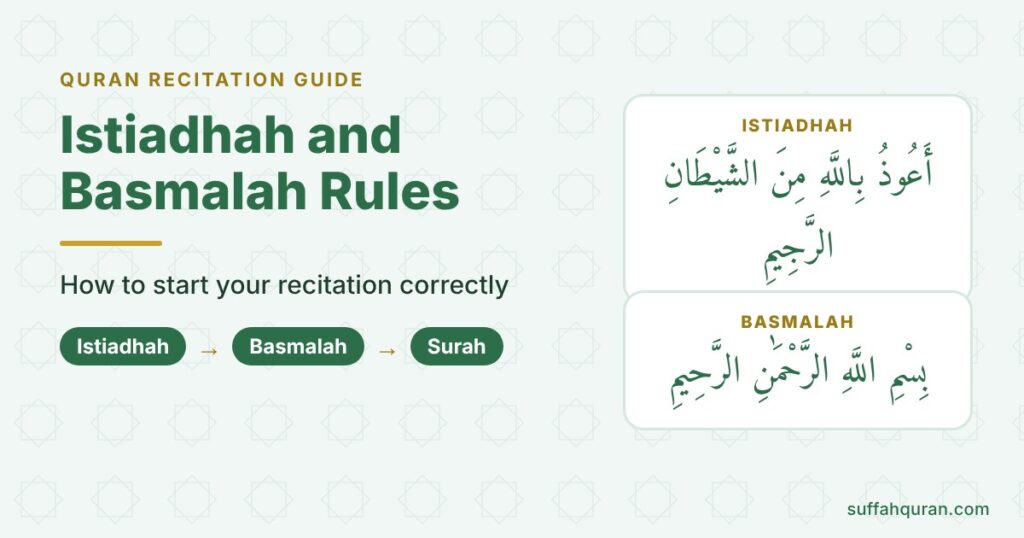
Istiadhah (الاستعاذة), also called Ta’awwudh, is the phrase “A’oodhu billahi minash-shaytanir-rajeem” (أَعُوذُ بِاللَّهِ مِنَ الشَّيْطَانِ الرَّجِيمِ) — “I seek refuge in Allah from Satan, the accursed.” It is said immediately before you begin reciting, as a short prayer asking Allah’s protection from Satan’s whispers and distractions while you recite His words.
Istiadhah is not part of the Quran itself — it is a statement the reciter adds before starting, based directly on the command in Surah An-Nahl: “So when you recite the Qur’an, seek refuge in Allah from Satan, the expelled [from His mercy]” (Quran 16:98). Most scholars of Tajweed and fiqh consider saying it mustahabb (strongly recommended) before every recitation; a minority read the verse’s command as making it obligatory. Either way, it is treated as essential practice — it is literally the first thing every learner is taught, before they even reach the opening words of Surah Al-Fatihah.
This is also the right place to connect Istiadhah to a concept you may already know from our Ghunnah guide: the words of the Istiadhah contain no noon sakinah, no tanween, and no shaddah on a noon or meem, so no ghunnah rule applies here. Every letter is simply pronounced clearly, with its normal sound and no special hold.
What Is Basmalah (Tasmiyah)?
Basmalah (البسملة), also called Tasmiyah, is the phrase “Bismillahi-r-Rahmani-r-Raheem” (بِسْمِ اللَّهِ الرَّحْمَٰنِ الرَّحِيمِ) — “In the name of Allah, the Entirely Merciful, the Especially Merciful.” Like Istiadhah, it is said before recitation begins.
Scholars agree the Basmalah is a genuine verse of the Quran at least once — as verse 30 of Surah An-Naml (27:30), where it appears mid-text as part of the Prophet Sulayman’s letter. What they differ on is whether it also counts as an actual numbered verse at the start of every other surah, or whether it is simply written there as a separator between surahs without being one of that surah’s own verses. This guide does not take a side on that difference — what matters practically for a learner is simply that the Basmalah is recited before starting, in the Hafs ‘an ‘Asim recitation followed by the vast majority of the Muslim world (and taught at Suffah Quran Academy): it is said between every two surahs, with exactly one exception, covered below.
When to Say Istiadhah Aloud vs. Silently
Tajweed teachers generally guide students with this practical pattern, rather than one rigid rule for every situation:
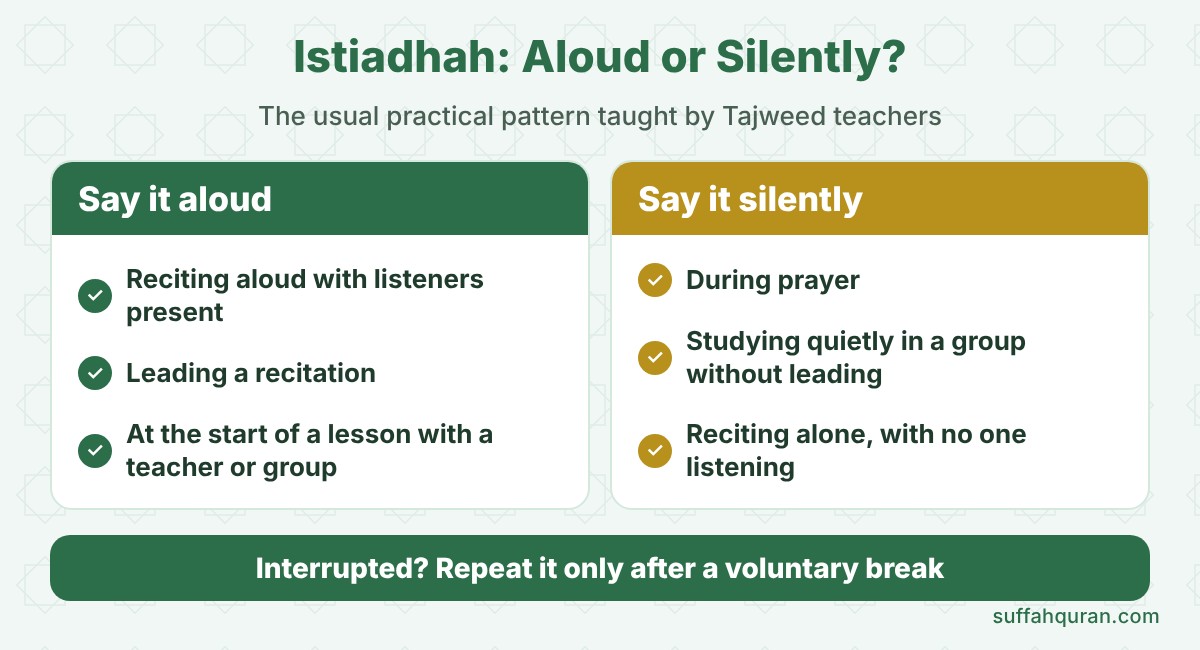
- Say it aloud when reciting Quran aloud with listeners present, when leading a recitation, and at the start of a lesson with a teacher or group.
- Say it silently during prayer (whether leading, following, or praying alone), when studying quietly in a group without leading the recitation yourself, and generally when reciting alone with no one listening.
One more detail students often ask about: do you have to repeat Istiadhah if something interrupts you mid-recitation? The answer depends on whether the interruption was voluntary or not.
- Involuntary interruption (coughing, sneezing, briefly pausing to explain a word to a student) — Istiadhah does not need to be repeated when you resume.
- Voluntary interruption (getting distracted, stopping to talk about something unrelated) — Istiadhah should be repeated before resuming.
Why Surah At-Tawbah Has No Basmalah
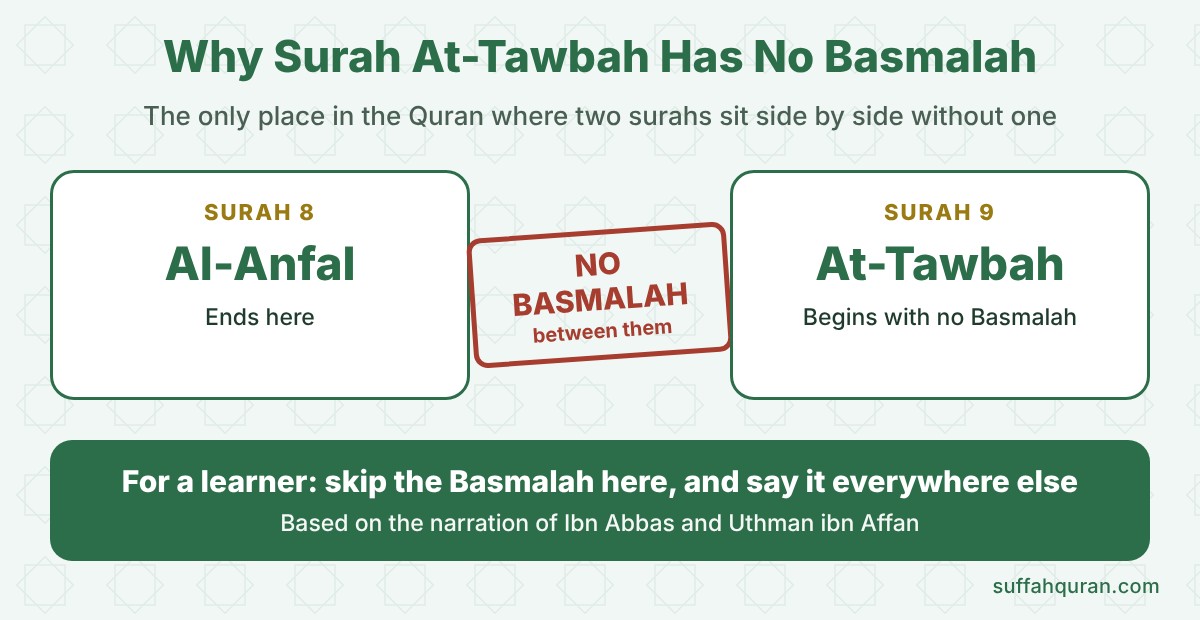
Every surah in the Quran opens with the Basmalah — except one: Surah At-Tawbah (Surah 9). Just as notably, the Basmalah is also skipped between the preceding surah, Al-Anfal, and At-Tawbah — the only place in the entire Quran where two surahs sit back-to-back with no Basmalah separating them.
The reason comes from a well-known narration recorded by Ahmad, Abu Dawud, and al-Tirmidhi (who graded it hasan, though some hadith scholars have questioned its chain). Ibn Abbas asked Uthman ibn Affan (the third Caliph, who oversaw the Quran’s compilation) why Al-Anfal and At-Tawbah were placed next to each other with no Basmalah between them. Uthman explained that the two surahs share closely related content — Al-Anfal was revealed early in the Madinan period and At-Tawbah among the last revelations — and the Prophet ﷺ passed away before clarifying whether At-Tawbah was actually a separate surah or simply a continuation of Al-Anfal. Because of that unresolved question, Uthman placed them adjacent without a Basmalah between them, and included At-Tawbah among what are known as “the seven long surahs” (as-sab’ at-tiwal).
For a learner, the practical takeaway is simple: when you reach the end of Al-Anfal and move into At-Tawbah, skip the Basmalah entirely. Everywhere else in the Quran, say it as usual.
Istiadhah and Basmalah Rules: The 4 Ways to Join Them with the Surah
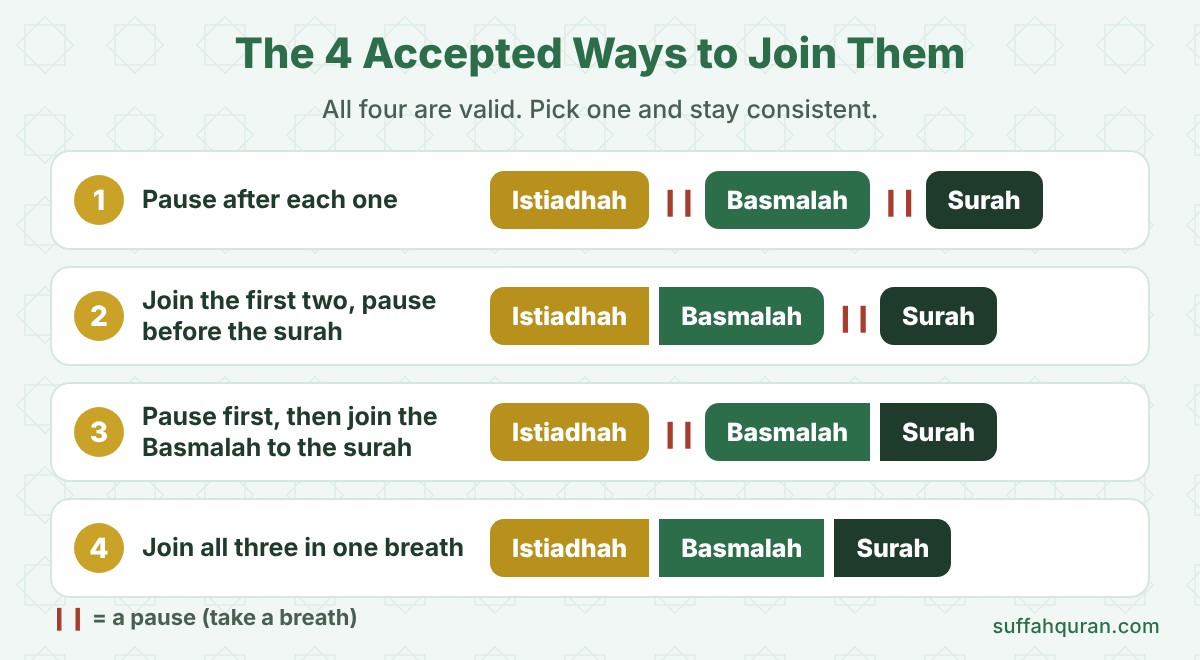
When you start reciting from the beginning of any surah other than At-Tawbah, Tajweed teachers recognise four accepted ways of joining (or pausing between) the Istiadhah, the Basmalah, and the surah’s opening words. All four are valid — which one you use is mostly a matter of breath and personal choice, not right versus wrong:
- Pause after each one. Say Istiadhah, pause (take a breath), say the Basmalah, pause again, then begin the surah. Many teachers consider this the clearest option for beginners.
- Connect Istiadhah to the Basmalah, then pause before the surah. Say Istiadhah and the Basmalah together in one breath, pause, then begin the surah separately.
- Pause after Istiadhah, then connect the Basmalah to the surah. Say Istiadhah, pause, then recite the Basmalah and the surah’s opening together in one breath.
- Connect all three together. Recite Istiadhah, the Basmalah, and the surah’s opening words all in a single breath, with no pause at all.
Starting at Surah At-Tawbah itself — or starting mid-surah anywhere the Basmalah isn’t recited — only two of these apply, since there is no Basmalah in the mix: connect Istiadhah directly to what follows, or pause after Istiadhah and then begin.
Joining the Basmalah Between Two Surahs
A slightly different question comes up when you’re reciting straight through the Quran and reach the end of one surah with another immediately following — for example, finishing Surah Al-Baqarah and continuing into Surah Aal-E-Imran. Here, Istiadhah has already been said once at the very start of your session, so the only question is how to handle the Basmalah between the two surahs.
| Situation | Accepted ways |
|---|---|
| Between any two ordinary surahs | (1) Pause at the end of the first surah, pause after the Basmalah, then begin the next surah. (2) Pause at the end of the first surah, then connect the Basmalah to the next surah. (3) Connect the end of the first surah straight into the Basmalah, then into the next surah. |
| Between Al-Anfal and At-Tawbah specifically | (1) Connect the end of Al-Anfal directly into the start of At-Tawbah, with no Basmalah. (2) Pause at the end of Al-Anfal, then begin At-Tawbah — still no Basmalah. (3) Use a brief saktah (a short pause with no breath taken) at the end of Al-Anfal, then begin At-Tawbah. |
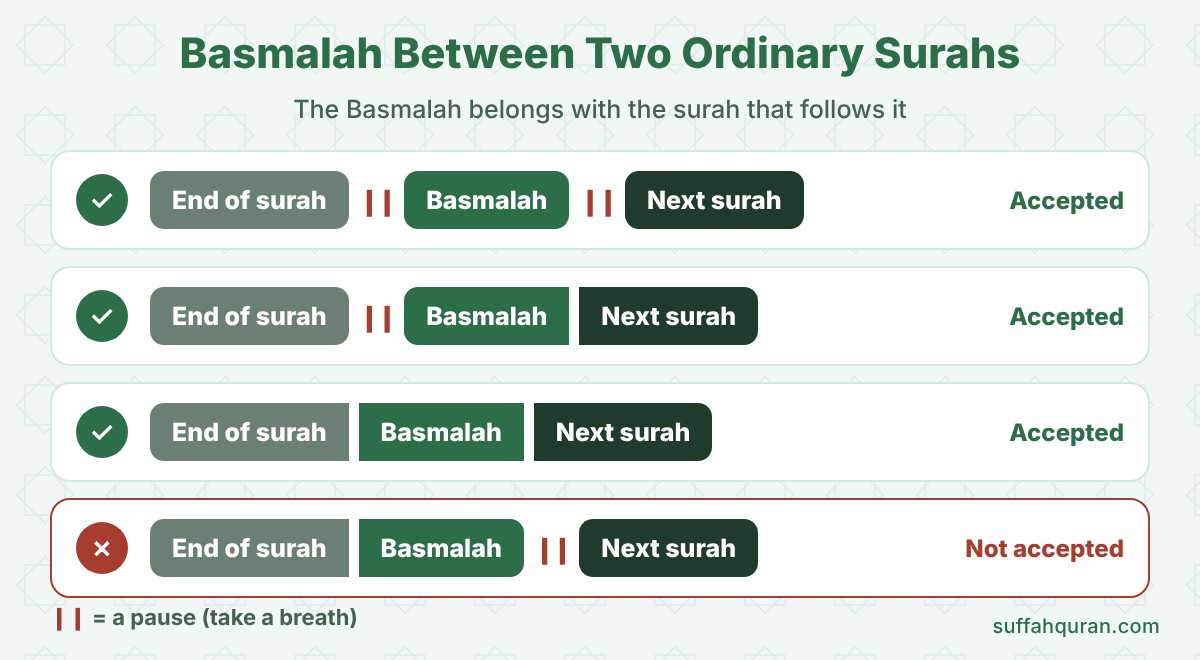
Note what is not an accepted option between two ordinary surahs: connecting the end of the first surah to the Basmalah, and then pausing before separating it from the next surah. Since the Basmalah belongs with the surah that follows it, not the one before it, leaving it stranded on its own this way isn’t permitted.
Common Mistakes Beginners Make
- Saying the Basmalah before Surah At-Tawbah. This is the single most common slip, especially for anyone reciting through the Quran in order for the first time and not yet expecting the exception.
- Treating Istiadhah as part of the Quran text. It should be recited with the understanding that it is a supplication the reciter adds, not a verse — this also affects how it’s taught to children, so they don’t confuse it with the Quran itself.
- Rushing both phrases without a clear breath plan. Picking one of the four accepted ways above — and sticking to it consistently — produces far steadier recitation than deciding on the fly each time.
- Not repeating Istiadhah after a real (voluntary) break. Stepping away mid-lesson to answer a phone call, for instance, calls for saying Istiadhah again before picking recitation back up.
Once this opening sequence feels automatic, it stops competing for your attention with the Tajweed rules that follow inside the surah itself — rules like Qalqalah or the elongations covered in our Madd rules guide. It is also one of the categories listed in our full Tajweed Rules Reference, if you’d like to see where it fits among everything else a beginner needs to learn. Before you move on, our guide to the adab of reciting the Quran covers the wider etiquette that surrounds recitation.
FAQ
Is Istiadhah part of the Quran?
No. Istiadhah (“A’oodhu billahi minash-shaytanir-rajeem”) is a supplication the reciter adds before starting, based on the instruction in Quran 16:98 — it is not itself a verse of the Quran.
Do I have to say Istiadhah every single time I recite?
The majority of scholars treat it as mustahabb (strongly recommended) before every recitation session, while a minority view treats it as obligatory based on the verse’s wording. In practice, it is taught as essential before you begin, whether aloud or silently depending on the situation.
Why doesn’t Surah At-Tawbah start with Bismillah?
Per the narration from Ibn Abbas about Uthman ibn Affan’s explanation, Al-Anfal and At-Tawbah share closely related content, and the Prophet ﷺ passed away without clarifying whether At-Tawbah was a distinct surah or part of Al-Anfal. Uthman placed them adjacent without a Basmalah between them as a result — making it the one place in the Quran with no Basmalah at all.
If I’m interrupted while reciting, do I repeat the Istiadhah?
It depends on whether the interruption was voluntary. An involuntary one — coughing, sneezing, briefly clarifying a word — doesn’t require repeating it. A voluntary one, like stepping away to do something unrelated, does.
Is the Basmalah a verse of every surah it appears before?
Scholars agree it is a genuine verse within Surah An-Naml (27:30). Whether it also counts as a numbered verse at the start of every other surah, rather than simply a written separator between surahs, is a point on which scholars differ — it doesn’t change that it is recited before each surah except At-Tawbah.
Want a teacher to walk through Istiadhah, Basmalah, and every rule that follows with you, live? Book a free trial Tajweed class with Suffah Quran Academy and start building correct habits from your very first lesson.

Written by Ustaz Ahmad Raza
Senior Quran & Tajweed Teacher · 8 Years Experience · Tajweed, Nazra Quran, Madani Qaida · Urdu, Hindi, English
Ustaz Ahmad Raza has been teaching Quran and Tajweed for 8 years and holds an Ijazah in Quran recitation with Tajweed. He wrote this guide because the opening sequence — Istiadhah and Basmalah — is the very first thing he teaches every new student, yet it’s often rushed through without explaining the reasoning behind it.
Meet our teaching team →