

This post contains affiliate links.
Published: September 12, 2026 · ⏱ 10 min read · Ustaz Imran Qadri, Tajweed & Makharij Instructor
Why These Makharij Mistakes Happen
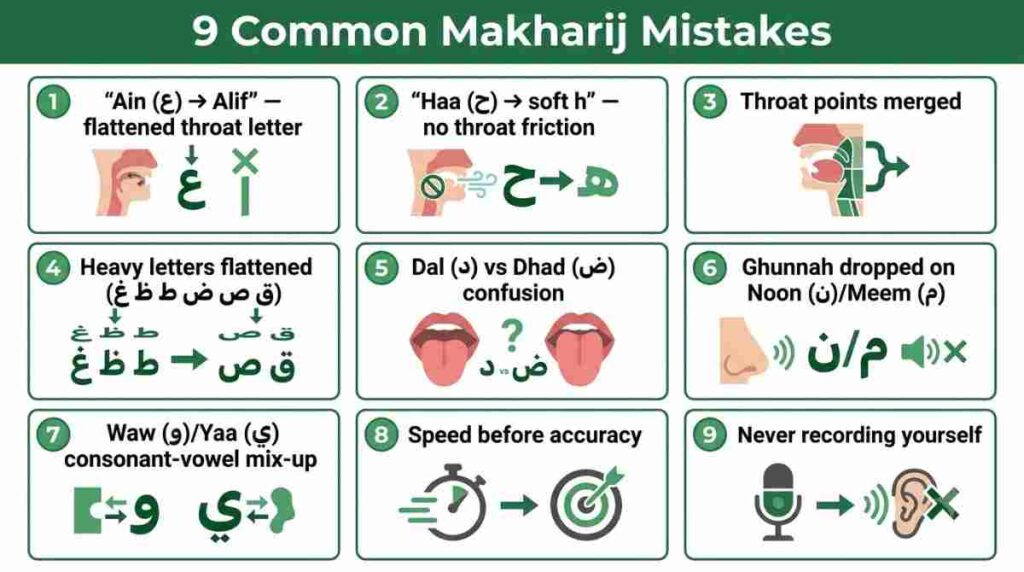
Every one of the nine makharij mistakes below shows up in our classes almost every term, and almost always for the same reason: the student is substituting a sound from their native language because it’s familiar, not because it’s correct. Hindi and Urdu don’t contain the deep throat letters or the heavy/light letter distinction the way Arabic does, so the mouth reaches for the nearest sound it already knows. That substitution feels right, which is exactly what makes it hard to catch without someone else listening.
If you haven’t yet learned which of the 29 letters belongs to which articulation point, start with our makharij al huroof chart before working through this list — it’s much easier to fix a mistake once you know exactly where the letter is supposed to come from. This guide assumes that theory and focuses only on the errors themselves: what each one sounds like, why it happens, and the specific drill that corrects it.
Mistake 1: Turning Ain (ع) Into a Plain Alif
This is the single most common makharij mistake we correct, and it’s often the one a student is least aware of. Ain comes from the middle of the throat, but because that exact spot has no equivalent in Hindi or Urdu, students instead produce a plain open vowel sound — essentially replacing Ain with Hamza or Alif. The word still sounds “close enough” to a beginner’s ear, but in the Quran the substitution can change the word entirely, since Ain and Hamza are separate letters with separate meanings.
How to Fix It
Say Ain in isolation 20 to 30 times with no vowel attached, focusing on a gentle constriction in the middle of the throat — not the back, not the front. Then alternate Ain and Hamza back to back (a…ain…a…ain) so your ear starts to hear the two as genuinely different sounds rather than variations of one.
Mistake 2: Softening Haa (ح) Into the Hindi/Urdu “h”
Haa (ح) sits right next to Ain in the middle of the throat, and it suffers from the same problem: the familiar Hindi/Urdu “h” sound is softer and comes from further forward, so students default to it without noticing. The Arabic Haa needs real friction at the middle of the throat, produced with a steady breath, not the light exhale most South Asian language speakers are used to making for their own “h”.
How to Fix It
Practice Haa with a longer, more deliberate exhale than feels natural at first — you should feel the friction in your throat, not just hear it. Drill it directly against the lighter Hindi/Urdu “h” so the contrast becomes obvious, and pair it with words like haḥd so you’re correcting it inside real recitation, not just in isolation.
Mistake 3: Merging the Three Throat Sub-Points
The six throat letters actually split into three distinct sub-points — far throat (Hamza, Haa), mid throat (Ain, Haa), and near throat (Ghain, Khaa) — but beginners often pronounce all six from roughly the same general area. The result isn’t one dramatic error; it’s six letters that all sound slightly “off” and slightly similar to each other, which is harder for a teacher to isolate and fix than one clearly wrong letter.
How to Fix It
Drill one sub-point at a time rather than all six throat letters together. Say the far-throat pair, pause, say the mid-throat pair, pause, say the near-throat pair — and notice how the depth in your throat should shift each time. Our makharij al huroof practice exercises worksheet has a drill table built exactly this way, sub-point by sub-point, if you want a printable version to work from.
Mistake 4: Flattening the Heavy Letters
Qaf, Sad, Dhad, Toa, Zoa, and Ghain all require tafkheem — a heaviness produced by raising the back of the tongue and filling the mouth with sound. Students trained in Hindi/Urdu phonetics, where this heavy/light distinction barely exists, tend to pronounce these letters like their lighter counterparts: Sad comes out sounding like Sa, Toa like Ta. The letter is technically recognizable, but the required weight is missing, and in the Quran that weight is part of the correct pronunciation, not an optional accent.
How to Fix It
Drill each heavy letter directly against its light counterpart, back to back: sa…sad…sa…sad. Exaggerate the heaviness at first — round your lips slightly and pull the back of the tongue up more than feels natural — then dial it back once the contrast is consistent. Overcorrecting briefly is a normal and useful part of learning this distinction.
Mistake 5: Confusing Dal (د) and Dhad (ض)
Dhad is often called the hardest letter in Arabic for non-native speakers, and it deserves its own entry separate from the general heavy-letter problem above. Dal comes from the tip of the tongue against the front teeth; Dhad comes from the side of the tongue pressed against the upper molars — a completely different contact point, not just a heavier version of the same sound. Students who haven’t isolated this specifically tend to collapse Dhad into Dal without realizing the two come from different places entirely.
How to Fix It
Press the side of your tongue against your upper back molars before making any sound, and get comfortable with that contact point in isolation before attaching the letter to it. This one usually needs more sessions than any other letter in this list — don’t be discouraged if it takes weeks longer than the rest to feel natural.
Mistake 6: Dropping Ghunnah on Noon and Meem
Noon and Meem both carry a two-count nasal sound called ghunnah, produced through the nasal cavity rather than the mouth. Beginners frequently drop it entirely, especially at the end of a word, pronouncing the letter cleanly through the mouth and cutting the sound off immediately. It’s an easy mistake to miss because the letter itself is still technically correct — what’s missing is a quality of the letter, not the letter’s basic articulation point.
How to Fix It
Pinch your nose lightly while saying Noon or Meem — if the sound changes or stops, you’re not actually nasalizing it. Practice holding the ghunnah for a full two counts at the end of a word rather than cutting it off the moment your mouth closes.
Mistake 7: Mixing Up Consonant and Vowel Waw/Yaa
Waw and Yaa each do double duty in Arabic: as consonants, they come from the lips (Waw) or the middle tongue (Yaa); as long vowels, they come from the open oral cavity, Al-Jawf, with no contact point at all. They’re written identically, so students who haven’t been taught the difference explicitly tend to pronounce every Waw and every Yaa the same way regardless of which role it’s playing — usually treating the vowel form like the consonant, which adds a contact point that shouldn’t be there.
How to Fix It
Find one word with the consonant form and one with the vowel form — walad for consonant Waw, nūr for vowel Waw — and say them back to back several times, paying attention to whether your lips touch (consonant) or stay open (vowel). Once you can hear the difference reliably, spotting which role a Waw or Yaa is playing in unfamiliar words gets much easier.
Mistake 8: Practicing Fast Before Practicing Correct
This mistake isn’t about a single letter — it’s about sequencing. Students who move to full-speed recitation before their makharij is solid end up reinforcing every error above, over and over, at a pace too fast to self-correct. Speed feels like progress because it sounds more like real Quran recitation, but it’s usually the opposite: it locks in whichever habits are already there, correct or not.
How to Fix It
Slow down deliberately whenever you’re drilling a letter you know is weak, even if it feels unnaturally slow. Only return to normal recitation speed once a teacher has confirmed the letter is landing correctly at a slow pace — speed should follow accuracy, not the other way around.
Mistake 9: Never Recording Yourself
This is less a pronunciation mistake and more the reason the other nine go uncorrected for so long. Almost no one can accurately judge their own Ain, Haa, or Dhad while they’re actually speaking — the error only becomes obvious on playback, once you’re listening rather than producing the sound. Self-taught students who skip this step can drill diligently for months and still not notice a mistake that would be obvious the moment they heard it back.
How to Fix It
Record a short clip on your phone at least once a week and listen back before your next practice session, comparing it to a teacher’s recitation of the same letters or words. It feels like an extra step, but it’s the fastest way to catch a mistake you genuinely cannot hear in the moment.
A List Can Name the Mistake — A Teacher Can Hear It in Your Voice
Reading about these nine mistakes is a start, but knowing which ones are actually in your own recitation takes a live ear. Book a free trial and one of our tajweed teachers will listen to your makharij and tell you exactly which of these nine to work on first.
Book Free Trial Class →Quick Self-Audit Checklist
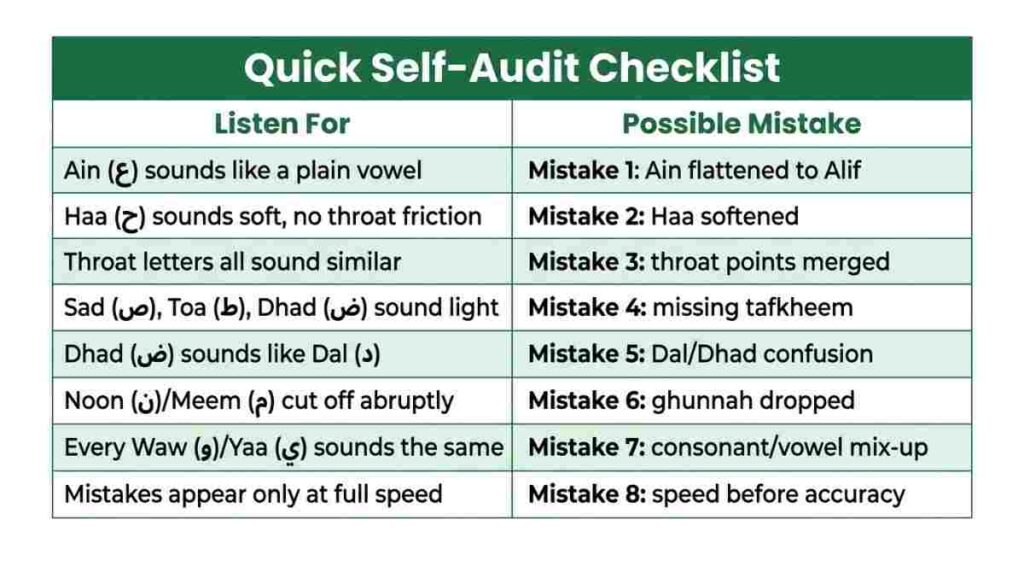
Before your next class, record yourself reading a short, familiar passage and go through this checklist while you listen back. You’re not trying to fix everything at once — just identify which of the nine mistakes above might be present, so you know what to bring to your teacher.
What to Listen For
| Listen For | Possible Mistake |
|---|---|
| Ain sounds like a plain vowel | Mistake 1 — Ain flattened to Alif |
| Haa sounds soft, no throat friction | Mistake 2 — Haa softened |
| All throat letters sound similar | Mistake 3 — throat points merged |
| Sad, Toa, Dhad sound light | Mistake 4 — missing tafkheem |
| Dhad sounds like Dal | Mistake 5 — Dal/Dhad confusion |
| Noon/Meem cut off abruptly | Mistake 6 — ghunnah dropped |
| Every Waw/Yaa sounds the same | Mistake 7 — consonant/vowel mix-up |
| Mistakes appear only at full speed | Mistake 8 — speed before accuracy |
How to Actually Fix These Mistakes
Knowing which mistake you’re making is only half the work. Fixing it takes the same isolated, repeated drilling regardless of which of the nine is present: say the letter alone, contrast it against the sound you’ve been substituting, then move to drill words once the isolated sound is consistent. Our makharij al huroof practice exercises worksheet is built for exactly this, with region-by-region drill tables and a dedicated set for the heavy/light pairs behind mistakes 4 and 5 above.
If you haven’t worked through the underlying theory yet — which of the 29 letters belongs to which of the 5 regions — our makharij al huroof chart is the right place to start before or alongside this list. And once your makharij feels solid across all three regions, the natural next step in a beginner’s tajweed path is our complete tajweed rules list for beginners, since rules like ghunnah, madd, and waqf all assume the base letters are already being produced correctly.
Making these mistakes isn’t a sign you’re bad at this — every one of them is common, predictable, and correctable, and they show up because of how Hindi and Urdu phonetics work, not because of anything wrong with your ear or effort. The real difference between a student who fixes them in weeks and one who carries them for years is simply whether someone caught the mistake early.
Frequently Asked Questions
The mistakes we see most often are turning Ain into a plain Alif, softening Haa into the Hindi/Urdu “h”, merging the three throat sub-points into one spot, flattening the heavy letters so they lose their tafkheem, confusing Dal and Dhad, dropping ghunnah on Noon and Meem, and mixing up the consonant and vowel forms of Waw and Yaa. Almost every beginner has two or three of these running at once without realizing it.
Hindi and Urdu phonetics don’t contain the deep throat letters or the heavy/light letter distinction the way Arabic does, so students substitute the nearest sound they already know from their native language. That substitution feels correct because it’s familiar, which is exactly why these mistakes are so hard to notice without outside correction.
Record yourself reciting a short passage on your phone, then compare it letter by letter against a teacher’s recitation or a reliable audio reference of the same ayah. Most people cannot judge their own makharij while they’re speaking — the error only becomes obvious on playback, which is why we ask students to record weekly rather than rely on how a letter feels in the mouth.
Yes, but it takes longer than building the habit correctly from the start. An established mistake has to be unlearned before the correct version can become automatic, so adult students correcting a years-old habit should expect several months of focused drilling rather than the few weeks it takes a new beginner to get the same letter right.
A makharij mistake means the letter is coming from the wrong physical point in the mouth or throat entirely — saying Ain like Hamza, for example. A sifaat mistake means the letter comes from the right point but is missing one of its required qualities, such as a heavy letter pronounced without enough tafkheem, or ghunnah left out of Noon. Makharij is corrected first because sifaat rules assume the base letter is already right.
Most students can produce an isolated letter correctly within a few focused sessions once a teacher has pointed out exactly what’s wrong. Making that correction hold up automatically inside full recitation, without reverting under speed, typically takes 4 to 8 weeks of short daily practice — longer for the throat letters and heavy/light pairs than for the easier lip letters.

Written by Ustaz Imran Qadri
Tajweed & Makharij Instructor · 9 Years Experience · Makharij, Sifaat, Beginner Correction
Ustaz Imran compiled this list from the corrections he makes most often with new students, specifically Hindi and Urdu speakers working through the throat and heavy letters that don’t exist in their native phonetics. He believes naming a mistake clearly is the first step to unlearning it.
Meet our teaching team →