

This post contains affiliate links.
Published: August 1, 2026 · ⏱ 8 min read · Ustaz Zaid Farooqui, Online Quran Instructor
Looking to enrol? See live pricing, teacher options and book a free class on our USA Quran Classes page →
Online Quran Classes Built Around US Time Zones
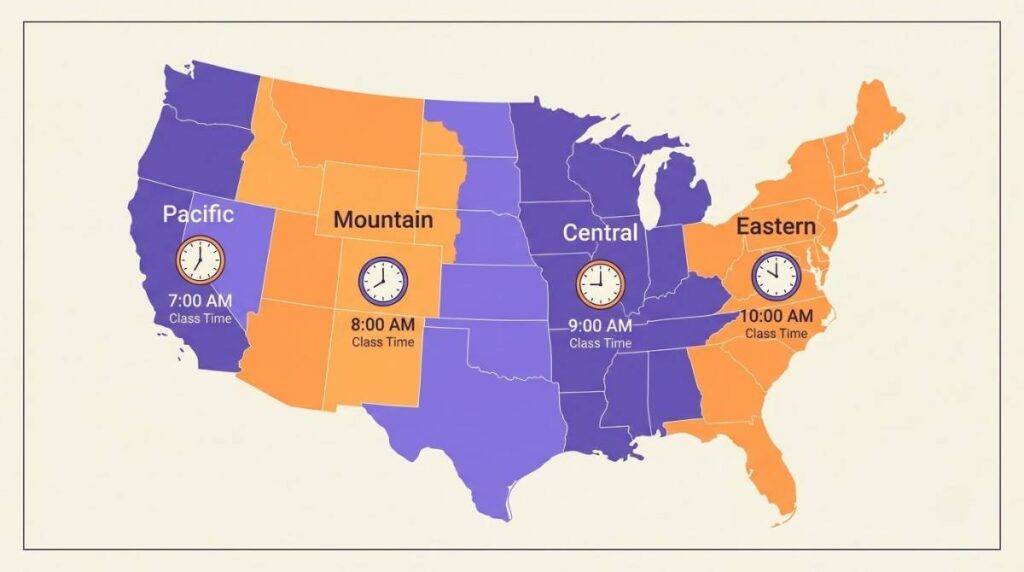
Most of the frustration we hear from American families searching for online Quran classes in the USA isn’t about the teaching itself — it’s about scheduling. A class booked without US time zones in mind means either a parent staying up past midnight or a child waking up before school. We build our scheduling around Eastern, Central, Mountain, and Pacific time from the start, not as an afterthought.
In practice, this usually means evening slots after school and work, or weekend mornings when families have more flexibility. We keep dedicated availability in both windows specifically because US family schedules tend to cluster around them.
Why US Families Are Turning to Online Quran Teachers
For many American Muslim families, the nearest mosque with a structured Quran program is a drive away, and evening or weekend school runs don’t always accommodate different learning paces. Online teaching removes the commute entirely and lets a teacher work one-on-one at a child’s actual level, rather than a group pace that’s either too fast or too slow.
The Principle
A consistent 20-minute class three times a week, at a time that actually fits your schedule, beats an hour-long weekend class that gets skipped every third week.
There’s also a reward tied to consistent recitation itself, independent of how quickly a student progresses:
“Whoever recites a letter from the Book of Allah, he will have a reward. And that reward will be multiplied by ten. I am not saying that ‘Alif, Lam, Mim’ is one letter, but Alif is a letter, Lam is a letter, and Mim is a letter.”
Source — Jami’ at-Tirmidhi, 2910
We share this with US parents specifically because progress can feel slow when a child is juggling school, sports, and Quran class all at once — the reward described isn’t tied to speed of completion.
What a Class Actually Looks Like
Every class is one-on-one over video call, typically 25 to 30 minutes, with the teacher listening to recitation live and correcting in real time — the same correction loop we’d use in person, just delivered over a screen. A typical weekly rhythm looks like this:
Sample Weekly Schedule (Eastern Time)
| Day | US Time (ET) | Focus |
|---|---|---|
| Monday | 6:30 PM | New lesson / current level |
| Wednesday | 6:30 PM | Revision and tajweed correction |
| Saturday | 10:00 AM | Extended session, progress review with parent |
Times shift comfortably to Central, Mountain, or Pacific once you’re matched with a teacher — this is simply one example rhythm.
See Your Schedule Before Committing
Book a free trial class at a time that actually fits your US schedule — no obligation, just a real class to see how it feels.
Book Free Trial Class →Curriculum: From Qaida to Hifz and Tajweed
Most students, regardless of starting point, move through a similar sequence, adjusted for age and prior exposure:
- Letter recognition and reading — through Madani Qaida for absolute beginners.
- Fluency building — reading full passages smoothly before adding tajweed rules.
- Tajweed — makharij, noon sakinah, waqf, and pronunciation correction.
- Hifz (optional track) — structured memorization for students and parents who choose it.
If you’re starting from zero, our guide to Madani Qaida explains the first stage in detail, and our tajweed rules list for beginners covers what comes after basic reading fluency.
Who’s Actually Teaching Your Child
US parents ask us this more directly than families in other regions, and it’s a fair question when a teacher is on the other side of a screen rather than in the same room. Our teachers are matched by specialization — tajweed, hifz, or beginner reading — and hold ijazah certification in the subject they teach, meaning their own recitation has been verified and authorized by a qualified scholar in an unbroken chain. Our guide to what ijazah certification actually means explains exactly what to check for when evaluating any online teacher, not just ours.
Common Concerns US Parents Raise
⚠️ What US Parents Usually Ask Before Enrolling
- “Will my child sit still for another screen-based class?” — One-on-one attention holds focus differently than passive screen time; most parents notice the difference after the first session.
- “Can a teacher overseas actually build rapport with my child?” — Consistency with the same teacher over weeks matters more than physical proximity for this.
- “What if my child falls behind school and other activities?” — Sessions are short by design specifically so Quran class doesn’t compete heavily with homework or sports schedules.
- “How do we know progress is actually happening?” — Regular parent updates and periodic progress reviews are part of the standard structure, not an add-on.

How to Get Started
- Book a free trial class at a time that fits your US time zone — no payment or long-term commitment required.
- The teacher assesses current level (or starts from zero) and recommends a track: Qaida, fluency, tajweed, or hifz.
- You choose a recurring weekly schedule that fits around school, work, and other commitments.
- Progress is reviewed with you periodically, and the pace adjusts as your child (or you) develop.
Most US families we work with settle into a rhythm within the first two to three weeks — the trial class exists specifically so you’re not guessing whether the schedule or teaching style will actually work before committing further.
Start With a Free Trial Class
Scheduled around your US time zone, with no obligation — just an honest first lesson to see if it’s the right fit.
Book Free Trial Class →Frequently Asked Questions
We schedule classes across Eastern, Central, Mountain, and Pacific time, including early morning and evening slots that work around US school and work schedules. Most of our teachers overlap comfortably with US evenings, which tend to be early-to-mid morning on our end.
For tajweed, reading, and hifz specifically, one-on-one online classes let a teacher hear a student’s recitation directly, correct in real time, and track progress just as closely as an in-person setting — in some cases more closely, since scheduling flexibility means fewer missed or rushed sessions.
Yes. Weekend slots are among the most requested times by US families, and we keep dedicated weekend availability specifically because weekday evenings often compete with homework, sports, and other commitments.
We teach children starting from around age 5 through adults, including parents learning alongside their children. Curriculum and pacing are adjusted by age and existing level rather than following one fixed track for everyone.
Our teachers hold ijazah certification in the areas they teach — tajweed, hifz, or qiraat — and are assigned to students based on specialization rather than general availability. See our guide on what an ijazah certification means for more detail on what to look for.
Yes, every new student — regardless of location — starts with a free trial class scheduled at a time that works for their US time zone, so you can assess fit before committing to a regular schedule.
More Country & City Guides

Written by Ustaz Zaid Farooqui
Online Quran Instructor · 7 Years Experience · Beginner Reading, Scheduling Coordination, International Students
Ustaz Zaid works primarily with international students, including a large number of US-based families, and builds class schedules around the student’s actual time zone rather than asking families to adjust to his. He focuses heavily on making the first few weeks of online learning feel consistent and low-friction.
Meet our teaching team →