

This post contains affiliate links.
Published: August 7, 2026 · ⏱ 8 min read · Ustaz Zaid Farooqui, Online Quran Instructor
Looking to enrol? See live pricing, teacher options and book a free class on our Australia Quran Classes page →
Online Quran Classes Across Every Australian Time Zone
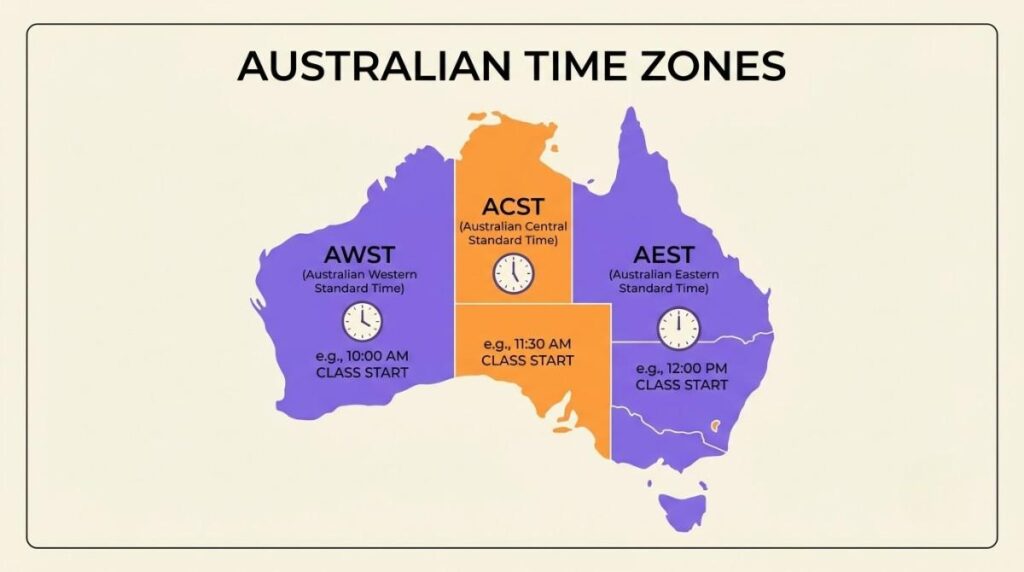
Australia spans three time zones, and families searching for online Quran classes in Australia are just as likely to be in Perth as they are in Sydney or Adelaide. We schedule across AEST/AEDT for the eastern states, ACST/ACDT for South Australia, and AWST for Western Australia, so the class time offered actually matches where a family lives rather than defaulting to one region.
In practice, most Australian families land on early evening slots after school and dinner, or weekend mornings — the same general pattern we see everywhere, just mapped onto Australian hours rather than assumed from elsewhere.
Why Distance Changes the Equation for Australian Families
Australia’s Muslim community is genuinely growing, but it’s also spread across a huge geography. A family in a major city might have several mosques and Islamic centres to choose from; a family in a regional town or a smaller state capital might have none within a reasonable drive, or a single option with a long waitlist. This isn’t a scheduling inconvenience the way it might be in a denser country — it’s often a real access gap.
The Principle
Where you live shouldn’t determine whether your child gets one-on-one, correctly taught tajweed. Online teaching exists to close exactly this kind of geographic gap, not just to add convenience for families who already have local options.
We work with a meaningful number of families in regional Australia specifically for this reason — for them, online isn’t a substitute for something better nearby; it’s often the only structured, one-on-one option available at all.
What a Class Actually Looks Like
Every class is one-on-one over video call, typically 25 to 30 minutes, with the teacher listening to recitation live and correcting in real time. A sample weekly rhythm for an eastern-states family might look like this:
Sample Weekly Schedule (AEST)
| Day | AEST | Focus |
|---|---|---|
| Monday | 5:30 PM | New lesson / current level |
| Thursday | 5:30 PM | Revision and tajweed correction |
| Saturday | 9:30 AM | Extended session, progress review with parent |
Times shift naturally for ACST or AWST once you’re matched with a teacher — this is one example rhythm, not a fixed structure.
See Your Schedule Before Committing
Book a free trial class at a time that fits your Australian time zone — no obligation, just a real class to see how it feels.
Book Free Trial Class →Curriculum: From Qaida to Hifz and Tajweed
Regardless of where a student starts, the sequence looks broadly similar, adjusted for age and prior exposure:
- Letter recognition and reading — through Madani Qaida for absolute beginners.
- Fluency building — reading full passages smoothly before layering in tajweed rules.
- Tajweed — makharij, noon sakinah, waqf, and pronunciation correction.
- Hifz (optional track) — structured memorization, paced around school terms.
If you’re starting from zero, our guide to Madani Qaida explains the first stage, and our tajweed rules list for beginners covers what typically follows once basic reading is solid.
Who’s Actually Teaching Your Child
This matters even more for families relying on online teaching as their primary option rather than a supplement. Our teachers are matched by specialization — tajweed, hifz, or beginner reading — and hold ijazah certification in the subject they teach, meaning their own recitation has been formally verified and authorised through a scholarly chain. Our guide to what ijazah certification actually means explains exactly what to check for when evaluating any online teacher, wherever you’re located.
Common Concerns Australian Parents Raise
⚠️ What Australian Parents Usually Ask Before Enrolling
- “We’re in a regional area — will internet quality be an issue?” — Video classes work reliably on standard home broadband; we can also advise on backup options for patchy regional connections.
- “Will this actually work as our child’s main Quran education, not just an extra?” — Yes, for many regional families it functions as the primary structured option, not a supplement to something already in place.
- “What happens over the long December-January summer break?” — Families choose either a full pause or a lighter maintenance schedule; both are common and neither is treated as falling behind.
- “How do we know progress is real, not just attendance?” — Regular parent updates and periodic progress reviews are part of the standard structure.
How to Get Started
- Book a free trial class at a time that fits your Australian time zone — no payment or long-term commitment required.
- The teacher assesses current level (or starts from zero) and recommends a track: Qaida, fluency, tajweed, or hifz.
- You choose a recurring weekly schedule that works around school and family commitments.
- Progress is reviewed with you periodically, with pacing adjusted as your child develops.
Most Australian families settle into a workable rhythm within the first two or three weeks — the trial class exists specifically so you’re not committing to a full schedule before knowing whether the timing and teaching style genuinely fit.

Start With a Free Trial Class
Scheduled around your Australian time zone, with no obligation — just an honest first lesson to see if it’s the right fit.
Book Free Trial Class →Frequently Asked Questions
We schedule across AEST/AEDT (eastern states), ACST/ACDT (South Australia), and AWST (Western Australia), so families in Sydney, Perth, Adelaide, or anywhere in between can find a class time that fits their evening or weekend.
For structured, one-on-one tajweed and reading instruction, yes — a teacher on a video call can hear recitation and correct it just as directly as one in the same room. This is often the more realistic option for regional and rural Australian families where the nearest dedicated Quran teacher may be hours away.
Classes continue through all four terms and typically pause only during the longer December-January summer break if a family requests it, or continue at a lighter pace for families who prefer to keep momentum through the holidays.
We teach children from around age 5 through adults, including parents learning alongside their children. Pacing and curriculum are set by the student’s age and current level rather than a fixed track for everyone.
Teachers hold ijazah certification in the subject they teach — tajweed, hifz, or qiraat — and are matched to students by specialization. Our guide on what an ijazah certification means explains what this credential actually verifies.
Yes, every new student starts with a free trial class at a time that suits their Australian time zone, so you can see the teaching style and pace before committing to a regular schedule.
More Country & City Guides

Written by Ustaz Zaid Farooqui
Online Quran Instructor · 7 Years Experience · Beginner Reading, Scheduling Coordination, International Students
Ustaz Zaid works with international students across several regions, including a growing number of Australian families in both major cities and regional areas. He pays particular attention to families for whom online teaching is the only structured Quran option available, not just a convenience.
Meet our teaching team →