This post contains affiliate links.
Published: June 07, 2026 · ⏱ 8 min read · Suffah Quran Academy
Wanting your child to become a Hafiz is one of the most beautiful aspirations a Muslim parent can hold. But wanting it and timing it correctly are two different things.
Starting Hifz before a child is genuinely ready does not accelerate the journey — it often derails it. A child who begins memorisation without the foundations in place struggles from the start, embeds errors they will spend years correcting, and sometimes develops a resistance to Quran learning that takes years to undo.
A child who begins when they are truly ready moves with confidence, builds momentum, and develops the kind of relationship with the Quran that the memorisation is supposed to create.
These seven signs tell you which situation your child is in.
Why Readiness Matters — The Cost of Starting Too Early
Hifz requires a child to memorise Arabic text they are hearing and reading — not text they understand linguistically. This means their ability to read the text correctly is the entire foundation of what they are memorising.
A child who cannot yet read Arabic fluently will memorise whatever they are hearing or saying — which may include errors. Those errors become part of the memorisation. Removing an embedded error from memorised Quran is significantly harder than preventing it from entering in the first place.
Beyond the reading foundation, Hifz demands sustained daily focus, emotional resilience when forgetting occurs, and a daily routine that a young child cannot maintain without family support. Beginning before these are in place is not ambition — it is timing the harvest before the crop is grown.
Sign 1: Your Child Reads Quran Fluently With Correct Tajweed
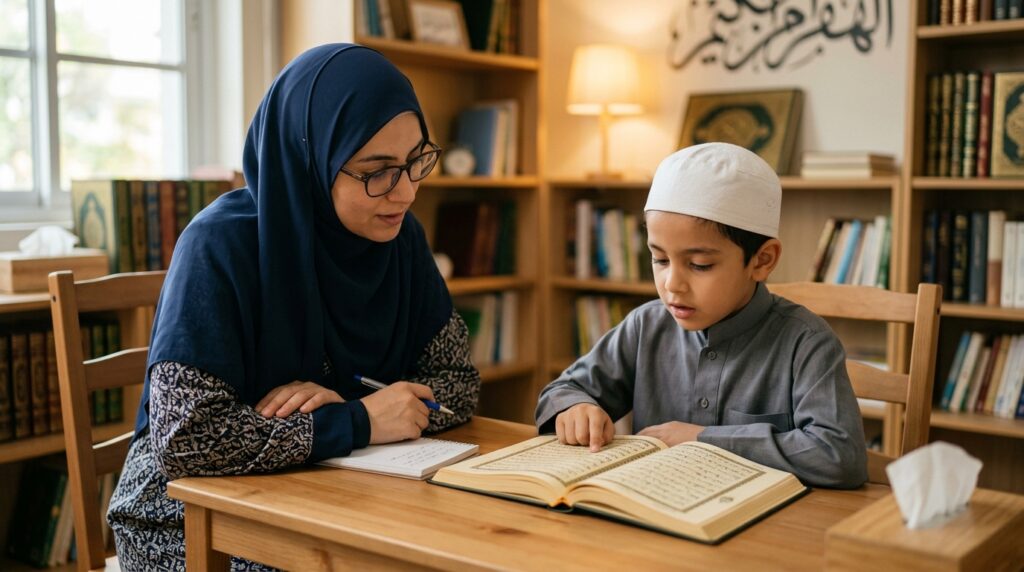
This is the single non-negotiable prerequisite. No Hifz teacher of experience will begin memorisation with a child who cannot read Arabic fluently and correctly.
"Fluently" means the child can read a page of Quran without significant hesitation — moving from letter to letter, word to word, with the marks applied correctly and the Tajweed rules observed. They are not sounding out each letter individually. They are reading.
"Correctly" means the letters are pronounced from their proper articulation points, the vowel marks are applied accurately, and basic Tajweed rules — Noon Sakinah, Madd durations, Qalqalah — are consistently applied. Not perfectly. Consistently.
If your child is still in Madani Qaida, or has recently completed it but reads slowly or with frequent errors — they are not yet ready for Hifz. The path is: Madani Qaida → Quran Reading with Tajweed → Hifz. Skipping stages does not save time. It costs it.
For the full breakdown of these stages, read our guide on what Madani Qaida teaches and when a child is ready to progress.
Sign 2: Your Child Can Focus for 45–60 Minutes
A Hifz session — unlike a Qaida session for a beginner — requires sustained focus for a meaningful stretch of time. New memorisation, recent revision, and older revision all need to happen in a single session. This typically takes 45 to 60 minutes for a child in an active Hifz programme.
A child who cannot sustain attention for this duration — who becomes restless, distracted, or disengaged after 20 minutes — will not be able to use the session productively. They may go through the motions, but the memorisation will not hold.
Test this honestly before beginning. Sit with your child for 45 minutes of focused activity — not passive screen time, but active engagement with a task. Can they maintain that? If yes, this sign is present. If not, work on building this capacity over the next few months before starting Hifz.
Sign 3: Your Child Demonstrates Short-Term Memory Capacity
Hifz is at its core a memory task. Not all children of the same age have the same memory capacity for this type of learning — and that is entirely normal. It does not predict whether they will eventually become a Hafiz. But it does affect when they are ready to begin.
A practical test: read your child three or four lines from the Quran — clearly, with correct pronunciation — then ask them to repeat it back immediately. How much do they retain? Can they hold the sound and rhythm in working memory while attempting to reproduce it?
A child who can repeat back two or three lines after hearing them a few times is showing the memory capacity needed to begin. A child who struggles to retain even a single line after multiple repetitions may need more time — or may benefit from a very gradual, patient start with smaller daily portions.
Sign 4: Your Child Responds Well to Correction
In Hifz, correction is constant. A child will be corrected every single session — on pronunciation, on memorisation gaps, on Tajweed application. This is not a sign that they are failing. It is how Hifz works.
But a child who breaks down, shuts down, or becomes resistant every time they are corrected will find the daily reality of Hifz deeply distressing. The emotional resilience to receive correction, adjust, and continue — without it becoming a source of anxiety or shame — is a genuine readiness indicator.
This does not mean your child must be impervious to frustration. All children feel frustrated sometimes. It means that correction is something they can receive and work with — that their general response to "try that again" is effort, not collapse.
If your child is currently very sensitive to correction, the right approach is not to avoid Hifz forever — it is to work on building this resilience through their existing Quran learning, with a patient teacher who corrects warmly and specifically. Our guide on making Quran learning positive covers how to build this environment at home.
Sign 5: Your Child Has Some Internal Motivation
This sign is more nuanced than the others — and it is important to be honest about what it means and what it does not mean.
It does not mean your child is passionately requesting Hifz. Many children who go on to complete Hifz started because their parents enrolled them — not because they asked. The internal motivation develops through the journey, not necessarily before it.
What it does mean: your child is not actively resistant. They are not expressing fear, dread, or strong reluctance about the idea of memorisation. They may be neutral. They may be mildly curious. They may be willing to try. Any of these is sufficient.
A child who is being forced into Hifz against strong and consistent resistance — who cries, refuses, or expresses genuine distress at the prospect — is telling you something worth listening to. That does not mean abandoning the goal. It may mean waiting, or addressing whatever is causing the resistance, before beginning.
Sign 6: The Family Is Ready
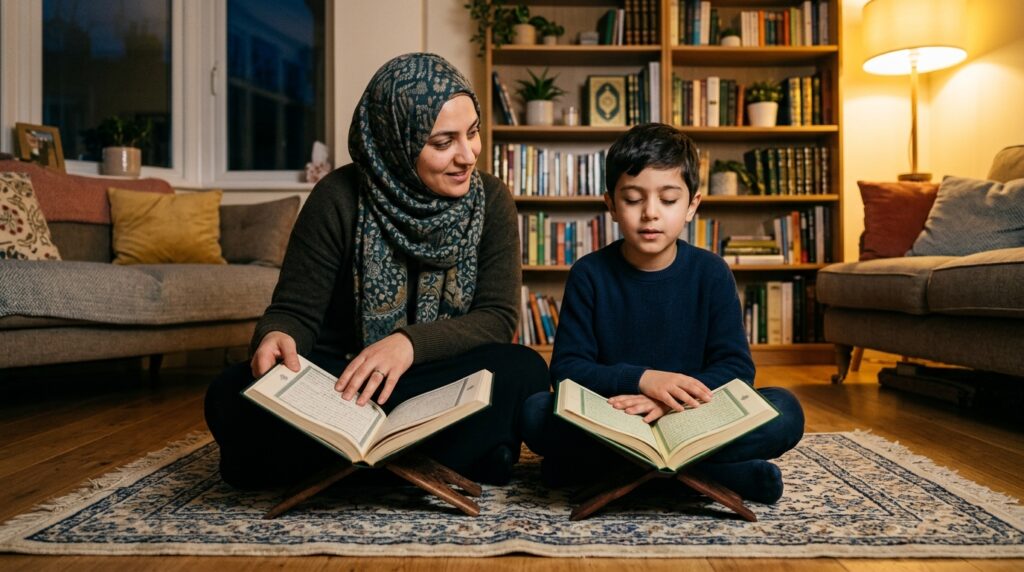
This sign is rarely listed — and it is one of the most important.
As we have covered in our guide on what Hifz ul Quran involves, the family's daily involvement is not optional — it is essential. A child's Hifz teacher works with them for one to two hours per day. The rest of the day — the daily listening, the revision routine, the protected Hifz time — depends on the family.
Before beginning Hifz, honestly assess:
- Can a parent sit with the child daily to listen to their Sabaq (new memorisation)?
- Is there a consistent time in the daily routine that can be protected for Hifz?
- Is the family in a stable enough period — no major moves, new siblings, or family upheaval — to sustain a new long-term commitment?
- Do the parents understand what the journey will require — and are they prepared to commit to it for years, not months?
If the honest answer to any of these is "not right now," Hifz can wait. The right moment is when both the child and the family are genuinely ready — not when the aspiration is present but the infrastructure is not.
Sign 7: A Qualified Hifz Teacher Is Available
The availability of a qualified teacher is as much a readiness sign as anything in the child. Hifz requires a teacher who has themselves completed Hifz, who understands the Sabaq-Sabqi-Manzil system, who has guided other students through the full journey, and who is available for near-daily sessions.
A Quran reading teacher — even a very good one — is not automatically a qualified Hifz teacher. The skills are related but distinct. Confirm that the teacher your child would work with has specific Hifz experience — ask how many students they have guided to completion.
At Suffah Quran Academy, our Hifz teachers are themselves Huffaz with experience guiding students through the complete memorisation journey. Learn more about our Hifz programme here.
3 Signs Your Child Is Not Yet Ready — And What to Do Instead
These three signs indicate that the right next step is not Hifz — but the preparation for it.
1. They cannot yet read Quran fluently. The only response here is to continue with Quran reading lessons until fluency is established. No shortcut exists. A child who begins Hifz without fluent reading will embed errors that haunt them for years.
What to do: Continue with Madani Qaida or Quran Reading with Tajweed. Revisit Hifz readiness in 6–12 months.
2. They cannot sustain focus for more than 20–25 minutes. Attention span develops with age and practice — this is not a permanent ceiling. But Hifz at this stage will be ineffective and may create negative associations.
What to do: Keep Quran sessions shorter and positive. Gradually extend focus time by 5-minute increments over months. Introduce short daily Surah revision — which builds the memory habit without the full Hifz load. Reassess in 3–6 months.
3. They are strongly resistant to the idea. A child in genuine distress about starting Hifz is communicating something worth understanding before proceeding. Forcing it rarely produces the outcome parents hope for.
What to do: Have a gentle conversation about why the child feels resistant. Involve the teacher. Look at whether the Quran learning environment at home is positive enough to support the idea of more. In some cases, waiting 6 months and creating more positive Quran experiences at home is the most effective path to eventual Hifz readiness.
Not Sure If Your Child Is Ready?
Book a free trial Hifz class. Our teachers will assess your child's reading level, focus capacity, and readiness — and give you an honest recommendation about whether now is the right time to begin.
Book Free Assessment →Frequently Asked Questions
Most Hifz teachers recommend starting between ages 7 and 10 — after the child can read Arabic fluently with correct Tajweed. Age alone is not the deciding factor. A child who is 7 but cannot yet read Quran fluently is not ready. A child who is 9 and reads confidently with correct Tajweed is ready. The readiness signs matter more than the birthday.
No. Completing Madani Qaida is the foundation of Arabic reading — a child who has not completed it cannot read Arabic fluently enough to memorise correctly. Errors become embedded in the memorisation and are very difficult to remove later. Complete Madani Qaida first, then Quran Reading with Tajweed, and only then consider Hifz.
The ability to sit and focus for 45–60 minutes is one of the key readiness signs for Hifz. If your child cannot yet do this, continue with regular Quran reading lessons, work on building the focus habit through shorter increasing sessions, and reassess in 3–6 months.
No — understanding Arabic is not a prerequisite for Hifz. Many Huffaz memorise the Quran before studying Arabic comprehension. However, even a basic familiarity with what is being memorised — through simple translations shared by parents — can deepen the child's connection to the words and support retention.
Starting Hifz and then pausing or stepping back is not failure. Life circumstances change, and the portions already memorised remain a blessing. Discuss with your Hifz teacher if the pace is overwhelming — a good teacher will adjust rather than push a child to burnout.
When the Signs Are Present — Begin With Confidence
The seven signs in this guide are not a perfect checklist — real children are complex, and readiness is rarely all-or-nothing. But when most of these signs are present, particularly the non-negotiable first sign of fluent Quran reading, you can begin Hifz with genuine confidence.
The families whose children complete Hifz are not those who started earliest. They are those who started at the right time — with a prepared child, a committed family, and a qualified teacher — and then stayed consistent through the years that followed.
If you would like an expert assessment of whether your child is ready to begin, our Hifz teachers are available for a free trial class — no payment, no commitment, and an honest conversation about your child's specific situation.
Book a Free Hifz Assessment
Our teacher will listen to your child recite, assess their readiness across all seven signs, and give you a clear, honest recommendation — with no obligation to enrol.
Book Free Trial Class →![[Teacher Name] — Hafiz ul Quran and Hifz teacher at Suffah Quran Academy](https://suffahquran.com/wp-content/uploads/[teacher-photo].jpg)
Written by Ustaz Bilal Ahmed
Hafiz ul Quran | Ijazah-Certified | Hifz Teacher
Ustaz Bilal Ahmed completed Hifz ul Quran at age 20 and has guided students from first recitation through to completed memorisation. The readiness signs in this guide come from direct experience — including the experience of students who started too early and what that cost them.
Meet our Hifz teachers →