
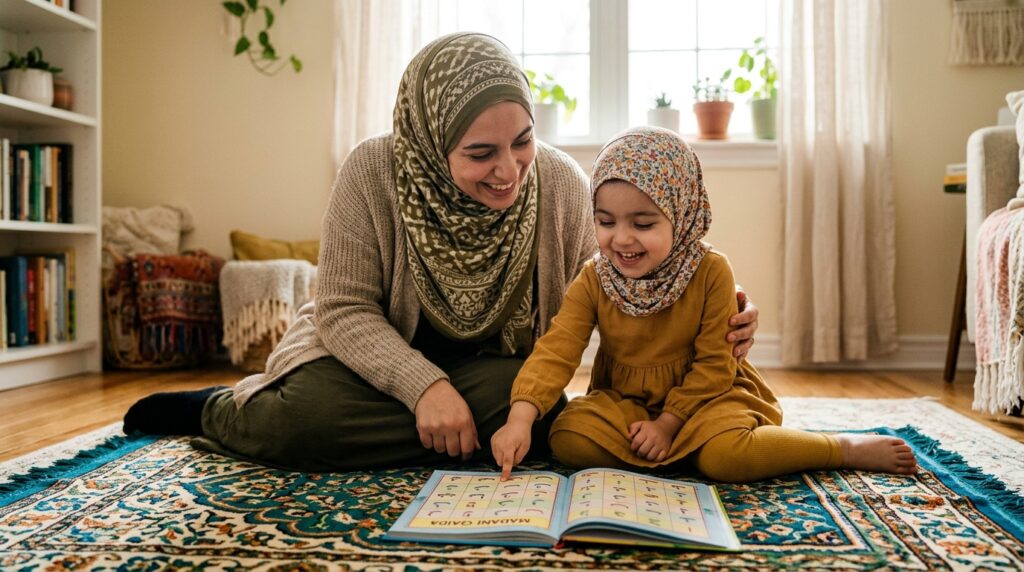
This post contains affiliate links.
Estimated reading time: 11 minutes
Table of contents
- Why Motivation Matters More Than You Think
- Tip 1: Keep Sessions Short — Especially at the Start
- Tip 2: Celebrate Specific Progress — Not Just Effort
- Tip 3: Connect the Quran to Daily Life
- Tip 4: Let the Child Teach Back to You
- Tip 5: Make the Teacher Relationship Count
- Tip 6: Use Songs, Rhymes, and Audio for the Alphabet Stage
- Tip 7: Protect the Quran From Punishment and Pressure
- A Word About the Teacher’s Role in All This
- Frequently Asked Questions
Every Muslim parent wants their child to love the Quran. Not just to learn it — but to genuinely love it, to feel drawn to it, to recite it with a sense of meaning and joy rather than obligation.
But the reality of teaching children anything — including Quran — is that motivation is not guaranteed. Some children take to it naturally. Others resist. Most are somewhere in between: willing when the conditions are right, reluctant when they are not.
The good news is that the conditions are largely within a parent’s control. Children do not resist Quran learning because they are bad or uninterested in Islam. They resist it when it feels like a chore, when the pressure is too high, when they feel they are failing, or when it simply is not engaging enough to compete with everything else in their lives.
These seven tips address each of those situations — drawn from the experience of teachers who have worked with hundreds of children across different ages, backgrounds, and temperaments.
Why Motivation Matters More Than You Think
Before the tips, a brief point worth making: a child who learns the Quran under duress will know it. A child who learns it with love will live it.
The habits built in childhood — the association between Quran and positive feeling or negative feeling — tend to last. Children who were forced through Quran learning with excessive pressure often grow into adults who avoid the Quran. Children who were given a positive, warm, appropriately paced experience tend to return to it throughout their lives.
This does not mean there are no standards, no correction, no expectations. It means that the overall emotional tone of the learning environment should be positive — and that these tips are designed to help you create that.
Tip 1: Keep Sessions Short — Especially at the Start
This is the tip that experienced teachers mention first — and parents resist most.
The instinct is understandable: there is a lot to learn, and longer sessions seem more productive. But for children, especially young ones, the opposite is true. A child who sits through a 45-minute session they cannot sustain will come out of it feeling bad — about themselves, about the class, about Quran learning in general.
A child who has a crisp 20-minute session that ends while they are still engaged will come out of it feeling good — and will be more willing to come back the next day.
Practical guideline by age:
- Ages 4-5: 15-20 minutes per session, maximum
- Ages 6-7: 20-25 minutes
- Ages 8-10: 25-35 minutes
- Ages 11+: 35-45 minutes
The key rule: End the session while the child still has energy — not when they are exhausted. “Let’s stop here — you did really well today” is far more powerful than grinding to the end of a planned session while the child has mentally checked out.
Tip 2: Celebrate Specific Progress — Not Just Effort
Generic praise (“good job,” “well done”) is pleasant but does not build lasting motivation. Specific praise connects the child to what they actually achieved — and makes them want to achieve more.
Compare:
- Generic: “Good job today.”
- Specific: “You said that Baa really clearly today — I could hear the difference from last week.”
The specific version tells the child exactly what they did right, which means they can repeat it. It also shows the child that the adult is actually listening — not just being encouraging for its own sake.
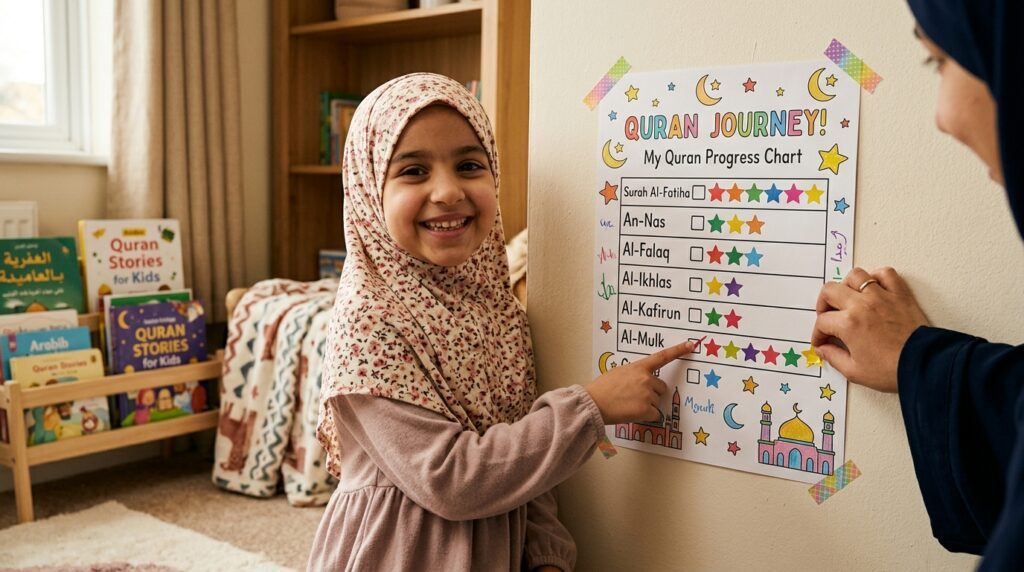
Apply this to milestones too: When a child completes a set of letters, a full page of Qaida, a Surah — mark it. A small celebration — a favourite meal, a sticker chart completion, a phone call to a grandparent to recite — makes the milestone feel real and earned.
For Hifz students: Tracking completed Juz on a visible chart on the bedroom wall is a technique many Hifz families use. Seeing the visual progress of memorization — the pages filled, the sections coloured — gives children a concrete sense of how far they have come.
Tip 3: Connect the Quran to Daily Life
The Quran that a child encounters only in a formal class setting — on a screen with a teacher, or in a designated “Quran time” — is a different Quran from the one that is woven through their daily life.
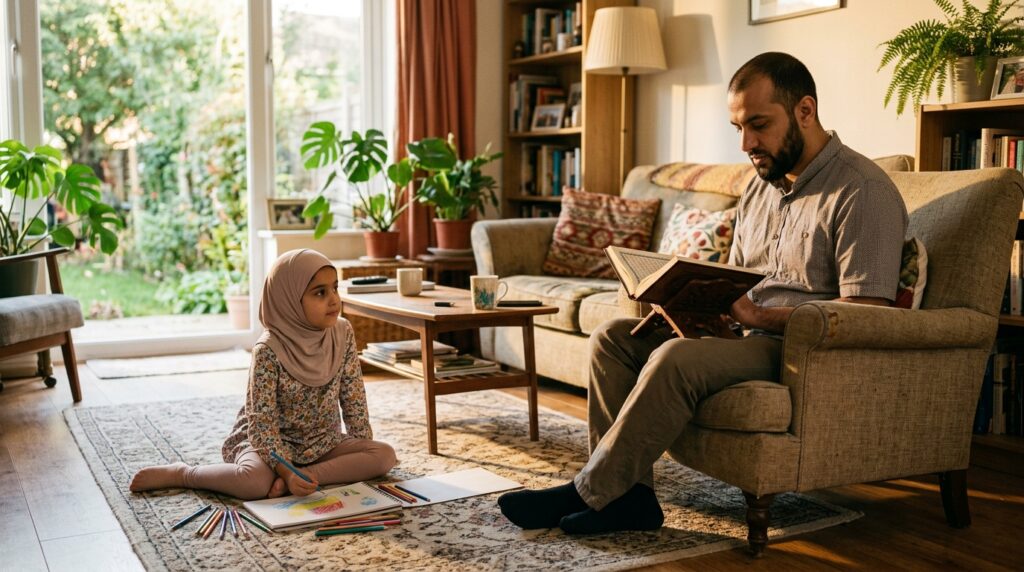
Children who grow up hearing the Quran recited at home — played softly in the morning, recited by parents during prayer, quoted briefly in conversation — develop an instinctive familiarity with it. When they encounter the same words in their lessons, it feels like recognition rather than foreignness.
Practical ways to weave Quran into daily life:
- Play Quran recitation softly during breakfast, car journeys, or before sleep
- Recite short Surahs with your child at Fajr or before bed — not as a lesson, just together
- When something good happens, recite الحمد لله together and explain what it means
- When starting a task, say بسم الله together and explain it
- Point out familiar words from lessons when you hear them in recitation — “Did you hear that? That was the word you learned yesterday”
These connections do not require extra time. They require presence and intentionality — making the Quran part of the texture of the day, not an event that happens at a scheduled time and then disappears.
Tip 4: Let the Child Teach Back to You
One of the most effective learning techniques is also one of the most enjoyable for children: the opportunity to be the teacher.
When a child explains something they have learned — to a parent, a sibling, even a toy — they are encoding the knowledge in a completely different way from when they passively receive it. They have to retrieve it, organise it, and present it. This process significantly strengthens retention.
How to do this: After a class, sit with your child and say: “Can you teach me what you learned today? Pretend I have never seen this letter before.” Then genuinely play along — make a mistake or two, let the child correct you, respond with “Ohhh, I see!” when they explain something.
Children who are allowed to be the teacher for five minutes after each class often retain the material significantly better than those who simply practise alone. And they enjoy it — being the one who knows something the adult does not is a source of genuine pride for children.
Tip 5: Make the Teacher Relationship Count
A child’s relationship with their Quran teacher is one of the most powerful variables in their motivation. A child who looks forward to seeing their teacher will show up engaged and willing. A child who feels indifferent to or intimidated by their teacher will approach each class with resistance.
This is why the free trial class matters so much — it is the first impression of that relationship. But the relationship continues to develop over months and years, and parents can support it.
Things parents can do:
- Ask your child: “What did the teacher say today that you liked?” rather than just “How did it go?”
- Speak positively about the teacher at home: “Your Ustadh/Ustadha really knows how to explain this well”
- Communicate with the teacher: let them know what your child is enjoying, what they are finding hard, what is happening at home that might be affecting the lessons
- If the relationship genuinely is not working after several weeks — change teachers. Not every teacher-student pair clicks, and a mismatch is no one’s fault
The teacher-student relationship in Quran education carries a particular spiritual weight in Islamic tradition. Nurturing it — on both sides — is worth the attention.
Tip 6: Use Songs, Rhymes, and Audio for the Alphabet Stage
For very young children (ages 4-6) who are learning Arabic letters for the first time, the learning does not need to happen only in formal classes.
Arabic alphabet songs, recitation recordings, and simple rhymes about letter shapes and sounds can turn commutes, mealtimes, and playtime into learning opportunities — without any of the structure or resistance that a formal class session can sometimes bring.
Practical resources:
- Arabic alphabet songs on YouTube (search “Arabic alphabet song for kids” — there are several high-quality free options)
- Recitation recordings by well-known reciters played at a child-appropriate volume
- Simple apps designed for Arabic letter recognition (there are several free ones — ask your child’s teacher for a recommendation)
These do not replace structured instruction — they supplement it. A child who has heard a letter sung forty times in a catchy melody will recognise it faster when the teacher introduces it formally.
Tip 7: Protect the Quran From Punishment and Pressure
This is the most important tip — and it is stated as a warning rather than a suggestion.
Using Quran time as punishment — “If you misbehave, you will have an extra Quran class” — creates an immediate negative association. Using it as a test to perform for guests — “Recite Surah Al-Fatiha for Uncle Hassan, come on, you know it” — creates performance anxiety. Expressing disappointment or frustration when a child forgets something they memorized — “How can you not remember? You just learned this!” — creates shame.
All of these damage the child’s relationship with the Quran in ways that can take years to repair.
The alternative is not the absence of expectations. Standards, correction, and consistent practice are all necessary. The question is how these are delivered.
Correction should be specific, patient, and forward-looking: “This letter sounds like this — try again.” Not: “You always get this wrong.”
Forgetting is normal and should be treated as a natural part of the process, not a failure: “This one is tricky — let’s review it more this week.”
Progress should be measured against the child’s own previous performance, not against siblings, cousins, or other students.
The environment that produces children who love the Quran is an environment where mistakes are part of learning, progress is noticed and celebrated, and the Quran itself is associated with warmth, patience, and family devotion — not pressure and performance.
A Word About the Teacher’s Role in All This
Everything in this guide describes what parents can do at home. But much of the emotional experience of Quran learning happens in the class itself — with the teacher.
A good Quran teacher naturally applies many of these principles: they correct patiently, they celebrate genuine progress, they adjust the pace to the child, they build a relationship before they build a curriculum.
If your child’s teacher consistently makes the class feel stressful rather than engaging — if your child regularly comes out of classes upset, anxious, or resistant — that is important information worth acting on.
At Suffah Quran Academy, our teachers are selected partly for their ability to work warmly and effectively with young learners. The free trial class is the best way to see this directly.
Book your child’s free trial class — no payment required →
Frequently Asked Questions
Motivation naturally fluctuates — especially in children. Sudden resistance often signals one of a few things: the pace has become too fast, there has been a negative experience (a harsh correction, feeling embarrassed), something is happening outside of Quran that is taking up emotional energy, or the child simply needs a brief break. Acknowledge the resistance without removing all expectations — reduce the load temporarily, increase the warmth, and identify whether there is a specific trigger.
For young children building a new habit, three times per week is often the sweet spot — frequent enough to maintain momentum, but not so frequent that it feels relentless. Daily is better for Hifz programmes. Whatever the frequency, consistency matters more than intensity — a child who attends reliably three times per week will outpace one who attends daily for a week then misses a week.
Acknowledge it without agreeing or dismissing: “I know it feels that way sometimes — learning something new always takes time before it feels natural.” Then apply one or two of the tips above — particularly the “teach back” technique and connecting Quran to daily life, which tend to shift the feeling most quickly.
Small, concrete rewards tied to specific milestones (completing a Surah, finishing a Qaida page, attending all classes in a week) are widely used and generally effective — particularly for younger children. The goal is to bridge the gap until the intrinsic satisfaction of making progress becomes its own motivator. Rewards should celebrate the milestone, not replace the love of learning.
Shyness with a new adult is completely normal. Give it several sessions — most children warm to a patient teacher over time. Make sure the class setup is comfortable (child at a proper desk, good lighting, parent nearby for younger children). Talk positively about the teacher at home. If shyness persists after a month of regular sessions, speak to the teacher about it — there may be adjustments they can make.