
This post contains affiliate links.
Published: July 5, 2026 · ⏱ 8 min read · Ustadah Maryam Ali, Female Islamic Studies Teacher
Parents searching for a Quran or Islamic studies teacher for their daughter often encounter the title Ustadah — on academy websites, WhatsApp groups, and online learning platforms. Most parents assume it carries specific requirements the way a medical or legal title does. It doesn’t always work that way, and understanding what the title actually means, where it comes from, and what it should require is worth knowing before you hand over your daughter’s Islamic education to someone carrying it.
The Title: Ustadah (أستاذة)
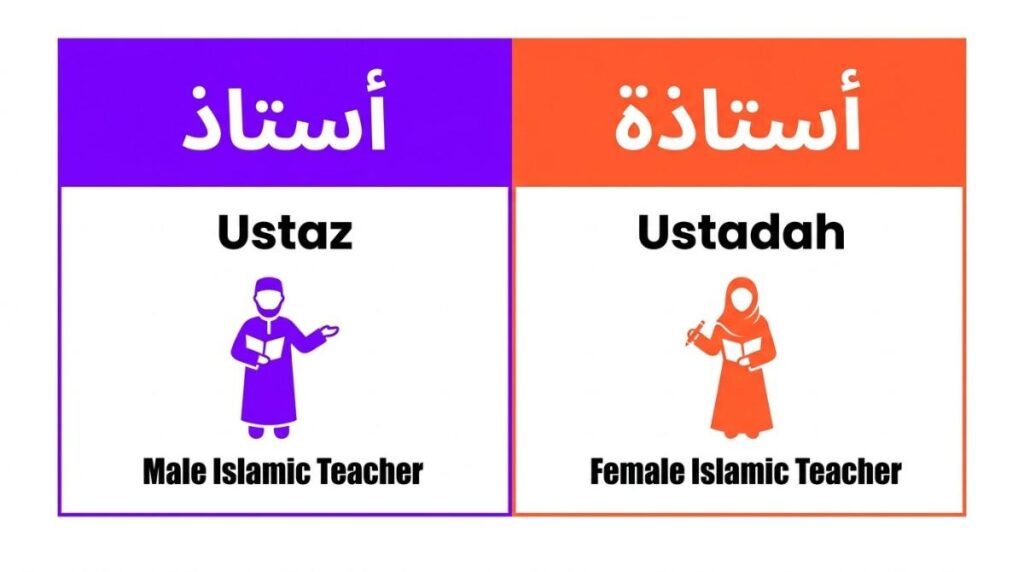
A female Islamic teacher is called Ustadah (أستاذة). It is the feminine form of the Arabic word Ustaz (أستاذ), and it translates most directly as “teacher” — but in Islamic educational contexts it carries more weight than that, functioning as a title of scholarly respect rather than just a job description.
The title is used across Muslim communities worldwide — in South Asia, the Middle East, Southeast Asia, and increasingly in the West — for qualified female teachers of Quran, Tajweed, Arabic, Islamic studies, and Hifz. When used properly, it signals that the person has received formal Islamic education, verified recitation, and has been recognized as a teacher by the community or institution she comes from.
Where the Title Comes From
The Arabic root of Ustadah is generally traced to the concept of mastery and guidance — an Ustadah is not just someone who knows a subject but someone qualified to transmit that knowledge to others. In classical Islamic scholarship, this distinction mattered enormously: knowing something and being authorized to teach it were treated as separate achievements, each requiring its own verification.
This is where the Ijazah system connects. An Ijazah — a formal certification through a chain of verified teachers tracing back to the Prophet ﷺ — is one of the traditional ways an Ustadah’s authority to teach Quran specifically is established. Receiving an Ijazah means her recitation has been checked and approved by a qualified teacher who themselves holds an Ijazah, and so on through an unbroken chain.
Ustaz vs Ustadah: What’s the Difference?
Quick Comparison
| Aspect | Ustaz (أستاذ) | Ustadah (أستاذة) |
|---|---|---|
| Gender | Male | Female |
| Root meaning | Teacher / Master | Teacher / Master |
| Used for | Male Quran, Tajweed, Arabic teachers | Female Quran, Tajweed, Arabic teachers |
| Required qualifications | Formal Islamic education, verified recitation | Formal Islamic education, verified recitation |
The only meaningful difference between Ustaz and Ustadah is grammatical gender — the Arabic language marks masculine and feminine in its nouns, and Ustadah is simply the feminine form of the same title. The standards, roles, and expectations are identical. An Ustadah teaching Quran carries the same weight of responsibility as an Ustaz teaching Quran.
Other Titles for Female Islamic Scholars
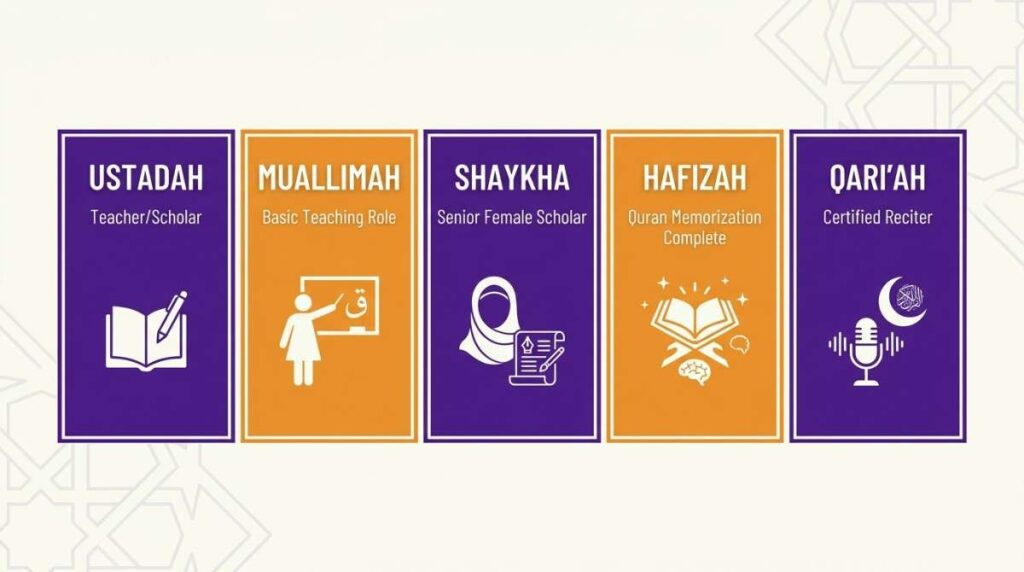
Ustadah is the most commonly used title across everyday Islamic education settings, but it isn’t the only one. Depending on the community, region, and level of scholarship, you may also encounter:
- Muallimah (معلمة) — Also meaning “teacher,” from the root ‘ilm (knowledge). Used more commonly in some Arab countries and South Asian communities for a female teacher at a basic level, particularly in madrasah settings.
- Shaykha — The feminine form of Shaykh, used for female Islamic scholars of significant standing. Far less common and carries a higher level of scholarly authority than Ustadah.
- Hafizah — Specifically denotes a woman who has completed memorization of the entire Quran. This is a title of achievement, not a teaching credential — a Hafizah is not automatically qualified to teach Hifz to others.
- Qari’ah — A woman who recites the Quran with proper Tajweed and has been recognized for her recitation ability. Again, a recitation credential rather than a teaching one.
Understanding these distinctions matters in practice. A parent looking for someone to teach her daughter Hifz needs an Ustadah or Muallimah with Hifz teaching experience — a Hafizah alone, without teaching qualifications, may or may not be equipped for the job.
What the Title Should Actually Require
In practice, Ustadah is used loosely — sometimes by anyone who has completed a Quran memorization course, sometimes by women with years of formal study and an Ijazah, and sometimes by platforms that apply it as a general label for any female teacher on their roster. This inconsistency is why parents cannot rely on the title alone.
A legitimate Ustadah teaching Quran or Tajweed should be able to demonstrate at minimum:
- Formal Quran education — from a recognized institution, madrasah, or qualified scholar, not self-study alone.
- Verified recitation — her own recitation has been checked and certified by a qualified teacher, ideally through an Ijazah or equivalent credential.
- Actual teaching experience — she has taught students, not just completed her own studies.
- Subject-specific qualification — an Ustadah teaching Tajweed should have Tajweed qualifications; one teaching Hifz should have Hifz experience specifically.
Why This Matters for Parents
For daughters specifically, finding a qualified Ustadah rather than just any female teacher is about more than Islamic correctness — it’s about a daughter learning with someone whose own knowledge has been verified through a proper chain, whose recitation won’t introduce errors into the child’s foundation, and whose teaching method has been shaped by real training rather than good intentions alone.
A mother’s first question should not be “is she an Ustadah?” — it should be “what does she mean when she uses that title?” The honest answer to that second question tells you everything the first one doesn’t. For more on evaluating a female Hifz teacher specifically, see our guide on finding the right female Hifz instructor for your daughter.
Meet Our Ustadahs — Qualified, Verified, Experienced
Every female teacher at Suffah Quran Academy has verified Quran education and real teaching experience. Book a free trial class to see the difference.
Book Free Trial Class →Frequently Asked Questions
A female Islamic teacher is called Ustadah (أستاذة). It is the feminine form of Ustaz (أستاذ), an Arabic title of respect meaning teacher or scholar, used across Islamic educational settings worldwide for qualified female teachers of Quran, Tajweed, Arabic, and Islamic studies.
Ustaz (أستاذ) is the masculine title for a male Islamic teacher. Ustadah (أستاذة) is the feminine form for a female Islamic teacher. The root word and meaning are identical — both refer to a qualified teacher or scholar of Islamic knowledge — with the distinction being grammatical gender in Arabic.
An Ijazah — a formal certification through a verified chain of teachers — is one of the strongest indicators of a legitimate Ustadah, particularly for Quran and Tajweed. For Hifz and Tajweed teaching specifically, an Ijazah or equivalent formal certification from a recognized institution matters significantly.
The title is often used as a general form of respect for any Muslim woman in a teaching role. However, strictly speaking, an Ustadah should have formal Islamic education, verified Quran recitation, and demonstrated teaching experience. Parents should ask about specific qualifications rather than accepting the title alone as a guarantee of competence.
Final Thoughts
Ustadah is a title that carries real meaning in Islamic tradition — a woman authorized to transmit knowledge through a verified chain, responsible for what she teaches and how. That meaning gets diluted when the title is applied too broadly, which is exactly why parents need to look past the title to the actual qualifications behind it.
The question isn’t whether a teacher is called Ustadah — it’s whether she has earned it. Verified recitation, real teaching experience, and subject-specific qualifications are what the title should represent. Insisting on those things for your daughter’s teacher isn’t excessive — it’s exactly the kind of care Islamic scholarship has always expected from parents.
Looking for a Qualified Ustadah for Your Daughter?
Start with a free trial class — meet our female teachers and see their credentials firsthand.
Claim Your Free Trial →
Written by Ustadah Maryam Ali
Female Islamic Studies Teacher · 5 Years Experience · Islamic Studies, Duas, Quran
Ustadah Maryam Ali teaches Islamic studies, Duas, and Quran to female students across age groups. She believes the title Ustadah carries a real responsibility — not just to know the subject, but to transmit it correctly and with care — and holds herself to that standard in every class she teaches.
Meet our teaching team →