

This post contains affiliate links.
Published: July 3, 2026 · ⏱ 8 min read · Ustaz Yusuf Khan, Advanced Tajweed Teacher
Ask most intermediate Quran students what tarteel means, and you’ll usually get one of two answers: either a blank look, or “isn’t that just Tajweed?” It isn’t. The two get confused constantly, and the confusion isn’t harmless — a student can spend years mastering Tajweed rules and still never develop tarteel, because they’re genuinely different skills measuring different things.
This article untangles the two: what tarteel actually means, where it’s commanded directly in the Quran, and why a reciter can have flawless Tajweed while still missing tarteel entirely.
What Does Tarteel Actually Mean?
Tarteel (ترتيل) comes from a root meaning “to arrange in order, clearly and distinctly.” Applied to Quran recitation, it means reciting slowly, clearly, and with reflection — giving each word room to be heard, understood, and absorbed, rather than moving through the text at a pace that blurs words together.
Tarteel isn’t about a specific pronunciation rule. It’s about the manner and pace of the entire recitation — the difference between reading a sentence quickly to get through it, and reading the same sentence slowly enough to actually take in what it says.
Where Tarteel Is Commanded in the Quran
وَرَتِّلِ الْقُرْآنَ تَرْتِيلًا
Wa Rattilil-Qur’ana Tarteela
And recite the Quran with measured, clear recitation. (Surah Al-Muzzammil, 73:4)
This isn’t a side recommendation — it’s a direct command, using the exact word “tarteel” within the ayah itself. The companions who described how the Prophet ﷺ recited consistently described a measured, clear pace — not rushed, not monotone, with each letter given its due weight. This is the model tarteel is built on.
It’s worth noting that this command was revealed specifically in the context of night prayer and reflection — reinforcing that tarteel isn’t just a recitation style, it’s connected to the purpose of recitation: understanding and contemplating what’s being recited, not simply completing it.
Tarteel vs Tajweed: The Real Difference
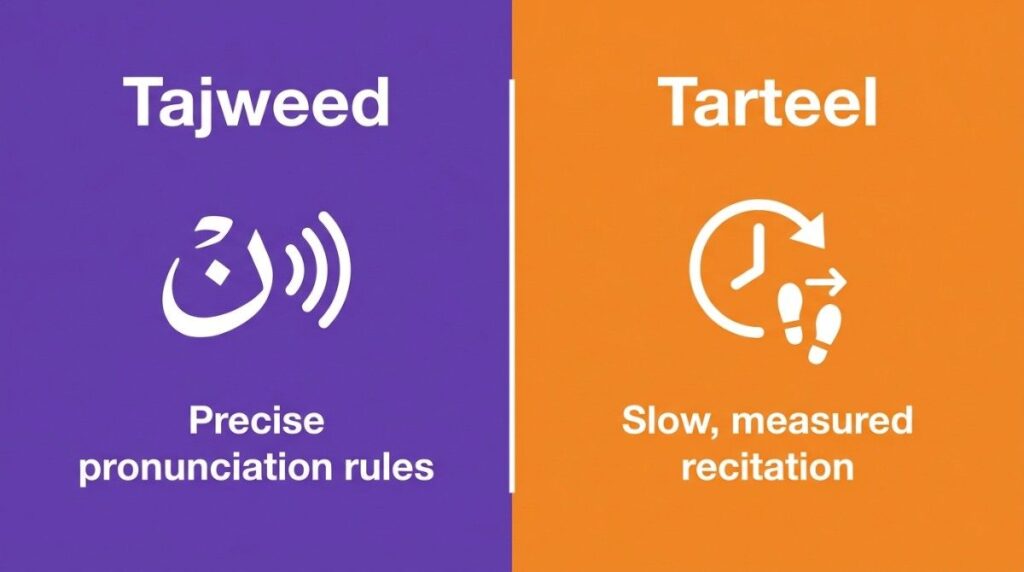
The simplest way to separate the two: Tajweed answers “how do I pronounce this correctly?” — articulation points (makharij), letter qualities, rules like ghunnah, qalqalah, and idgham. Tarteel answers “at what pace and with what presence am I reciting?”
| Aspect | Tajweed | Tarteel |
|---|---|---|
| Focus | Correct pronunciation of letters/sounds | Pace, clarity, and reflection during recitation |
| Governs | Articulation points, letter qualities, specific rules | Speed, presence of mind, measured delivery |
| Can exist without the other? | Yes — technically correct but rushed | Yes — slow and reflective but mispronounced |
| Quranic basis | Implied through preserved oral transmission | Directly commanded (73:4) |
Neither replaces the other. A reciter ideally has both — correct Tajweed delivered at a tarteel pace. But in practice, many students develop one without the other, usually Tajweed without tarteel, because Tajweed gets formally taught and tested while tarteel is assumed to “come naturally.”
Can You Have One Without the Other?
Yes — and this is exactly where the confusion causes real problems. We regularly hear fluent reciters who have clearly mastered Tajweed rules technically, but who race through ayat at a pace that leaves no room for reflection, pauses correctly per waqf symbols only because muscle memory forces a brief stop, and finishes a full page in a fraction of the time a measured reading would take.
This reciter has Tajweed. They do not have tarteel. The letters are correct. The experience — for the reciter and for anyone listening — is not what the Quran is describing when it commands “rattil.”
The reverse also happens, though less often: a reciter who reads slowly and reflectively but mispronounces letters or skips Tajweed rules. This reciter has tarteel in spirit but lacks the technical accuracy that makes the recitation correct in the first place. Both gaps matter — they’re just different gaps.
How Tarteel Connects to Waqf
Tarteel and waqf reinforce each other directly. Waqf gives you the specific points where pausing is required, forbidden, or optional. Tarteel is what makes those pauses meaningful rather than mechanical — a measured pace naturally allows a stop to actually function as a stop, rather than a rushed half-breath squeezed in before continuing at speed.
Students who rush their recitation tend to treat waqf symbols as obstacles to get past quickly rather than intentional points built into the text. Slowing down for tarteel is often what makes waqf rules finally click — see our rules of stopping guide for how pacing and pausing work together in practice.
How to Actually Practice Tarteel
Tarteel isn’t something you can drill the way you drill a Tajweed rule — it’s a habit of pace and attention built over time. The approach that works consistently with students:
- Recite at half your normal speed for one full session. Most students discover they were reading faster than they realized once forced to slow down deliberately.
- Translate as you go, even briefly. Pausing mentally to register the meaning of a phrase — even a one-word gloss — naturally slows pace to a tarteel level.
- Record yourself and listen back. Reciters are often surprised at how rushed their own recitation sounds played back, compared to how it felt while reciting.
- Practice with a teacher who corrects pace, not just pronunciation. Most self-correction focuses on Tajweed accuracy alone. A teacher listening specifically for pace and presence catches what self-study misses.
Is Your Recitation Missing Tarteel?
Book a free trial class and get live feedback on both your Tajweed accuracy and your recitation pace.
Book Free Trial Class →Frequently Asked Questions
Tarteel (ترتيل) means to recite the Quran slowly, clearly, and with reflection, allowing each word and verse to be understood and absorbed rather than rushed through. Allah commands tarteel directly in Surah Al-Muzzammil (73:4). Tarteel is about the manner and pace of recitation, not just correct pronunciation.
Tajweed is the set of rules governing correct pronunciation of Arabic letters and sounds. Tarteel is the broader practice of reciting slowly, clearly, and reflectively. You can follow every Tajweed rule while still rushing through recitation without tarteel. Tajweed answers “how do I pronounce this?” Tarteel answers “at what pace am I reciting?”
Tarteel is commanded directly in the Quran (73:4) and was the way the Prophet ﷺ recited, as described by his companions. Tarteel is considered the ideal and recommended manner of recitation, especially during memorization, teaching, and reflective reading, and is generally expected when reciting in Salah.
Yes. A reciter can pronounce every letter with technically correct Tajweed rules while still reading too fast, without pausing to reflect, and without applying waqf rules properly. Correct Tajweed without tarteel produces accurate sound but loses the reflective, measured quality the Quran specifically asks for.
Two Skills, One Goal
Tajweed and tarteel aren’t competing skills — they’re complementary ones, and the goal is both together: correct pronunciation delivered at a measured, reflective pace. Most students need to be told explicitly that tarteel is a separate thing worth practicing, because it never gets the dedicated attention Tajweed rules receive in formal study.
Once tarteel becomes a habit, recitation changes in a way that’s hard to describe until you’ve experienced it — waqf marks stop feeling like interruptions, meaning becomes harder to skip past unnoticed, and the entire experience of reciting shifts from “getting through the page” to actually being present in it.
Build Both Tajweed and Tarteel With a Real Teacher
Join a free trial class at Suffah Quran Academy and get feedback on pronunciation and pace, together.
Book Free Trial Class →
Written by Ustaz Yusuf Khan
Advanced Tajweed Teacher · 8 Years Experience · Advanced Tajweed, Fluency
Ustaz Yusuf Khan focuses on taking students from technically correct recitation to fluent, measured, reflective recitation. He treats tarteel as a skill worth teaching deliberately, not something students are expected to pick up on their own.
Meet our teaching team →