
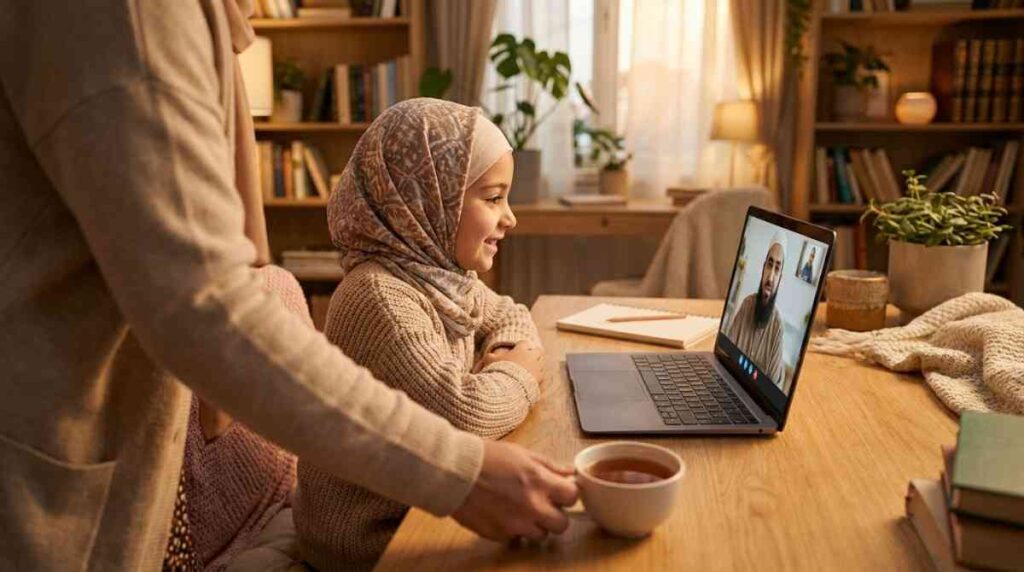
This post contains affiliate links.
Published: June 21, 2026 · ⏱ 7 min read · Ustaz Zaid Farooqui, Online Quran Tutor
For any Muslim parent considering online Quran classes for their child, safety comes before everything else. Before the teacher’s qualifications. Before the curriculum. Before the price. Before anything else.
This is the right instinct. And the right question deserves a thorough, honest answer — not a dismissal of the concern or a vague reassurance that everything is fine.
This guide covers what safe online Quran learning actually looks like, what safeguarding measures should be in place, what questions to ask before enrolling, and what warning signs should cause concern.
The Honest Answer
Yes — online Quran learning is safe for children, when proper safeguarding measures are in place and parents remain appropriately involved.
It is not automatically safe with any academy, through any platform, or without parental involvement. The safety comes from specific structures — and parents who know what those structures look like can evaluate any academy against them before enrolling.
The online format, when managed correctly, actually offers some safeguarding advantages over traditional in-person settings. Sessions happen in the child’s home — in a familiar environment, with a parent able to be present. The video format means both parties are visible. Sessions can be recorded. There is a clear digital trail of every interaction.
What matters is whether the academy has implemented the measures that make this format safe in practice.
What a Safe Online Quran Class Looks Like
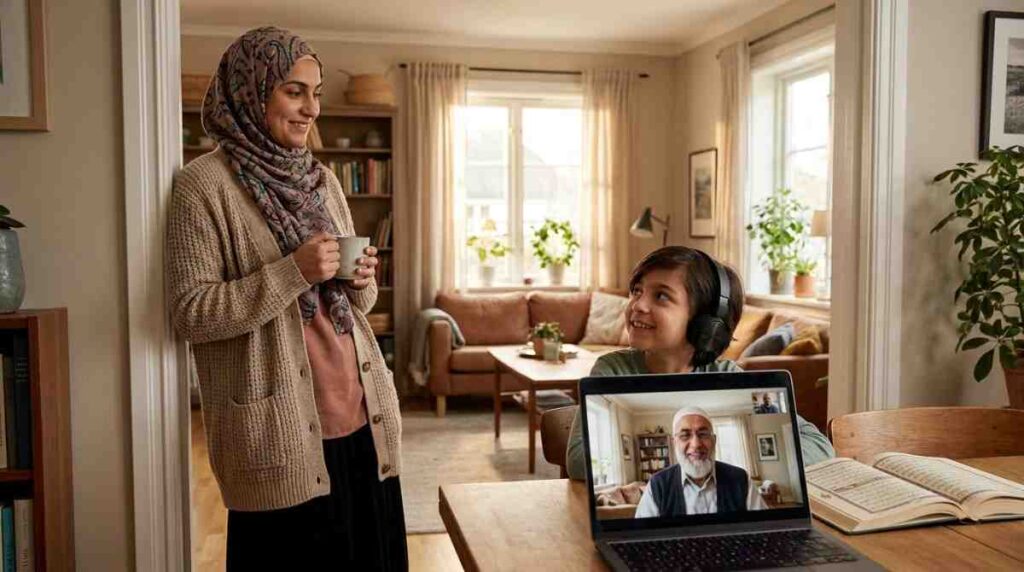
A safe online Quran class has these characteristics:
- Video call — not audio only. Both the teacher and the child are visible on camera throughout the session. Audio-only contact between a child and an adult who is not family is not acceptable. Video provides mutual visibility and accountability.
- Parent welcome — no exceptions. The parent can be present in the same room at any time, without needing to announce in advance. A teacher who asks parents to leave or who becomes uncomfortable with parental presence is a red flag, not a safeguarding feature.
- Sessions recorded. Reputable academies record sessions so parents can review what happened in any class. This protects both the child and the teacher — a teacher who conducts classes correctly has nothing to fear from recording.
- Verified teacher identity. The teacher is who they say they are. The academy has verified their identity, their credentials, and their background before they were assigned to any child.
- Academy platform for all communication. All contact between teacher and student — messages, scheduling, materials — happens through the academy’s platform. No private messaging, phone calls, or social media contact between teacher and child outside the official channel.
- Clear complaint process. If a parent has a concern about a teacher, there is a clear, accessible process to raise it — and the academy takes concerns seriously rather than dismissing them.
6 Safeguarding Questions to Ask Any Academy
Before enrolling your child with any online Quran academy, ask these six questions. The answers will tell you quickly whether the academy has safeguarding built into its operations — or whether it is an afterthought.
| Question | Good Answer | Concern Signal |
|---|---|---|
| Are classes conducted via video call? | Yes — always video, both parties visible | Audio-only option offered |
| Are sessions recorded? | Yes — recordings available to parents | No recording policy or recordings not accessible |
| How are teachers vetted? | Identity verified, references checked, credentials confirmed | Vague answer or no clear vetting process |
| Can a parent be present during class? | Always — no notice required | Discouraged or requires advance notice |
| How does communication happen? | Through academy platform only — no private contact | Teacher shares personal number or social media |
| Do you have a safeguarding policy? | Yes — written, accessible, with clear complaint process | No policy or vague response |
A reputable academy answers all six questions immediately, confidently, and specifically. An academy that hesitates, deflects, or cannot answer any of them is signalling that safeguarding has not been systematically addressed.
Your Role During Classes
Parental involvement during online Quran classes is not just permitted at Suffah — it is encouraged. Here is what appropriate parental involvement looks like at different ages:
Ages 4-7: Be in the same room throughout the class. You do not need to be on camera or actively participate — simply being nearby provides security for the child and oversight for you. Check the screen periodically. Know what is happening in every session.
Ages 7-10: Be in the same room or within easy earshot. Pop in and out as your schedule allows. Joining unannounced — randomly checking what is on the screen — is entirely appropriate and healthy. A trustworthy teacher will not react to this with discomfort.
Ages 10+: Nearby availability rather than constant presence is usually sufficient. Review session recordings periodically. Ask your child what they covered, how the teacher responded, and whether anything felt uncomfortable. These conversations, done calmly and regularly, are your most valuable safeguarding tool.
At any age: if something in a session makes you uncomfortable, act on it. Request the recording. Ask the academy for an explanation. Change teachers if necessary. Your instinct as a parent is one of the most reliable safeguarding mechanisms available.
Red Flags to Watch For
These are specific signals that something is wrong and requires immediate action:
- The teacher requests audio-only contact. Any suggestion that camera should be turned off, or that audio-only is preferred, is not acceptable. Full video contact for both parties is the baseline standard.
- The teacher contacts the child directly outside the academy platform. Messages, calls, or social media contact between a teacher and a child that bypasses the academy platform is a serious red flag. All contact should be through official channels, visible to the academy.
- The teacher tells the child to keep something secret from parents. Secrecy between an adult teacher and a child — particularly secrecy from parents — is one of the most serious warning signs in any child safeguarding context. A trustworthy teacher has nothing to keep secret.
- Your child becomes reluctant to attend class without being able to explain why. Reluctance alone may just be a child who prefers screen time to studying. Reluctance combined with changed behaviour, mood, or vague explanations is worth investigating carefully through calm, open conversation.
- The teacher discourages parental presence or observation. Any resistance to a parent being present during class is unacceptable. No reason justifies excluding a parent from their child’s online class.
- The academy is dismissive when you raise a concern. A reputable academy takes parental concerns seriously — investigates them, communicates clearly, and makes necessary changes. An academy that dismisses, minimises, or deflects parental safety concerns is not one to trust with your child.
Talking to Your Child About Online Safety

Children who have been taught what appropriate adult-child interaction looks like are better equipped to recognise and report anything that does not match. These conversations do not need to be alarming or detailed — they should be calm, age-appropriate, and regular.
Key messages for children (adapted by age):
- “Your Quran teacher is here to teach you — they should never ask you to keep secrets from us.”
- “If anything in class ever makes you feel uncomfortable, you can always tell us — we will never be angry at you for it.”
- “If a teacher ever asks to talk to you on a different app or phone, you tell us straight away.”
- “Your job in class is to learn Quran. The teacher’s job is to teach you. If anything ever feels different from that, tell us.”
These messages, delivered calmly and periodically as part of normal family conversation, create a child who knows what boundaries look like and who will report violations — which is the most effective child protection tool available.
How Suffah Quran Academy Handles Safeguarding
At Suffah Quran Academy, our safeguarding approach includes:
- All classes via video call — both teacher and student on camera throughout
- Parents welcome at every session — no notice required, no exceptions
- All teacher communication through our platform — no private contact between teachers and students
- Teacher identity verification — every teacher’s identity, credentials, and Ijazah are verified before they teach any student
- Clear escalation process — any parental concern is taken seriously, investigated, and responded to specifically
If you have any questions about our safeguarding approach before booking, contact us directly and we will answer them fully.
Book a Free Trial — See Our Safeguarding in Practice
The best way to assess whether an academy is safe is to experience a class. Book a free trial at Suffah Quran Academy — be present, observe the session, and judge for yourself.
Frequently Asked Questions
Yes — with proper safeguarding measures in place. A reputable online Quran academy conducts all classes via video call with parents welcome to be present, records sessions for parental review, verifies teacher backgrounds, and has a clear safeguarding policy. Parents should confirm these measures before enrolling and remain nearby during classes for young children.
Ask these six: Are classes via video call (not audio-only)? Are sessions recorded and available to parents? How are teachers vetted? Is a parent welcome during class at any time? Does all communication go through the academy platform only? Does the academy have a written safeguarding policy? A reputable academy answers all six immediately and specifically.
For children under 10, being in the same room is strongly recommended. For older children, being nearby or checking in periodically is appropriate. Randomly joining sessions unannounced is healthy — a trustworthy teacher welcomes it. Your presence is a safeguarding measure, not an intrusion.
Signs of a trustworthy teacher: they conduct class via video, welcome parental presence, do not ask the child to keep anything secret from parents, maintain professional boundaries, and provide verifiable Ijazah credentials. Red flags: requests for audio-only, direct contact with the child outside the academy platform, or any instruction to not tell parents something.
Take it seriously. Ask calm, open questions about what happened. Children rarely fabricate discomfort. If your child expresses specific concerns about a teacher, report them to the academy immediately. A reputable academy investigates concerns seriously and makes alternative arrangements without pressure or dismissal.
Safety and Learning Are Not in Tension
Online Quran learning and child safety are entirely compatible — when the right measures are in place. The parent who asks safeguarding questions before enrolling, who stays present during sessions, who talks openly with their child about what appropriate adult-child interaction looks like — that parent is not obstructing the learning. They are making it possible to trust the learning.
An academy that welcomes these questions, answers them fully, and actively supports parental involvement is an academy that takes its responsibility seriously. That combination — qualified teaching and robust safeguarding — is what your child deserves.
Enrol With Confidence
At Suffah Quran Academy, every class is video, every parent is welcome, every teacher is verified. Book a free trial class and see our safeguarding approach in practice.
Written by Ustaz Zaid Farooqui
Online Quran Tutor · 7 Years Experience · Online Quran Teaching, Qaida · Urdu, Hindi, English
Ustaz Zaid Farooqui has 7 years of experience teaching international students online. He has worked with families across the UK, USA, Canada, and Australia — and understands that parents’ trust is the foundation on which every online teaching relationship is built. Every class he conducts is open to parental presence, always.