This post contains affiliate links.
Published: June 10, 2026 · ⏱ 8 min read · Ustaz Imran Qadri, Tajweed Expert
Every Muslim knows, in some sense, that the Quran is important. It is the word of Allah. It is the foundation of Islam. It guides every aspect of a believer’s life.
But sometimes the weight of what the Prophet ﷺ actually said about learning, reciting, and teaching the Quran — specifically, in his own words — needs to be brought back to the surface. Not as background knowledge, but as a living reminder that sharpens intention and renews commitment.
This is that reminder.
The Best of People
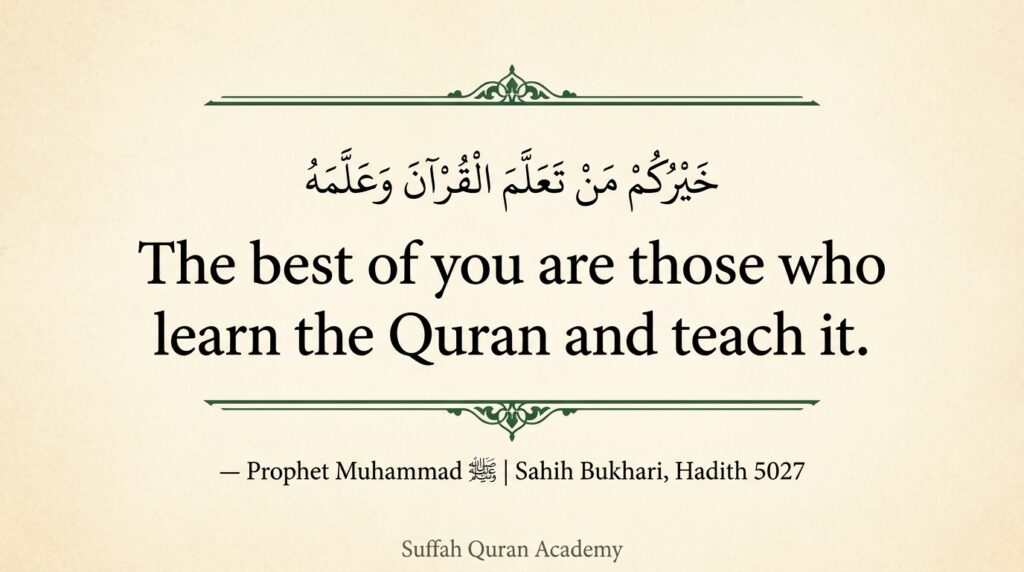
“The best of you are those who learn the Quran and teach it.”
— Prophet Muhammad ﷺ | Sahih Bukhari, Hadith 5027
This is perhaps the most often-quoted Hadith in the context of Quran education — and its simplicity is its power.
The Prophet ﷺ did not say the best of people are the wealthiest, or the most educated in worldly knowledge, or the most powerful. He connected the highest description — the best of you — to a specific relationship with the Quran: learning it and teaching it.
This Hadith has no age limit, no prerequisite of existing knowledge, and no requirement of a particular level of recitation. The person who begins learning Quran today — whether a child starting Madani Qaida or an adult beginning for the first time — is engaged in the activity the Prophet ﷺ identified as producing the best of people.
And teaching — whether as a formal scholar or as a parent sitting with their child — is included in the same description. The parent who ensures their child learns the Quran is not merely supporting their child’s religious development. They are participating directly in what the Prophet ﷺ described as the highest of occupations.
Reward for Every Letter
“Whoever reads a letter from the Book of Allah will receive a reward. And that reward is multiplied by ten. I do not say that Alif Lam Meem is one letter. Rather, Alif is a letter, Lam is a letter, and Meem is a letter.”
— Prophet Muhammad ﷺ | Tirmidhi, Hadith 2910
The mathematics of this Hadith are staggering when you sit with them.
The Quran contains approximately 323,000 letters. At ten rewards per letter, a single complete recitation of the Quran produces over three million rewards. In Ramadan — when good deeds are multiplied — the number becomes incomprehensible.
The Prophet ﷺ chose to illustrate this with the opening of Surah Al-Baqarah — Alif Lam Meem. Three letters. Thirty rewards. Letters that many beginners learn in their very first Quran class.
There is a particular mercy in this Hadith for those who read slowly, who pause and correct themselves, who struggle with letters. Every letter — regardless of how long it takes to produce — carries its ten rewards. The person who reads one page slowly and correctly has earned far more than the person who races through ten pages with errors. And the person who is correcting an error today, reciting the same word twenty times to get it right, is earning rewards with every repetition.
The Quran Intercedes on the Day of Judgement
“Read the Quran, for it will come as an intercessor for its reciters on the Day of Resurrection.”
— Prophet Muhammad ﷺ | Sahih Muslim, Hadith 804
This Hadith reframes the entire relationship with the Quran. It is not merely a text to be read — it is a companion that accompanies the reciter beyond this life.
The word used — intercessor (شفيع) — is the same word used for the Prophet ﷺ himself in the context of intercession on the Day of Judgement. The Quran, for those who gave it its right of recitation and relationship, will stand and speak on their behalf.
In a related narration, the Prophet ﷺ specifically mentioned Surah Al-Baqarah and Surah Al-Imran — describing them as two lights that will come on the Day of Resurrection and intercede for those who recited them, providing shade as they stand before Allah.
For parents who are asking themselves whether the effort and commitment of Quran education is truly worth it — this Hadith is one of the most direct answers. The recitation your child builds today is not just a skill. It is a relationship being formed with a companion who will be present at the moment it matters most.
The Status of the Hafiz
“The one who memorised the Quran shall come on the Day of Judgement and the Quran shall say: O Lord, decorate him. So he will be adorned with a crown of dignity. Then it will say: O Lord, give him more. So he will be given a garment of dignity. Then it will say: O Lord, be pleased with him. So He will be pleased with him.”
— Prophet Muhammad ﷺ | Tirmidhi, Hadith 2915
The imagery of this Hadith is extraordinary. The Quran speaks. It requests on behalf of the one who memorised it. And what it requests is not merely forgiveness — it is honour, decoration, the pleasure of Allah Himself.
In another narration, the Prophet ﷺ said that the Hafiz will be told on the Day of Judgement to recite — and for every verse they recite, they will be raised a level in Paradise. The full memorisation of the Quran — 6,236 verses — represents 6,236 levels of elevation.
And the mercy extends to the family. The Prophet ﷺ described the parents of a Hafiz being given a crown of light on the Day of Judgement — whose radiance will fill everything the eye can see. The child who carries the Quran in their heart carries a gift that will reach beyond them, into the next life, to those who made it possible.
For parents considering a Hifz programme for their child — this is what is being invested in.
Struggling Is Rewarded Too
“The one who recites the Quran and is proficient in it will be with the noble, righteous scribes. And the one who recites the Quran but falters in it — and it is difficult for him — will have two rewards.”
— Prophet Muhammad ﷺ | Sahih Muslim, Hadith 798
This Hadith is one of the most comforting in the entire body of Prophetic tradition — and one of the most important for adult beginners, children who find reading difficult, and anyone who has carried guilt about the state of their recitation.
Two categories are described. The first: the person who recites with proficiency — fluently, correctly, with Tajweed. They will be with the angels. The second: the person who recites but struggles — who stumbles, who finds it hard. They receive double the reward.
Not a lesser reward. Double.
The reason, as scholars have explained, is that the struggle itself carries weight. The person who finds recitation difficult and continues anyway — who sits down every day despite the difficulty — is making a sacrifice that the fluent reciter is not making. That sacrifice is recognised and rewarded specifically.
This Hadith is for the adult who begins learning Quran for the first time at forty. The child who has been struggling with the same letters for months. The revert who cannot yet read Arabic. The person whose recitation has errors they are embarrassed by.
All of them are reciting. All of them are earning reward. And those for whom it is hardest are earning the most.
The Reward of Teaching Children
“When a person dies, all their deeds come to an end except three: a continuing charity, knowledge from which others benefit, or a righteous child who prays for them.”
— Prophet Muhammad ﷺ | Sahih Muslim, Hadith 1631
Quran education given to a child is one of the most enduring investments a parent can make — because it does not end when the parent dies.
A child who learns the Quran recites it in their prayers for the rest of their life. Every Salah they pray — for seventy, eighty years after you are gone — contains the Quran you made possible for them to learn. Every recitation they make, every letter that produces ten rewards, every time the Quran intercedes for them — your role in making that possible continues to generate reward for you.
And if that child teaches their own children — and those children teach theirs — the chain of reward extends across generations, all traceable back to the moment a parent decided that their child’s Quran education mattered enough to invest in properly.
This is what it means to give a child the Quran. Not simply a skill. Not merely a cultural tradition. A living inheritance that generates reward — for the child, and for the parent — long after both have left this world.
The Quran in the Heart — A Home That Cannot Be Taken
“The one whose heart has nothing of the Quran in it is like a ruined house.”
— Prophet Muhammad ﷺ | Tirmidhi, Hadith 2913
The image is striking in its simplicity. A house without inhabitants becomes a ruin — walls standing but nothing living inside. A heart without the Quran is described the same way.
This does not refer only to memorisation. It refers to the presence of the Quran in a person’s life — its recitation, its guidance, its words remembered and returned to. A person who recites even a small portion of the Quran regularly, who carries some of its words in their heart, has a home in the heart that is alive.
This Hadith is the foundation of why Quran education — at whatever level — matters so deeply. It is not about qualification or performance. It is about whether the heart has inhabitants or is empty.
Every letter a child learns, every Surah they memorise, every page they read — is filling that house. The teacher who guides them is helping build something that will stand long after the lessons are done.
What This Means for Your Family Today
These Hadith are not history. They are guidance — alive, applicable, and waiting to be acted on.
If your child has not yet begun Quran learning — or has begun but is not progressing — the reminder in this article is an invitation to take the next step. Not tomorrow. Today.
If you yourself have not yet learned to recite correctly — if you have been carrying guilt about your recitation, or have been meaning to improve but have not started — the Hadith about struggling reciters receiving double reward is for you. Your difficulty is not an obstacle to beginning. It is, according to the Prophet ﷺ himself, a reason your recitation is worth more.
And if you are already on the path — your child attending classes, their recitation improving, the Quran becoming more familiar in your home — this article is a reminder of what is being built. Not just a skill. An intercession. A crown. A companion for the Day that nothing else will prepare you for in quite the same way.
At Suffah Quran Academy, we teach because we believe in what these Hadith describe. Every class — with every child, every adult, every struggling beginner — is contributing to something that the Prophet ﷺ called the best of what a person can do.
Begin Today — The First Class Is Free
Whether you want Quran education for your child or for yourself — book a free trial class. No payment, no commitment. Just a real class with a qualified teacher, and the beginning of something that will last far beyond it.
Book Free Trial Class →Frequently Asked Questions
The Prophet Muhammad ﷺ said: “The best of you are those who learn the Quran and teach it.” (Sahih Bukhari, Hadith 5027). He also said that reciting the Quran with proficiency places a person with the noble and righteous scribes (angels), and that even a person who struggles with recitation receives double the reward for their effort (Sahih Muslim). These Hadith establish that Quran learning is an honour at every level of ability.
The Prophet ﷺ said: “Whoever reads a letter from the Book of Allah will receive a reward. And that reward is multiplied by ten.” (Tirmidhi, Hadith 2910). He gave the example that Alif Lam Meem is three letters — thirty rewards. The Quran contains approximately 323,000 letters, meaning a single complete recitation produces over three million rewards.
The Prophet ﷺ said that on the Day of Judgement, the Quran will intercede for the Hafiz, requesting that Allah decorate them, grant them dignity, and be pleased with them. (Tirmidhi). The Prophet also said the Hafiz will ascend in Paradise for every verse they recite — 6,236 levels for the complete memorisation — and that the parents of a Hafiz will be given a crown of light.
Yes. The Prophet ﷺ said: “Read the Quran, for it will come as an intercessor for its reciters on the Day of Resurrection.” (Sahih Muslim, Hadith 804). He also described Surah Al-Baqarah and Surah Al-Imran as two lights that will intercede for those who recited them on the Day of Resurrection.
The Prophet ﷺ said the best of people are those who learn and teach the Quran. A parent who ensures their child receives proper Quran education participates in this directly. Furthermore, every Salah the child prays for the rest of their life — containing the Quran the parent made possible — continues to generate reward for the parent even after death (Sadaqah Jariyah).
The Best of What We Can Do
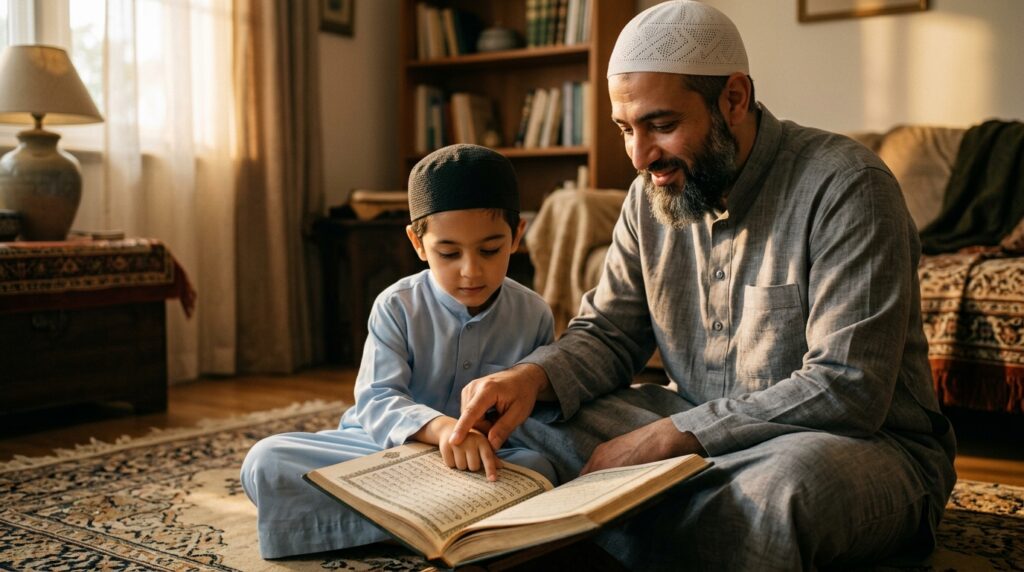
The Prophet ﷺ was asked many questions about the best of people, the best of deeds, the best of this and that. On the question of who among the people is the best — his answer was the one who learns the Quran and teaches it.
Not the wealthiest. Not the most powerful. Not even the most knowledgeable in other fields of Islamic study. The one with a relationship to the Quran — learning it, and passing it on.
Every family that invests in Quran education — for their child, for themselves — is pursuing the best of what the Prophet ﷺ described. That is not a small thing. It is the thing.
Start Your Family’s Quran Journey
Ijazah-certified teachers. One-on-one classes. Female scholars available. Your first class is completely free — for your child or for yourself.
Book Free Trial Class →
Written by Ustaz Imran Qadri
Tajweed Expert · 9 Years Experience · Specialisation: Tajweed Rules, Makharij
Ustaz Imran Qadri specialises in improving Quran pronunciation and Makharij with 9 years of teaching experience. His classes are designed for students who want to perfect their recitation — from beginner foundations to advanced Tajweed refinement. He teaches in Urdu and Hindi.
Meet our teaching team →