
This post contains affiliate links.
Estimated reading time: 13 minutes
Table of contents
- First: The Guilt Stops Here
- Why Adults Actually Have Real Advantages
- The 5 Most Common Starting Points for Adult Learners
- What to Do in the First Week
- What a Typical Adult Quran Class Looks Like
- How Long Will It Take? Honest Expectations
- The Role of Home Practice for Adult Learners
- Choosing the Right Teacher for Adult Learning
- A Word About Embarrassment
- Frequently Asked Questions
- Begin Today. Not When You Feel Ready.
There is a particular kind of quiet sadness that many adult Muslims carry.
They grew up in homes where Quran was important — recited, revered, present. But somehow, the actual learning never happened. School was busy. The right teacher was never found. Life moved fast. And now here they are — adults who love the Quran, who want to connect with it properly, but who have never learned to read it.
If that is you, this guide is written for you.
Not for children. Not for parents researching classes for their kids. For you — the adult who wants to begin, and is not sure where or how.
By the end of this guide, you will know exactly what to expect, what to do first, and how long it realistically takes. And you will understand why beginning as an adult is not a disadvantage — in several important ways, it is actually easier.
First: The Guilt Stops Here
Before anything practical, let us address the thing that gets in the way for most adult beginners: the guilt.
Many adult Muslims feel they should have learned the Quran already. They compare themselves to people who started as children. They feel embarrassed about not knowing something they believe they should know.
This guilt is understandable. It is also completely unhelpful — and it is based on a false assumption.
The Quran was not revealed with an age limit on learning it. The Prophet Muhammad (peace be upon him) said:
“The best of you are those who learn the Quran and teach it.” (Sahih Bukhari, Hadith 5027 — sunnah.com/bukhari:5027)
There is no asterisk after that. No “except if you are over thirty.” No “unless you should have started earlier.”
You are beginning now. That is what matters.
Why Adults Actually Have Real Advantages
Here is something most people do not realise: adult learners have genuine advantages over young children in many aspects of Quran learning.
Better concentration. An adult who sits down to learn can focus for a full 45-60 minute session with real attention. A young child manages 20-30 minutes on a good day. This means adults often cover more ground per session than children do.
Stronger comprehension. When a teacher explains a rule — why this letter sounds this way, why this mark changes the pronunciation — an adult understands the explanation immediately. A young child needs the rule demonstrated and repeated many more times before it is absorbed.
Genuine motivation. Children often learn Quran because their parents enrolled them. Adults learn because they want to. That internal motivation is a significant accelerator of progress. Students who choose to be in a class learn faster than students who are placed there.
Emotional connection. An adult who begins learning the Quran brings years of Islamic practice, prayer, and connection to Allah with them. When they read even a short phrase from the Quran correctly for the first time, the emotional weight of that moment is profound. That connection makes the learning meaningful in a way that is difficult to replicate in childhood.
The 5 Most Common Starting Points for Adult Learners
Not all adult beginners are the same. Here are the five most common situations — find yours and read what applies:
1. Complete Beginners: Never Learned Arabic Script
You cannot read Arabic at all. You may know the names of some letters but cannot read them. You have never worked through a Qaida or any Arabic literacy course.
Where to start: Madani Qaida. This is a structured beginner’s programme that takes you from zero — individual Arabic letters — through vowel marks, sound rules, and connected text, until you can read basic Arabic. It is not just for children. Many of our adult students begin here.
Realistic timeframe: 4-8 months to complete Madani Qaida at 2-3 sessions per week. Adults typically move faster than young children.
2. Letter-Recognisers: Know the Alphabet But Cannot Read Fluently
You can identify individual Arabic letters — perhaps you learned them as a child — but you cannot read connected Arabic text. Words look like separate shapes that do not connect into meaning.
Where to start: A brief review of Madani Qaida (often just the first half) to confirm your letter knowledge and vowel marks, then moving into Quran Reading with Tajweed. A qualified teacher will assess your level in the first session and tell you exactly where to begin.
Realistic timeframe: 2-4 months to reach fluent Quran reading, depending on your current level.
3. Readers Without Tajweed: Can Read But Pronunciation Is Incorrect
You can read Arabic text — you get through the words — but your pronunciation is inconsistent or incorrect. You may skip vowel marks, merge sounds that should be distinct, or have no awareness of Tajweed rules.
Where to start: A dedicated Tajweed course. This is specifically designed for people who can already read but need to correct and refine their recitation. The focus is on Makhaarij (points of articulation), rules of Noon Sakinah and Tanween, Madd (prolongation), and applying these rules in actual Quranic recitation.
Realistic timeframe: 6-12 months for a solid foundation in Tajweed, depending on how many patterns need correcting and how deeply you want to go.
4. Reverts: New to Islam and Starting From Zero
If you came to Islam as an adult — whether recently or years ago — you may be navigating Quran learning alongside everything else: learning to pray, learning about Islamic practice, finding a community, integrating a new worldview into your life.
Quran learning as a revert does not need to happen immediately and does not need to happen all at once. Many reverts begin with learning to recite Surah Al-Fatiha correctly — because this is required for Salah — before working on broader Arabic reading. A teacher who understands the revert experience will pace the learning accordingly.
Where to start: A conversation with a qualified teacher who works with beginners, explaining your background. They will design a path that makes sense for where you are.
Realistic timeframe: Highly individual. Patience with yourself is the most important thing.
5. Re-learners: Learned as a Child But Have Forgotten Most of It
You attended Quran classes as a child. You completed some of the Qaida, perhaps even parts of the Quran. But that was fifteen or twenty years ago, and almost all of it has faded.
Where to start: A short assessment session with a teacher who will read with you and identify what remains and what needs rebuilding. Most re-learners have more foundation than they think — but they also have some incorrect habits that became fixed over years of undirected reading.
Realistic timeframe: 3-6 months to re-establish a solid reading foundation, faster than starting from scratch but slower than picking up from where you left off.
What to Do in the First Week
Knowing where to start is one thing. Actually starting is another. Here is what to do in the first seven days:
Day 1-2: Book a free trial class. Do not spend more time researching academies, reading reviews, or thinking about whether you are ready. You are ready. The trial class exists precisely so that you can experience a real session, meet a teacher, and make a decision based on actual experience — not internet research.
Day 3-4: Let the teacher assess your level. In the trial class, a good teacher will ask you to read some Arabic — or, if you cannot read yet, will explain what Madani Qaida involves. By the end of the session, you will know exactly where you are and what your learning path looks like.
Day 5-6: Decide on a schedule. Two to three sessions per week is ideal for most adult learners. More than three can feel overwhelming alongside work and family commitments. Fewer than two often means too much forgetting between sessions. Two is the minimum; three is the sweet spot.
Day 7: Begin. That is all. Begin.
Book your free trial class at Suffah Quran Academy — no payment required
What a Typical Adult Quran Class Looks Like
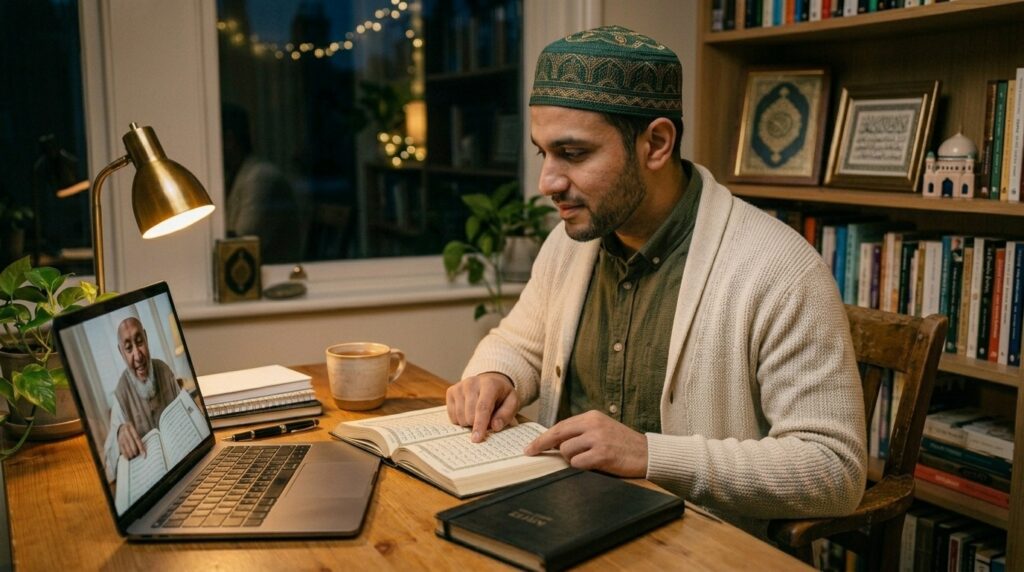
Adult classes at a good online Quran academy are not like children’s classes — and they should not be. Here is what to expect from a well-structured adult session:
No condescension. A good teacher of adults treats the student as an intelligent adult who simply has not yet learned this skill. There is no baby talk, no oversimplification, no sense that you should be embarrassed to be at this level.
Explanation alongside instruction. When a rule is introduced, it is explained — why it exists, what it affects, how to remember it. Adults learn rules better when they understand them, not just when they practise them.
Correction with context. When you make a mistake, a good teacher does not just correct it — they explain what went wrong and how to fix it permanently. This is different from children’s teaching, where repetition does most of the work.
Flexible pacing. Adult learners have varying attention spans, varying starting points, and varying amounts of time to practise between sessions. A good teacher adjusts constantly.
A 45-60 minute session. Adult sessions are typically longer than children’s sessions — because adults can sustain focus for longer and have more to cover per session.
How Long Will It Take? Honest Expectations
One of the most common questions adult beginners ask — and one that deserves an honest, specific answer.
If you are a complete beginner (cannot read Arabic at all): Reading fluently with basic Tajweed: 12-18 months at 2-3 sessions per week This includes completing Madani Qaida (4-8 months) and then Quran Reading with Tajweed (6-12 months).
If you know the letters but cannot read connected text: Reading fluently with basic Tajweed: 6-10 months at 2-3 sessions per week
If you can read but need Tajweed correction: Solid Tajweed foundation: 6-12 months, depending on how many patterns need correcting
These timeframes assume consistent attendance and some home practice between sessions — even 10 minutes per day reviewing what was covered. Without any home practice, progress is slower. With daily practice, it can be significantly faster.
The most honest thing we can tell you is this: every person progresses at their own pace, and that pace cannot be predicted precisely before beginning. What can be said with certainty is that consistent, patient effort with a qualified teacher produces results. Every student who begins and stays with it makes genuine progress.
The Role of Home Practice for Adult Learners
Home practice matters enormously — and for adults, it looks different than it does for children.
You do not need a parent standing over you. You simply need to create a brief daily habit.
After each class, spend 10-15 minutes reviewing what was covered. Read through the letters or phrases your teacher introduced. Identify the ones that felt uncertain and repeat them specifically. Record yourself reading if it helps — hearing your own recitation is one of the most effective ways to identify what still needs work.
Between sessions, recite what you already know in your daily prayers. Every Muslim adult prays — and Salah is itself Quran recitation practice. Paying deliberate attention to how you are reciting Surah Al-Fatiha and your other recitations in prayer is practice that fits naturally into the day.
Play Quran recitation in the background. Passive exposure to correct recitation builds familiarity with sounds, rhythms, and pronunciation patterns. Over weeks and months, this makes a measurable difference to a learner’s instincts.
Choosing the Right Teacher for Adult Learning
Not every Quran teacher is equally good at teaching adults. Here is what to look for specifically:
Experience with adult students. Ask directly: “Do you teach adults, or primarily children?” A teacher who works mainly with young children uses different methods that may not transfer well to adults.
Ijazah certification. This applies regardless of age — you want a teacher whose credentials are verifiable, not just self-described. At Suffah Quran Academy, every teacher holds Ijazah certification.
Patience without condescension. The first session will tell you this. Does the teacher explain things clearly? Do they correct without making you feel foolish? Do they treat you as an intelligent person who is learning something new?
Female teacher available. For Muslim women who prefer to learn from a female scholar, this matters. Check that the academy has qualified female teachers on staff, not just as a rare option.
A real free trial. A teacher confident in their abilities will let you experience a session before you commit. If an academy does not offer a genuine free trial, move on.
See our Quran courses for adult learners
A Word About Embarrassment
Let us address it directly, because almost every adult beginner feels it at some point.
Sitting in a class as an adult, not knowing things that children know — it can feel embarrassing. The thought of reading haltingly, making mistakes, asking basic questions — it is uncomfortable for people who are competent and capable in every other area of their life.
Here is the truth: your teacher has seen this before. Every teacher who works with adult beginners knows that their students are intelligent, accomplished people who simply have not yet learned this particular skill. There is no pity in the room. There is no judgment.
What there is, in a good class, is the recognition that beginning something is an act of courage — and that every person who sits down to learn the Quran as an adult has made a decision that deserves respect, not condescension.
The embarrassment fades very quickly once you begin. Progress dissolves it. The moment you read your first Quranic verse correctly — and hear the sound of those words in your own voice — something shifts. It becomes about the learning, not about the discomfort.
Begin. The rest takes care of itself.
Frequently Asked Questions
No. There is no age at which learning the Quran becomes impossible or even significantly harder. Adults have different advantages than children — stronger concentration, greater comprehension, internal motivation — and while some aspects of language learning are easier in childhood, structured Quran reading with a qualified teacher produces genuine results at any age.
A complete adult beginner who cannot read Arabic at all typically reaches fluent Quran reading with basic Tajweed in 12-18 months, attending 2-3 sessions per week with daily home practice. Adults who already know the alphabet progress faster. Every individual varies.
Yes — and for many adults, online learning is more practical than finding a local teacher. One-on-one online sessions offer the flexibility to schedule around work and family commitments, the privacy that some adult beginners prefer, and access to Ijazah-certified teachers regardless of your location. Visit our guide on how to choose an online Quran academy (/how-to-choose-online-quran-academy-parents-trust/) for what to look for.
Begin with a qualified teacher who has experience working with reverts. Many reverts start by learning to recite Surah Al-Fatiha correctly for Salah before moving into a full Quran reading programme. A good teacher will design a path around where you are and what you need most urgently.
You need to learn to read Arabic script — the letters, vowel marks, and pronunciation rules that make up Quranic recitation. You do not need to understand conversational Arabic or modern standard Arabic to recite the Quran correctly. Tajweed and Quran reading is a distinct skill from Arabic language acquisition, and the two are often learned separately.
Review what your teacher covered in the last session for 10-15 minutes each day. Recite in your daily prayers with deliberate attention. Play Quran recitation in the background of your home. Record yourself and listen back. Even 10 minutes per day of focused practice produces significant results over weeks and months.
Begin Today. Not When You Feel Ready.
Waiting to feel ready is the thing that has delayed many adult learners for years — or decades.
You will not feel ready before you begin. You will feel ready after the first few classes, when the letters start to come, when the teacher’s voice and method become familiar, when you read your first line and it sounds the way you hoped it would.
That feeling of readiness comes from doing the thing, not from thinking about it.
At Suffah Quran Academy, we work with adult learners from every background — complete beginners, reverts, re-learners, parents who want to learn alongside their children. Our teachers are Ijazah-certified, experienced with adults, and patient with the process.
Your first class is free. No payment. No commitment. Just a real session with a real teacher.