
This post contains affiliate links.
Published: June 26, 2026 · ⏱ 8 min read · Ustadah Maryam Ali, Female Islamic Studies Teacher
The Duas a child learns in their early years become the language they speak to Allah for the rest of their life. A child who says Bismillah before every meal from age three will say it at fifty without thinking — not because they were told to, but because it is simply how they begin things.
That is what childhood Dua teaching produces: not compliance, but instinct. Not performance, but habit. The habits built in these early years are among the most lasting gifts Islamic parenting offers.
These ten Duas are the most important ones for everyday life — covering the situations that occur most frequently in any child’s day. Each entry includes the Arabic, an easy transliteration, the meaning, and when to use it.
Why These Ten?
These ten were chosen because they are: authenticated in the Sunnah, short enough for young children to learn, used in situations that occur every single day, and collectively cover the full arc of a child’s daily routine from morning to night.
A child who knows all ten of these Duas will have an Islamic framework wrapped around their entire day — waking, eating, leaving, returning, using the bathroom, sleeping. That framework, internalized in childhood, is what Islamic character is built from.
How to Teach Duas to Young Children
The most effective method is not a formal lesson. It is consistent contextual repetition — saying the Dua in its natural situation, together with the child, every time that situation occurs.
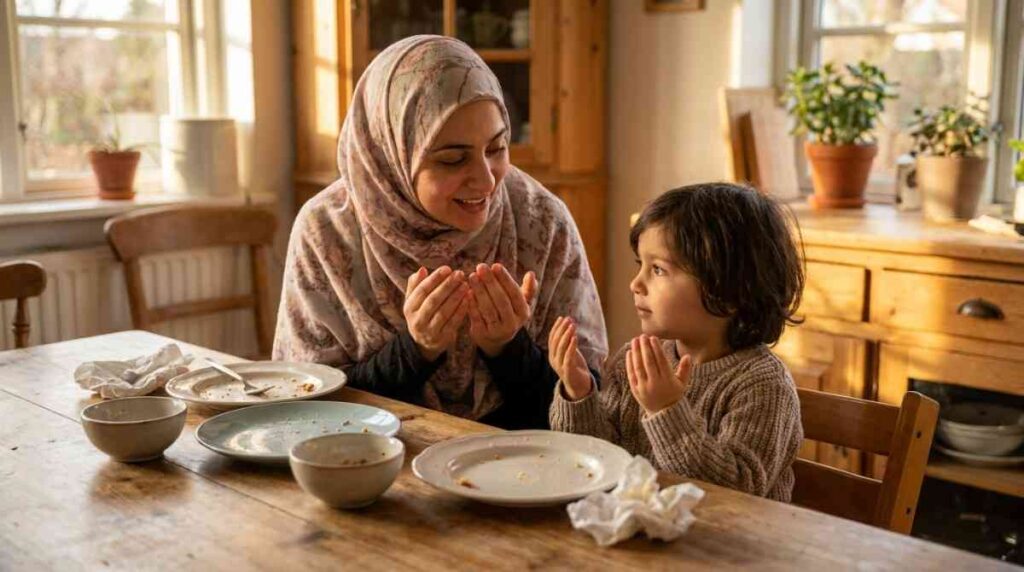
Before every meal: “Let’s say Bismillah.” Say it together. Do this every meal for two weeks before expecting the child to remember it independently. The repetition in context is what builds automaticity.
Teach one Dua at a time. Use it consistently in its context for at least two weeks before introducing the next. Do not rush. A child who has genuinely internalized five Duas knows more than a child who has been briefly taught twenty.
Dua 1: Bismillah — Before Eating and Starting Anything
بِسْمِ اللہِ
Bismillah
Meaning: In the name of Allah
When to say it: Before eating, before drinking, before starting any task or activity.
The fuller version before eating: Bismillahi wa ‘ala barakatillah — “In the name of Allah and with the blessings of Allah.” Both versions are established in the Sunnah.
If you forget to say it before starting: The Prophet ﷺ taught: if you forget and remember midway, say “Bismillahi awwalahu wa akhirahu” — “In the name of Allah at its beginning and its end.”
Teaching tip: Make a household rule — no one begins eating until Bismillah is said together. Even very young children (2-3 years) can participate in saying Bismillah before meals as a family moment.
Dua 2: Alhamdulillah — After Eating and Expressing Gratitude
الْحَمْدُ لِلہ الَّذِي أَطْعَمَنَا وَسَقَانَا وَجَعَلَنَا مُسْلِمِينَ
Alhamdu lillahil-ladhi at’amana wa saqana wa ja’alana muslimin
Meaning: All praise is for Allah who fed us, gave us drink, and made us Muslims
When to say it: After finishing a meal. The shorter “Alhamdulillah” alone is also established and appropriate for young children starting out.
Teaching tip: Pair with Bismillah — before and after every meal becomes the natural rhythm. Young children who say both from early childhood develop an eating ritual that frames every meal as an act of gratitude.
Dua 3: Before Sleeping
اللَّهُمَّ بِاسْمِكَ أَمُوتُ وَأَحْيَا
Allahumma Bismika amutu wa ahya
Meaning: In Your name, O Allah, I die and I live
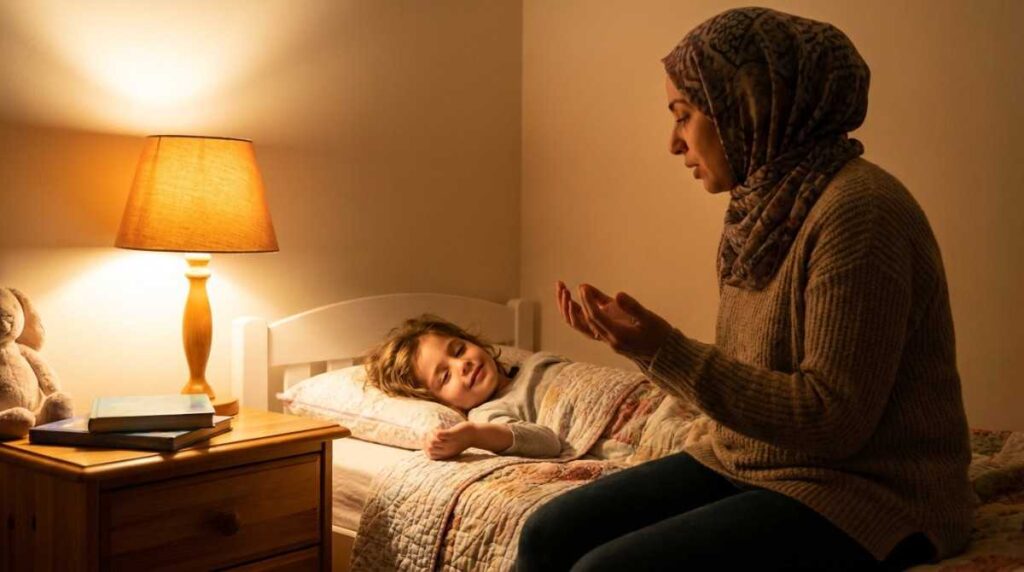
When to say it: When lying down to sleep. The Prophet ﷺ would say this before sleeping, acknowledging that sleep is a minor death — a letting go of consciousness into Allah’s care.
Teaching tip: Incorporate into the bedtime routine alongside recitation of Al-Ikhlas, Al-Falaq, and An-Naas. Children who have a consistent Islamic bedtime routine carry it into adulthood.
Dua 4: Upon Waking
الْحَمْدُ لِلِہ الَّذِي أَحْيَانَا بَعْدَ مَا أَمَاتَنَا وَإِلَيْهِ النُّشُورُ
Alhamdu lillahil-ladhi ahyana ba’da ma amatana wa ilayhin-nushur
Meaning: All praise is for Allah who gave us life after causing us to die, and to Him is the resurrection
When to say it: Immediately upon waking — before getting out of bed. The Prophet ﷺ would say this upon waking, beginning each new day with gratitude and awareness of Allah.
Teaching tip: Teach alongside the sleeping Dua as a pair. “We say this before sleep and this when we wake.” Children who understand the pair grasp the concept of the day as a gift given by Allah each morning.
Dua 5: Leaving the Home
بِسْمِ اللہِ تَوَكَّلْتُ عَلَى اللَّهِ وَلَا حَوْلَ وَلَا قُوَّةَ إِلَّا بِااللہِ
Bismillahi tawakkaltu ‘alallahi wa la hawla wa la quwwata illa billah
Meaning: In the name of Allah, I place my trust in Allah, and there is no might or power except with Allah
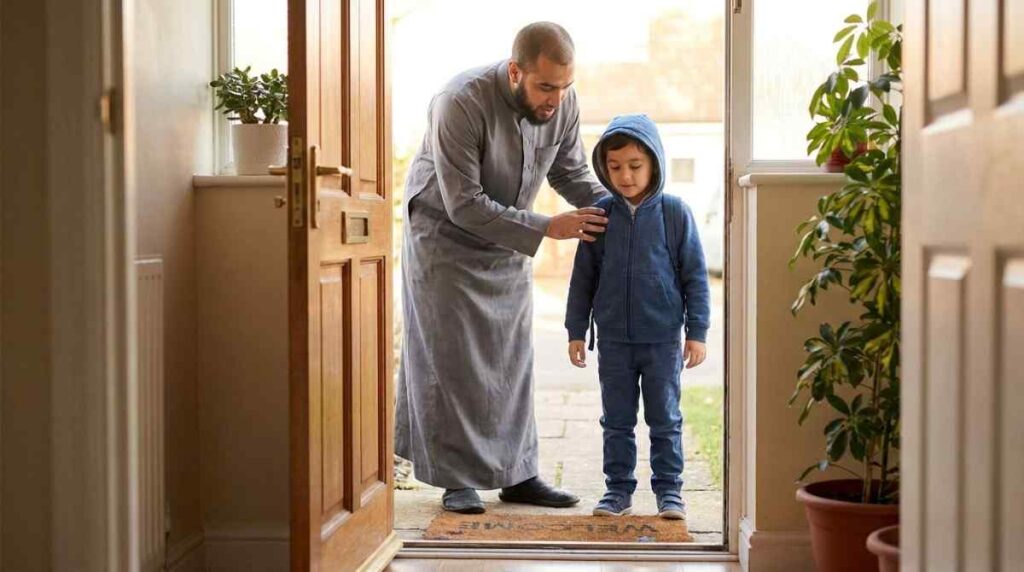
When to say it: Every time leaving the home — for school, for the masjid, for any journey.
What it builds in a child: The habit of placing their day in Allah’s hands as they step out. A child who says this at the door before school is beginning their school day with tawakkul — trust in Allah — embedded in the departure.
Teaching tip: Say it together at the door, every time, for weeks before asking the child to remember it independently. The physical trigger of the door makes this one of the easiest Duas to make automatic.
Dua 6: Entering the Home
اللَّهُمَّ إِنِّي أَسْأَلُكَ خَيْرَ الْمَوْلَجِ وَخَيْرَ الْمَخْرَجِ
Allahumma inni as’aluka khayral-mawlaji wa khayral-makhraji
Meaning: O Allah, I ask You for goodness upon entering and goodness upon leaving
When to say it: When entering the home. This pairs with the leaving Dua — departure and return both marked with remembrance of Allah.
Simpler alternative for very young children: Begin with just “Bismillah” upon entering and leaving. The longer Duas can be introduced gradually as the child grows.
Dua 7: Before Entering the Bathroom
اللَّهُمَّ إِنِّي أَعُوذُ بِكَ مِنَ الْخُبُثِ وَالْخَبَائِثِ
Allahumma inni a’udhu bika minal-khubuthi wal-khaba’ith
Meaning: O Allah, I seek Your protection from evil and the evil ones
When to say it: Before entering the bathroom — said before crossing the threshold, not inside. The bathroom is considered a place of impurity, and this Dua seeks protection before entering.
Teaching tip: Young children can learn the shorter version: “Bismillah” said before entering. The full Dua is appropriate from around age 6-7 once children begin Wudu independently.
Dua 8: After Leaving the Bathroom
غُفْرَانَكَ
Ghufranaka
Meaning: I ask for Your forgiveness
When to say it: Upon leaving the bathroom — as soon as you step out. This is one of the shortest authenticated Duas in the Sunnah — a single word that carries the meaning of seeking forgiveness upon exiting a place of impurity.
Teaching tip: Because it is so short, this is often one of the easiest Duas for young children to memorize. Teach it as a pair with the bathroom entry Dua.
Dua 9: For Parents
رَبِّ اغْفِرْ لِي وَلِوَالِدَيَّ
Rabbigh-fir li wa li-walidayya
Meaning: My Lord, forgive me and my parents
When to say it: In daily Dua — particularly after Salah. This is from Surah Ibrahim (14:41) and teaches children to pray for their parents as a natural expression of love and gratitude.
The longer version from Surah Al-Isra (17:24):
رَبِّ ارْحَمْهُمَا كَمَا رَبَّيَانِي صَغِيرًا
Rabbir hamhuma kama rabbayani saghira
Meaning: My Lord, have mercy on them both, as they raised me when I was small
Teaching tip: This Dua is particularly powerful to teach young children — they are still small, still being raised, and the meaning resonates directly with their experience. Ask them: “Who raised you when you were small? Yes, Allah wants you to make Dua for them.”
Dua 10: Before Beginning Study or Learning
رَبِّ زِدْنِي عِلْمًا
Rabbi zidni ‘ilma
Meaning: My Lord, increase me in knowledge
When to say it: Before starting school homework, Quran lessons, Islamic studies, or any learning. This is from Surah Ta-Ha (20:114) — the only place in the Quran where Allah commands the Prophet ﷺ to ask for more of something, and what He commands him to ask for is knowledge.
What it builds: The habit of beginning intellectual effort with an acknowledgement that all knowledge comes from Allah. A child who says this before opening their schoolbook is setting their learning within an Islamic framework — seeking divine assistance for what they are about to study.
Teaching tip: Say it together before every Quran class. “Before we begin learning — what do we say?” This Dua is particularly well-suited to Quran classes, Islamic studies, and any learning that a child values.
Suggested Teaching Order
Teach these Duas in this order — simplest and most frequently used first:
| Order | Dua | Age | Weeks to Establish |
|---|---|---|---|
| 1 | Bismillah | From age 2-3 | 2-3 weeks |
| 2 | Alhamdulillah (after eating) | From age 3-4 | 2-3 weeks |
| 3 | Ghufranaka (after bathroom) | From age 4 | 1-2 weeks |
| 4 | Before sleeping | From age 4-5 | 2-3 weeks |
| 5 | Upon waking | From age 5 | 2-3 weeks |
| 6 | Leaving the home | From age 5-6 | 2-3 weeks |
| 7 | Entering home | From age 5-6 | 2-3 weeks |
| 8 | Before bathroom | From age 6 | 2 weeks |
| 9 | For parents | From age 6-7 | 2-3 weeks |
| 10 | Before learning | From age 6-7 | 2 weeks |
At this pace — one Dua established every 2-3 weeks — a child who begins at age 3 will know all ten by age 4-5. A child who begins at age 5 will know them all by age 6-7. The pace is not the point. The internalization is.
Build Your Child’s Islamic Foundation With Qualified Teaching
At Suffah Quran Academy, our Islamic Studies classes for children cover Duas, basic Fiqh, and Islamic character alongside Quran reading. Book a free trial class to see the full curriculum.
Book Free Trial Class →Frequently Asked Questions
The essential everyday Duas are: Bismillah (before eating and starting anything), Alhamdulillah (after eating), the sleeping Dua (Bismika Allahumma amutu wa ahya), the waking Dua, the leaving home Dua, the entering home Dua, the bathroom entry and exit Duas, the Dua for parents, and the Dua before learning. These cover the full arc of a child’s day and build the habit of remembrance from childhood.
Children can begin with Bismillah and Alhamdulillah from age 2-3. By age 7-8, most children can know all 10 Duas in this guide. Teach one at a time, using it consistently in its daily context for at least two weeks before introducing the next.
Contextual repetition — saying the Dua in its natural situation, together with the child, every time that situation occurs. Bismillah before every meal, together, for weeks before expecting independent recall. Hearing it repeatedly in context is more effective than any formal lesson.
Yes — even basic meaning awareness deepens the relationship with the Dua. A child who knows Bismillah means “in the name of Allah” understands they are beginning in His name. Share the meaning in simple age-appropriate language alongside the Arabic — not as a separate lesson, but woven into the teaching.
Dua means supplication — a request directed to Allah. Dhikr means remembrance — phrases that glorify Allah. In practice, many everyday phrases serve both purposes. The distinction matters less for children than the habit of remembrance — both Dua and Dhikr build the connection to Allah that Islamic childhood aims to establish.
The Language of a Lifetime Begins Here
A child who grows up saying Bismillah before they eat, Alhamdulillah after, Bismika Allahumma before they sleep, and Alhamdu lillah when they wake — that child has an Islamic framework woven into their day before they are old enough to understand theology.
That framework, internalized in childhood, does not disappear. It becomes the baseline — the natural way of inhabiting the world. When that child is an adult, facing difficult moments, the Duas they learned at three years old will surface as their instinctive response.
That is what childhood Dua teaching produces. And it costs nothing more than a parent who says Bismillah before every meal, every time, for years — until the child says it too, without being asked, because it is simply what you do when you begin.
Complement Dua Learning With Quran Reading
Duas are the beginning. Quran reading builds the full Islamic foundation. Book a free trial class to start your child’s Quran journey today.
Book Free Trial Class →
Written by Ustadah Maryam Ali
Female Islamic Studies Teacher · 5 Years Experience · Islamic Studies, Duas, Quran · Urdu, Hindi, English
Ustadah Maryam Ali teaches Quran, Duas, and basic Fiqh for sisters and children in a simple and practical style. She believes that Islamic education built on everyday practice — Dua before meals, remembrance through the day, Quran in Salah — produces a different kind of Muslim than one built on theory alone.
Meet our teaching team →