

This post contains affiliate links.
Published: June 16, 2026 · ⏱ 7 min read · Ustaz Yusuf Khan, Advanced Tajweed Instructor
The question is a reasonable one. Tajweed has always been transmitted orally — teacher to student, sound to ear, correction given in the moment. The Prophet ﷺ received it from Jibreel. The Companions received it from the Prophet. Each generation received it from the one before.
Can that transmission really happen through a laptop screen? Or is something essential lost when the teacher is not physically present?
This article gives the honest answer — not a marketing answer, not a dismissive scepticism, but a clear-eyed assessment of what online Tajweed instruction can and cannot do.
The Concern — Why People Are Sceptical
The scepticism about online Tajweed comes from a correct instinct: Tajweed is not theoretical. It is physical. The letters of Arabic are produced from specific points in the mouth, throat, and nasal cavity. Correction requires a teacher to hear whether the letter is coming from the right place. Some people feel that this kind of precise listening requires physical proximity.
This instinct, while understandable, reflects a misunderstanding of how Tajweed is actually transmitted. The transmission happens through sound — not through physical presence.
How Tajweed Is Actually Transmitted
The core mechanism of Tajweed transmission is simple: the teacher produces a sound correctly. The student hears it and imitates. The teacher listens to the student’s attempt and corrects what is wrong. The student tries again. This repeats until the correct sound is embedded.
Notice what is central to this process: sound. The teacher hears. The teacher speaks. The student hears. The student speaks. The correction is auditory.
Physical presence adds context — the teacher can see the student’s mouth position, can physically gesture toward the throat to indicate where a sound comes from. These are useful aids. But they are supplementary to the auditory transmission, not central to it.
Sound travels through the internet. A microphone captures the student’s recitation accurately enough for a skilled teacher to identify every letter error — including subtle ones in Makhaarij, Ghunnah duration, Madd count, and Qalqalah quality. The correction is then given verbally, demonstrated by the teacher’s voice on the student’s speakers, and the student tries again.
This is the same process. Through a different medium.
What Online Tajweed Can Do
- Identify letter errors in real time. A qualified teacher listening through a good microphone can hear whether a Qaaf is being produced from the right position, whether the Ain is genuinely coming from the throat, whether the Ghunnah is lasting two counts or half a count. These distinctions are auditory — and audio through a video call carries them accurately.
- Correct Noon Sakinah rules, Madd, Qalqalah, and all other Tajweed rules with the same precision as in-person instruction. These are rule applications — the teacher hears whether the correct rule was applied and corrects if not.
- Demonstrate correct sounds verbally. The teacher recites the correct version; the student hears it through speakers or headphones and imitates. This is exactly the same mechanism as in-person demonstration — through a different delivery channel.
- Provide structured, progressive Tajweed instruction — from foundational rules to advanced refinement — with the same curriculum that would be followed in a face-to-face class.
- Grant Ijazah. Ijazah — the formal certification of recitation transmitted through a verified chain — can be and has been granted through online recitation sessions, with a qualified scholar listening and evaluating. The transmission is valid regardless of the medium.
What Online Tajweed Cannot Do (Honestly)
In the interest of genuine honesty:
A teacher cannot physically gesture toward your throat to show you where a letter comes from. They can describe the position, demonstrate the sound, and ask you to try — but the physical pointing and touching that sometimes aids Makhaarij instruction in person is not available.
Poor audio quality limits correction precision. If the student’s microphone is poor, or the connection unstable, subtle differences in letter production may be lost. A student whose microphone makes their Ain sound like a generic vowel is giving the teacher insufficient information to work with.
The immersive environment is absent. Sitting in a room with a scholar, surrounded by the atmosphere of traditional Islamic learning, carries a quality that a screen cannot replicate. For some students, this atmosphere is motivating and meaningful. Online learning is different in this dimension — neither inferior nor superior, but different.
These are real limitations. They are also, for most students in the UK, USA, Canada, and Australia, significantly outweighed by a practical reality: qualified Tajweed teachers within accessible distance are rare. The choice is often not between online and in-person instruction from a qualified teacher — it is between online instruction from a qualified teacher and no qualified instruction at all.
The Medium Matters Less Than the Teacher
This is the most important point in this article, and it deserves emphasis.
The debate about online versus in-person Tajweed instruction is almost always the wrong debate. The right question is not where the teacher is teaching from — it is who the teacher is.
A qualified, Ijazah-certified teacher teaching online will produce better results than an unqualified teacher teaching in person. Every time. The teacher’s qualification — the verification of their recitation through the Ijazah chain, their experience identifying and correcting the specific errors that students make, their knowledge of Makhaarij and Tajweed rules — is what determines outcomes.
The medium is the delivery channel. The teacher is the substance.
When people ask “can you really learn Tajweed online?”, they are usually asking the wrong question. The question they should be asking is: “Is this teacher genuinely qualified — and can they hear my recitation clearly enough to correct it?” If the answer to both is yes, online Tajweed instruction works.
What to Look For in an Online Tajweed Teacher
Ijazah certification — verified, not claimed. Ask specifically: does this teacher hold an Ijazah in Quran recitation? Can they provide their Sanad — the chain of transmission connecting them back through their teacher to the Prophet ﷺ? A teacher with genuine Ijazah will answer this immediately and provide documentation. For a full explanation, read our guide on what an Ijazah is.
One-on-one sessions. Tajweed correction is individual. Each student’s errors are specific to them — their native language phonetics, their history with Arabic, what they were taught incorrectly before. A group class cannot provide the individual correction that Tajweed requires. One-on-one is not a preference — it is a requirement for effective Tajweed instruction.
A free trial before commitment. Listen to the teacher recite. A teacher with genuine Tajweed mastery will recite with obvious quality — clear Makhaarij, correct rule application, confident and precise. If the teacher’s own recitation does not sound correct, that is your answer about their qualification.
Specific correction in the trial session. In a first class, a qualified Tajweed teacher will ask you to recite and will give you specific, named corrections — not “that was good, keep trying” but “that letter is Ain, not a glottal stop — it comes from the middle throat, here is how it sounds.” The specificity of correction is a direct indicator of the teacher’s knowledge.
The Practical Setup That Makes It Work
Online Tajweed instruction works best when these practical conditions are in place:
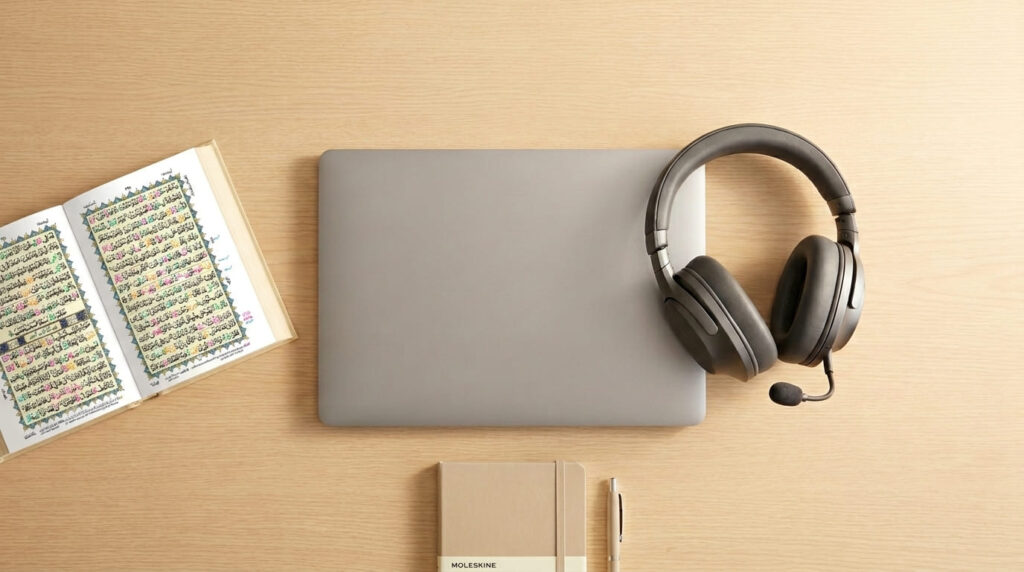
- A good microphone. The built-in microphone on most modern laptops and tablets is adequate for general speech. For Tajweed — where subtle letter distinctions matter — a headset with a closer microphone produces noticeably better audio for the teacher. This is the single most impactful hardware investment for online Tajweed students.
- Stable internet connection. A dropped connection in the middle of a correction sequence disrupts the learning process. Sitting close to the router, or using ethernet where possible, prevents most connectivity problems.
- A quiet space. Background noise — television, other people, traffic — makes it harder for the teacher to hear subtle letter distinctions. Even a modest quiet corner is sufficient.
- The same Mushaf edition as the teacher uses. When working through actual Quran text in Tajweed sessions, using the same edition (most teachers use the Madina Mushaf) ensures teacher and student are looking at the same page layout.
With these in place — a qualified teacher, one-on-one sessions, good audio, stable connection — online Tajweed instruction produces the same outcomes as in-person instruction for the vast majority of students.
Experience Online Tajweed — The First Class Is Free
Book a free trial Tajweed class with one of our Ijazah-certified teachers. Recite, receive real correction, and judge for yourself whether the medium works. No payment, no commitment.
Book Free Trial Class →Frequently Asked Questions
Yes — online one-on-one Tajweed instruction with a qualified teacher is genuinely effective. The teacher hears your recitation through the microphone in real time and corrects errors immediately. Tajweed transmission has always been through sound — the teacher produces the correct sound, the student imitates and is corrected. This process works through a video call as effectively as in person, with good audio and a qualified teacher.
The main limitation is audio quality — poor microphone or unstable connection can prevent the teacher from hearing subtle letter distinctions. A second limitation is that physical gestures toward mouth position are not possible. Both are manageable with a good headset microphone, stable connection, and a teacher who can clearly demonstrate sounds vocally.
Three things: Ijazah certification (their recitation formally verified through a chain back to the Prophet), one-on-one sessions (group classes cannot provide individual Tajweed correction), and a free trial before commitment. Listen to the teacher recite — a teacher with genuine mastery will sound obviously correct and confident.
For most students in Western countries — where qualified Tajweed teachers are scarce locally — online instruction from a qualified teacher is significantly better than the available alternatives. The medium matters less than the teacher’s qualification. A qualified teacher online produces better results than an unqualified teacher in person, every time.
Both. Beginners learn foundational Tajweed rules as part of learning to read the Quran from Madani Qaida onward. Advanced students use online classes to refine recitation, work through Makhaarij, and prepare for Ijazah. Online Tajweed instruction is effective at every level.
The Answer Is Yes — With the Right Teacher
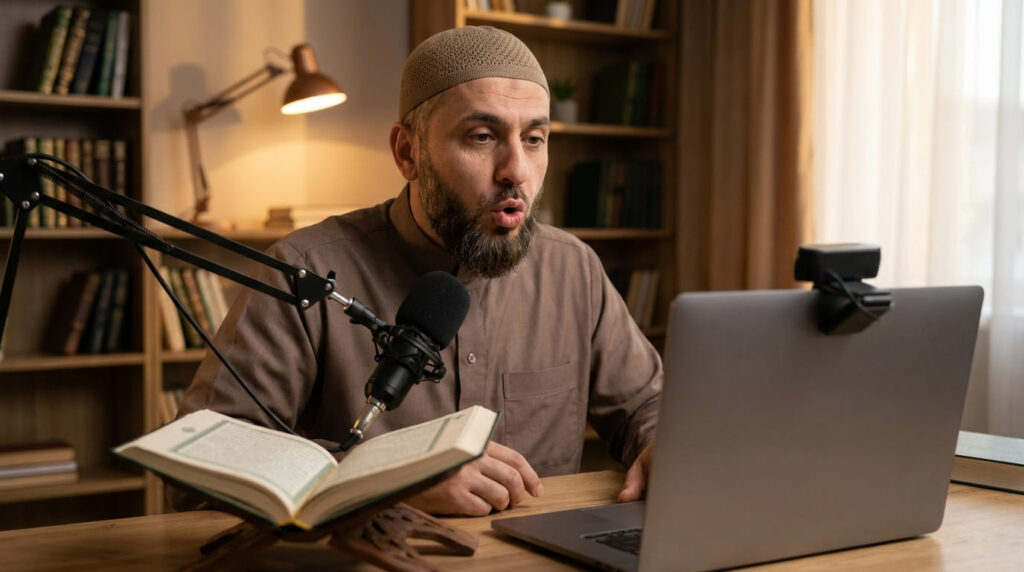
Can you really learn Tajweed online? Yes — when the teacher is qualified, the sessions are one-on-one, and the audio is clear enough for the teacher to hear what you are actually producing.
The transmission of Tajweed has always been through sound. Sound travels through the internet. The process works.
What does not work is a group class, a pre-recorded video series, or a teacher without verified credentials. Those limitations have nothing to do with the medium and everything to do with the format and the qualification of the teacher.
Get the right teacher, in the right format, with good audio — and the medium answers itself.
Find Out For Yourself — Free Trial Class
One session with an Ijazah-certified teacher. Recite. Receive specific, named corrections. Judge whether the medium works for you — before any financial commitment.
Book Free Trial Class →
Written by Ustaz Yusuf Khan
Advanced Tajweed Instructor · 8 Years Experience · Advanced Tajweed, Fluency Training · Urdu, Hindi, Arabic
Ustaz Yusuf Khan has taught advanced Tajweed and Quran fluency exclusively online for 8 years — working with students across the UK, USA, Canada, Australia, and beyond. He has seen firsthand what online Tajweed instruction can and cannot do, and teaches with the precision and honesty that serious recitation improvement requires.
Meet our teaching team →