
This post contains affiliate links.
Published: October 14, 2026 · ⏱ 9 min read · Ustaz Ahmad Raza, Senior Quran & Tajweed Teacher
📖 In This Guide
- What Is Hamzat al-Wasl? (The Connecting Hamza)
- What Is Hamzat al-Qat’? (The Cutting Hamza)
- How to Tell Them Apart in Writing
- Where Hamzat al-Wasl Appears: 3 Categories
- Where Hamzat al-Qat’ Appears
- How to Pronounce Hamzat al-Wasl: Starting vs. Connecting
- Quran Examples You Can Practice With
- Common Mistakes Beginners Make
- FAQ
Arabic has only one hamza sound, but Tajweed treats it as two very different rules depending on where it sits in a word. Get them confused and you’ll either drop a sound that needs to stay, or hold onto a sound that’s supposed to disappear the moment you connect it to the word before it. The two are called Hamzat al-Wasl (the “connecting hamza”) and Hamzat al-Qat’ (the “cutting hamza”) — and the difference between them is one of the first things that separates a reciter who sounds fluent from one who sounds like they’re reading letter by letter. This guide covers Hamzat al-Wasl vs. Hamzat al-Qat’ in full, with real Quran examples.
What Is Hamzat al-Wasl? (The Connecting Hamza)
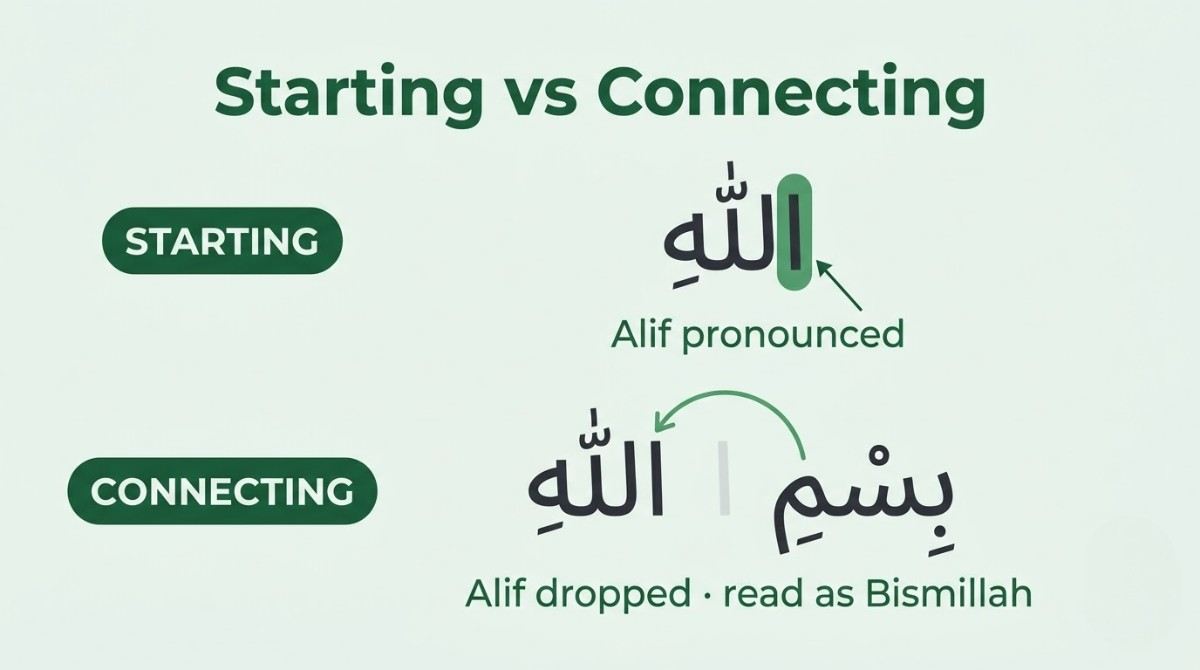
Hamzat al-Wasl is a hamza that exists only to let you start a word that otherwise couldn’t begin with a vowel sound on its own — Arabic doesn’t allow a word to open directly with a vowel, so this hamza is added as a kind of starting point. The rule that gives it its name is simple: it is pronounced when you begin speech with it, but dropped the moment you connect it to the word before it in the middle of a sentence. It never changes the underlying meaning of the word — it’s purely a pronunciation mechanism for starting and connecting smoothly.
What Is Hamzat al-Qat’? (The Cutting Hamza)
Hamzat al-Qat’ is the “real” hamza — a full consonant letter in its own right, just like Ba or Ta. It is always pronounced, in every position: at the start of speech, in the middle of a connected sentence, or at the end of a word. It never disappears, and unlike Hamzat al-Wasl, it genuinely belongs to the root of the word rather than being added just to make the word pronounceable.
How to Tell Them Apart in Writing
You don’t need to guess — the Mushaf marks the difference visually every time:
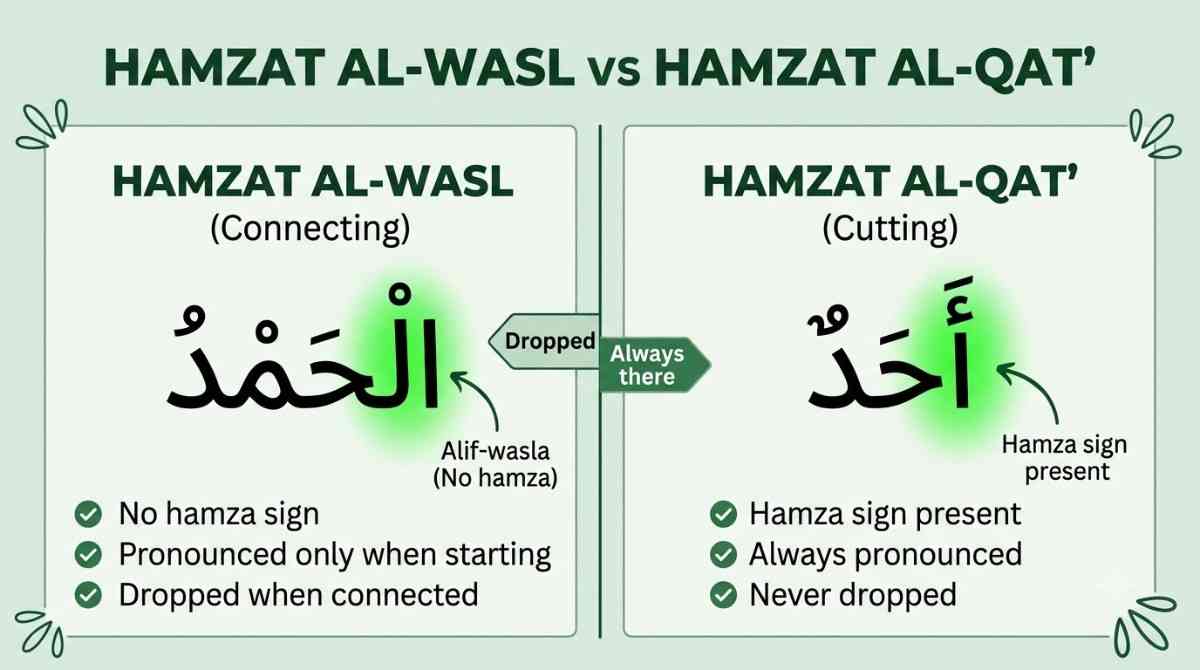
| Hamzat al-Wasl | Hamzat al-Qat’ | |
|---|---|---|
| How it’s written | A plain alif with no hamza sign at all (ٱ in many Mushaf printings, or simply ا) | A hamza sign sits on or under a carrier letter: أ (on alif, fatha/damma), إ (under alif, kasra), ؤ (on waw), ئ (on ya), or stands alone (ء) |
| When it’s pronounced | Only when it opens a sentence or follows a pause | Always — at the start, middle, or end, connected or not |
| What it attaches to | A small, fixed set of words (see below) — it isn’t part of the root | Part of the word’s actual root letters |
In practice: if you see a hamza mark (أ / إ / ؤ / ئ / ء), pronounce it, full stop. If you see a bare alif with no mark at the start of a word you already know is grammatically one of the wasl categories below, that’s your cue to check whether you’re starting fresh or connecting.
Where Hamzat al-Wasl Appears: 3 Categories
Hamzat al-Wasl isn’t scattered randomly through the language — it only ever shows up in three specific places, and all three are fixed, learnable categories rather than something you have to guess word by word.
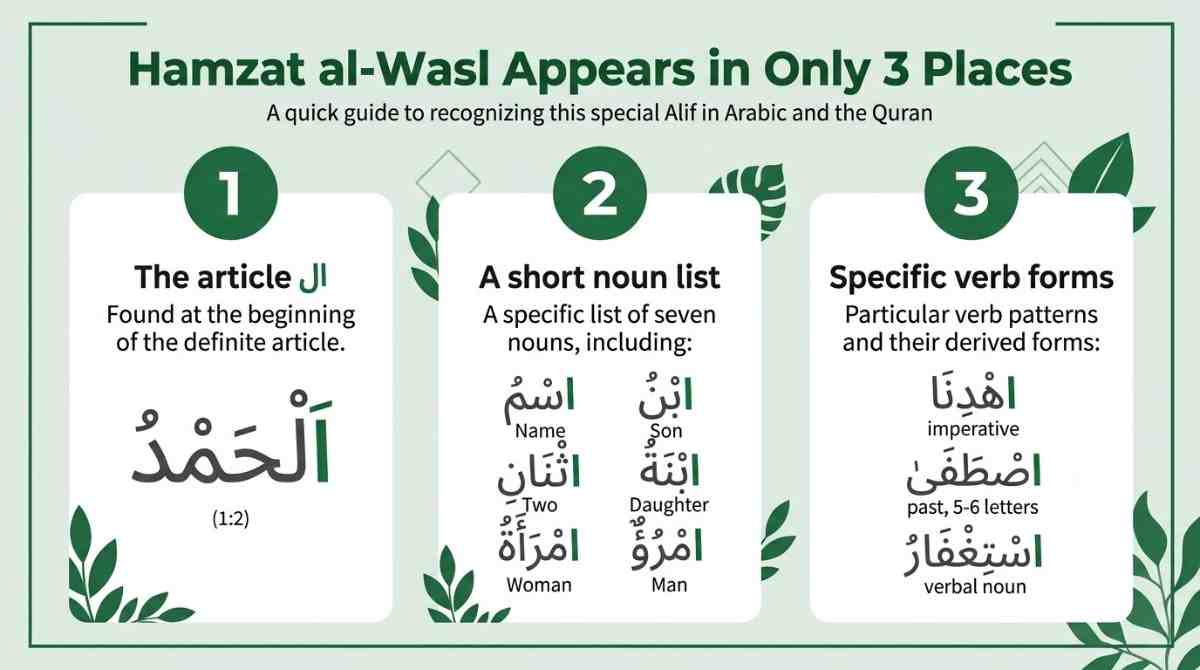
- 1. The definite article “al-” (ال). Every single time you see ال attached to a noun, its hamza is Hamzat al-Wasl — no exceptions. Examples: ٱلْحَمْدُ (1:2), ٱلرَّحْمَٰنِ (1:3), ٱلْمَلِكِ (1:4).
- 2. A short list of specific nouns. Classical Tajweed texts list a small, fixed group that simply has to be memorized, since nothing about their spelling predicts it. The core set is usually given as: ٱسْمُ (ism, “name” — as in 96:1), ٱبْنُ (ibn, “son” — as in 2:87), ٱبْنَةُ (ibnah, “daughter”), ٱثْنَانِ / ٱثْنَتَانِ (ithnani/ithnatani, “two”), ٱمْرُؤٌ (imru’, “a man”), and ٱمْرَأَةُ (imra’ah, “a woman” — as in 66:10). Some teachers add two oath expressions, ٱيْمُ اللَّه and ٱيْمُنُ اللَّه, bringing the full list to nine — but these two are rare enough in everyday recitation that most students only need the first seven cold.
- 3. Specific verb forms. Three sub-cases: the imperative (command) form of verbs — e.g. ٱهْدِنَا (1:6), ٱدْخُلُوا (2:58), ٱذْهَبْ (20:24); the past tense of verbs with five or six root letters — e.g. ٱصْطَفَىٰ (3:33), ٱجْتَبَيْتَهَا (7:203); and the verbal noun (masdar) of those same longer verb forms — e.g. ٱسْتِغْفَارُ (9:114).
Where Hamzat al-Qat’ Appears
Hamzat al-Qat’ is the default — if a hamza doesn’t fall into one of the three wasl categories above, it’s qat’. In practice that covers three broad groups:
- Ordinary nouns whose root simply begins with hamza — e.g. أَحَدٌ (“One,” 112:1), إِيمَان (“faith”).
- Verbs — every present-tense verb that starts with hamza, plus the past tense and verbal noun of three- and four-letter root verbs — e.g. أَخَذَتِ (“she/it took,” 10:24), يَأْمُرُكُمْ (“he commands you,” 4:58).
- Particles — small grammatical words such as أَنْ, إِنْ, أَوْ, and إِذَا.
How to Pronounce Hamzat al-Wasl: Starting vs. Connecting
This is where most of the real confusion happens, because Hamzat al-Wasl doesn’t just turn on and off — when it is pronounced (starting a sentence or verse), it takes one of three starting vowels, and the vowel isn’t random either:
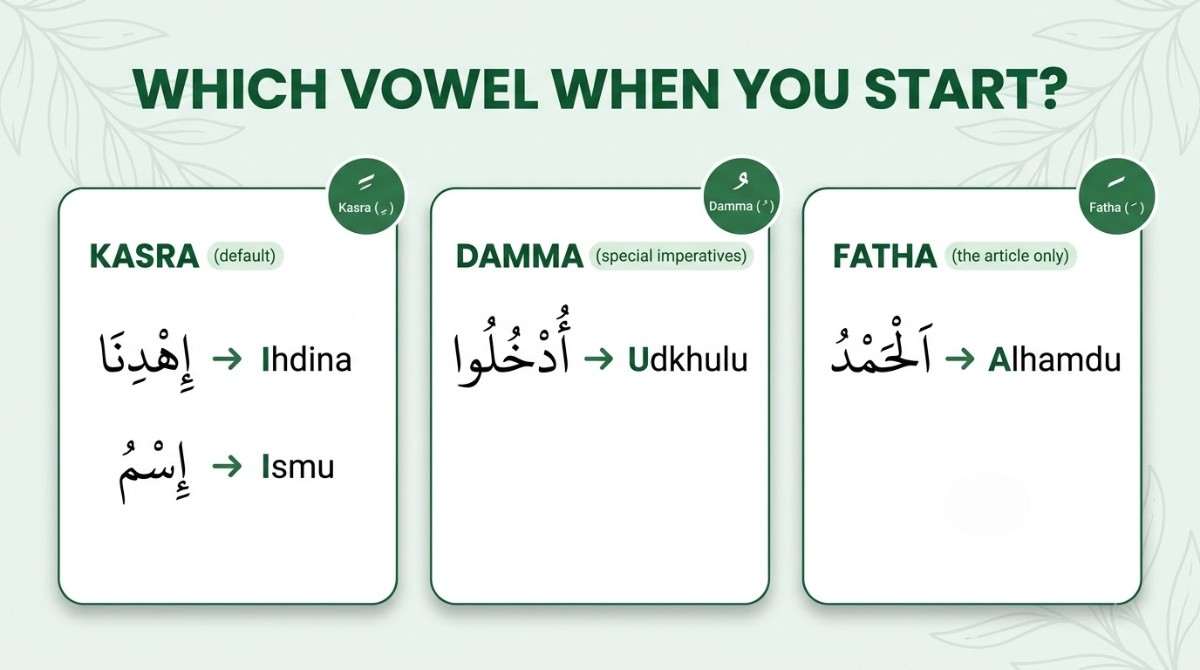
- Kasra (the default). Most verb forms and the specific-noun list take kasra when you start on them: ٱهْدِنَا → “Ihdina,” ٱسْمُ → “Ismu,” ٱبْنُ → “Ibnu.”
- Damma. Only for imperative verbs whose third root letter is pronounced with damma in the present tense — e.g. ٱدْخُلُوا → “Udkhulu.”
- Fatha. Reserved for exactly one case: the definite article ال itself — e.g. ٱلْحَمْدُ → “Alhamdu.”
Now the other half of the rule: the moment that same word is connected to whatever comes before it — which is the normal case in continuous recitation, not the exception — the hamza and its vowel both vanish, and you flow straight from the end of the previous word into the consonant that follows. بِسْمِ ٱللَّهِ is read as one unbroken “Bismillah,” not “Bi-ismi-Allah.” رَبِّ ٱهْدِنَا flows as “Rabbihdina.” وَٱسْتَعِينُوا بِٱلصَّبْرِ (2:45) reads as “Wasta’inu bis-sabr.” This is also exactly why Hamzat al-Wasl is named what it is: its entire purpose is to let words connect smoothly rather than forcing a glottal stop between every pair of words.
Quran Examples You Can Practice With
| Reference | Word | Type | Note |
|---|---|---|---|
| 1:2 | ٱلْحَمْدُ | Wasl | Definite article — fatha when starting |
| 1:6 | ٱهْدِنَا | Wasl | Imperative verb — kasra when starting |
| 2:58 | ٱدْخُلُوا | Wasl | Imperative, third letter damma — so damma when starting |
| 96:1 | ٱسْمُ | Wasl | One of the memorized nouns |
| 2:45 | وَٱسْتَعِينُوا | Wasl (connected) | Hamza dropped — reads “wasta’eenu” |
| 112:1 | أَحَدٌ | Qat’ | Pronounced firmly, root letter |
| 10:24 | أَخَذَتِ | Qat’ | Past-tense verb, hamza is the first root letter |
| 4:58 | يَأْمُرُكُمْ | Qat’ | Present-tense verb — pronounced mid-word too |
Common Mistakes Beginners Make
- Pronouncing Hamzat al-Wasl mid-sentence. The single most common slip — reading بِسْمِ ٱللَّهِ as two separate chunks with a glottal stop before “Allah” instead of flowing straight through as “Bismillah.”
- Dropping Hamzat al-Qat’ because it “looks similar.” Treating any word that starts with alif as automatically droppable. Qat’ is never dropped, in any position — the hamza sign is the giveaway.
- Guessing the starting vowel instead of checking the category. Defaulting to kasra on every wasl word, including the definite article, which actually takes fatha, or an imperative verb that needs damma.
- Trying to memorize word-by-word instead of by category. Hamzat al-Wasl only ever falls into the three categories above — the article, the short noun list, and specific verb forms. Learning the categories covers every case in the Quran; memorizing examples one at a time doesn’t.
This rule sits right alongside the other letter-level distinctions that make recitation sound smooth rather than choppy — much like how Lam Shamsiyah and Lam Qamariyah decide whether the Lam of “al-” survives or disappears. Both rules are usually introduced early, right alongside the rest of our complete Tajweed Rules Reference, since getting comfortable with how the definite article behaves unlocks several rules at once. If you’re still working on exactly where each Arabic letter is articulated in the first place, our Makharij al-Huroof chart is the right companion piece — and once you’re ready for how Noon and Tanween behave in similar connecting situations, Noon Sakinah and Tanween Rules is the natural next stop.
FAQ
What is the difference between Hamzat al-Wasl and Hamzat al-Qat’?
Hamzat al-Wasl is pronounced only when it begins a sentence and is dropped when connected to the word before it. Hamzat al-Qat’ is always pronounced, in every position, because it’s a genuine root letter rather than a connecting device.
How do you know if a hamza is wasl or qat’ just by looking at it?
Check for a hamza sign. If you see one — أ, إ, ؤ, ئ, or ء — it’s Hamzat al-Qat’ and always pronounced. If the word starts with a plain, unmarked alif and falls into one of the three wasl categories (the definite article, the short noun list, or specific verb forms), it’s Hamzat al-Wasl.
What vowel do you use when starting on Hamzat al-Wasl?
Kasra by default, damma only for imperative verbs whose third root letter takes damma in the present tense, and fatha only for the definite article “al-.”
Does Hamzat al-Wasl ever appear in the middle of a word?
No — by definition it only ever opens a word. If a hamza appears in the middle or at the end of a word, it’s always Hamzat al-Qat’.
Why does Arabic need Hamzat al-Wasl at all?
Arabic doesn’t allow a word to begin directly with a bare vowel sound. Hamzat al-Wasl is added purely to give certain words a legal way to start when read in isolation, while disappearing automatically once there’s already a preceding sound to connect from.
Want a teacher to check whether you’re connecting and cutting your hamzas correctly in real recitation? Book a free trial Tajweed class with Suffah Quran Academy and get feedback from day one.