

This post contains affiliate links.
Published: October 13, 2026 · ⏱ 8 min read · Ustaz Ahmad Raza, Senior Quran & Tajweed Teacher
📖 In This Guide
- What Is Lam Shamsiyah and Lam Qamariyah?
- Why This Rule Exists: The Definite Article “Al-” (ال)
- The 14 Sun Letters (Lam Shamsiyah)
- The 14 Moon Letters (Lam Qamariyah)
- How to Spot Them in the Mushaf: Shaddah vs. Sukoon
- Sun and Moon Letters in Real Ayahs (With References)
- Common Mistakes Beginners Make
- A 30-Second Self-Test
- FAQ
What Is Lam Shamsiyah and Lam Qamariyah?
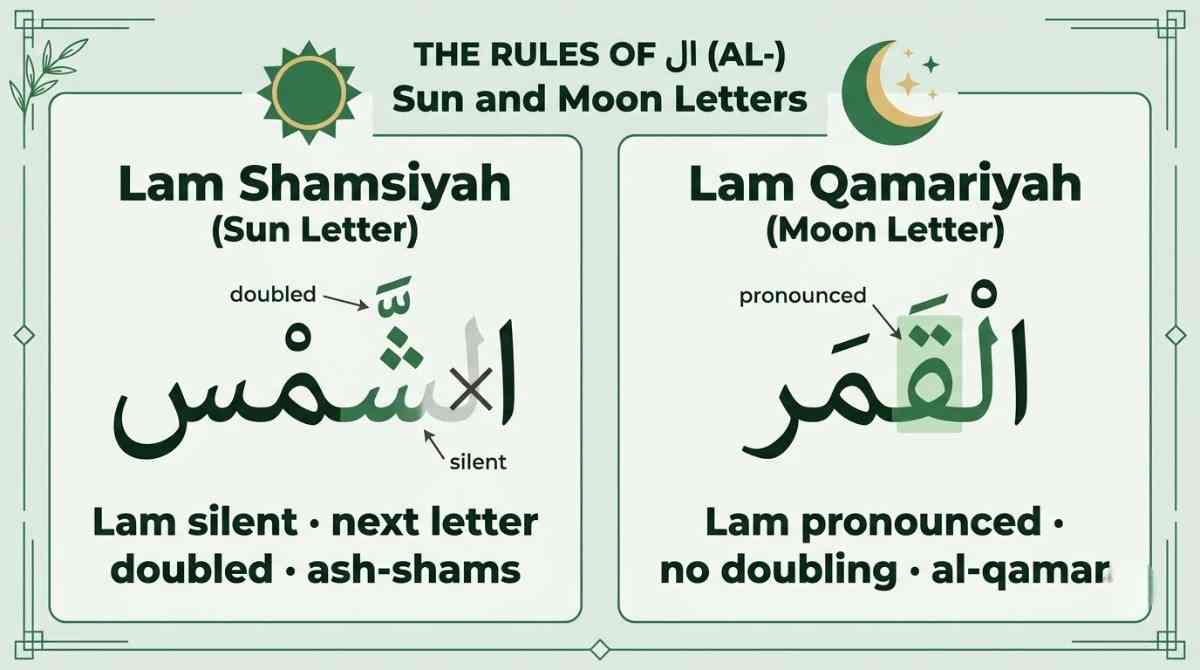
Every Arabic noun can take the definite article “al-” (ال) — roughly equivalent to “the” in English. What changes is what happens to the Lam (ل) inside that “al-” once it meets the first letter of the word it’s attached to. Sometimes the Lam is pronounced clearly. Sometimes it disappears entirely, swallowed into the letter that follows it. Which one happens isn’t random — it depends on exactly one thing: which of the 28 Arabic letters comes right after “al-“. That is exactly what Lam Shamsiyah and Lam Qamariyah describe.
Lam Shamsiyah (“solar Lam”) is what happens when the Lam is silenced and the next letter is doubled in its place. Lam Qamariyah (“lunar Lam”) is what happens when the Lam is pronounced normally and nothing doubles. The names come from the two example words classical grammarians used to teach the rule: الشَّمْس (ash-shams, “the sun”) loses its Lam, while الْقَمَر (al-qamar, “the moon”) keeps it — hence “sun letters” and “moon letters” for the two groups that trigger each outcome.
Why This Rule Exists: The Definite Article “Al-” (ال)
Classical Arabic strongly prefers not to stack certain consonant sounds awkwardly against each other. The 28 letters of the alphabet split into two articulation families: fourteen are pronounced with the tip or blade of the tongue touching near the front of the mouth (dental, alveolar, and related points), and fourteen are pronounced further back — with the lips, throat, or deeper in the mouth. When “al-” is followed by one of those front-of-mouth letters, pronouncing a separate Lam before it creates an unnecessary, clunky double-tap of the tongue in almost the same spot. Arabic resolves this by merging the Lam into the next letter instead, which is also doubled (a process called idgham) to preserve the syllable’s weight. Follow “al-” with a back-of-mouth letter instead, and there’s no such clash — so the Lam is simply pronounced on its own, clearly (izhar).
This isn’t a Tajweed rule invented for Quran recitation specifically — it’s a feature of Arabic pronunciation generally, which is why you’ll hear native Arabic speakers apply it automatically in everyday speech, not just in the Mushaf. Tajweed simply formalizes it and makes sure Quran reciters apply it with precision rather than guessing.
The 14 Sun Letters (Lam Shamsiyah)
When “al-” is followed by any of these 14 letters, the Lam is silent and the following letter is doubled (shaddah):
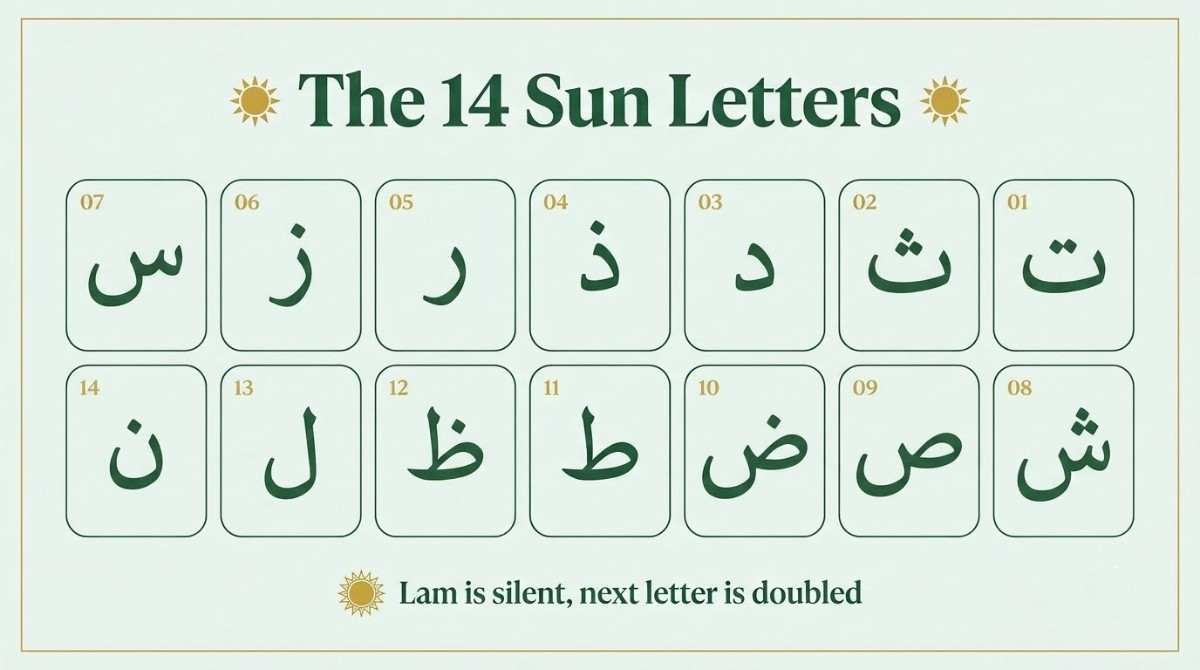
| Letter | Name | Example | Pronounced |
|---|---|---|---|
| ت | Ta | التَّوَّاب | at-tawwaab |
| ث | Tha | الثَّمَرَات | ath-thamaraat |
| د | Dal | الدِّين | ad-deen |
| ذ | Dhal | الذَّاكِرِين | adh-dhaakireen |
| ر | Ra | الرَّحْمَن | ar-rahmaan |
| ز | Zay | الزَّهْرَة | az-zahrah |
| س | Sin | السَّمَاء | as-samaa’ |
| ش | Shin | الشَّمْس | ash-shams |
| ص | Sad | الصَّالِحِين | as-saaliheen |
| ض | Dad | الضَّالِّين | ad-daalleen |
| ط | Ta (heavy) | الطَّامَّة | at-taammah |
| ظ | Zha | الظَّالِمِين | az-zhaalimeen |
| ل | Lam | اللَّيْل | al-layl (doubled Lam) |
| ن | Nun | النَّاس | an-naas |
Notice Lam itself is on this list. When “al-” meets a word starting with Lam — as in اللَّيْل (“the night”) — the two Lams simply merge into one doubled Lam, which is why it can look, at first glance, like the rule doesn’t apply there at all.
The 14 Moon Letters (Lam Qamariyah)
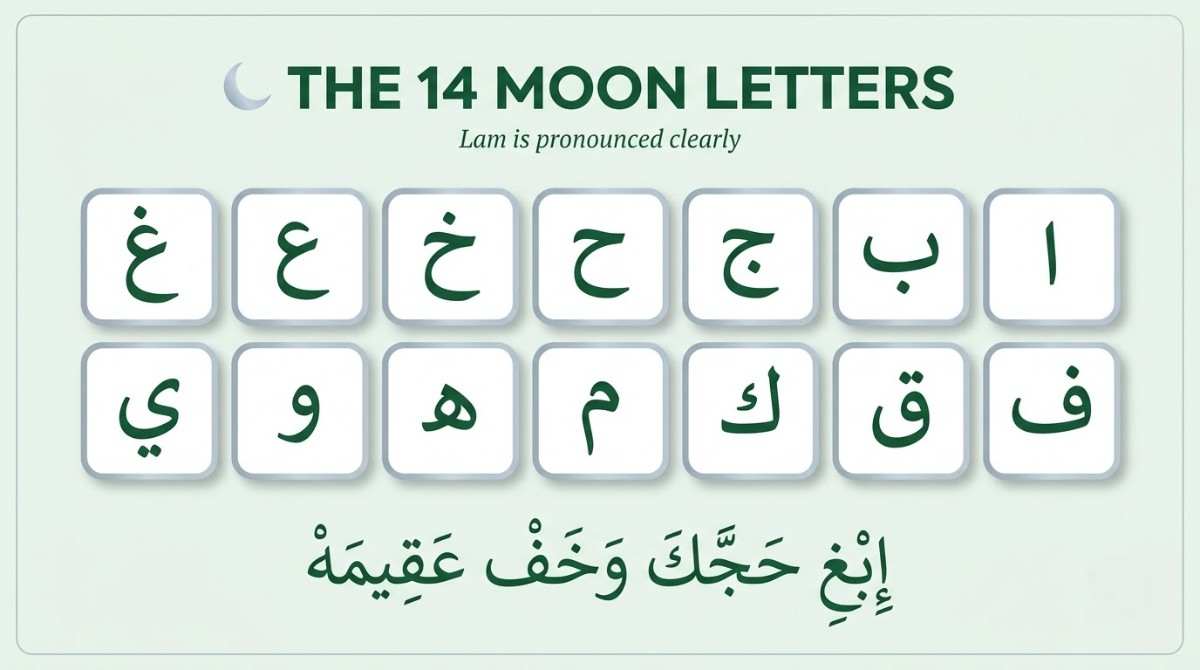
When “al-” is followed by any of these 14 letters, the Lam is pronounced clearly and nothing is doubled:
| Letter | Name | Example | Pronounced |
|---|---|---|---|
| ا / أ | Alif / Hamza | الأَمِين | al-ameen |
| ب | Ba | البَيْت | al-bayt |
| ج | Jeem | الجَنَّة | al-jannah |
| ح | Ha | الْحَمْد | al-hamd |
| خ | Kha | الخَيْر | al-khayr |
| ع | Ayn | الْعَالَمِين | al-‘aalameen |
| غ | Ghayn | الغَفُور | al-ghafoor |
| ف | Fa | الفَجْر | al-fajr |
| ق | Qaf | الْقَمَر | al-qamar |
| ك | Kaf | الْكِتَاب | al-kitaab |
| م | Meem | المَلِك | al-malik |
| ه | Ha (soft) | الْهُدَى | al-huda |
| و | Waw | الوَلَد | al-walad |
| ي | Ya | اليَوْم | al-yawm |
A well-known classical mnemonic strings all 14 moon letters into a single memorable phrase: اِبْغِ حَجَّكَ وَخَفْ عَقِيمَهْ (“Ibghi hajjaka wakhaf ‘aqeemah”). Taken letter by letter, that phrase spells out all 14 moon letters — it’s the version most Tajweed teachers have students memorize first, because getting the 14 moon letters cold makes every other letter in the alphabet a sun letter by default.
How to Spot Them in the Mushaf: Shaddah vs. Sukoon
You don’t have to memorize both lists perfectly to read correctly — the Uthmani script used in every standard printed Mushaf marks the rule visually, every single time:
- Sun letter (Lam Shamsiyah): the Lam carries no sukoon mark, and the letter right after it carries a shaddah (ّ) — your visual cue to silence the Lam and double the next sound. Example: الشَّمْس.
- Moon letter (Lam Qamariyah): the Lam carries a visible sukoon (ْ), and the following letter has no shaddah — your cue to pronounce the Lam clearly on its own. Example: الْقَمَر.
This is genuinely the fastest way to apply the rule in real time while reciting — you’re not running through two memorized lists of 14 letters mid-ayah, you’re just reading the marks the printers already put there for you. The lists matter for understanding why the mark is there; the mark itself is what you actually read off the page.
Sun and Moon Letters in Real Ayahs (With References)
Some of the most frequently recited verses in the Quran carry both rules side by side:
- Surah Al-Fatihah 1:2 — الْحَمْدُ لِلَّهِ رَبِّ الْعَالَمِينَ (“All praise is due to Allah, Lord of the worlds”) contains two moon letters back to back: الْحَمْدُ (Ha) and الْعَالَمِينَ (Ayn) — both Lams pronounced clearly, both marked with a visible sukoon.
- Surah Al-Baqarah 2:2 — الْكِتَابُ (“the Book”), another moon letter (Kaf), opens one of the most frequently quoted verses in the Quran.
- Surah Ash-Shams 91:1–2 — وَالشَّمْسِ وَضُحَاهَا وَالْقَمَرِ إِذَا تَلَاهَا (“By the sun and its brightness, and the moon as it follows it”) — the surah that gave the rule its name opens with a sun letter (الشَّمْسِ, Shin) immediately followed by a moon letter (الْقَمَرِ, Qaf), making it the single best self-test verse in the entire Quran.
- Surah Ar-Rahman 55:1 — الرَّحْمَنُ (“The Most Merciful”), a sun letter (Ra), opens the surah named after this very attribute of Allah.
Common Mistakes Beginners Make
- Pronouncing the Lam anyway on a sun letter. The single most common slip — reading الشَّمْس as “al-shams” instead of “ash-shams.” The Lam has to disappear completely, not just get quieter.
- Under-doubling the sun letter. Silencing the Lam correctly but then reading the following letter as a single, ordinary consonant instead of a doubled (shaddah) one — the doubling is what carries the weight the missing Lam left behind.
- Guessing from English spelling instead of the Arabic letter. English transliterations can mislead — “the sun” in English has nothing to do with which Arabic letters count as “sun letters.” The classification is purely about the 14 specific Arabic letters, nothing else.
- Treating it as optional or stylistic. Some beginners assume either pronunciation is “close enough.” It isn’t — like every Tajweed rule tied to a visible Mushaf mark, it’s a fixed rule, not a reading preference.
A 30-Second Self-Test
Read this phrase aloud slowly: وَالشَّمْسِ وَالْقَمَرِ. If you silenced the Lam completely and doubled the Shin in الشَّمْسِ (ash-shamsi), then pronounced the Lam clearly before the Qaf in الْقَمَرِ (al-qamari), you’ve got both rules down in a single breath. If you caught yourself saying “al-shamsi” instead of “ash-shamsi,” that’s the exact habit to flag for your next class.
This kind of letter-by-letter precision is exactly what our Sabaq Sabqi Manzil review system is built to catch early, before a slipped Lam becomes a permanent habit. Sun and moon letters are foundational enough that they’re usually introduced right alongside Madani Qaida, before a student even reaches the rest of our complete Tajweed Rules Reference. Getting comfortable with where each letter is actually articulated also helps — our Makharij al-Huroof chart is a good companion once you’re ready to go deeper.
FAQ
What are sun letters and moon letters in Tajweed?
They’re the two groups the 28 Arabic letters split into based on what happens to the Lam of the definite article “al-” (ال) when attached to a word. Sun letters (14) silence that Lam and double themselves instead. Moon letters (14) leave the Lam pronounced clearly with no doubling.
How many sun letters and moon letters are there?
Exactly 14 of each, covering all 28 letters of the Arabic alphabet between them. Every Arabic letter belongs to one group or the other — there’s no third category.
How can I tell if a letter is a sun letter or a moon letter without memorizing both lists?
Look at the Mushaf itself. A sun letter shows no sukoon on the Lam and a shaddah on the next letter. A moon letter shows a visible sukoon on the Lam and no shaddah on what follows. The printed marks do the classifying for you in real time.
Why is the Lam of “Al-” silent before sun letters?
Sun letters are articulated at the front of the mouth, close to where the Lam itself is pronounced. Keeping a separate Lam sound there would create an awkward double-tap in nearly the same spot, so classical Arabic merges it into the following letter instead and doubles that letter to preserve the syllable’s weight.
Is Lam Shamsiyah the same rule as Idgham?
They’re closely related — Lam Shamsiyah is technically a specific case of idgham (merging), since the Lam’s sound disappears into the following letter. It’s usually taught as its own standalone rule, though, because it applies specifically to the definite article “al-” rather than to Noon Sakinah or Tanween, which is what most general idgham discussions cover.
Want a teacher to check whether you’re silencing and doubling your sun letters correctly? Book a free trial Tajweed class with Suffah Quran Academy and get feedback on your recitation from day one.