
Published: September 30, 2026 · ⏱ 7 min read · Ustaz Ahmad Raza, Senior Quran & Tajweed Teacher
📖 In This Guide
- What Is Ghunnah?
- Baseline Ghunnah vs. Confirmed (2-Count) Ghunnah
- The Simplest Case: Noon or Meem Mushaddad
- Ghunnah Inside the Noon Sakinah Rules
- Ghunnah Inside the Meem Sakinah Rules
- Where Ghunnah Does NOT Apply
- Common Mistakes Beginners Make
- A 60-Second Self-Test
- FAQ
What Is Ghunnah?
Ghunnah (غنة) is a nasal sound that comes purely from the nasal passage — no movement of the tongue or lips is needed to produce it. Of all 28 Arabic letters, exactly two are capable of carrying it: Noon (ن) and Meem (م). No other letter has this quality at all, which is exactly why Noon and Meem keep showing up as the trigger letter across so many different Tajweed rules.
If you’ve already worked through our guides to Noon Sakinah and Tanween rules or Meem Sakinah rules, you’ve already met ghunnah — it’s mentioned inside almost every rule in both systems. What neither of those guides does on its own is step back and explain ghunnah as its own concept: where it’s a fixed, required 2-count hold, where it’s just a background quality of the letter, and where it doesn’t apply at all. That’s what this guide pulls together in one place.
Baseline Ghunnah vs. Confirmed (2-Count) Ghunnah
This is the distinction most beginners never get told clearly, and it’s the one that makes everything else in this guide make sense.
- Baseline ghunnah: Noon and Meem carry a light, permanent nasal quality every single time they’re pronounced, in any position, under any rule. This is simply one of their built-in letter characteristics (sifaat) — it’s always there in the background, but it’s brief and unremarkable.
- Confirmed ghunnah: in specific rule-triggered situations, that same nasal quality is deliberately extended and emphasized for a fixed 2 counts (harakat) — roughly the time it takes to hold two evenly-spaced beats. This is the version people usually mean when they talk about “applying ghunnah,” and it’s the version this guide focuses on.
The 2-count duration doesn’t change depending on which rule triggers it — it’s the same fixed length whether it shows up in a doubled letter, inside a Noon Sakinah rule, or inside a Meem Sakinah rule. What changes from rule to rule is only whether confirmed ghunnah is required at all.
The Simplest Case: Noon or Meem Mushaddad
Before you even get to Noon Sakinah or Meem Sakinah, there’s a more basic situation that requires confirmed 2-count ghunnah: any Noon or Meem carrying a shaddah (ّ) — a doubled letter, pronounced with emphasis.
- Example (Noon Mushaddad): إِنَّ (inna) — the doubled Noon here is held with full 2-count ghunnah.
- Example (Meem Mushaddad): ثُمَّ (thumma) — the doubled Meem is held the same way.
This case is worth learning first because it doesn’t depend on a sakinah (a silent letter with no vowel) at all — it applies purely because the letter is doubled. Many learners move straight into Noon Sakinah and Meem Sakinah rules and never realize that ghunnah has its own independent trigger sitting underneath both systems.
Ghunnah Inside the Noon Sakinah Rules
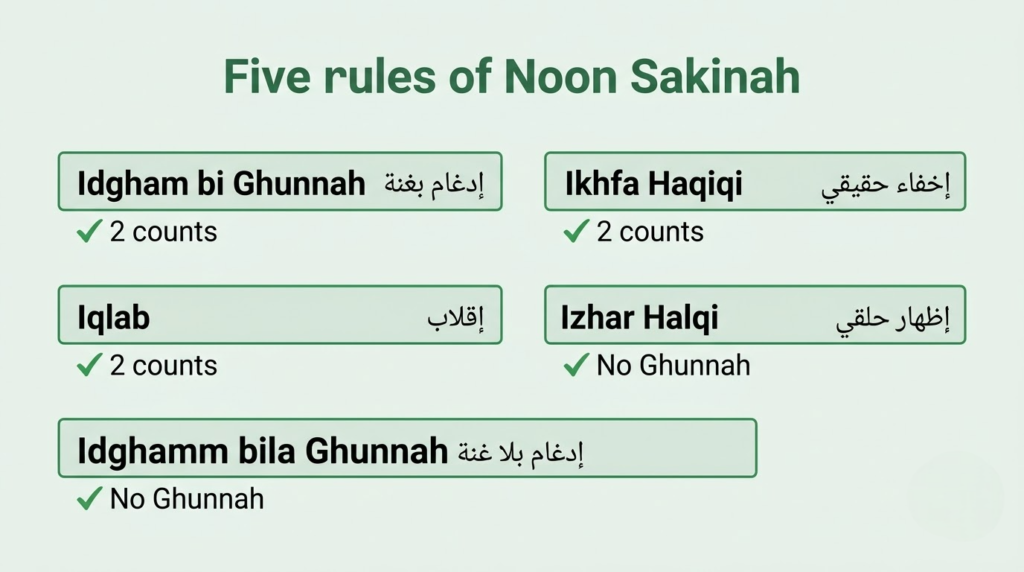
Our full Noon Sakinah and Tanween rules guide covers all four rules in detail. Here’s specifically where confirmed ghunnah does and doesn’t show up among them:
| Rule | Confirmed Ghunnah? | Notes |
|---|---|---|
| Idgham bi Ghunnah | Yes — 2 counts | Merges into Yaa, Noon, Meem, or Waw, carrying full ghunnah |
| Ikhfa Haqiqi | Yes — 2 counts | Concealed pronunciation across all 15 trigger letters, ghunnah held throughout |
| Iqlab | Yes — 2 counts | Noon/Tanween converts to a Meem sound before Ba, carrying ghunnah |
| Izhar Halqi | No | Clear pronunciation from the throat, no nasal hold at all |
| Idgham bila Ghunnah | No | Merges into Laam or Ra with no nasal hold, despite otherwise being an Idgham |
That last row is the one that trips people up most: two of the four Idgham cases carry ghunnah and two don’t, purely depending on which letter follows. It’s not “Idgham always has ghunnah” — it’s specifically bi Ghunnah (with) versus bila Ghunnah (without), and the name tells you which is which.
Ghunnah Inside the Meem Sakinah Rules
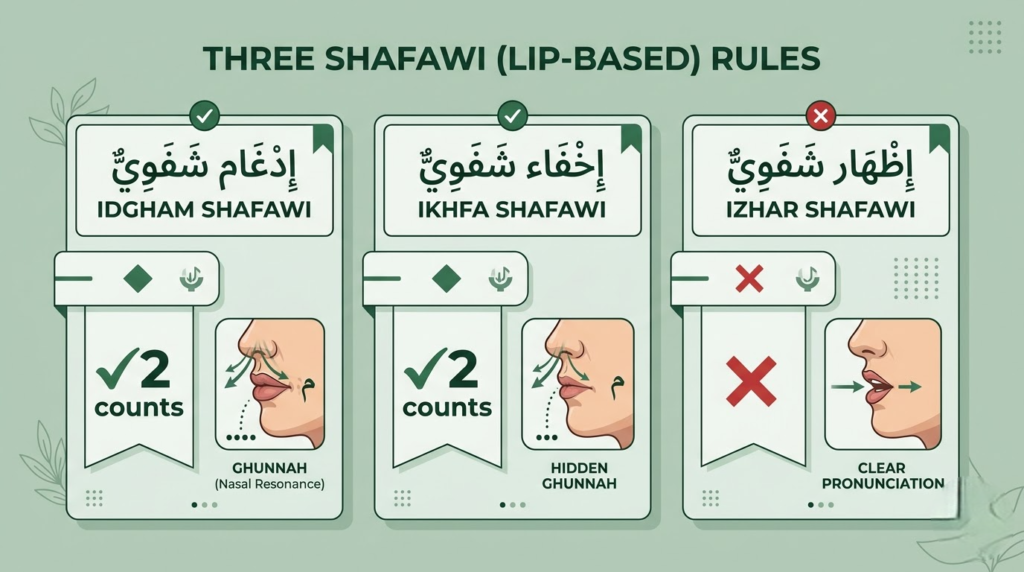
The same pattern repeats, in a smaller form, across the three Meem Sakinah rules:
| Rule | Confirmed Ghunnah? | Notes |
|---|---|---|
| Idgham Shafawi | Yes — 2 counts | Meem merges into a following Meem |
| Ikhfa Shafawi | Yes — 2 counts | Lightly concealed before a following Ba |
| Izhar Shafawi | No | Clear pronunciation before the other 26 letters, no nasal hold |
Notice the pattern holding across both systems: whenever a rule fully merges (Idgham) or conceals (Ikhfa) the letter, ghunnah is confirmed. Whenever a rule leaves the letter clearly, plainly pronounced (Izhar, in either its Halqi or Shafawi form), ghunnah is absent. Once you see that pattern, you stop needing to memorize each rule in isolation.
Where Ghunnah Does NOT Apply
To close the loop, here’s the full list of situations where you should not be holding a 2-count nasal sound:
- Izhar Halqi — Noon Sakinah/Tanween followed by one of the six throat letters.
- Idgham bila Ghunnah — Noon Sakinah/Tanween merging into Laam or Ra specifically.
- Izhar Shafawi — Meem Sakinah followed by any letter other than Meem or Ba.
- Any Noon or Meem with no shaddah and no sakinah-rule trigger — just their ordinary baseline quality, not the emphasized version.
Common Mistakes Beginners Make
- Nasalizing through the mouth instead of the nose. A correct ghunnah should feel like the sound is resonating behind the nose, not being pushed out through an open mouth — this is the single most common correction teachers make in one-to-one classes.
- Holding it too short or too long. The 2-count duration is fixed — rushing through it (closer to 1 count) or over-holding it (stretching toward madd-length) are both treated as errors, not stylistic choices.
- Forgetting Noon/Meem Mushaddad outside a sakinah rule. Because most Tajweed teaching starts with Noon Sakinah and Meem Sakinah, learners sometimes never apply ghunnah to a simple doubled Noon or Meem that isn’t part of either system.
- Applying full Izhar clarity where Ikhfa concealment was needed. This is the same mistake flagged in our Meem Sakinah guide for Ikhfa Shafawi specifically — pronouncing the letter too clearly and skipping the concealment removes the ghunnah along with it.
A 60-Second Self-Test
Before your next recitation session, look at these five words and decide, out loud, whether each one needs a 2-count ghunnah or not: إِنَّ, مَنْ يَقُولُ, مِنْ خَيْرٍ, لَكُمْ مَا, and عَلَيْهِمْ وَعَلَى. If you can name the rule behind each answer (Noon Mushaddad, Idgham bi Ghunnah, Izhar Halqi, Idgham Shafawi, and Izhar Shafawi, in that order), you’ve genuinely internalized the pattern rather than just memorized five separate rule names.
This kind of short, focused drill is exactly what our Sabaq Sabqi Manzil review system is built around — testing a specific rule in isolation, in a handful of real examples, rather than only reading it about it once and moving on.
Once ghunnah feels automatic across all three of its trigger contexts, it slots naturally into everything else in our complete Tajweed Rules Reference — most other rules either assume you already know when to hold it, or explicitly build on top of it.
FAQ
Which letters produce ghunnah?
Only two: Noon (ن) and Meem (م). No other Arabic letter is capable of carrying a nasal ghunnah sound, which is why both letters keep appearing as the trigger across multiple, separately-named Tajweed rules.
How long should ghunnah be held?
Confirmed ghunnah is held for 2 counts (harakat) — a fixed duration that doesn’t change depending on which rule triggers it, whether that’s a doubled letter, a Noon Sakinah rule, or a Meem Sakinah rule.
Does every Noon and Meem get a 2-count ghunnah?
No. Every Noon and Meem carries a light baseline nasal quality just by being pronounced, but the emphasized 2-count version only applies in specific situations: when the letter is doubled (mushaddad), or inside the ghunnah-carrying rules of the Noon Sakinah and Meem Sakinah systems (Idgham bi Ghunnah, Ikhfa Haqiqi, Iqlab, Idgham Shafawi, and Ikhfa Shafawi).
What’s the difference between Idgham bi Ghunnah and Idgham bila Ghunnah?
Both are Idgham rules within the Noon Sakinah/Tanween system, but they’re triggered by different letters. Idgham bi Ghunnah (with ghunnah) is triggered by Yaa, Noon, Meem, or Waw and carries the full 2-count nasal hold. Idgham bila Ghunnah (without ghunnah) is triggered specifically by Laam or Ra and has no nasal hold at all — the merge happens cleanly with no nasal resonance.
Is ghunnah the same thing as Izhar, Ikhfa, or Idgham?
No — ghunnah is a sound quality, not a rule category on its own. It shows up as a required feature inside some Izhar, Ikhfa, and Idgham rules (and is absent from others), which is exactly why this guide organizes them by whether ghunnah applies rather than treating ghunnah as a fifth separate rule.
Want a teacher to listen to your ghunnah live and correct the hold length in real time? Book a free trial Tajweed class with Suffah Quran Academy and get feedback on your recitation from day one.