

Published: September 26, 2026 · ⏱ 11 min read · Ustaz Ahmad Raza, Senior Quran & Tajweed Teacher
📖 In This Guide
- What Is Madd? (The Basic Idea)
- The Three Madd Letters
- Madd Asli (Madd Tabee’i) — The Natural Madd
- Madd Far’i — The Branching Madd Rules (Muttasil, Munfasil, ‘Aarid Lissukoon, Lazim, Badal, ‘Iwad, Leen)
- Quick Reference Table: All Madd Types at a Glance
- Common Madd Mistakes Beginners Make
- How to Practice Madd Rules Properly
- FAQ
What Is Madd? (The Basic Idea)
Madd (مَدّ) literally means “to stretch” or “to extend.” In Tajweed, it refers to prolonging the sound of certain letters beyond their normal length when reciting the Qur’an. Getting Madd right isn’t a stylistic flourish — in several cases, shortening or lengthening a Madd incorrectly can change the meaning of a word, or simply make the recitation sound rushed and unclear.
Every reciter eventually runs into the same question: how long is “long”? Tajweed answers this with a unit called the harakah — roughly the time it takes to open or close a finger while counting. One harakah is the baseline length of a short vowel. A Madd is measured in multiples of this unit — typically 2, 4, 5, or 6 harakat depending on which type of Madd applies.
This guide walks through every classical Madd rule, in the order most Tajweed teachers introduce them, with the letter counts and examples you need to actually apply them — not just memorize their names.
The Three Madd Letters
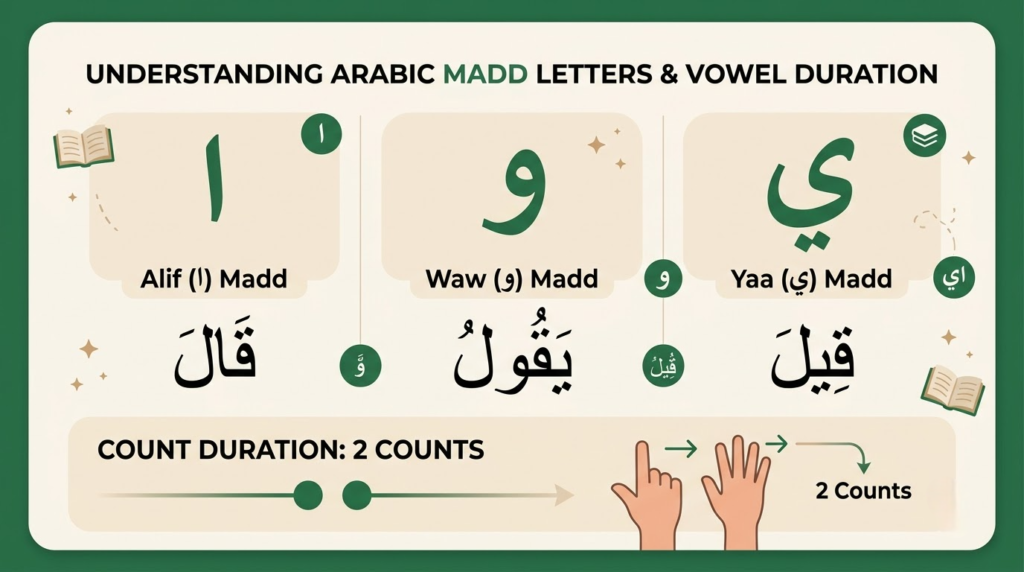
Madd only happens with three specific letters, and only when each is preceded by its matching short vowel:
- Alif (ا) — preceded by a fathah (the short “a” sound), as in “قَالَ”
- Waw (و) sakinah — preceded by a dammah (the short “u” sound), as in “يَقُولُ”
- Yaa (ي) sakinah — preceded by a kasrah (the short “i” sound), as in “قِيلَ”
If the vowel before the letter doesn’t match — for example, a waw preceded by a fathah instead of a dammah — no Madd occurs; that’s a different rule (Madd Leen, covered below).
Madd Asli (Madd Tabee’i) — The Natural Madd
Madd Asli, also called Madd Tabee’i (“natural Madd”), is the baseline case: one of the three Madd letters appears, and it is not followed by a hamzah (ء) or a sukoon. Nothing extra is triggering it — it’s simply the letter behaving normally.
- Length: 2 harakat
- Example: the alif in “قَالَ” (qaala), the waw in “يَقُولُونَ” (yaquuloona), the yaa in “فِيهِ” (feehi)
Every other Madd rule below is a variation that adds length on top of this baseline, because of what comes immediately after the Madd letter — usually a hamzah or a sukoon.
Madd Far’i — The Branching Madd Rules
Madd Far’i (“branching” or “secondary” Madd) is the umbrella term for every Madd that is extended beyond 2 harakat because a hamzah or a sukoon follows the Madd letter. There are seven recognized subtypes.
Madd Muttasil (Connected Madd)
Occurs when a Madd letter is followed by a hamzah in the same word.
- Length: 4–5 harakat (commonly taught as 4, with some qira’at extending to 5)
- Ruling: Wajib (obligatory) — this one is never shortened to 2 harakat
- Example: “جَاءَ” (jaa’a), “السَّمَاءِ” (as-samaa’i)
Madd Munfasil (Separated Madd)
Occurs when a Madd letter ends one word, and the next word begins with a hamzah.
- Length: 2, 4, or 5 harakat — this is the one area where reciters legitimately differ, depending on which riwayah (transmission style) they follow
- Ruling: Ja’iz (permissible range, not a fixed single count)
- Example: “يَا أَيُّهَا” (yaa ayyuhaa), “فِي أَنفُسِكُمْ” (fee anfusikum)
Madd ‘Aarid Lissukoon (Temporary Madd on Stopping)
Occurs when a Madd letter appears just before a word’s final letter, and that final letter only becomes sakin (silent, no vowel) because you’re stopping there — if you kept reciting past it, that letter would carry its normal vowel.
- Length: 2, 4, or 6 harakat — reciter’s choice, but pick one length and stay consistent
- Ruling: Ja’iz — only applies when pausing; continuing past the word collapses it back to a normal 2-harakat Madd Asli
- Example: stopping on “الرَّحِيمٴ” (ar-raheem) at the end of a verse — read fluently it’s just “ar-raheemi,” but on stopping the final vowel drops and the Madd before it can be extended
Madd Lazim (Obligatory Madd)
Occurs when a Madd letter is followed by a permanent sukoon or shaddah that never changes, whether you stop or continue reciting. Because the trigger never disappears, this is the one Madd type with a fixed, non-negotiable length.
- Length: Always 6 harakat
- Ruling: Lazim (obligatory) — the strictest category
Four sub-varieties, depending on whether the sukoon/shaddah is inside a normal word or inside the “disconnected letters” (al-huroof al-muqatta’ah) that open certain surahs:
- Kalimi Muthaqqal (word-based, heavy) — followed by a shaddah in the same word, e.g. “الضَّالِّينَ” (ad-daaalleen) in Surah Al-Fatihah
- Kalimi Mukhaffaf (word-based, light) — followed by a plain sukoon with no shaddah; rare, the classic example is “أالْأَانَ” (aal-aana) in Surah Yunus
- Harfi Muthaqqal (letter-based, heavy) — appears in the disconnected letters at the start of some surahs, where spelling the letter’s name out loud produces a shaddah, e.g. the “Laam” in “الم” (Alif-Laam-Meem)
- Harfi Mukhaffaf (letter-based, light) — a disconnected letter whose name, spelled out, has no shaddah — these are simply read as Madd Asli (2 harakat) despite appearing in a muqatta’at set
Madd Badal (Substitute Madd)
Occurs when a hamzah comes before the Madd letter — the reverse order of Muttasil and Munfasil. Historically, this Madd letter is understood as “substituting” for what would otherwise be a second hamzah.
- Length: 2 harakat — the same length as Madd Asli
- Example: “آمَنُوا” (aamanoo), “إِيمَان” (eemaan), “أُوتِيَ” (ootiya)
Madd ‘Iwad (Compensation Madd)
Occurs only when stopping on a word that ends in fathatain (the double-fathah tanween sound) on a letter other than a taa marbutah. The tanween’s “n” sound is dropped, and a plain elongated alif sound takes its place.
- Length: 2 harakat
- Example: stopping on “عَلِيمًا” (aleeman while reciting continuously) becomes “aleemaa” when you pause there
Madd Leen (Soft Madd)
A different pairing from the three classic Madd letters: a waw sakinah or yaa sakinah preceded by a fathah (not a dammah or kasrah), as in “بَيْت” (bayt) or “قَوْم” (qawm). This only stretches when stopping on that word.
- Length: 2, 4, or 6 harakat when stopping (reciter’s choice); no elongation at all when continuing past the word
- Example: stopping on “خَوْف” (khawf) at the end of a verse
Quick Reference Table: All Madd Types at a Glance
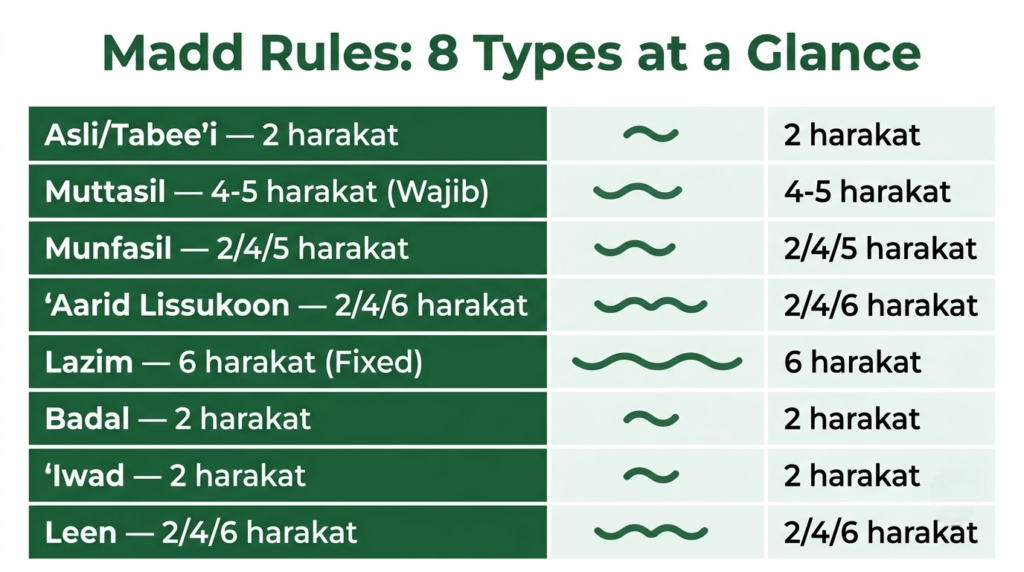
| Madd Type | Trigger | Length (Harakat) | Ruling |
|---|---|---|---|
| Asli / Tabee’i | Madd letter, no hamzah/sukoon after | 2 | Baseline |
| Muttasil | Hamzah in the same word | 4–5 | Wajib |
| Munfasil | Hamzah starts the next word | 2, 4, or 5 | Ja’iz |
| ‘Aarid Lissukoon | Last letter is sakin only on stopping | 2, 4, or 6 | Ja’iz |
| Lazim | Permanent sukoon/shaddah after Madd letter | 6 (fixed) | Lazim |
| Badal | Hamzah comes before the Madd letter | 2 | Standard |
| ‘Iwad | Fathatain at word end, only on stopping | 2 | On stopping only |
| Leen | Waw/Yaa sakinah after a fathah, only on stopping | 2, 4, or 6 | On stopping only |
Common Madd Mistakes Beginners Make
- Treating every long vowel the same length. The single most common error — reciting a 2-harakat Madd Asli and a 6-harakat Madd Lazim with the same stretch. These two rules read side by side make the difference obvious once you start counting deliberately.
- Rushing Madd Muttasil. Because it’s “just one word,” many beginners clip it down to 2 harakat instead of the required 4–5. Since it’s wajib, this is one of the more frequently corrected mistakes in one-to-one classes.
- Guessing at Madd Lazim in muqatta’at letters. The disconnected letters that open surahs mix Harfi Muthaqqal and Harfi Mukhaffaf letters in the same line — without knowing which letter names carry a shaddah, it’s easy to either over- or under-stretch them.
- Forgetting that some Madd only applies on stopping. Madd ‘Aarid Lissukoon, Madd ‘Iwad, and Madd Leen are easy to miss because they don’t exist at all mid-verse — they only appear the moment you pause.
This overlaps closely with the articulation issues covered in Common Tajweed Mistakes Beginners Make — Madd length and correct makhraj (articulation point) are usually taught and corrected together. For the articulation side specifically, see the full Makharij al-Huroof Chart.
How to Practice Madd Rules Properly
- Start by counting out loud. Before applying Madd rules to actual verses, practice counting 2, 4, and 6 harakat on a single held vowel sound so your ear learns the difference before your tongue has to apply it live.
- Isolate one Madd type at a time. Pick a short surah and go through it hunting only for Madd Muttasil, then only for Madd Lazim, and so on.
- Practice your stopping points deliberately. Rehearse the same verse both continuing through it and stopping at the end — you should hear the Madd appear and disappear.
- Build it into a daily routine. See our 15-Minute Daily Tajweed Practice Routine for a structured plan that folds Madd drills in alongside articulation and waqf practice.
- Pair Madd with waqf practice. Several Madd rules only appear when stopping, so they’re best learned together with proper stopping technique — see our Waqf Rules in Quran Recitation guide.
- Get live correction. Harakah counts are subtle — a teacher listening in real time catches drifting counts far faster than solo practice.
Madd also interacts closely with the Noon Sakinah and Tanween rules — several Madd ‘Iwad examples involve tanween directly, so if that topic is still unfamiliar, our Noon Sakinah and Tanween Rules guide is a natural companion to this one.
FAQ
How many types of Madd are there in Tajweed?
Two main categories: Madd Asli (the natural, 2-harakat baseline) and Madd Far’i, which has seven recognized subtypes — Muttasil, Munfasil, ‘Aarid Lissukoon, Lazim, Badal, ‘Iwad, and Leen.
What is the difference between Madd Asli and Madd Far’i?
Madd Asli is the default 2-harakat stretch that happens whenever a Madd letter isn’t followed by a hamzah or sukoon. Madd Far’i is any Madd that gets extended beyond 2 harakat because a hamzah or sukoon follows the Madd letter.
Which Madd rule is obligatory (wajib)?
Madd Muttasil is the Madd rule most consistently taught as wajib — it must be extended to at least 4 harakat and is never shortened to 2. Madd Lazim’s 6-harakat length is completely fixed with no acceptable range.
Why do some Madd rules only apply when I stop reciting?
Three Madd types — ‘Aarid Lissukoon, ‘Iwad, and Leen — are triggered by a letter becoming sakin specifically because of a pause. If you continue reciting past that word instead of stopping, the letter keeps its normal vowel and the Madd rule doesn’t apply at all.
How long does it take to learn all the Madd rules properly?
Recognizing the seven Madd Far’i types by name typically takes a few sessions of focused study. Applying them correctly and consistently while reciting — especially getting the harakah counts right by ear — usually takes longer and benefits significantly from a teacher’s live correction rather than self-study alone.
Want a teacher to walk through Madd rules with you verse by verse and correct your counts in real time? Book a free trial Tajweed class with Suffah Quran Academy and get feedback on your recitation from day one.