
Published: September 26, 2026 · ⏱ 8 min read · Ustadah Ayesha Siddiqua, Female Quran Tutor
Already decided you want to start? See live IST timings, teacher options and INR-friendly pricing on our Online Quran Classes India page →
Most of what gets written about online Quran classes in India is aimed at parents enrolling their children. This piece is for someone else entirely: the woman herself — the mother, the working professional, the newly married daughter-in-law, the woman who reverted years ago and never quite finished the basics — who wants to start or restart her own Quran learning, and isn’t sure what actually happens next.
Why This Question Comes Up So Often
The pattern repeats across the messages we get from Indian women considering this for themselves: Quran classes as a child that stopped somewhere around Class 8 or 9 when school took over, a recitation that’s “rusty,” a house full of children she’s teaching Duas to while feeling she never properly finished her own Tajweed, or simply never having had the chance growing up. None of this is unusual, and none of it means starting now is starting from nothing — it means starting from wherever you actually are, which a one-on-one teacher can work with directly.
What’s different about asking this as an adult woman in India specifically is less about the Quran itself and more about the practical questions around it: will a teacher actually be a woman, will classes work in Hindi or Urdu if English isn’t comfortable, will this fit into a day that’s already full, and what will people at home think of a grown woman “going back to Qaida.” Those are reasonable questions, and they deserve real answers rather than being brushed aside.
What Actually Happens When You Enrol
The process is deliberately short, because the biggest barrier for most adult women isn’t the learning — it’s the first step. Here’s exactly what it looks like:
- Message on WhatsApp or fill the trial form. A short message — even just “I’d like to book a free trial, I’d prefer a female teacher” — is enough to start.
- You’re matched with a teacher and a time. Say whether you’d prefer English, Hindi, or Urdu medium, and mention your IST availability — most working women land on a post-Isha or mid-morning slot.
- The free trial class happens — a real class, not a sales call. Your teacher listens to your current recitation (or starts from the very first letter if you’re beginning from zero) and gets an honest sense of where you actually are.
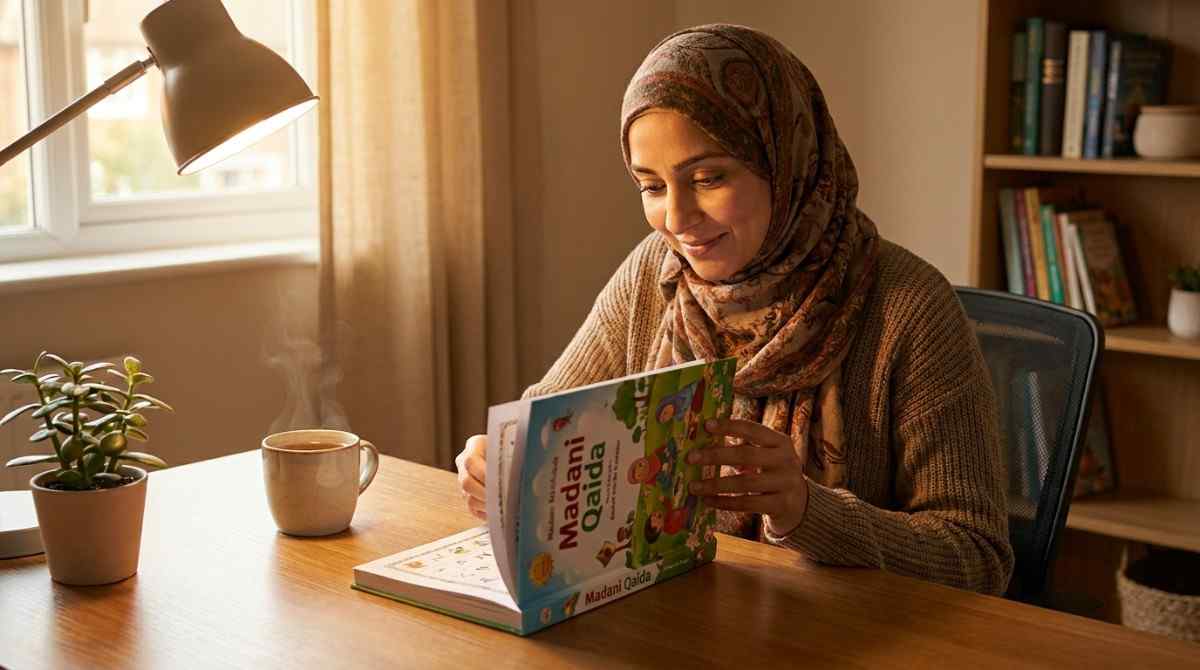
- You agree on a starting point and a weekly rhythm. This might be Madani Qaida if you’re starting fresh, a Tajweed refresher if your reading is solid but your rules are shaky, or a Hifz track if memorisation is the goal.
No card is asked for before the trial, and there’s no pressure to continue after it. The point of the trial is for you to sit through one real class and decide for yourself whether the pace and the teacher feel right.
Choosing Your Teacher and Where to Start
Request a female teacher explicitly when you book — it’s a standard option, not a special request that needs justifying. Our female teachers are ijazah-certified in the same way as our male teachers, background-checked, and available in English, Hindi, and Urdu medium, so language doesn’t have to be a second barrier on top of everything else.
Where you start depends entirely on where you actually are, not on your age:
- Starting from zero or near-zero — beginning with Madani Qaida, the same gentle letter-by-letter foundation used with young children, just paced for an adult learner. Our guide on what to do if you never learned to read the Quran walks through exactly what the first few weeks look like.
- Reading already, but rusty on the rules — moving straight into Tajweed correction, since this is usually the fastest, most satisfying starting point for a woman who learned as a child and is picking it back up.
- Wanting to memorise, at any age — our companion piece on starting Hifz as a woman in your 30s or later goes into the specific concerns around memorisation, household balance, and realistic pacing in far more depth than this article does.
If your main concern is the female-teacher question itself rather than the curriculum, our broader guide on female Quran teachers covers what to ask any academy — most of it applies exactly the same way whether you’re enrolling your daughter or yourself.
Fitting Classes Around an Indian Household
A recurring worry we hear is some version of: “I already have children, in-laws, a job, a home to run — where does this fit?” It’s a fair question, and the honest answer is that it fits into the same category as anything else you protect time for, not a separate, larger commitment than it needs to be.
What Actually Works, Reported by Students Themselves
- One 25–30 minute class, two or three times a week — not a daily hour. Since all of India runs on a single time zone, keeping the same IST slot week to week is simpler here than for students juggling classes across regions.
- Post-Isha or early-morning slots are the two windows most working women and mothers land on — after the household has settled for the night, or before it wakes up.
- Classes are recorded, so a missed portion because a child needed attention mid-class isn’t a lost lesson — it can be reviewed afterward.
- Saying it out loud at home — telling family “this is my Quran time” the same way one might protect time for Fajr or a doctor’s appointment — tends to matter more for consistency than any scheduling trick.
Common Hesitations Indian Women Raise
⚠️ What Comes Up Before Enrolling
- “Log kya kahenge — will people think it’s strange for me to be learning Qaida at my age?” — Genuinely no. A meaningful share of our adult women students are exactly in this position, and it’s treated as completely ordinary here, not as a curiosity.
- “Will I actually get a female teacher, or just get told one ‘isn’t available right now’?” — Female teachers are a standing part of the offering, not a rare exception you have to hope for. Ask directly when booking.
- “I’m not comfortable in English — can classes really run in Hindi or Urdu?” — Yes, this is stated plainly when you book, not something you have to push for after the fact.
- “What does this actually cost in rupees?” — Pricing is transparent and INR-friendly; see the fee page for current plans rather than a number repeated (and risking going stale) here.
What One Student’s Experience Looked Like
Rather than describe this in the abstract, here’s what one of our own adult students in India said, in her own words, reviewing her experience:
❝
I wanted to improve my Tajweed as an adult with a female teacher who could speak Urdu. Suffah matched me perfectly. My recitation has improved more in 3 months than in years of trying on my own.
Nadia Begum · Adult learner · Delhi, India
Her situation is a common one: not a beginner, not pursuing Hifz, just someone who wanted her own recitation corrected properly and hadn’t found the right match locally. More reviews from students and parents, including from other adult learners, are collected on our reviews page.
How to Get Started
- Message us on WhatsApp or book online — mention you’d like a female teacher and your preferred medium (English, Hindi, or Urdu).
- Attend your free trial class at an IST slot that suits you — no payment, no obligation.
- Agree on a realistic starting point and a weekly rhythm that fits your actual household, not an idealised one.
- Progress is reviewed with you regularly, and pacing adjusts as life does.
Start With a Free Trial — Female Teacher on Request
A real class at an IST-friendly time, in English, Hindi, or Urdu — no card required, no obligation to continue.
Book Free Trial Class → Chat on WhatsApp →Frequently Asked Questions
Yes. Female teachers are a standing part of the offering for students of any age, including adult women learning for themselves. Mention this when you book your free trial and you’ll be matched accordingly.
Yes. Teachers are available in English, Hindi, and Urdu medium. Mention your preferred language when booking your free trial.
No. Classes start from wherever you actually are, including from the very first Arabic letter if needed, using the same Madani Qaida foundation used with young beginners, paced for an adult learner.
Most adult women in India attend two to three 25–30 minute classes a week. A short, consistent slot — often post-Isha or early morning — tends to work better than trying to find one long session.
Pricing is transparent and INR-friendly, with plans kept on one page so the figures stay current — see the fee page for the latest rates rather than a number that could go stale here.
No. The free trial is a real, live class with no card required and no obligation to continue afterward. It exists so you can judge the fit for yourself before deciding anything.
Final Thoughts
None of the practical questions here — the teacher’s gender, the language, the household schedule, what people might think — are reasons to keep putting this off. They’re logistics, and every one of them has a straightforward answer once you actually ask it. The Quran doesn’t come with an age limit or a “too late” clause, and starting from wherever you are today, at your own pace, in your own language, with a teacher you’re comfortable with, counts as a real beginning.
Related Guides

Written by Ustadah Ayesha Siddiqua
Female Quran Tutor · 5 Years Experience · Hifz, Noorani Qaida, Nazra
Ustadah Ayesha Siddiqua teaches Quran recitation and Hifz to students of different ages, including adult women beginning or restarting later in life, with a calm, structured approach that adapts pacing to the student in front of her rather than a fixed template.
Meet our teaching team →