
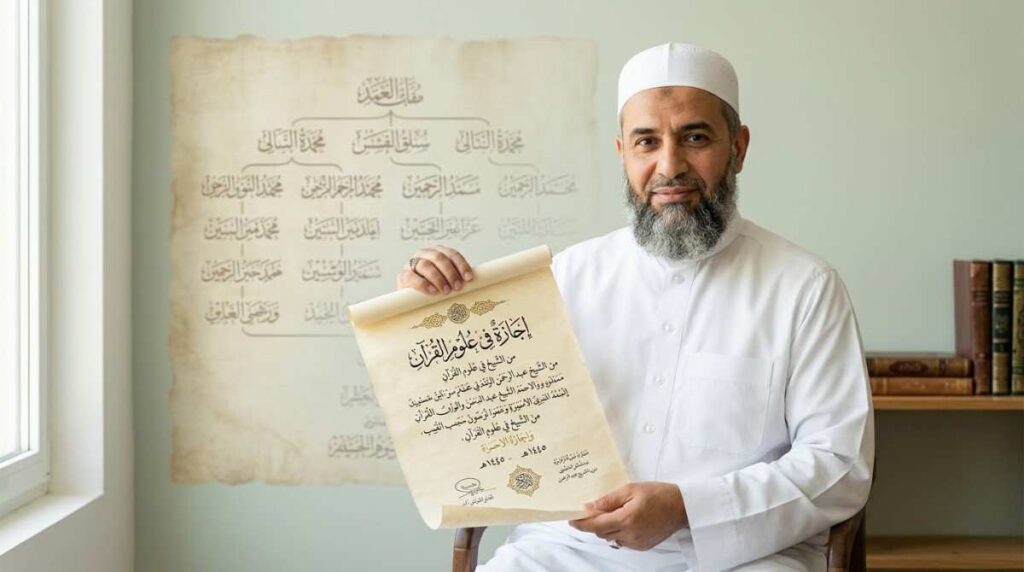
Published: August 31, 2026 · ⏱ 7 min read · Ustaz Yusuf Khan, Advanced Tajweed & Fluency Instructor
New to these terms? Read What Is an Ijazah? for the full background, or How to Get an Online Ijazah if you’re ready to start the process yourself. This guide focuses on one narrower question both of those leave open: what actually separates the two words.
Ijazah and Sanad show up together so often in Quran teaching — often in the very same sentence — that many parents and students reasonably assume they mean the same thing. They don’t. They are two different pieces of one system, and mixing them up makes it harder to ask a teacher the right question when it actually matters.
This guide is deliberately narrow. It does not re-explain what an Ijazah is in full, and it does not walk through how to earn one — both of those are covered in depth elsewhere on this site. What it does is answer the one question search brings people here for: what exactly separates an Ijazah from a Sanad, and which one should you actually ask to see?
The Quick Answer
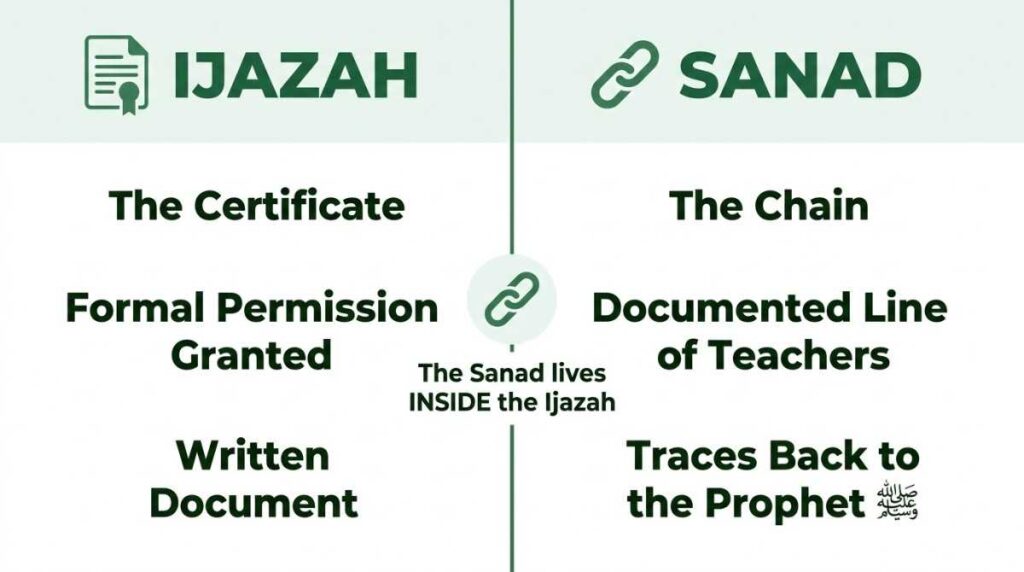
An Ijazah is the certificate — the formal permission a qualified scholar grants a student after verifying their recitation. A Sanad is the chain — the documented list of names connecting that student, through their teacher, and their teacher’s teacher, all the way back to the Prophet Muhammad (peace be upon him). The Ijazah is the permission that gets granted; the Sanad is the pedigree that comes attached to it.
What Is an Ijazah, Briefly
An Ijazah (إجازة, meaning “permission” or “authorisation”) is a formal certification granted by a qualified scholar to a student who has recited the Quran to them in full, been corrected throughout, and met the required standard of Tajweed. It grants two things at once: confirmation that the student’s recitation has been verified, and permission for that student to teach others — and, in time, to grant Ijazah of their own.
Think of the Ijazah as the document. It has a form: typically written, often in Arabic, naming the student, the granting scholar, the Riwaya (recitation style) covered, and the date. If you want the full explanation of how one is earned and what it does and doesn’t prove about a teacher, that is covered thoroughly in What Is an Ijazah? Why Your Quran Teacher’s Certification Matters.
What Is a Sanad, Briefly
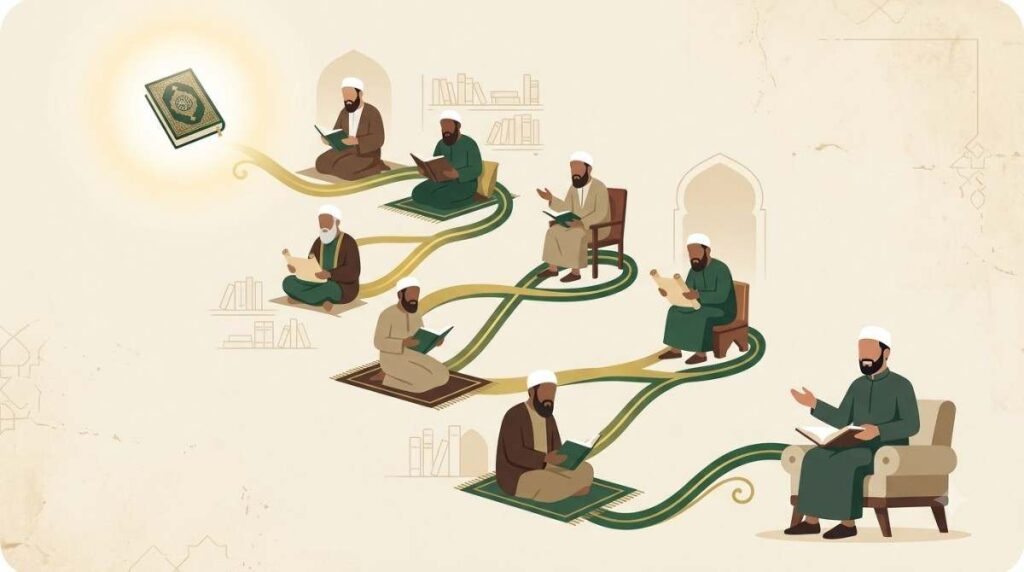
A Sanad (سند, meaning “support” or “chain”) is not a certificate — it is a record. Specifically, it is the list of names tracing a line of teachers backward in time: this teacher learned from that teacher, who learned from another, continuing generation by generation until the chain reaches the Companions of the Prophet (peace be upon him), who received the Quran directly from him.
A Sanad does not, by itself, grant anyone permission to do anything. It is evidence — a genealogy of transmission that shows a reciter’s knowledge did not appear from nowhere, but was passed down hand to hand, correction to correction, across roughly 1,400 years.
Ijazah vs Sanad: Side-by-Side
| Ijazah | Sanad | |
|---|---|---|
| What it is | A formal certificate of permission | A documented chain of names |
| What it certifies | That recitation was verified and teaching permission was granted | That an unbroken line of teachers separates the reciter from the source |
| Form it takes | A written document naming teacher, student, and Riwaya | A list of names, usually printed inside or alongside the Ijazah |
| Can it stand alone? | No — a credible Ijazah always includes a Sanad | Yes, as a historical record, but it grants no teaching permission by itself |
| What you ask a teacher | “Do you hold an Ijazah?” | “Can I see your Sanad?” |
How the Two Fit Together
The clearest way to see the relationship is that a Sanad lives inside an Ijazah, not beside it. When a scholar grants a student an Ijazah, the certificate does not just say “approved” — it names the scholar’s own teacher, and their teacher’s teacher, reproducing the whole chain the scholar themselves inherited, with the student’s name added as the newest link.
So an Ijazah without a Sanad would be a permission slip with no history behind it — which is exactly why traditional scholars never issue one that way. And a Sanad without an Ijazah is just a historical claim with nobody currently standing behind it as your teacher. In practice, you are never really choosing between the two. You are asking to see one document that contains both: the permission, and the pedigree that makes the permission worth something.
Is a Sanad the Same as an Isnad or Silsila?
You will occasionally see two other words used almost interchangeably with Sanad, and it is worth clearing them up in the same breath.
Isnad (إسناد) is essentially a synonym for Sanad — both refer to the chain of transmission, and the two words are used interchangeably across Islamic scholarship, including in hadith transmission. You do not need to treat them as separate concepts.
Silsila (سلسلة, literally “chain” or “series”) is broader still — used for chains of transmission generally, including a Sufi order’s chain of spiritual teachers, rather than specifically for Quran recitation. In everyday conversation about Quran certification, Sanad and Isnad are the two words you will actually encounter.
Why the Distinction Matters When Choosing a Teacher
This is not just a vocabulary exercise — the two questions catch different problems. “Do you hold an Ijazah?” checks whether a teacher was ever formally evaluated at all; some teachers who recite well were simply never put through the process, so this is a genuine yes-or-no filter.
“Can I see your Sanad?” checks something different — whether the permission traces back through people you, or a knowledgeable third party, can actually identify. A teacher can technically answer yes to the first question while staying vague about the second, which is itself worth noticing. A teacher confident in their certification will usually produce the chain without hesitation.
Want to See Ours?
Every teacher at Suffah Quran Academy holds a verified Ijazah, and we’re happy to share the Sanad behind it on request. Book a free trial class and ask us directly.
Book Free Trial Class →Frequently Asked Questions
Not in any meaningful sense. A Sanad is simply the chain of names documenting a line of transmission — it only becomes significant when a qualified scholar has verified a specific person’s recitation and formally granted them an Ijazah that includes that chain. Someone cannot claim a personal Sanad while skipping the actual certification that attaches it to them.
A genuine, traditional Ijazah always includes a Sanad, because the chain of transmission is the entire point of the certification. If a certificate calls itself an Ijazah but cannot show a documented chain of teachers back through history, it is worth asking more questions — it may be a course completion certificate using the word loosely rather than a traditional Ijazah.
Ask for both, but they answer slightly different questions. Asking whether they hold an Ijazah confirms they were formally evaluated and given permission to teach. Asking to see their Sanad confirms exactly whose chain that permission traces back through, so you can judge its credibility for yourself.
Yes, quite commonly. Many students learn from the same scholar and are each granted an Ijazah carrying that scholar’s Sanad. From that point in the chain backward, their Sanads are identical; only the final link — their own name and the date they were certified — differs between them.
Not directly. Every valid Sanad reaches back the same historical distance to the Companions and the Prophet (peace be upon him), so length reflects how many teachers happened to pass certification along the way rather than how rigorous any single link was. What matters more is whether each link in the chain is a genuinely qualified, verifiable scholar, not simply how many names are listed.
The Bottom Line
An Ijazah is the permission. A Sanad is the pedigree behind it. Neither one means much without the other, which is exactly why a genuine certification always carries both together — and why the right move, when evaluating any teacher, is to ask about both by name rather than treating the two words as interchangeable shorthand for “qualified.”
If you want the fuller picture, What Is an Ijazah? covers what the certification proves and doesn’t prove, and How to Get an Online Ijazah walks through the actual process of earning one, start to finish.
Book a free trial class with an Ijazah-certified teacher → No payment, no commitment — and yes, we’ll show you the Sanad behind it.

Written by Ustaz Yusuf Khan
Advanced Tajweed & Fluency Instructor · Ijazah-Certified, Riwayat Hafs an Asim · 8 Years Experience · Urdu, Hindi, Arabic
Ustaz Yusuf Khan holds an ijazah in Quran recitation with tajweed in Riwayat Hafs an Asim and can produce the full Sanad behind it on request. He teaches advanced tajweed and fluency courses for teenagers and adults at Suffah Quran Academy, working with students across the UK, USA, Canada, and Australia.
Meet our teaching team →