

This post contains affiliate links.
Published: August 27, 2026 · ⏱ 8 min read · Ustaz Zaid Farooqui, Online Quran Instructor
Looking to enrol? See live pricing, teacher options and book a free class on our India Quran Classes page →
Online Quran Classes Built Around IST
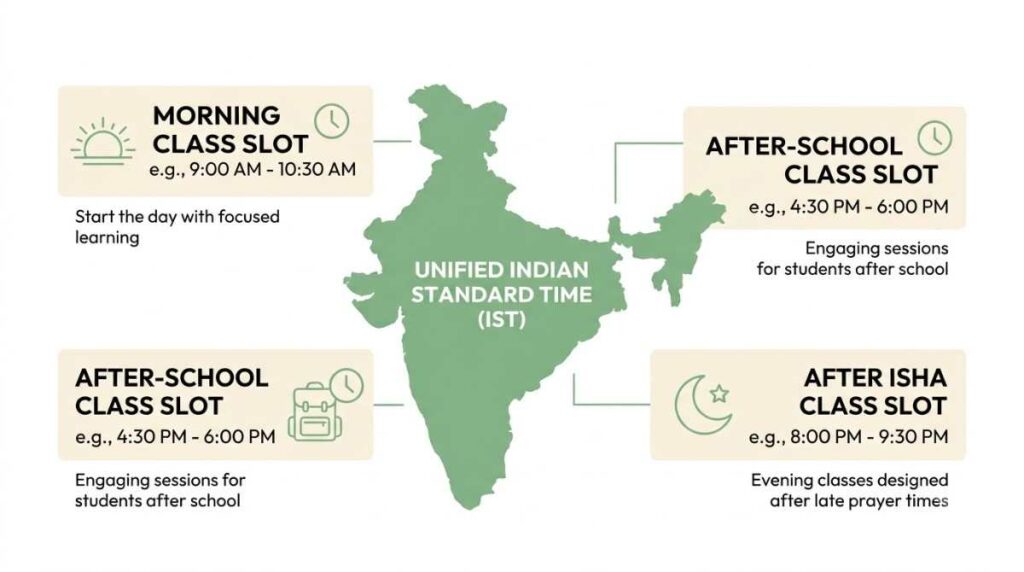
For families searching for online Quran classes in India, the practical challenge is usually less about finding a teacher and more about finding one who is genuinely qualified, available at a workable time, and a good fit for your child. We schedule classes right across Indian Standard Time, from early morning through late night, with the heaviest demand landing in the after-school window between 4pm and 8pm and again after Isha for adults and working parents.
One genuine advantage for Indian families: the whole country runs on a single time zone. Parents in Mumbai, Delhi, Hyderabad, Bangalore, Chennai, and Kolkata are all coordinating against the same clock, so there’s no juggling between regions the way families in the US or Australia sometimes have to. That makes booking a slot, and keeping it consistent week to week, noticeably simpler.
Online Classes vs the Local Madrassah Model
Local maktabs and madrassahs remain a central part of community life across India, and plenty of children learn well in that setting. But the format has a structural limit: one teacher, one group, one pace that has to work for every child in the room. A child who’s ahead gets bored waiting their turn; a child who needs more repetition can get quietly left behind rather than held back the whole class.
The Principle
One-on-one, two or three short sessions a week typically move a student further in a term than a single weekly group class — not because the group format is wrong, but because pacing matched to one child compounds faster.
There’s also a coverage issue that’s specific to India: a truly qualified, Ijazah-certified teacher isn’t always available within reasonable distance, especially outside the larger cities. Online classes remove that constraint entirely — the teacher’s location stops mattering, and many families end up combining both, keeping a local maktab for the community side and adding a focused midweek online session for individual correction.
What a Class Actually Looks Like
Every class is one-on-one over video call, typically 25 to 30 minutes, with live correction rather than a recorded lesson. A typical week for a student in India looks something like this:
Sample Weekly Schedule (IST)
| Day | IST Time | Focus |
|---|---|---|
| Tuesday | 6:00 PM | New lesson / current level |
| Thursday | 6:00 PM | Revision and tajweed correction |
| Sunday | 11:00 AM | Extended session, progress review with parent |
Days and times adjust freely once you’re matched with a teacher — this is one example rhythm, not a fixed structure. Because scheduling stays within a single IST window, most families find it easy to keep the same slot consistent week after week, even around shifting school and work commitments.
See Your Schedule Before Committing
Book a free trial class at a time that actually fits your IST routine — no obligation, just a real class to see how it feels.
Book Free Trial Class →Curriculum: From Qaida to Hifz and Tajweed
Regardless of starting point, most students move through a similar sequence, adjusted for age and prior exposure:
- Letter recognition and reading — through Madani Qaida for absolute beginners.
- Fluency building — reading full passages smoothly before adding tajweed rules.
- Tajweed — makharij, noon sakinah, waqf, and pronunciation correction.
- Hifz (optional track) — structured memorisation, paced around school commitments.
If your child is starting from zero, our guide to Madani Qaida explains the first stage, and our tajweed rules list for beginners covers what typically comes next once basic reading is solid.
Who’s Actually Teaching Your Child
This is usually the first question Indian parents ask, and rightly so — an online class means trusting a teacher you haven’t met in person. Our teachers are matched by specialisation — tajweed, hifz, or beginner reading — and hold ijazah certification in the subject they teach, meaning their own recitation has been formally verified and authorised through a scholarly chain. Every teacher is also background-checked, and male and female tutors are both available. Our guide to what ijazah certification actually means walks through exactly what this credential confirms, useful whether you’re evaluating our teachers or comparing options.
Common Concerns Indian Parents Raise
⚠️ What Indian Parents Usually Ask Before Enrolling
- “Is this affordable compared to a local tutor?” — Pricing is transparent and INR-friendly, and one-on-one attention every session tends to deliver faster progress than a comparably priced group option.
- “Will video calls work with our internet connection?” — Classes are designed to run smoothly on standard home broadband or a stable mobile connection, and teachers can adjust video quality if a connection is inconsistent.
- “Can we get a female teacher, and can classes run in Hindi or Urdu?” — Yes to both. Mention your preference when booking your free trial and we match accordingly.
- “How do we know it’s actually working?” — Regular parent updates and periodic progress reviews are built into the structure, not something you have to ask for separately.

How to Get Started
- Book a free trial class at an IST-friendly time — no payment or long-term commitment required.
- The teacher assesses current level (or starts from zero) and recommends a track: Qaida, fluency, tajweed, or hifz.
- You choose a recurring weekly schedule that works around school, work, and existing commitments.
- Progress is reviewed with you periodically, with pacing adjusted as your child develops.
Most families across India settle into a workable rhythm within the first two or three weeks — the trial class exists so you’re not committing to a full schedule before knowing whether the timing and teaching style genuinely fit your household.
Start With a Free Trial Class
Scheduled around your IST routine, with no obligation — just an honest first lesson to see if it’s the right fit.
Book Free Trial Class →Frequently Asked Questions
We schedule classes from early morning through late night in IST, with the busiest windows being before school, after school between 4pm and 8pm, and after Isha for adults and working parents. Because all of India runs on a single time zone, coordinating a slot is simpler than in countries that span several zones.
A neighbourhood maktab usually teaches in a group, at a fixed pace and fixed time, and often depends on finding a qualified teacher nearby. Online one-on-one classes let a teacher work at your child’s actual level, at a time that fits your household, without depending on who happens to be available in your area.
Yes. Our teachers can teach in English, Urdu, and Hindi. Let us know your preferred language when you book your free trial and we will match you with a teacher fluent in it.
Children can start from around age 4 to 5 with our Madani Qaida course, which uses short, gentle sessions for young beginners. We also have fully qualified, background-checked female teachers available on request.
Teachers hold ijazah certification in their specialisation — tajweed, hifz, or qiraat — and are matched to students by subject and level. Our guide on what an ijazah certification means explains exactly what this credential verifies.
Yes, every new student starts with a free trial class scheduled at an IST-friendly time, so you can see the teaching style and pace before committing to a regular weekly schedule.
More Country & City Guides

Written by Ustaz Zaid Farooqui
Online Quran Instructor · 7 Years Experience · Beginner Reading, Scheduling Coordination, International Students
Ustaz Zaid works with international students across several regions, including a growing number of families across India, and builds each schedule around the household’s actual routine rather than a fixed template. He often recommends short midweek sessions alongside existing local madrassah attendance rather than as a replacement for it.
Meet our teaching team →