

This post contains affiliate links.
Published: July 13, 2026 · ⏱ 10 min read · Ustaz Muhammad Saad, Hifz Instructor
There is no shortage of Quran memorization advice online. Most of it repeats the same general points — be consistent, make dua, find a good teacher — without telling you the specific mechanics of how memorization actually happens in a real lesson with a real student. This article is different. These seven techniques are what Hifz teachers use in actual sessions, across different age groups and ability levels, and what consistently produces memorization that holds over years rather than fading within weeks.
Not every technique works equally well for every student — but every technique here has a clear reason behind it, and understanding that reason helps a student or parent decide which ones to prioritize.
Technique 1: Small Segments, High Repetition
The Principle
Memorize less at a time, but repeat it far more times than feels necessary.
The most common beginner mistake in Hifz is treating memorization like reading comprehension — reading a passage several times until it “feels familiar” and then trying to recall it. Familiarity is not memorization. A passage that feels familiar after five readings will be gone within two days.
What actually creates durable memorization is high-repetition encoding: reading a single line or short verse set a minimum of 20 to 40 times while looking at the text — actively repeating it, not passively re-reading it — before attempting to recite it from memory. The number that works varies by student age and individual memory, but it is almost always higher than students initially expect.
The segment size matters too. Half a page per session, memorized solidly to the point of recitation without looking, is worth far more than two pages memorized to 60% recall. The solid half-page stays. The half-memorized two pages creates a problem that compounds daily.
Technique 2: The Accumulation Method
The Principle
Always recite the new line with everything that came before it — never in isolation.
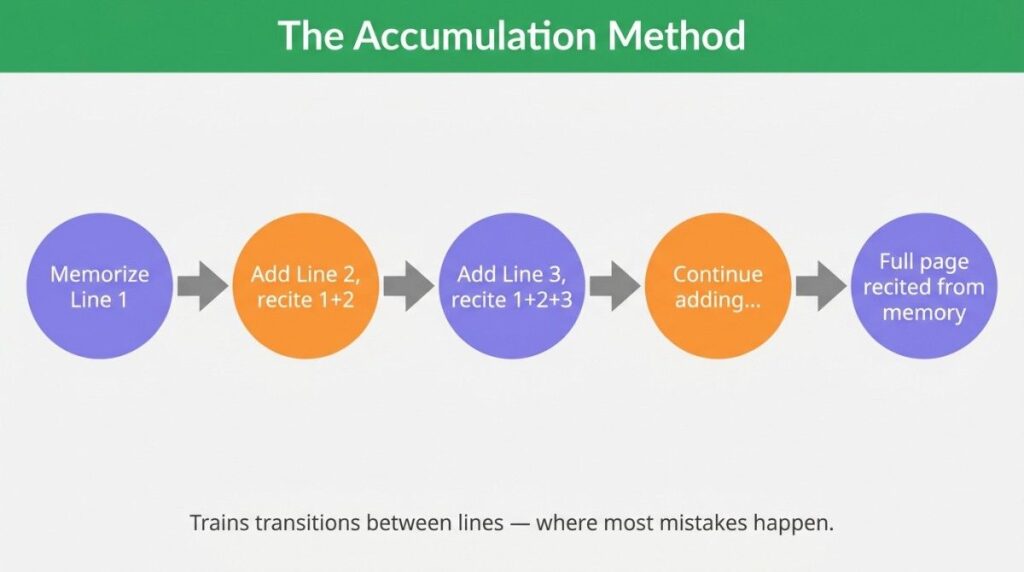
This is one of the most effective and underused techniques in structured Hifz programs. When memorizing a new page, most students memorize line by line — line 1, then line 2, then line 3 — but test themselves on each line separately. The accumulation method works differently:
- Memorize line 1 with high repetition until solid
- Memorize line 2 with high repetition until solid
- Recite line 1 + line 2 together until that combination is solid
- Memorize line 3 with high repetition
- Recite line 1 + line 2 + line 3 together until solid
- Continue adding one line at a time, always reciting the full accumulated passage
By the end of the session, the student can recite the entire new passage from memory — because they have been practicing the transitions between lines, not just each line individually. Transitions between lines are where most Hifz mistakes happen during recitation, and this method specifically trains those transition points.
Technique 3: Structured Daily Revision (Dawr)
The Principle
Memorization without structured revision is not Hifz — it is temporary storage.
Dawr — structured daily revision of previously memorized material — is the single most important practice in long-term Hifz, and the most consistently neglected one. New memorization gets the attention because it feels like progress. Revision feels like maintenance. But without daily revision, everything memorized before begins a slow fade that eventually undoes months of work.
A structured dawr system works in rotating cycles. A student who has memorized five juz divides that memorization into portions and reviews a different portion each day — so the full five juz is revisited within a fixed cycle, typically every seven to ten days. As more is memorized, the cycle length adjusts, but no portion of the Quran sits unreviewed for more than two weeks.
We build this system with every student from their very first page — not from the point when they realize they need it. At that point, it is already much harder to catch up. For a deeper look at how revision interacts with timeline, see our guide on how long Hifz actually takes.
Technique 4: Salah Integration
The Principle
What is recited in salah is retained far more reliably than what is only practiced in sessions.
This is the most natural and spiritually grounded reinforcement method available — and most students do not use it deliberately enough. When a student begins memorizing a new surah or page, that material should immediately start appearing in their daily salah — in Fajr, Maghrib, or any other prayer where they have the chance to recite freely.
The reason this works so powerfully is that salah creates a context of focused attention that is qualitatively different from practice. The student is not running through memorized material mechanically — they are reciting it as an act of worship, with the accompanying presence of mind. That context strengthens the neural encoding of the memorization in a way that practice sessions alone do not replicate.
Teachers notice this consistently: a surah that a student has been using in salah for two weeks is almost always more solidly retained than one of equal recency that has only been practiced in class.
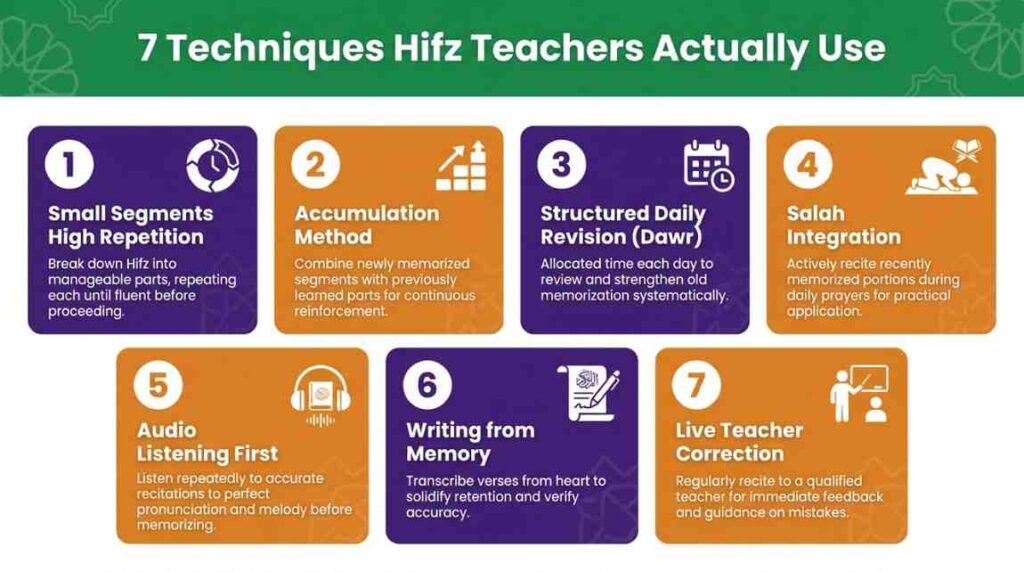
Technique 5: Audio Listening Before Memorizing
The Principle
The ear often learns faster than the eye — especially for a language that is not the student’s first.
Before beginning to memorize a new page, listening to a clear, correct recitation of that page multiple times — by a certified reciter such as Sheikh Mahmoud Khalil al-Husary or Sheikh Abdul Basit Abdul Samad — creates an audio template in the student’s memory. When they then begin the text-based memorization, they are filling in a pattern they already partially know rather than starting from complete unfamiliarity.
This technique is particularly effective for students who struggle with Arabic as a foreign language, because the audio exposure builds familiarity with the sounds, rhythms, and natural pauses of the passage before the visual memorization begins. It also naturally models correct Tajweed — the student’s ear begins to notice when their own recitation doesn’t match what they have been listening to.
A practical way to use this: listen to the target page ten to fifteen times over the day before the memorization session — during commute, household tasks, or before sleep — then begin the formal repetition-based memorization in the dedicated practice session.
Technique 6: Writing as a Memorization Tool
The Principle
Writing engages a different memory pathway than reading — and some students retain far better when they write.
This technique is not universally recommended for all students, but for certain learners — particularly those who struggle to retain material through audio or visual repetition alone — writing out memorized material from memory is a powerful diagnostic and reinforcement tool.
The method: after completing the repetition-based memorization of a new section, the student closes the Mushaf and writes out what they have just memorized in Arabic from memory. The gaps and errors that appear in writing often reveal exactly which parts of the memorization are weak — not just “approximately there” but precisely which word or letter the student is unsure of.
For students who type rather than handwrite Arabic, the same principle applies digitally — but handwriting tends to produce stronger memory encoding than typing for most students, because the physical act of forming each letter engages the memory more deeply.
Technique 7: Live Teacher Correction — Every Session
The Principle
You cannot hear your own mistakes the way a teacher can — and memorized mistakes are far harder to correct than mistakes caught early.
This is the technique that separates productive Hifz from self-study that produces confident but incorrect memorization. No student, at any level, can fully assess their own recitation while they are reciting it. The attention required to recall and produce the memorized material occupies most of the cognitive resources that would otherwise be checking pronunciation, Tajweed, and accuracy simultaneously.
A teacher listening specifically to identify errors catches things the student genuinely cannot hear in themselves — a shortened vowel on a specific letter, a missing ghunnah, a word slightly different from what the Mushaf says. Each of these errors, if memorized, gets repeated thousands of times before it is noticed. The earlier it is caught, the easier it is to correct.
This is not an argument for teacher dependency — students should practice daily independently. It is an argument for weekly live correction as a non-negotiable component of any serious Hifz program, not an optional extra for when the student feels uncertain. Uncertainty is not always visible to the student themselves.
What Doesn’t Work (And Why)
As useful as the seven techniques above are, it helps to name what consistently fails — because many students have tried these approaches and been confused about why they didn’t work:
- Passive listening without active repetition. Listening to a surah on repeat while doing other things builds familiarity, not memorization. Active vocal repetition is what creates the encoding that becomes retrievable under pressure.
- Memorizing without revision. Any approach that focuses entirely on new material and treats revision as optional will eventually collapse — no matter how strong the initial memorization technique.
- Rushing to finish a page rather than solidifying a portion. Completing a page on paper with 70% retention is not progress — it is deferred re-work. A student who memorizes half a page to 100% moves faster overall than one who attempts full pages at 70%.
- Changing the Mushaf edition mid-Hifz. The brain encodes memorization partly through visual layout — where a line appears on the page, where a page turns. Switching editions mid-Hifz disrupts this visual encoding and typically causes significant confusion and re-memorization.
Want to Apply These Techniques With a Qualified Teacher?
Book a free trial Hifz class — our instructors will show you how these methods work in an actual session, not just in theory.
Book Free Trial Class →Frequently Asked Questions
The most effective method combines small daily segments of new memorization with a structured daily revision system. Memorizing half a page at a time with 20 to 40 repetitions per line, then revising all previously memorized material daily, produces far stronger long-term retention than memorizing large sections quickly.
The fastest sustainable approach is small daily targets with very high repetition — repeating each line at least 20 to 40 times before moving on — combined with using memorized material in daily prayers. Students who rush by memorizing large sections quickly typically spend far more time later re-memorizing faded pages than they saved initially.
With a teacher. Self-memorization without external checking allows mispronunciations and missing words to become embedded without the student realizing. A teacher who listens regularly catches these errors early — saving significantly more time and effort than correcting them after months of repetition.
The repetition method involves reading each new line or verse 20 to 40 times while looking at the text before attempting to recite from memory. This high-repetition approach creates stronger initial encoding than reading a passage once or twice and immediately attempting recall. The number of repetitions required varies by age and individual memory strength.
Final Thoughts
Memorization of the Quran is ultimately a spiritual act sustained by consistent physical practice — and the techniques above are the physical mechanics that make that practice productive rather than frustrating. No single technique replaces the others: small segments need high repetition, high repetition needs daily revision, daily revision needs live correction, and live correction works best when the student is also reinforcing in salah.
If you are planning a Hifz journey, our guides on realistic Hifz timelines and adult Hifz programs cover what to expect at different stages. And if you are still in the early stages of learning to read Quran before memorization begins, start with Madani Qaida — solid recitation before Hifz is not optional, it is the foundation everything else is built on.
Ready to Start Hifz the Right Way?
Book a free trial class — see these techniques applied in a real session with a qualified Hifz instructor.
Claim Your Free Trial →
Written by Ustaz Muhammad Saad
Hifz Instructor · 6 Years Experience · Hifz, Revision, Tajweed
Ustaz Muhammad Saad has tested these techniques across students of all ages and abilities. His view is simple: there is no mystery to Hifz — just method applied consistently. The students who succeed are the ones who internalize the method, not the ones who rely on motivation alone.
Meet our teaching team →