This post contains affiliate links.
Published: July 6, 2026 · ⏱ 9 min read · Ustadah Ayesha Siddiqua, Female Quran Tutor
A lot of Muslim girls who have completed Hifz or finished advanced Quran studies reach the same fork in the road: they know the Quran, they love it, and they want to pass it on — but they have no clear picture of what becoming a qualified teacher actually involves. Is completing Hifz enough? Do you need an Ijazah? Can you teach online from home? How do you get your first students?
This guide covers the real path — what training looks like, which qualifications matter and why, and how female Quran teachers are building sustainable teaching careers online without leaving home.
Knowing the Quran vs Being Able to Teach It
This is the gap most aspiring teachers underestimate. Memorizing the Quran — or reciting it with strong Tajweed — confirms that you know the material. It says nothing about whether you can break that material down for a seven-year-old who forgets the same ayah four sessions in a row, or manage a teenager who is losing motivation three months into Hifz, or structure a lesson plan that actually builds a beginner’s skills systematically rather than just checking whether they remembered yesterday’s page.
Teaching is a separate skill from knowing. The Islamic tradition has always understood this — which is why the chain of teacher-to-student transmission (silsila) was considered so important, and why the Ijazah system exists to verify not just knowledge but the authorization to transmit it correctly. Knowing something and being qualified to teach it were treated as two distinct achievements.
The Path to Becoming a Quran Instructor
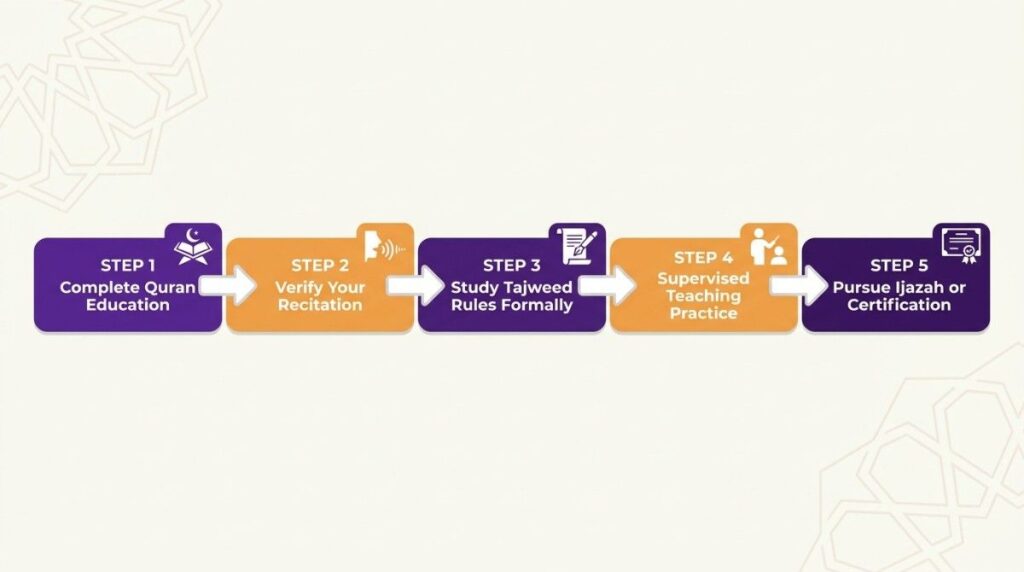
There is no single fixed route, but the most credible paths follow a recognizable pattern:
- Complete your own Quran education to a high level. This usually means Hifz completion or advanced Tajweed — not just basic recitation. You cannot teach Tajweed rules you don’t know or Hifz methods you haven’t lived through yourself.
- Get your own recitation formally verified. This means working with a qualified teacher who corrects your recitation systematically — ideally until you are ready for an Ijazah — rather than assuming your current level is correct because no one has told you otherwise.
- Study Tajweed rules formally, not just in practice. Many students recite with good Tajweed without being able to name or explain the rules they’re applying. A teacher needs to be able to explain them, identify which rule a student is breaking, and describe how to correct it.
- Get supervised teaching practice. Teaching your younger siblings or cousins is a start — but supervised practice under a senior teacher who can observe and correct your teaching method is what actually builds the skill.
- Pursue an Ijazah or institutional certification. This is the step that formally authorizes you to teach and gives parents and academies a verifiable reason to trust your credentials.
Qualifications That Actually Matter
Not all credentials carry equal weight in the Quran teaching field. Here is an honest ranking:
- Ijazah in Quran recitation (Riwayah Hafs or equivalent) — The gold standard. A verified, unbroken chain from your teacher back to the Prophet ﷺ. Recognized universally by parents and academies.
- Ijazah in Tajweed — Specifically certifies that your Tajweed has been formally checked and approved. Particularly important if you plan to teach Tajweed as a primary subject.
- Hifz completion certificate from a recognized institution — Strong credential for Hifz teaching specifically, especially from a madrasah or Islamic institute with a verifiable reputation.
- Formal Tajweed course completion — Weaker than an Ijazah but meaningful, especially if it includes written examinations and supervised recitation checks.
- Self-study or informal learning only — Not a teaching credential. Many talented reciters fall into this category and don’t realize it until they try to teach and realize their knowledge has unverified gaps.
The Role of Ijazah in Teacher Credibility
An Ijazah is not just a certificate — it is an authorization. It means a qualified teacher has listened to your full recitation, corrected it, and formally transmitted the permission to teach to you through a chain that has been maintained across centuries. That chain matters because it guarantees that what you are transmitting as a teacher has been verified all the way back, not just checked by whoever taught you most recently.
For female Quran teachers specifically, an Ijazah carries additional credibility because it removes any question of whether your knowledge was informally acquired. A parent enrolling their daughter is not just trusting your recitation — they are trusting that your recitation has been formally confirmed to be correct by someone whose own recitation was confirmed, and so on.
Working toward an Ijazah, even while you are already teaching at a basic level, signals to the community that you take the responsibility seriously — and that seriousness is itself a form of qualification.
Why Teaching Methodology Is Its Own Training
This is the part that new teachers most consistently wish someone had told them earlier. Knowing what to teach and knowing how to teach it are two entirely different problems, and the second one only gets solved through practice and feedback — not through additional recitation study.
Specifically, a new Quran teacher needs to learn:
- How to structure a lesson — revision first, new material second, assessment at the end. This sounds obvious until you watch a new teacher skip revision because new pages feel more productive.
- How to correct mistakes without discouraging the student. The tone and timing of correction matters as much as the correction itself, especially with children.
- How to pace a student individually. Not every student memorizes at the same speed, and pushing a slow student faster than their natural pace causes dropout, not progress.
- How to keep students motivated across months and years. Short-term enthusiasm is easy to generate. Long-term consistency — especially through the slow middle months of a Hifz program — requires a teacher with real motivational tools, not just pressure.
These skills are built through supervised teaching experience, observation of senior teachers, and honest feedback on your own classes — not through reading about them.
Teaching Online: What It Actually Looks Like
Online Quran teaching has opened the path to a legitimate teaching career for Muslim girls in a way that simply wasn’t possible a generation ago. A qualified female teacher can now build a full student roster from home, teach students in multiple countries, earn a sustainable income, and contribute to the community’s Quran education — all without needing to commute to a madrasah or depend on local demand alone.
What it practically requires:
- A stable internet connection and a quiet space for classes
- A working microphone — audio quality is critical for Tajweed correction online
- A structured class format that works across a screen (open Quran on both sides, clear verbal correction since physical pointing isn’t possible)
- Familiarity with platforms like Zoom, Google Meet, or similar tools
- A consistent weekly schedule that students and parents can rely on
The limitation most new online teachers underestimate is audio. Online Tajweed correction is entirely dependent on sound quality — a poor microphone or unstable connection makes accurate correction genuinely difficult. Investing in a decent headset before taking on students is not optional, it’s foundational.

How to Get Started If You’re Serious
If you’ve read this far and the path feels right, here’s the most direct honest version of what to do next:
- Get your own recitation checked by a qualified teacher right now — before you teach a single student. You need to know where your gaps are, not find out through a student’s parent flagging an error.
- Start working toward an Ijazah — even if it takes two years. The process of working toward it will improve your recitation and your knowledge of Tajweed rules faster than anything else.
- Teach a small number of students under supervision first — family, community, or through an academy that provides teacher mentoring and quality checks.
- Ask to observe experienced teachers before going solo — watching how a senior Ustadah handles a struggling student or a slow week is worth more than any methodology book.
- Join a reputable online academy as a teacher — academies like Suffah Quran Academy provide student referrals, scheduling support, and quality oversight that is genuinely hard to replicate on your own when you’re starting out.
Thinking of Teaching Quran Online?
At Suffah Quran Academy we are always looking for qualified female teachers. Start by booking a free trial class to experience our teaching standards firsthand.
Book Free Trial Class →Frequently Asked Questions
At minimum, a female Quran teacher should have completed Hifz or advanced Quran recitation, have her own recitation verified by a qualified teacher — ideally through an Ijazah — and have undergone some form of teaching practice or methodology training. An Ijazah in Tajweed or Quran recitation is the most recognized credential in the field.
Yes — many qualified Quran teachers work without a formal Ijazah, particularly at a beginner or intermediate level. However, an Ijazah significantly increases credibility, especially for Tajweed and Hifz instruction, and is increasingly expected by parents seeking teachers for their children. Working toward an Ijazah, even after starting to teach, is strongly recommended.
A student who has already completed Hifz can pursue an Ijazah in Tajweed in as little as one to two years of dedicated study. Those starting from basic Quran recitation should expect a longer path — typically three to five years — before they are ready to teach formally.
Yes, and many qualified female Quran teachers do exactly that. Online teaching removes geographic limitations, allows a flexible schedule, and opens up a student base far beyond the local community. Academies like Suffah Quran Academy specifically recruit and train female teachers to deliver one-on-one Quran classes online.
Final Thoughts
The path from completing your own Quran education to becoming a qualified, trusted Quran instructor is real, achievable, and increasingly accessible online — but it requires honest preparation that goes beyond recitation ability alone. Verified credentials, supervised teaching practice, and a genuine teaching methodology are what separate a qualified Ustadah from someone who simply knows the Quran well.
The need for qualified female Quran teachers is significant and growing — parents everywhere are looking for trustworthy female Hifz teachers and verified Ustadahs for their daughters. That need is your opportunity — if you approach the path with the seriousness it deserves.
Experience What Quality Quran Teaching Looks Like
Book a free trial class at Suffah Quran Academy — learn from qualified Ustadahs and see the standard we hold our teachers to.
Claim Your Free Trial →
Written by Ustadah Ayesha Siddiqua
Female Quran Tutor · 5 Years Experience · Noorani Qaida, Nazra, Hifz Support
Ustadah Ayesha Siddiqua began her own teaching journey shortly after completing advanced Quran recitation, and understands firsthand what it takes to move from knowing the Quran to being trusted to teach it. She now teaches girls across multiple countries online and mentors newer teachers at Suffah Quran Academy.
Meet our teaching team →