
This post contains affiliate links.
Published: July 4, 2026 · ⏱ 9 min read · Ustadah Ayesha Siddiqua, Female Quran Tutor
Most parents searching for a female Hifz teacher start with one filter: is she a hafiza? That’s necessary, but it’s nowhere near sufficient. Memorizing the Quran herself and successfully guiding a seven or ten-year-old through years of memorization are different skill sets entirely — and the gap between them is exactly where a lot of well-intentioned Hifz journeys stall.
This guide covers what actually matters when choosing a female Hifz instructor for your daughter, the questions worth asking before enrolling, and the red flags that are easy to miss when you’re evaluating credentials on paper rather than watching someone teach.
Why “She’s a Hafiza” Isn’t Enough
Being a hafiza confirms one thing clearly: she has memorized the Quran herself, with correct pronunciation, verified by her own teachers. That’s the foundation — but it says nothing about whether she can teach a young child, manage the inevitable frustration of forgotten pages, or keep a daughter motivated through a multi-year process that has slow weeks and setbacks built into it.
We’ve seen highly qualified hafizas struggle with young learners simply because their own Hifz journey was as an adult or teenager, with an entirely different kind of discipline and attention span than a seven-year-old has. Teaching children Hifz is its own specialty, separate from having completed Hifz personally.
What to Actually Look For
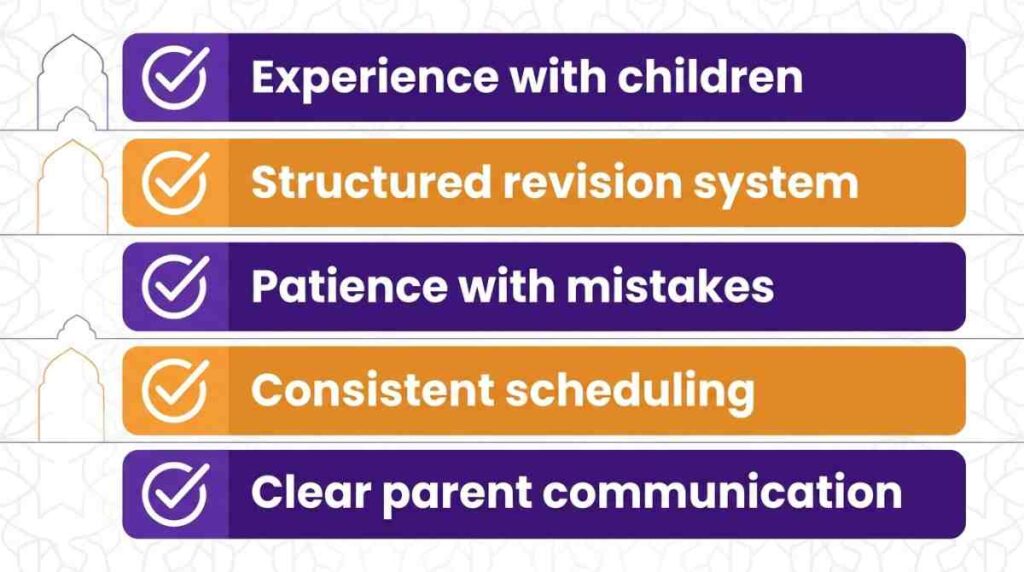
- Demonstrated experience with children, specifically. Not just Hifz experience in general — experience teaching the age group your daughter is in right now.
- A structured revision (dawr) system. Memorization without a serious daily and weekly revision plan leads to forgotten pages piling up. Ask exactly how she structures revision, not just new memorization.
- Patience with repeated mistakes. Children forget the same page multiple times during Hifz — this is normal, not a sign of failure. A teacher’s reaction to the fifth repeated mistake tells you more than her reaction to the first.
- Consistent, predictable scheduling. Hifz progress depends heavily on consistency. A teacher who reschedules frequently or lacks a fixed weekly structure makes long-term progress harder regardless of her own ability.
- Clear communication with parents. Regular updates on progress, honest feedback when a child is falling behind, and willingness to adjust pacing rather than pushing a rigid schedule regardless of the child’s pace.
Questions to Ask Before Enrolling
Most parents ask about qualifications and stop there. The more useful questions are about method and daily reality:
- “How do you structure daily revision versus new memorization?”
- “What happens when my daughter forgets a page she memorized weeks ago?”
- “How do you keep a child motivated during a difficult or slow stretch?”
- “How often will I receive updates on her progress, and in what format?”
- “What happens if she falls behind the expected pace — do you adjust the plan or push to catch up?”
The answers matter less for their specific content and more for whether they’re specific at all. A teacher with a real, tested method will answer these in detail, immediately. Vague answers — “we just keep going,” “she’ll catch up” — are themselves the signal.
Red Flags Parents Often Miss
- No clear revision structure. If the focus is entirely on new pages with no defined system for retaining old ones, forgotten Hifz accumulates silently until it becomes a much larger problem.
- Pressure-based motivation only. Some teachers rely heavily on guilt or pressure (“you’re disappointing Allah,” “you’re behind”) rather than building genuine engagement. This can produce short-term compliance but often damages a child’s relationship with the Quran long-term.
- No willingness to do a trial class. A confident, experienced teacher is usually happy to demonstrate her method directly. Reluctance to do a trial, or rushing straight to enrollment, is worth noticing.
- One-size-fits-all pacing. Every child memorizes at a different pace. A teacher who insists on an identical schedule for every student regardless of individual progress is optimizing for her own convenience, not the child’s actual learning.
Why a Trial Class Matters More Than a Resume
Credentials tell you what a teacher knows. A trial class tells you how she teaches — which is the part that actually determines whether your daughter thrives or struggles. During a trial, watch specifically for:
- How she responds in the moment your daughter makes a mistake — patiently, or with visible frustration
- Whether she adjusts her pace and tone based on your daughter’s responses, or runs a fixed script regardless
- Whether your daughter seems engaged and comfortable, or anxious and quiet, by the end of the session
This last point is the most reliable signal available to a parent. A child’s comfort level after a single session is rarely wrong, even when it’s hard to put into words.

Online vs In-Person: Does It Matter?
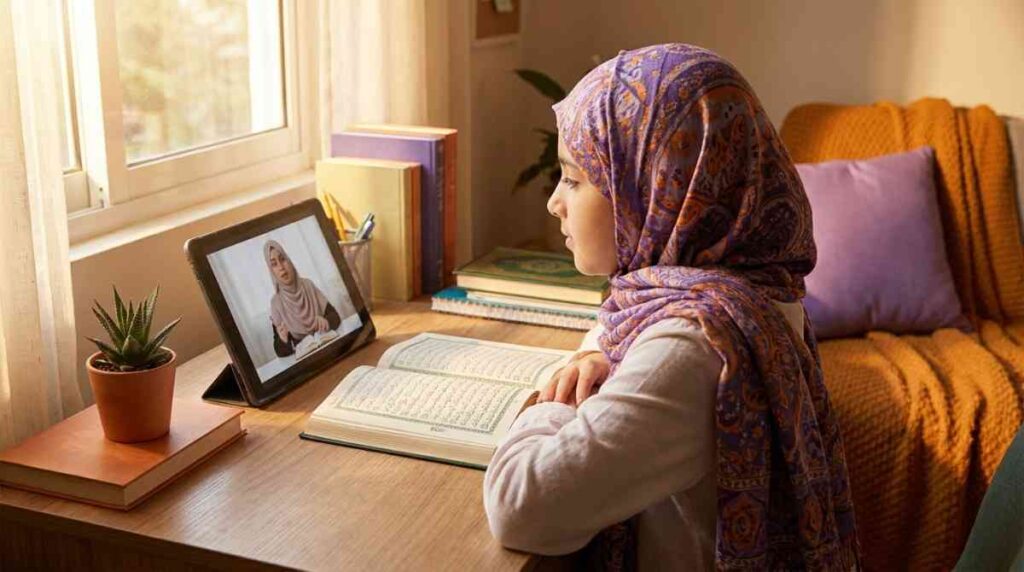
Less than most parents assume. A structured online Hifz program with a qualified female teacher, consistent scheduling, and proper one-on-one correction can be just as effective as an in-person class — sometimes more so, because it removes commute time and widens the pool of available teachers significantly, which matters in areas where qualified female Hifz teachers are scarce locally.
What actually determines outcomes is the teacher’s method and consistency, not the medium. The same checklist above applies whether the class happens in a room or over a video call.
See Our Female Hifz Teaching Method in Action
Book a free trial class for your daughter and watch how our female Hifz teachers actually teach.
Book Free Trial Class →Frequently Asked Questions
Look beyond being a hafiza alone. A strong female Hifz teacher for a child should have demonstrated teaching experience with children specifically, a clear and structured revision (dawr) system, patience with mistakes, and the ability to keep a young student motivated over months and years.
An Ijazah confirms a teacher’s own recitation has been verified by a qualified chain of teachers, which matters for accuracy. However, an Ijazah alone does not guarantee teaching skill with children. Parents should ask about both credentials and actual classroom experience with young students.
The clearest way is a trial class. Watch how the teacher responds when your daughter makes a mistake, whether she adjusts her pace to the child’s level, and whether your daughter seems comfortable rather than anxious during the session.
Online Hifz with a qualified female teacher can be just as effective as in-person classes when the program includes structured daily revision, one-on-one correction, and consistent scheduling. What matters most is the teacher’s method and consistency, not the medium.
Final Thoughts
Finding the right female Hifz teacher for your daughter is less about finding the most credentialed hafiza available and more about finding someone whose teaching method, patience, and consistency match what your daughter specifically needs. Credentials get you in the door. A trial class tells you whether to stay.
If you’re still deciding between teaching formats, our guide on one-on-one vs group Quran classes for children covers how class structure affects Hifz progress specifically.
Ready to Find the Right Fit for Your Daughter?
Book a free trial class — no commitment, just a real look at how we teach.
Claim Your Free Trial →
Written by Ustadah Ayesha Siddiqua
Female Quran Tutor · 5 Years Experience · Noorani Qaida, Nazra
Ustadah Ayesha Siddiqua specializes in teaching young girls Quran recitation and memorization with a calm, structured approach. She believes the right teacher-student fit matters as much as technical qualification, especially in the early years of a child’s Hifz journey.
Meet our teaching team →