
This post contains affiliate links.
Published: June 24, 2026 · ⏱ 7 min read · Ustaz Zaid Farooqui, Online Quran Tutor
The cost of online Quran education is one of the most searched questions Muslim families ask — and one of the most difficult to answer clearly, because pricing varies enormously between academies and formats.
This guide gives honest, specific numbers — current as of mid-2026 for the UK, USA, Canada, and Australia — and more importantly, explains what determines value rather than simply listing prices.
Typical Pricing — What to Expect
| Format | Sessions/Week | UK (£/month) | USA ($/month) |
|---|---|---|---|
| One-on-one, 30 min | 2 per week | £30 – £55 | $40 – $70 |
| One-on-one, 30 min | 3 per week | £45 – £80 | $55 – $100 |
| One-on-one, 45 min | 3 per week | £60 – £110 | $75 – $130 |
| Hifz programme, daily | 5–6 per week | £80 – £150 | $100 – $180 |
| Group class (4-8 students) | 2–3 per week | £15 – £35 | $20 – $45 |
These ranges reflect mid-2026 pricing from reputable academies with Ijazah-certified teachers in the UK and USA. Prices from academies based in Pakistan, Bangladesh, or Egypt typically run 30-50% lower — but quality varies significantly and credentials require careful verification.
What Drives the Cost
Understanding what drives pricing helps evaluate whether a given price is reasonable or suspect.
Teacher qualification. An Ijazah-certified teacher who has spent years developing their credentials and teaching experience commands a higher rate than an unverified teacher. This is the most important cost driver — and the most important quality signal. A session priced at £3-£4 cannot be paying a qualified teacher a professional rate.
Session format. One-on-one sessions cost more than group sessions because the teacher’s full time and attention go to one student. This is not a premium — it is the appropriate price for what is actually being delivered. Group sessions are cheaper because the teacher’s attention is divided. The cost difference reflects the learning difference.
Session length. 30-minute and 45-minute sessions are the most common. Some academies offer 60-minute sessions at proportionally higher prices. For young children, 30 minutes is optimal — longer sessions often produce diminishing returns. For adults and Hifz programmes, 45-60 minutes is more appropriate.
Teacher location. Teachers based in the UK, USA, or Canada are typically paid higher rates than those based in South Asia, which is reflected in session pricing. Both can be qualified — the geographic cost difference is about living costs, not necessarily about competence. However, teachers in lower-cost countries should be verified with the same rigour as any other teacher.
Academy overheads. A structured academy — with administrative support, scheduling systems, parental communication, quality control, and safeguarding measures — costs more to run than a freelance teacher with a WhatsApp number. The overhead is reflected in pricing, and the overhead is often what makes the learning reliably safe and consistently managed.
Why Very Low Prices Are a Risk Signal
Prices significantly below the ranges in the table above — particularly offers under £5-£6 per session for “one-on-one Ijazah-certified teaching” — warrant specific scrutiny. There are only a few ways an academy can charge those prices:
- Teachers without Ijazah. Unverified teachers command lower rates — but provide no chain of transmission and no guarantee of recitation accuracy.
- Group sessions described as individual. Some academies describe sessions as “personalised” or “individual attention” while actually running small groups. At those prices, individual attention is not economically viable.
- Introductory pricing. A very low initial price that increases significantly after enrolment, or that reflects a discounted trial that transitions to a higher ongoing rate. Always ask what the ongoing price is after any introductory period.
- No quality oversight. Some very low-cost platforms are marketplaces connecting students to freelance teachers with no quality verification, no safeguarding policy, and no accountability when something goes wrong.
This does not mean the cheapest option is always bad. It means that when a price is significantly below market, the reason matters — and it should be investigated, not assumed.
Evaluating Value — Not Just Price
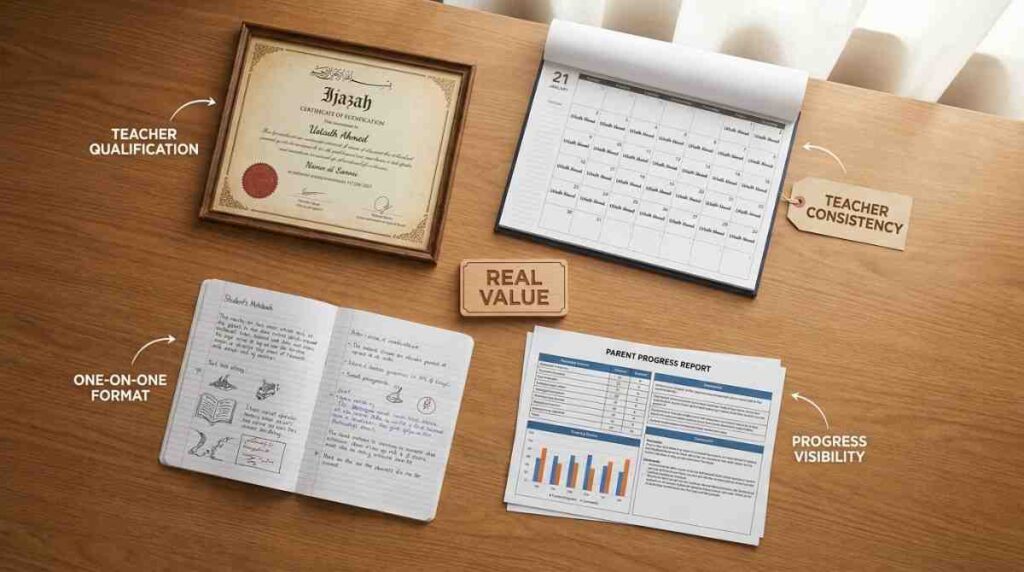
Price is one input. Value is what matters. These four factors determine value — and none of them are visible in the price alone:
1. Teacher Ijazah certification. Non-negotiable for quality Quran instruction. Verify it — ask for the Sanad. Read our guide on what an Ijazah is to understand what to ask for.
2. One-on-one format. Confirmed, genuine individual sessions — not a small group described as one-on-one. In a group of six students, each student receives approximately 5 minutes of active recitation time in a 30-minute session. In a genuine one-on-one session, every minute is theirs. The difference in Tajweed correction quality is significant. Read our comparison: one-on-one vs group Quran classes.
3. Teacher consistency. Your child should have the same teacher across sessions — not a different one each week from a rotation. Teacher-student relationships build over time. A teacher who has worked with a student for three months knows their specific errors, their pace, their emotional responses to correction. A rotating roster starts that relationship from scratch every week.
4. Progress visibility. A good academy communicates regularly with parents — what was covered, what errors were corrected, what to practise at home. This visibility is both a quality signal and a practical benefit. Parents who know what their child is working on can support it at home.
A mid-range academy providing all four — verified Ijazah, genuine one-on-one, consistent teacher, parental communication — is significantly better value than an expensive academy that charges more for marketing and provides none of them.
Hidden Costs to Ask About
Before committing, ask these questions to understand the full cost:
- Registration or enrolment fee? Some academies charge a one-time registration fee of £10-£30. This is normal if the ongoing session pricing is reasonable — but worth knowing upfront.
- Materials or book costs? Madani Qaida, specific Mushaf editions, or printed materials may be required and charged separately. Typical cost: £5-£15 one-time.
- Missed session policy? If your child misses a class — illness, school event — how is it handled? Is the session rescheduled, credited, or lost? A family-friendly academy reschedules with reasonable notice.
- Price after trial or introductory period? Always ask what the ongoing monthly price is — not just the trial price or the first-month discount.
- Price for additional siblings? Families enrolling multiple children often receive a discount. Ask before assuming.
Mosque Classes vs Online — Cost Compared Fairly
Many families compare online Quran classes to subsidised mosque group classes, which may cost £10-£25 per month or less. This comparison deserves honesty rather than dismissal.
Mosque group classes are less expensive because they are typically subsidised by the community and taught by a single teacher managing multiple students. For many families, they are the accessible entry point into Quran education — and they are better than no Quran education.
But the comparison is not simply price. It is also: how much individual correction time does my child receive? In a group of ten, approximately 3 minutes per hour. In one-on-one online, every minute. For building correct Tajweed — where each child’s errors are specific and immediate correction matters — the difference is significant.
Many families successfully combine both — mosque group classes for community and Islamic environment, online one-on-one for individual correction and faster progress. This is often the most practical and most complete approach.
See the Value Before Committing to Any Price
Book a free trial at Suffah Quran Academy. Experience a genuine one-on-one session with an Ijazah-certified teacher — before paying anything. Judge the value yourself.
Book Free Trial Class →Frequently Asked Questions
For one-on-one sessions with Ijazah-certified teachers, typical pricing ranges from £30-£55/month (UK) or $40-$70/month (USA) for 2 sessions per week at 30 minutes each. Three sessions per week typically costs £45-£80/month (UK) or $55-$100/month (USA). Group classes are cheaper (£15-£35/month) but provide significantly less individual correction time per student.
Very low pricing (under £5-£6 per session) typically reflects unverified teachers without Ijazah, group sessions described as individual, introductory pricing that increases after enrolment, or no quality oversight. Quality individual instruction requires qualified teachers — and qualified teachers cannot be paid professional rates at extremely low session prices.
No. High price does not guarantee quality. The factors that determine quality are teacher Ijazah certification, genuine one-on-one format, consistent teacher assignment, and parental visibility. A mid-range academy providing all four is better value than an expensive academy that charges more for marketing. Always verify credentials directly.
A reasonable academy should include: the teaching session, scheduling support, a free trial before commitment, and parental communication about progress. Additional costs to ask about include registration fees (normal if modest), materials, missed session policies, and ongoing pricing after any introductory period.
Evaluate four factors: teacher Ijazah certification (non-negotiable), genuine one-on-one format (not a group), consistent teacher assignment (same teacher throughout), and progress visibility (parental updates, recorded sessions). A moderately priced academy providing all four is better value than a cheap academy providing none of them.
The Question Is Not What It Costs — It Is What It Produces
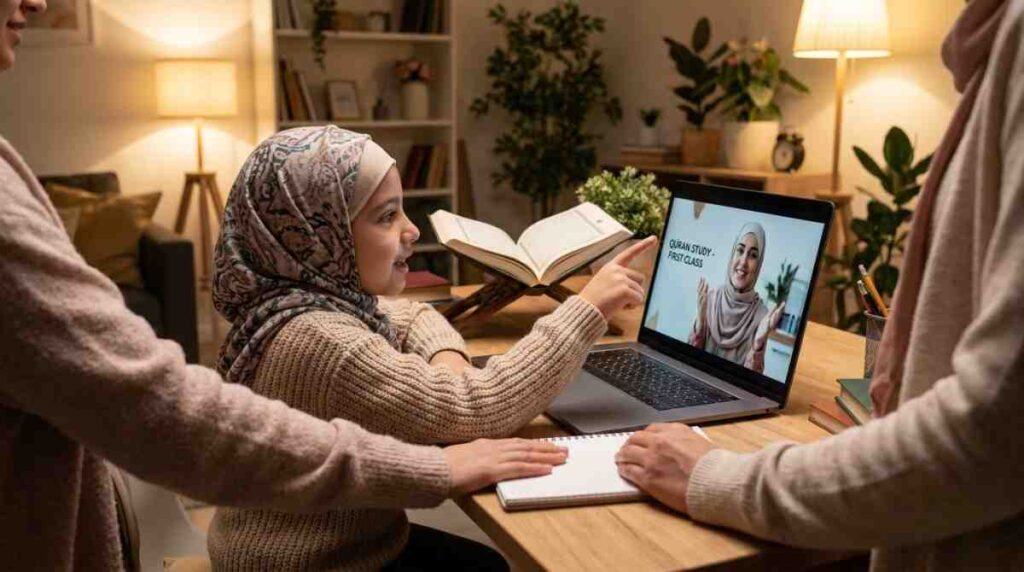
Every pound or dollar spent on Quran education for a child produces one of two outcomes: a child who develops correct, durable recitation under a qualified teacher’s guidance, or a child who attends sessions that feel productive but build on an unverified foundation.
The price difference between these two outcomes is often smaller than families expect. A qualified, one-on-one academy costs more per session than a cheap unverified one — but the gap in monthly cost is typically £20-£40. The gap in what is produced over years of learning is significantly larger.
Evaluate what you are actually getting for the price. The free trial is the most honest evaluation available — experience the session, assess the teacher, judge the value before committing to any ongoing cost.
Experience Before You Pay
One free session with an Ijazah-certified teacher. Real class. Real correction. No payment required to see what quality Quran instruction looks like.
Book Free Trial Class →
Written by Ustaz Zaid Farooqui
Online Quran Tutor · 7 Years Experience · Online Quran Teaching, Qaida · Urdu, Hindi, English
Ustaz Zaid Farooqui has 7 years of experience teaching international students online. He has seen students move between academies for price reasons, and has watched the consequences — both positive and negative — of those choices. His perspective on cost vs value comes from working in this field long enough to know what actually produces results.
Meet our teaching team →